Author: Consultant

  • Canada’s services PMI fell in March as downturn deepened

    The downturn in Canada’s services sector deepened in March as higher prices and elevated borrowing costs crimped customer demand but firms remained confident that better times lie ahead, S&P Global Canada services PMI data showed on Wednesday.

    The headline business activity index fell to 46.4 from 46.6 in February. A reading below 50 indicates contraction in the sector, with the index stuck below that threshold for ten straight months, the longest such stretch in three years.

    “Canada’s services economy remained mired in a downturn during March, with both activity and new business volumes declining again,” Paul Smith, economics director at S&P Global Market Intelligence, said in a statement.

    “The restrictive impact on market activity of high prices and elevated interest rates remains plain to see.”

    The new business index showed sales declining for an eighth successive month, held back by reduced consumer confidence and high prices.

    The input prices index rose to 61.0 from 59.5 in February, bolstered by higher wages, while service providers sought to pass on increased costs by raising sales prices.

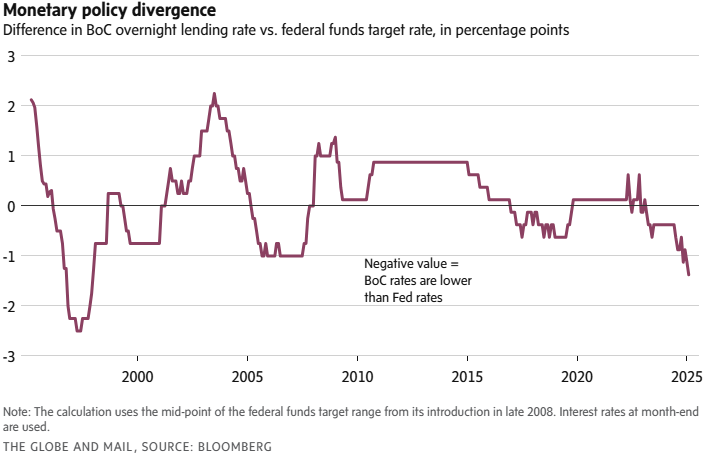
    Investors expect the Bank of Canada to leave its benchmark interest rate on hold at a 22-year high of 5 per cent at a policy decision on April 10 but to then begin an easing cycle in June or July.

    The prospect of rate cuts supported hopes of a stronger economic climate in the next year. The future activity index eased only slightly to 63.6 after climbing to 63.7 in February, its highest level since April.

    The S&P Global Canada Composite PMI Output Index, which captures manufacturing as well as service sector activity, dipped to 47.0 in March from 47.1 in February.

    Data on Monday showed that the manufacturing PMI edged up to an 11-month high at 49.8 last month.

  • Powell says Fed still sees rate cuts this year, election timing won’t affect decision

    Federal Reserve officials will likely reduce their benchmark interest rate later this year, chair Jerome Powell said Wednesday, despite recent reports showing the U.S. economy is still strong and that U.S. inflation picked up in January and February.

    “The recent data do not … materially change the overall picture,” Mr. Powell said in a speech at Stanford University, “which continues to be one of solid growth, a strong but rebalancing labour market and inflation moving down toward 2 per cent on a sometimes bumpy path.”

    Most Fed officials “see it as likely to be appropriate” to start cutting their key rate “at some point this year,” he added.

    In his speech, Mr. Powell also sought to dispel any notion that the Fed’s interest-rate decisions might be affected by this year’s presidential election campaign. The Fed will meet and decide whether to cut rates during the peak of the campaign, in July and September.

    Though inflation has cooled significantly from its peak, it remains above the Fed’s 2-per-cent target. And average prices are still well above their pre-pandemic levels – a source of discontent for many Americans and potentially a threat to President Joe Biden’s re-election bid.

    The recent pickup in inflation, though slight, has led some economists to postpone their projections for when the Fed will begin cutting rates. Rate cuts would begin to reverse the 11 increases the Fed carried out beginning in March, 2022, to fight the worst inflation bout in four decades. They would likely lead, over time, to lower borrowing rates for households and businesses.

    Many economists now predict that the central bank’s first rate cut won’t come until July or even later. That expectation has fuelled some speculation on Wall Street that the Fed might end up deciding to delay rate cuts until after the presidential election. The Fed’s November meeting will take place Nov. 6-7, immediately after Election Day.

    Former president Donald Trump has called Mr. Powell “political” for considering rate cuts Mr. Trump has said could benefit Mr. Biden and other Democrats. Mr. Powell was first nominated to be Fed chair by Mr. Trump, who has said that, if he is elected president, he will replace Mr. Powell when the Fed chair’s term ends in 2026.

    In his speech Wednesday, Mr. Powell noted that Congress intended the Fed to be fully independent of politics, with officials serving long terms that don’t coincide with elections.

    “This independence,” Mr. Powell said, “both enables and requires us to make our monetary policy decisions without consideration of short-term political matters.”

    The Fed chair’s remarks follow several reports showing that the economy remains healthy, largely because of solid consumer spending. Yet that strength could make it tougher for the Fed to achieve its goal of slowing inflation to its 2-per-cent target. Annual inflation ticked up in February to 2.5 per cent, according to the central bank’s preferred measure, though that was down sharply from its peak of 7.1 per cent.

    When they met two weeks ago, Fed officials forecast that they could cut their benchmark rate three times this year. Still, nearly half the 19 policy makers pencilled in just two or fewer rate cuts.

    Strong economic growth could diminish the likelihood of a Fed rate cut later this year for two reasons. One is that steady hiring and brisk consumer spending can lead companies to raise prices and thereby worsen inflation.

    The other reason is that a healthy economy reduces the need for the Fed to cut rates, which tends to stimulate growth. Typically, the central bank reduces its key rate when growth stumbles and companies start cutting jobs. Mr. Powell and other officials have underscored that as long as the economy remains healthy, they can take time to assess the path of inflation and ensure that it’s headed back down to their 2-per-cent target.

    Last week, a government report showed that consumer spending accelerated in February, and prices rose faster than is consisted with the Fed’s inflation target for the second straight month.

    “On inflation, it is too soon to say whether the recent readings represent more than just a bump,” Mr. Powell said. “Given the strength of the economy and progress on inflation so far, we have time to let the incoming data guide our decisions on policy.”

    In remarks this week, some other Fed officials reiterated their expectations for three quarter-point rate reductions this year, while also underscoring that such cuts would depend on inflation slowing from the January and February readings.

    “I think three is still reasonable, but it’s a close call,” Loretta Mester, president of the Federal Reserve’s Cleveland branch, told reporters Tuesday.

    Still, Raphael Bostic, president of the Atlanta Fed, said earlier Wednesday on CNBC that he envisions just one interest-rate cut this year, likely in the final three months of the year.

    Mr. Bostic is among the 12 policy makers with a vote on the central bank’s interest-rate decisions this year.

  • Oil prices edge lower after booking strong first quarter

    Crude oil futures ticked slightly lower Monday, taking a breather after a strong first quarter.

    The West Texas Intermediate contract for May delivery lost 33 cents, or 0.4%, to $82.84 a barrel on the first day of trading for the second quarter. The Brent contract for June delivery dropped 40 cents, or 0.49%, to $86.57 a barrel.

    U.S. crude and Brent also booked three consecutive months of gains. WTI is up 15.5% for the year while Brent has risen 12.3%.

    https://www.cnbc.com/2024/04/01/crude-oil-prices-today.html

  • Gold prices hit another record high after fresh U.S. data spurs Fed cut expectations

    • Gold prices scaled to another record high Monday, propelled by U.S. interest rate cut expectations and the metal’s appeal as a safe haven asset.
    • Market watchers are expecting the U.S. Federal Reserve to cut rates in June.

    https://www.cnbc.com/2024/04/01/gold-prices-hit-new-record-high-on-fed-cut-expectations.html

  • Mar 27, 2024: TSX Ends On Strong Note

    ublished: 3/27/2024 4:51 PM ET | 

    The Canadian market ended on a firm note on Wednesday thanks to sustained buying at several counters in healthcare and materials sectors. Real estate, consumer discretionary, utilities, industrials and energy stocks were among the other notable gainers.

    The mood remained positive amid optimism several central banks will start cutting rates from the second half of the year.

    The benchmark S&P/TSX Composite Index ended up by 194.56 points or 0.89% at 22,107.08, the day’s high.

    The Healthcare Capped Index climbed nearly 4%. Tilray Inc (TLRY.TO) and Bausch Health Companies (BHC.TO) gained 7.7% and 6.2%,

    respectively. Chartwell Retirement Residences (CSH.UN.TO) gained 1.65% and Sienna Senior Living (SIA.TO) ended higher by 1.1%.

    MAG Silver Corp (MAG.TO), up 9.5%, was the top gainer in the Materials Index. New Gold (NGD.TO), Alamos Gold (AGI.TO), First Quantum Minerals (FM.TO), Torex Gold Resources (TXG.TO) and First Majestic Silver Corp (FR.TO) gained 6 to 7.5%.

    Endeavour Mining Inc (EDV.TO) climbed nearly 7%. The company reported adjusted net earnings of $42 million or $0.17 per share for the fourth quarter, compared to prior year’s $14 million or $0.06 per share.

    Energy stocks Vermilion Energy (VET.TO), Pason Systems (PSI.TO), Mattr Corp (MATR.TO), Tourmaline Oil Corp (TOU.TO), Arc Resources (ARX.TO), Birchcliff Energy (BIR.TO) and Prairiesky Royalty (PSK.TO) gained 2 to 4.1%.

    Real estate stocks Dream Industrial (DIR.UN.TO), First Capital (FCR.UN.TO), Granite Real Estate (GRT.UN.TO) and Colliers International (CIGI.TO) gained 2.2 to 3.3%.

    Among consumer discretionary stocks, Canada Goose Holdings (GOOS.TO) climbed nearly 5%. Linamar Corp (LNR.TO), Brp Inc (DOO.TO) and Aritzia Inc (ATZ.TO) gained 2.2 to 2.5%.

    Utilities shares Algonquin Power & Utilities (AQN.TO), Innergex Renewable (INE.TO), Northland Power (NPI.TO) and Boralex (BLX.TO) ended sharply higher.

    Finning International (FTT.TO), Ballard Power Systems (BLDP.TO), Gfl Environmental (GFL.TO), Brookfield Business Partners (BBU.TO) and Cargojet (CJT.TO) gained 3 to 5%

  • Dow surges more than 450 points, S&P 500 closes at a fresh record: Live updates (Mar 28)

    The S&P 500 rose Wednesday, closing at a record as the index heads for its best first quarter since 2019.

    The broader market index gained 0.86% to close at 5,248.49, while the Dow Jones Industrial Average advanced 477.75 points, or 1.22%, to end at 39,760.08. Both indexes snapped three-day losing streaks. The Nasdaq Composite rose 0.51%, closing at 16,399.52.

    Stocks rose in a broad rally Wednesday, with all 11 sectors of the S&P 500 registering gains. Utilities led the index higher, posting a nearly 2.8% jump. Real estate followed with a 2.4% advance, and industrials added 1.6%.

    “Look at the S&P 500: Leadership’s coming from the losers,” said Art Hogan, chief market strategist with B. Riley Wealth. “So it really feels like a quarter-end rebalance and certainly more enthusiasm for equities, in what otherwise would be a quiet week, if not for the end of the quarter.”

    The major averages are poised to end the first quarter of 2024 on a strong note. The S&P 500 is tracking for a 10% advance, pacing for its best first-quarter gain since 2019 when it added 13.1%. The 30-stock Dow is up about 5.5%, and on pace for its best first-quarter gain since 2021, when it added 7.4%. The Nasdaq is up roughly 9.3% over the quarter.

    March has also proven powerful, with the three major averages on pace for a fifth straight winning month. As of Wednesday’s close, the S&P 500 is up about 3%. Both the Nasdaq and the Dow are up roughly 1.9% month to date.

    “A soft landing for the US economy is now widely expected, and markets have dialed back their expectations for interest rate cuts,” wrote UBS Wealth Management strategists in a note.

    “Looking ahead to the second quarter, we see the next stage of two primary market drivers playing out: the start of rate-cutting cycles by major central banks, and the broadening-out of AI adoption and implementation across a wider range of companies,” they added.

    Later this week, investors will watch for data on jobless claims, gross domestic product and consumer sentiment. While the market is closed on Good Friday, attention will be on economic releases tied to personal income, consumer spending and the personal consumption expenditures expected in the mornin

  • BRP reports fourth-quarter profit and revenue down from year ago, raises quarterly dividend

    BRP Inc. DOO-T +5.64%increase raised its dividend as it reported its fourth-quarter profit and revenue fell compared with a year earlier and said its results for its 2025 financial year are expected to be down compared with the year it just completed.

    The Ski-Doo and Sea-Doo maker says it will now pay a quarterly dividend of 21 cents per share, up from 18 cents per share.

    BRP says it earned $188.2-million or $2.46 per diluted share for the quarter ended Jan. 31, down from $365.1-million or $4.54 per diluted share a year earlier.

    Revenue for the quarter totalled $2.69-billion, down from $3.08-billion.

    On an normalized basis, BRP says it earned $2.46 per diluted share in its latest quarter compared with a normalized profit of $3.85 per diluted share a year earlier.

    In its outlook for its 2025 financial year, BRP says it expects revenue in a range of $9.1-billion to $9.5-billion, down from $10.37-billion it recorded for its 2024 financial year. Normalized diluted earnings per share for 2025 are expected in a range of $7.25 to $8.25, down from $11.11 in 2024.

  • Canada’s GDP outperforms growth forecast in January, likely grew 0.4% in February

    Canada’s gross domestic product in January increased 0.6 per cent, the fastest growth rate in a year and higher than forecasts, and the economy likely expanded 0.4 per cent in February, data showed on Thursday.

    Analysts polled by Reuters had forecast a GDP growth of 0.4 per cent in the month. December GDP was revised to a 0.1 per cent contraction from zero growth initially reported.

    January’s rise, the fastest since the 0.7 per cent growth in January 2023, was helped by a rebound in educational services as public sector strikes ended in Quebec, Statistics Canada said.

    Thursday’s data shows the Canadian economy started 2024 strongly after growth stalled in the second half of last year; GDP was flat or negative on a monthly basis in four out of the last six months of 2023.

    The strong rebound could allow the Bank of Canada more time to assess whether inflation is slowing sufficiently without risking a severe downturn, though the bank has said it does not want to stay on hold longer than needed.

    Money markets trimmed their bets for a June rate cut to 65 per cent from just over 70 per cent after the GDP numbers were released. They widely expect the BoC to hold its key overnight rate at the same level in April.

    The Canadian dollar pared losses after the numbers, with the loonie weaker by 0.09 per cent to 1.3579 against the greenback at 12:40 GMT. The two-year government bond yields also rose by 4.6 basis points to 4.188 per cent.

    The central bank has maintained its key policy rate at a 22-year high of 5 per cent since July, but BoC’s Governing Council in March agreed that conditions for rate cuts should materialize this year if the economy evolves in line with its projections.

    The bank in January forecast a growth rate of 0.5 per cent in the first quarter, and Thursday’s data keeps the economy on a path of small growth in the first three months of 2024. The BoC will release new projections along with its rate announcement on April 10.

    Growth in January was broad-based, with 18 out of 20 sectors expanding output in the month, Statscan said. Real estate and rental and leasing grew for the third consecutive month, as activity at the offices of real estate agents and brokers drove the gain in January, it said.

    Overall, the services-producing industries grew 0.7 per cent, while the goods-producing expanded 0.2 per cent.

    In a preliminary estimate for February, Statscan said GDP was likely up 0.4 per cent, helped by mining, quarrying, and oil and gas extraction, manufacturing, and finance and insurance industries.