Indonesian stocks suffered the deepest two-day sell-off recorded, while authorities in Jakarta demanded an explanation from MSCI whose warning on Friday that it could strip the country of “emerging market” status next year prompted the rout.
Jakarta’s benchmark stocks closed down 3.6 per cent on Monday after plunging 11.6 per cent on Friday, a combined two-session fall steeper than any during the 1998 Asian financial crisis. The index also hit a six-year low during the session.
The selling began after MSCI on Friday said it was considering shifting Indonesia to “standalone” instead of “emerging markets” status, a more-severe-than-expected shift that rattled investors and officials.
A shift would risk cutting Southeast Asia’s biggest economy off from international capital and making it an investment backwater.
The nervous selling flowed through to the Indonesian currency and bond markets. The rupiah weakened to 18,030 per dollar, not far from the record low of 18,190 hit in June, and a slide in Indonesian government bonds pushed the 10-year yield to 7.4 per cent, according to traders, from 7.169 per cent on Friday.
“We did not expect there would be such announcement (from MSCI). Such an unexpected statement caused the market to react in panic,” Indonesia Stock Exchange Chief Executive Jeffrey Hendrik said, ahead of a meeting with MSCI seeking explanation.
Indonesia is committed to capital market reforms
After the online meeting with MSCI, Jeffrey said Indonesia remained committed to the ongoing capital market reforms it launched after an initial warning from MSCI in January, adding that he could not disclose details of the meeting.
He also announced two policies to improve market transparency and price discovery. They include the exclusion of stocks with a high concentration of ownership by the same person or entity from the benchmark Jakarta Composite Index “to provide a more accurate picture of the main index’s movements.”
To try to reduce volatility, the IDX on Monday also reduced the daily down limit on stock prices to 7 per cent from 15 per cent, meaning the exchange will automatically reject any sell orders at lower prices to prevent further falls.
Investors reassess their exposure
MSCI’s move has intensified pressure on Indonesia’s regulators and finance officials as investors re-evaluate their exposure to Indonesian assets more broadly.
It has also raised the concern of capital flight risk from a country that had been an emerging market favourite. Its appeal had already decreased since the pandemic, investors say, as confidence waned in Indonesia’s fiscal health and the independence of its central bank under President Prabowo Subianto.
Prabowo was meeting with financial officials on Monday to discuss the “current economic condition,” two government officials with knowledge of the matter said.
S&P Global Ratings sovereign analyst Rain Lin said MSCI’s latest warning was likely to result in additional capital outflows but did not anticipate them to be of a magnitude that would materially increase financing costs.
“More concerning is the potential damage to investor confidence and the risk that sentiment weakens more broadly across government bond markets and foreign direct investment.”
Wide risks from MSCI threat
MSCI’s warning on Friday follows repeated setbacks for Prabowo’s government this year, after Moody’s and Fitch cut their sovereign rating outlooks to negative.
It also precedes a policy decision from Bank Indonesia this week. Although the central bank is widely expected to leave rates unchanged, some analysts have raised the possibility of a rate hike to stem the sell-off in the bond market.
MSCI had threatened to downgrade the Jakarta market to “frontier” status in January but said on Friday a lack of progress in remedying its concerns about opacity in ownership and trading behavior meant even a drop to that status would not reflect the severity of the issues.
Goldman Sachs estimates a full MSCI removal could trigger US$5.6-billion of passive outflows. Active funds benchmarked to these indexes hold more than US$8-billion, although any selling would be discretionary rather than benchmark-driven, they wrote.
Foreign investors have net sold US$4.98-billion worth of Indonesian stocks so far this year, on track for the biggest annual outflow in at least 16 years.
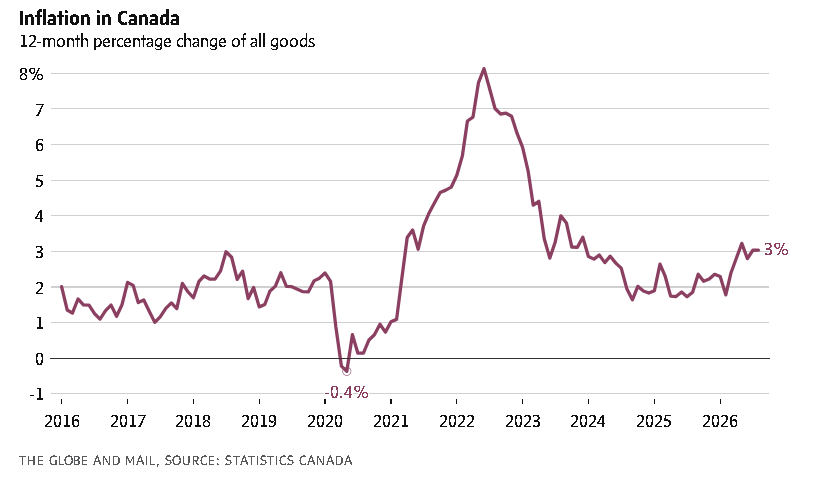
The annual pace of inflation rose to 3.1 per cent in September as war in the Middle East continued to drive up gas prices, Statistics Canada said Monday.
The agency said the acceleration was led by a 27.8-per-cent spike in gasoline prices last month compared with a year earlier, despite the switch to the less expensive winter gas blend.
Excluding gasoline, consumer prices increased 2.2 per cent year-over-year in September.
The agency said fuel oil and other fuels surged 57.8 per cent in September, hitting consumers hard in Atlantic Canada where many homes are heated with oil.
Meanwhile, grocery prices increased 1.7 per cent last month, the smallest yearly increase since May 2024, according to Statistics Canada.
Driving the slowdown was a 2.9-per-cent drop in prices for fresh vegetables, while sugar and confectionary items fell 2.7 per cent.
Beef prices, meanwhile, rose at a slower pace in September, up 8.7 per cent compared with an 11 per cent increase in August.
Despite the year-over-year slowdown, the agency said prices for groceries have increased 33 per cent since September 2020.
Statistics Canada said shelter prices rose 1.8 per cent in September, up from 1.5 per cent in August.
In addition to the spike in fuel oil, the agency said a 4.9-per-cent increase in mortgage insurance and 1.2-per-cent increase in home maintenance and repair costs led the acceleration.
The September inflation report is the Bank of Canada’s last look at price data before its next interest rate decision on Oct. 28.
Economists had broadly expected inflation to accelerate to 3.2 per cent last month, up from three per cent in August.
Andrew Grantham, senior economist with CIBC Capital Markets, said in a client note that the “hawkish tone” of Bank of Canada governor Tiff Macklem’s comments over the weekend had raised market expectations of an interest rate hike later this month.
But the inflation report “suggests that there is little rush and policy-makers can take more time to assess how U.S. trade relations and the impact of new tariffs develop before raising rates,” Grantham said.
During a media roundtable from Thailand on Saturday, Macklem warned that persistently high energy prices were increasing the risk of broader inflation and that the central bank was prepared to raise rates if necessary.
He said the prevailing message from his peers at the International Monetary Fund meetings in Bangkok was that the global economy has been performing better than expected in the face of ongoing wars in Iran and Ukraine, sweeping trade disruptions and higher borrowing costs from rising bond yields.
But Macklem also said that resilience is increasingly “under strain” as shocks like the Middle East conflict persist and drive up energy prices.
Some of those sources of resilience – like releasing global oil reserves – are being depleted, he said.
“You can only release strategic energy, oil reserves so many times, but that has helped contain this energy price shock,” Macklem said.
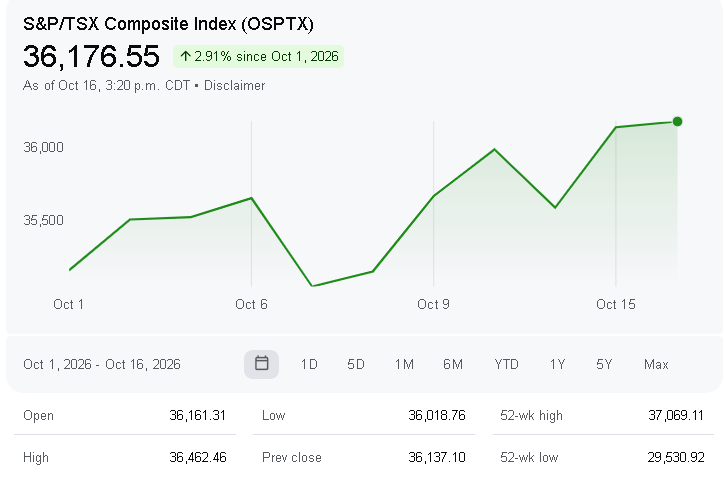
The S&P/TSX Composite Index enters the week of October 19, 2026, positioned at 36,176.55 following a 1.44% weekly gain driven by a strong utilities rally and sticky commodity markets. The index is expected to experience increased volatility and a downward or defensive bias due to a critical collision of domestic macroeconomic releases, heightened political uncertainty, and geopolitical commodity premiums
Key Macroeconomic Catalysts
The TSX faces significant macro events that will set the tone for the upcoming Bank of Canada (BoC) interest rate decision on October 28:
Date
Economic Indicator / Event
Market Impact & Expectations
Mon, Oct 19
September Consumer Price Index (CPI)
Consensus expects headline inflation to accelerate to 3.2% YoY (up from 3.0%). A hotter reading will pressure interest-rate-sensitive sectors like Financials and Real Estate.
Mon, Oct 19
BoC Business Outlook & Consumer Survey
Focus will remain on shifts in long-term inflation expectations. Signs of unanchored expectations will strengthen the case for a central bank rate hike by year-end.
Fri, Oct 23
August Retail Sales Report
Anticipating a robust 1.3% monthly expansion driven by summer spending volumes. This data captures consumer resilience despite elevated borrowing costs.
Geopolitical & Domestic Risk Factors
The Alberta Referendum: On Monday, October 19, Albertans vote on whether to initiate a process toward a future binding referendum on provincial separation. While recent polls indicate 68% support for remaining in Canada, any surprising momentum toward separation risks introducing a distinct political risk premium, potentially weighing on Western Canadian energy and infrastructure assets.
Energy and Supply Chains: Global oil markets maintain a geopolitical premium due to persistent disruptions around the Strait of Hormuz. Brent crude holding above $106/bbl and WTI near $98/bbl will continue to inject structural support into heavy-weighted TSX Energy constituents, buffering broader index losses.
Industrial Commodity Support: Copper prices remain elevated at 664.05 cents per pound following a post-summit U.S.-China tariff détente. This macro relief will keep the TSX Materials sector resilient. [1]
Technical and Sector Outlook
Defensive Sector Rotations: With core inflation drifting back above the BoC’s 2% target, defensive sectors like Utilities and consumer staples are poised to outperform as investors position against a potentially more hawkish central bank posture.
Financials Under Pressure: Recent consecutive labor market contractions in August and September (unemployment plateaued at 6.5%) mean the financial sector faces lower credit demand and rising provisions for credit losses if the BoC holds tight.
Given the combination of expanding inflation and local political risk, the TSX is highly likely to test support ranges between 35,500 and 35,800 early in the week unless CPI data dramatically cools.
Monday, October 19 — Canadian inflation: September CPI is the most important domestic economic release. Market consensus is approximately 3.2% year over year, versus 3.0% previously.
Monday, October 19 — Bank of Canada surveys: Business and consumer inflation expectations will provide additional evidence ahead of the October 28 interest-rate decision.
Monday, October 19 — China’s Q3 GDP: Consensus growth is approximately 4.4% YoY. The results could influence copper, uranium and other resource shares.
Wednesday–Friday — U.S. corporate earnings: Results from major technology, industrial and energy companies could drive sector rotation and influence the TSX.
Throughout the week — Oil, inflation and geopolitics: Middle East supply disruptions and U.S.–Canada trade uncertainty remain significant market risks.
The week’s main question is whether strong commodity prices can continue supporting Canadian equities while inflation and global technology weakness increase pressure on valuations.
TD Economics
+3
1. Economic calendar and TSX implications
Release times are Eastern Daylight Time (EDT).
Date
Key event
Time (EDT)
TSX sectors affected
Mon Oct 19
China Q3 GDP, industrial production and retail sales
Before TSX opens
Materials, energy
Mon Oct 19
Canada September CPI
8:30 AM
Banks, utilities, real estate, gold
Mon Oct 19
BoC Business Outlook and Consumer Expectations surveys
11:30 AM
Financials, consumer sectors
Tue Oct 20
U.S. housing starts and building permits
8:30 AM
Industrials, materials
Wed Oct 21
UK September CPI
2:00 AM
Global rates, financials
Thu Oct 22
U.S. jobless claims
8:30 AM
Broad market
Thu Oct 22
Canadian industrial and raw materials prices
8:30 AM
Materials, industrials
Fri Oct 23
Canadian August retail sales
8:30 AM
Consumer discretionary, banks
Fri Oct 23
U.S. flash manufacturing and services PMI
9:45 AM
Industrials, technology, materials
Fri Oct 23
U.S. consumer sentiment and inflation expectations
10:00 AM
Financials, technology, broad TSX
TD Economics
+3
2. The three most important economic releases
Monday — Canadian September CPI
High market sensitivity
Metric
Figure
Previous headline CPI
3.0% YoY
TD Economics consensus
3.2% YoY
BoC next decision
October 28
A reading above 3.2% could increase expectations that the Bank of Canada will maintain restrictive policy or eventually raise rates. A lower reading could reduce rate pressure, particularly if the BoC’s preferred underlying inflation measures also improve.
Potential TSX effects: RY, TD, BMO and NA may experience bond-yield-related volatility; interest-sensitive utilities and real estate companies could be pressured by higher yields. Gold shares such as AEM, ABX and WPM could also react to movements in real yields and the Canadian dollar.
TD Economics
+2
Monday — China’s third-quarter GDP
High resource-sector sensitivity
Metric
Figure
Previous quarter GDP growth
4.3% YoY
Reuters consensus forecast
4.4% YoY
Additional releases
Industrial production, retail sales, investment
China is an important source of global demand for industrial metals.
Stronger-than-expected industrial production could support copper prices and companies including TECK.B, FM and LUN. Disappointing output or consumption could weaken demand expectations, even if headline GDP meets consensus.
What matters most: Whether China’s manufacturing and infrastructure activity is actually improving, not merely whether GDP exceeds the forecast.
Reuters
+1
Friday — Canadian retail sales
TD Economics’ calendar shows consensus expectations for August retail sales growth of approximately 1.3% month over month, compared with a previous decline of 0.7%.
A stronger result would suggest resilient Canadian consumer spending, potentially supporting retail businesses and banks. Weak results could reinforce concerns about household finances, unemployment and credit quality.
Companies to monitor include ATD, L, WN, DOL and major Canadian banks.
TD Economics
3. Major corporate earnings to watch
Date
Company
Why it matters to the TSX
Oct 20
Netflix, GE Aerospace, Halliburton
Consumer spending, industrial demand and energy-service profitability
Oct 21
Meta Platforms, Tesla
AI spending, technology valuations and market risk appetite
Oct 21–22
Semiconductor companies including Lam Research
AI infrastructure demand and technology-sector sentiment
Oct 22
Procter & Gamble
Consumer spending, pricing power and inflation
Oct 23
Rogers Communications (RCI.B)
Canadian telecommunications revenue, debt, free cash flow and profitability
Oct 23
Exxon Mobil, SLB (calendar-listed)
Oil profitability, capital spending and service activity
Dates are scheduled or calendar-listed and may change. Rogers, Meta and Tesla dates are confirmed through company announcements.
Investor’s Business Daily
+4
4. Geopolitical and market risks throughout the week
Oil and Middle East disruptions
The Bank of Canada has warned that elevated oil prices could substantially increase its inflation outlook. Continued disruptions to shipping or refining capacity could keep crude prices elevated.
Reuters
For the TSX, SU, CNQ and IMO generally benefit from stronger realized crude prices, while airlines, transportation and consumer businesses face higher costs.
U.S.–Canada trade uncertainty
Trade tensions remain relevant for Canadian manufacturers, transportation companies and banks with exposure to tariff-sensitive borrowers. The U.S. Federal Reserve’s October Beige Book also identified trade-related difficulties in northern U.S. regions.
Reuters
Any new tariff announcement during the week would be an unscheduled catalyst, not a confirmed calendar event.
U.S. technology and bond yields
Following the recent Nasdaq selloff, Meta’s October 21 earnings will be particularly important. Investors will examine whether AI spending is delivering adequate revenue growth and free cash flow.
Reuters
Weak results could put pressure on SHOP, KXS and CSU through valuation sentiment, even though their business models differ.
5. Bull / Base / Bear scenarios for the TSX
Scenario
Conditions
Potential consequence
Bull
CPI below expectations, stronger China activity, resilient technology earnings
Financials, materials and technology improve
Base
CPI near 3.2%, mixed earnings, crude remains elevated
Choppy trading, with energy relatively supported
Bear
Inflation exceeds expectations, weak China data, renewed AI selling
Broad TSX decline led by rate-sensitive and cyclical stocks
These scenarios are illustrative; probabilities have not been estimated.
6. Key TSX indicators to monitor
Indicator
What matters
TSX Composite
Holding 36,000; resistance around 36,400–36,500
WTI crude
Changes in supply disruptions and inflation expectations
Gold
Direction relative to US$4,100–4,250/oz
Copper
Reaction to China’s GDP and industrial-production figures
Canada 10-year yield
Whether inflation data pushes yields higher
Nasdaq
Whether the AI-related selloff stabilizes
The index levels are approximate technical reference points from the previously supplied TSX chart, not forecast prices.
Actionable Takeaways
Monday, October 19, is the most important scheduled Canadian macroeconomic day. CPI and the Bank of Canada surveys will help shape expectations for the October 28 policy announcement. China’s GDP release adds a potentially significant catalyst for materials stocks.
Wednesday, October 21, is particularly important for technology. Meta and Tesla earnings could influence investor appetite for highly valued growth companies.
Friday, October 23, provides a direct test of Canadian consumer and corporate conditions, through retail sales and Rogers’ quarterly results.
The central TSX issue for the week is whether resource-sector strength can offset renewed pressure from inflation, interest rates and global technology valuations.
China releases third quarter GDP plus September retail sales and industrial production
830 am ET: Canada consumer price index for September. Consensus is for a monthly rise of 0.2%, or 3.2% year over year, accelerating from August’s 3.0%
10 am ET: U.S. NAHB housing market index
1130 am ET: Bank of Canada business outlook survey and survey of consumer expectations
Alberta referendum vote
Earnings include: BHP Group Ltd.; Cleveland-Cliffs Inc.; Fifth Third Bancorp; Steel Dynamics Inc.; W.R. Berkley Corp.
Tuesday October 20
Germany business sentiment survey and UK employment data
815 am ET: U.S. ADP employment data
830 am ET: Canadian household and mortgage credit data
830 am ET: U.S. housing starts and building permits
10 am ET: U.S. pending home sales for September
Earnings include: Capital One Financial Corp.; Chubb Ltd.; GE Aerospace; General Motors Co.; Halliburton Co.; Netflix Inc.; Philip Morris International Inc.; Rtx Corp.; United Airlines Holdings Inc.; 3M Corp.
Wednesday October 21
Japan trade balance for September
UK inflation for September
830 am ET: Canadian construction investment data for August
Earnings include: AT&T Inc.; CSX Corp.; IBM; Kinder Morgan Inc.; Meta Platforms Inc.; Nextera Energy Inc.; Tesla Inc.; Texas Instruments Inc.; Thermo Fisher Scientific Inc.; Waste Connections Inc.
Thursday October 22
Euro area consumer conference and France business confidence
8 am ET: Canada’s CFIB business barometer
830 am ET: Canada’s industrial product and raw materials price indexes for September. BMO economists estimate a rise of 1% and 5% respectively.
830 am ET: Canada new housing price index for September. BMO forecasts a monthly decline of 0.1%, or a drop of 2% from a year earlier.
830 am ET: U.S. initial jobless claims
10 am ET: U.S. leading indicators
Earnings include: Blackstone Inc.; Comcast Corp.; FirstService Corp.; Gilead Sciences Inc.; Honeywell International Inc.; Lockheed Martin Corp.; Mullen Group Ltd.; Nasdaq Inc.; Newmont Corp.; Procter & Gamble Co.; Roche Holdings AG; Spotify Technology SA; Union Pacific Corp.; Western Digital Corp.; Winpak Ltd.
Friday October 23
Japan consumer prices for September and October purchasing managers indexes (PMIs)
Euro area manufacturing PMIs; ECB three-year CPI expectations; UK consumer confidence, retail sales and PMIs
830 am ET: Canada retail sales for August. Consensus is for a rise of 1.1%, reversing from a 0.7% drop in July
830 am ET: Canada manufacturing sales for September
945 am ET: S&P Global manufacturing and services PMIs for the U.S.
10 am ET: University of Michigan consumer sentiment
Earnings include: American Express Co.; ExxonMobil Holdings Corp.; Rogers Communications Inc.
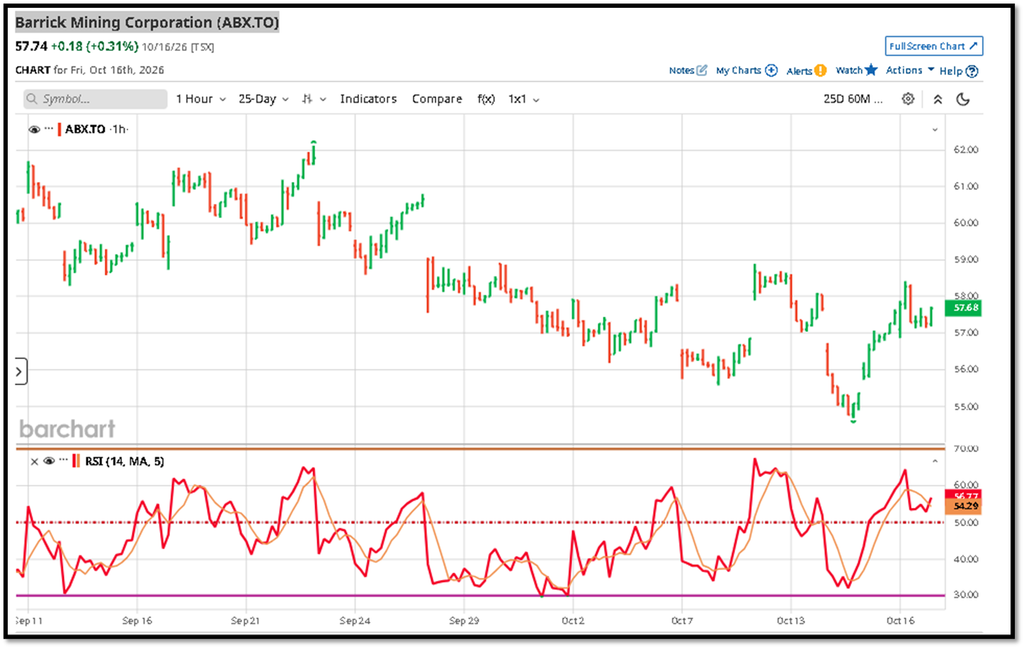
Rising bond yields: Higher yields increased the opportunity cost of holding gold, contributing to pressure on precious-metal investments.
Profit-taking: Selling followed the September rally toward C$62.
Market volatility: Broader weakness in mining shares and uncertainty surrounding inflation and interest rates may have amplified the decline.
These are plausible contributing factors rather than verified explanations for individual trading sessions.
Technical outlook
Indicator
Assessment
October 16 close
C$57.74
RSI(14), hourly
56.77 — moderately positive
Immediate support
C$56–57
Stronger support
C$54.50–55
Resistance
C$58.50–59
Stronger resistance
C$60–62
Conclusion: Barrick experienced a moderate correction followed by an encouraging rebound. The RSI above 50 indicates improving short-term momentum, but the share price remains below its September high.
A sustained move above C$59 would strengthen the recovery case, while a decline below C$56 would indicate renewed selling pressure.
Royal Bank declined approximately 1.4%, from C$284 to C$280.01, after reaching a high near C$291 in late September.
Price movements
September 11–22: Advanced toward C$291, supported by positive banking-sector sentiment.
September 23–October 1: Declined toward C$274 as selling pressure increased across Canadian banks.
October 2–6: Stabilized around C$278–280.
October 7–9: Renewed selling pushed shares toward C$269, the lowest level on the chart.
October 12–16: Recovered to C$280.01, approximately 4.1% above the recent low.
Main reasons for the decline
Interest-rate uncertainty: Rising bond yields increased concerns about bank valuations and funding costs.
Credit-loss concerns: Investors worried about potential increases in loan-loss provisions amid economic and trade uncertainty.
Profit-taking: Shares had risen toward C$291 before investors reduced exposure.
Bank-sector recovery: Improving sentiment and easing bond-market pressures coincided with the rebound during October 12–16.
These are plausible market explanations, not a verified attribution of each price movement.
Technical outlook
Indicator
Assessment
October 16 close
C$280.01
RSI(14), hourly
60.8 — positive, not currently overbought
Immediate support
C$275–277
Stronger support
C$269–270
Resistance
C$282–285
Stronger resistance
C$289–291
Important RSI clarification: Your chart labels the stock as overbought, but the latest RSI is approximately 60.8, below the conventional overbought threshold of 70. It briefly reached 70 around October 16 before retreating.
Conclusion: Royal Bank experienced a correction followed by a relatively strong recovery. The rebound from C$269 to C$280 suggests improving momentum, but the stock remains below its September high.
A sustained move above C$285 would strengthen the recovery outlook. A decline below C$275 would weaken it, while a break below C$269 would signal renewed downside risk.
First Quantum Minerals Ltd is a diversified mining company. The company’s principal activities include mineral exploration, mine engineering and construction, and development and mining operations. The firm produces copper in concentrate, copper anode, copper cathode, nickel, gold, zinc, silver, acid, and pyrite. It has operating mines located in Zambia, Panama, Turkey, Spain, Australia, and Mauritania. The company’s reportable operating segments are Cobre Panama, Kansanshi, and Trident.
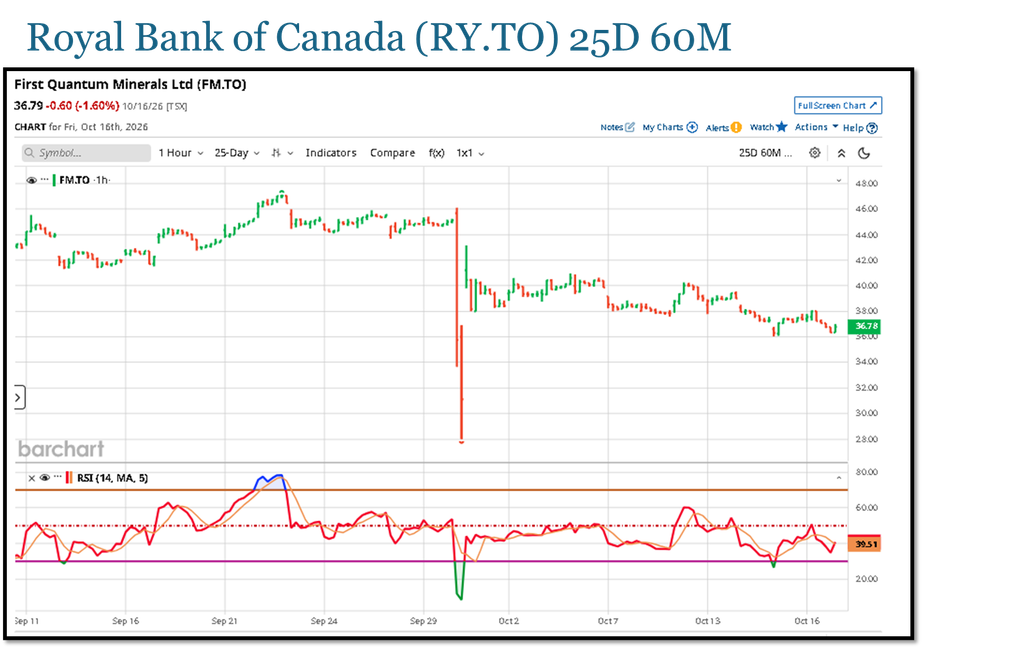
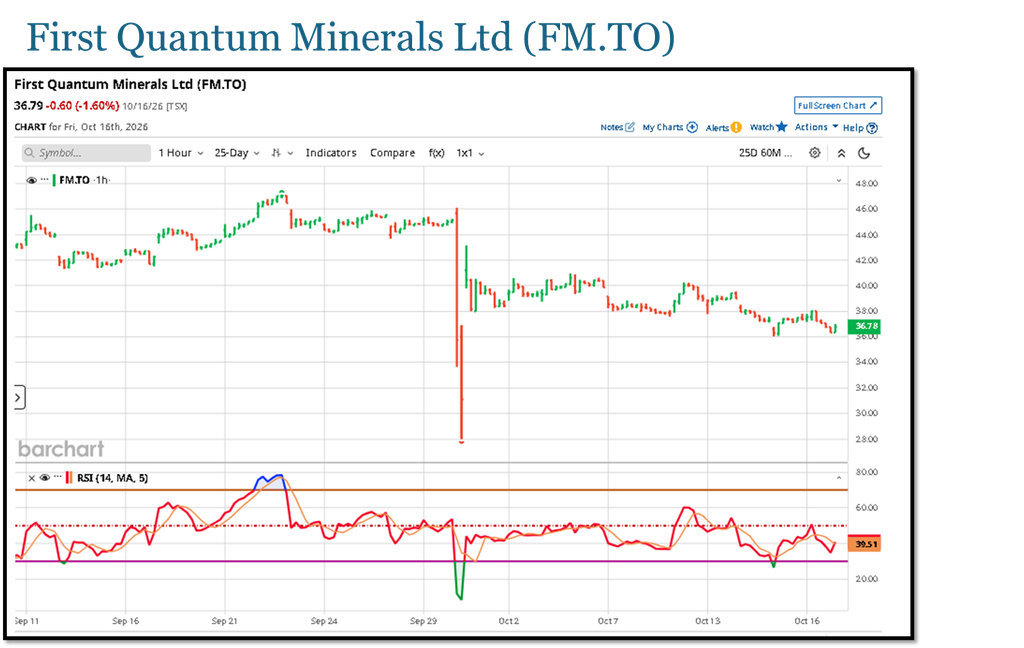
First Quantum declined approximately 15%, from C$43.50 to C$36.79, mainly because of uncertainty surrounding its Cobre Panamá copper mine.
Price movements
September 11–22: Advanced toward C$47.50, reflecting optimism about copper and the possibility of restarting Cobre Panamá.
September 23–29: Stabilized around C$44–46.
September 30: Shares plunged as much as 38% intraday to approximately C$28, before recovering to close at C$38.23.
October 1–10: Stabilized around C$38–41, but remained well below September levels.
October 12–16: Renewed selling pushed shares to C$36.79.
Main reasons for the decline
Cobre Panamá uncertainty — primary cause: On September 30, a Panamanian government commission recommended negotiations that could permit the mine to restart, but with operations eventually funding its orderly closure. Investors feared a shorter operating life and reduced future cash flows. Reuters+1
Regulatory uncertainty: The operating period, ownership arrangements and legal conditions remain unresolved.
Profit-taking: The earlier rally left the shares vulnerable to selling following the announcement.
Copper-market uncertainty: Concerns about global industrial demand added potential pressure, although the September 30 plunge was primarily company-specific.
Technical outlook
Indicator
Assessment
October 16 close
C$36.79
RSI(14), hourly
Approximately 39.5 — weak
Support
C$36–37
Lower support
C$34–35
Resistance
C$39–40
Stronger resistance
C$44–45
Conclusion: Unlike several other TSX stocks, First Quantum’s decline was driven predominantly by a specific corporate development rather than general market weakness.
The critical factor is whether First Quantum can negotiate a commercially viable, sufficiently long operating agreement for Cobre Panamá.
A favourable agreement could materially improve the valuation outlook. Restrictive operating terms or failure to reach an agreement would undermine the recovery thesis.