Imperial Oil’sIMO-T -0.49%decreaseapplication to extend the life of its remote Norman Wells oil and gas facility in the Northwest Territories has been put on hold pending an environmental assessment report, the Canada Energy Regulator said on Tuesday.
The Norman Wells site produces around 6,500 barrels of oil equivalent per day (boepd) and is spread across nine natural and artificial islands in the Mackenzie River – Canada’s longest river – and the town of Norman Wells on the riverbank.
Imperial, majority-owned by Exxon Mobil Corp, applied last year to extend its Norman Wells operating permit, which is due to expire on Dec. 31 2024, by another 10 years.
However, the regional Indigenous government, the Sahtu Secretariat Incorporated (SSI), decided in September that the application required an environmental assessment, because Imperial also proposed replacing pipelines between its wells and processing facility.
The environmental assessment will be conducted by the Mackenzie Valley Environmental Impact Review Board, and the regulator said it will extend Imperial’s permit in the interim.
“This will allow the Norman Wells facility to continue operating while the Review Board’s environmental assessment process unfolds,” the CER said in a statement on social media.
An Imperial spokeswoman said the Calgary-based company was reviewing the latest update and assessing its next steps.
The SSI outlined concerns about the impact of climate change on the Norman Wells operations and the Enbridge pipeline that transports the oil to Alberta in a September letter to the CER.
SSI Chair Charles McNeely said melting permafrost in the far northern region raised questions about the stability of the oil and gas infrastructure, while the Mackenzie River is experiencing unprecedented riverbed scouring, threatening the numerous pipelines within the Norman Wells operation.
“Today, in an area of increasing environmental sensitivity, does it make sense to accept any degree of risk from an aging oil field that in 2021 provided less than 1% of Canada’s daily Conventional Light Crude production?” McNeely wrote.
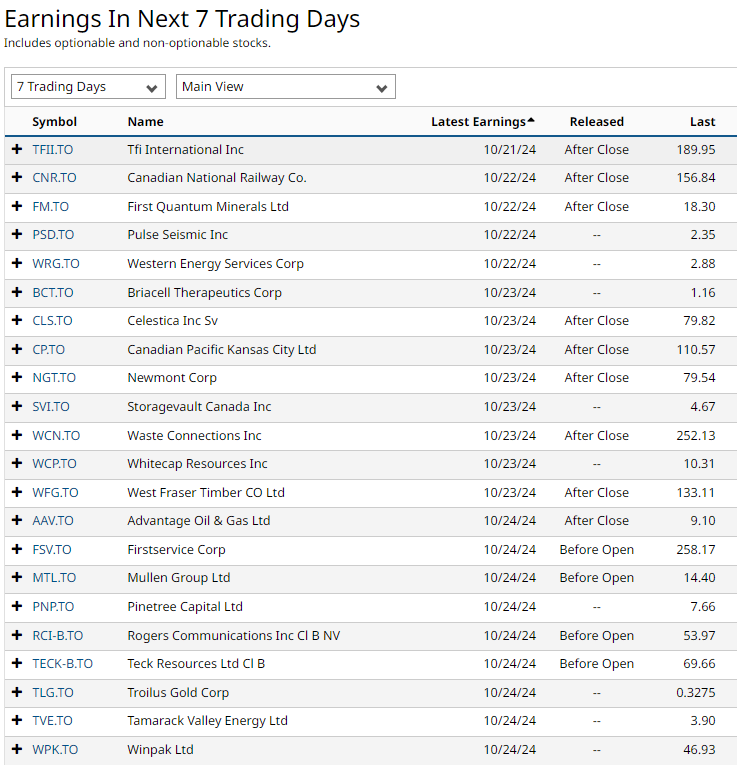
MONTREAL, Oct. 03, 2024 (GLOBE NEWSWIRE) — CN (TSX: CNR) (NYSE: CNI) will issue its third-quarter 2024 financial and operating results after the market close on October 22, 2024.
CN’s senior officers will review the results and the railway’s outlook in a conference call starting at 4:30 p.m. Eastern Time on October 22. Tracy Robinson, CN President and Chief Executive Officer, will lead the call.
Parties wishing to participate via telephone may dial 1-800-715-9871 (Canada/U.S.), or 1-647-932-3411 (International), using 5497429 as the passcode. Participants are advised to dial in 10 minutes prior to the call.
CN will webcast the presentation live and furnish slides supporting the officers’ remarks via the Investors section of its website at www.cn.ca/en/investors. A webcast replay will be available after the call ends.
The Biden administration rang up a budget topping $1.8 trillion in fiscal 2024, up more than 8% from the previous year and the third highest on record.
Interest expense for the year totaled $1.16 trillion, the first time that figure has topped the trillion-dollar level.
The Biden administration rang up a budget deficit topping $1.8 trillion in fiscal 2024, up more than 8% from the previous year and the third highest on record, the Treasury Department said Friday.
Even with a modest surplus in September, the shortfall totaled $1.833 trillion, $138 billion higher than a year ago. The only years the U.S. has seen a great deficit were 2020 and 2021 when the government poured trillions into spending associated with the Covid-19 pandemic.
The deficit came despite record receipts of $4.9 trillion, which fell well short of outlays of $6.75 trillion.
Government debt has swelled to $35.7 trillion, an increase of $2.3 trillion from the end of fiscal 2023.
One aggravating factor for the debt and deficit picture has been high interest rates from the Federal Reserve’s series of hikes to fight inflation.
Interest expense for the year totaled $1.16 trillion, the first time that figure has topped the trillion-dollar level. Net of interest earned on the government’s investments, the total was a record $882 billion, the third-largest outlay in the budget, outstripping all other items except Social Security and health care.
The average interest rate on all the government debt was 3.32% for 2024, up from 2.97% the previous year, a Treasury official said.
The government did run a surplus in September of $64.3 billion, the product in part of calendar effects that pushed benefit payments into August, which saw a $380 billion deficit, the biggest month of the year.
As a share of the total U.S. economy, the deficit is running above 6%, unusual historically during an expansion and well above the 3.7% historical average over the past 50 years, according to the Congressional Budget Office.
The CBO expects deficits to continue to rise, hitting $2.8 trillion by 2034. On the debt side, the office expects it to rise from the current level near 100% of GDP to 122% in 2034.
The Canadian market climbed to a fresh record high on Thursday with stocks from materials and energy sectors moving higher on firm commodity prices. A rate cut by the European Central Bank and expectations of interest rate cuts by the Federal Reserve and the Bank of Canada aided sentiment.
Data showing an unexpected increase in U.S. retail sales, and a drop in U.S. jobless claims contributed as well to the positive mood in the market.
The benchmark S&P/TSX Composite Index, which surged to 24,561.20, settled with a gain of 129.28 points or 0.53% at 24,690.48.
Onex Corporation (ONEX.TO) gained about 3.6%. GFL Environmental (GFL.TO), RB Global (RBA.TO), Cameco Corporation (CCO.TO), Imperial Oil (IMO.TO), Boyd Group Services (BYD.TO), Franco-Nevada Corporation (FNV.TO) and Senvest Capital (SEC.TO) climbed 1.5 to 3%.
CGI Inc (GIB.A.TO), Descartes Systems Group (DSG.TO), Intact Financial Corporation (IFC.TO) and Fairfax Financial Holdings (FFH.TO) also closed with strong gains.
Ag Growth International (AFN.TO), Ero Copper (ERO.TO), Brookfield Business Corporation (BBUC.TO), TFI International (TFII.TO), Restaurant Brands International (QSR.TO) and Stella-Jones (SJ.TO) lost 1 to 3.2%.
Canopy Growth Corporation (WEED.TO) announced today that it has made early prepayment on its senior secured term loan equal to $100 million at a discounted price of $97.5 million. Canopy expects that the prepayment will reduce its annualized interest expense by about $14 million. The stock gained 1.7%.d
BRP Inc. (DOO.TO) gained about 0.7%. The company announced today that it will sell its Marine businesses namely Alumacraft, Manitou, Telwater, and Marine parts, accessories and apparel. BRP said this process excludes all activities related to its Sea-Doo personal watercraft, Sea-Doo Switch pontoons and jet propulsion systems.
TORONTO, Oct. 17, 2024 /CNW/ – Royal Bank of Canada (TSX: RY) (NYSE: RY) today announced the offering of US$1.0 billion of non-viability contingent capital (NVCC) Additional Tier 1 (AT1) Limited Recourse Capital Notes, Series 5 (the “LRCNs”). The securities offered are registered with the U.S. Securities and Exchange Commission (the “SEC”).
The LRCNs will bear interest at a rate of 6.350 per cent annually, payable quarterly, for the initial period ending November 24, 2034. Thereafter, the interest rate on the LRCNs will reset every five years at a rate equal to the prevailing 5-year U.S. Treasury Rate plus 2.257 per cent. The LRCNs will mature on November 24, 2084. The expected closing date of the offering is November 1, 2024, subject to customary closing conditions.
RBC Capital Markets, LLC, BofA Securities, Inc., Citigroup Global Markets Inc., J.P. Morgan Securities LLC, Morgan Stanley & Co. LLC, and HSBC Securities (USA) Inc. are the joint book-running managers for the offering.
Concurrently with the issuance of the LRCNs, the bank will issue NVCC Non-Cumulative 5-Year Fixed Rate Reset First Preferred Shares, Series BX (“Preferred Shares Series BX”) to be held by Computershare Trust Company of Canada as trustee for Leo LRCN Limited Recourse Trust™ (the “Limited Recourse Trust”). In case of non-payment of interest on or principal of the LRCNs when due, the recourse of each LRCN holder will be limited to that holder’s proportionate share of the Limited Recourse Trust’s assets, which will consist of Preferred Shares Series BX except in limited circumstances.
The bank may redeem the LRCNs on November 24, 2034 and on each February 24, May 24, August 24, and November 24 thereafter, only upon the redemption by the bank of the Preferred Shares Series BX held in the Limited Recourse Trust, in accordance with the terms of such shares and with the prior written approval of the Superintendent of Financial Institutions (Canada), in whole on not less than 10 nor more than 60 days’ prior notice.
Stocks have climbed since the Federal Reserve lowered interest rates a month ago, with investors betting that it marked the beginning of a series of cuts that will offer a tail wind to the market.
And the economy continues to hum, with reports this month showing robust hiring and milder inflation, bolstering the rally.
As big companies begin to announce their latest quarterly financial results, providing key numbers that analysts use to model where the market is headed, there is a renewed sense of optimism across Wall Street. That bullishness is largely based on confidence that the Fed will tame inflation without tipping the economy into recession, a “soft landing” seldom achieved by policymakers.
“There has been a marked shift relative to 18 months ago,” said Ben Snider, an equity analyst at Goldman Sachs. “When I talk to investors there is much less concern about an economic downturn.”
Falling interest rates are generally good news for stocks because lower borrowing costs can boost corporate profits and raise market valuations. Lower rates also make the potential gains on stocks more attractive relative to the returns offered by bonds.
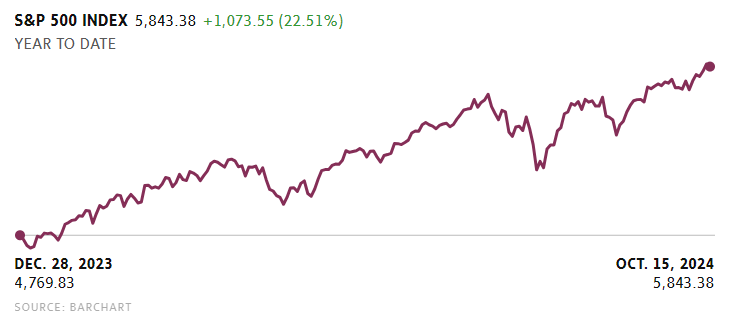
The S&P 500 index has risen 4% since the Fed cut rates last month as investors have funneled more than $20 billion into funds that buy U.S. stocks. The benchmark index has set a series of fresh record highs, including after a rise Monday.
Last week, analysts at Fundstrat and Goldman Sachs both raised their year-end forecasts for stocks, with Goldman expecting a further gain of just a little over 2%, with the index having already surpassed its previous prediction. That would come on top of what has already been a buoyant year, with the S&P 500 up more than 20% through Monday.
Even just a few weeks ago, concerns about the economy led analysts to lower their expectations for quarterly corporate earnings growth by more than usual, according to data from FactSet.
But the initial batch of earnings reports late last week from bellwether corporations like JPMorgan Chase and Wells Fargo were stronger than anticipated, a sign that the economy remained solid. More companies open their books this week, including the rest of the big banks, Johnson and Johnson, Netflix and Procter and Gamble. This next wave of presentations to analysts will help bolster the stock market’s heady valuation — or not.
Despite the bumper gains for major stock indexes, beneath the surface many companies and even entire sectors have recorded far less heady gains this year, with much of the rally being driven by the giant tech companies on the forefront of artificial intelligence. Investors hope that if the economy can remain resilient, the gradual decline of interest rates will lift more unloved areas of the market, offering a new driving force for the rally — and the economy in general.
And while the Fed’s September rate cut was too recent to have much of an impact on the latest batch of earnings, it could still shift sentiment, said James Demmert, chief investment officer at Main Street Research.
“It feeds the animal spirits of people running businesses to have the confidence to say we don’t need to be cost cutting, we need to be investing,” he said.
But the Russell 2000 index of smaller companies, which is linked to the ebb and flow of the U.S. economy, has struggled to keep up with the indexes dominated by multinational giants.
Much of the thinking behind forecasts for the continued ascent of stock prices centers on a broader group of industries generating the lift, but the reality is that indexes like the S&P 500 will continue to remain heavily dependent on investors’ exuberance for tech and especially AI.
Goldman Sachs expects higher earnings, and therefore higher stock prices, to be driven primarily by a more resilient economy that supports spending. But the bank also highlighted a recovery in the supply chain for the microchips that power AI applications to raise profits for companies that make the chips, as well as for companies like Google and Microsoft developing new AI applications.
“It’s not that we expect the megacaps to do poorly but the earnings environment for the rest of the market does seem to be improving,” Snider said.
Other concerns, such as the intensified fighting in the Middle East and the uncertainty around the U.S. presidential election, have been downplayed as less important than the positive economic conditions supporting earnings growth.
Typically, rising geopolitical tensions generate sharp but short-lived sell-offs, while presidential elections are often preceded by a mild sell-off followed by a rally. Analysts at Deutsche Bank recently said that these sorts of events may have less of an effect on the market than in the past.
“One key point with geopolitical shocks, as well as elections, is that the economic context has eventually always dominated,” the analysts noted.
And that context, for the time being, remains favorable to stock prices pushing higher. Even as the Fed has lowered the short-term interest rates it controls, longer-dated rates in the market for U.S. Treasury bonds have risen, typically a sign of expectations for future economic growth.
Bob Elliott, chief investment officer at fund manager Unlimited, said the economy is in “a pretty unusual circumstance globally.” Neither growth nor unemployment are flashing warning signs over the economy, “but still we are getting easing,” he said, referring to central banks around the world cutting interest rates as the global economy continues to expand.
“It’s not a normal cycle,” said Kristina Hooper, chief market strategist at Invesco.
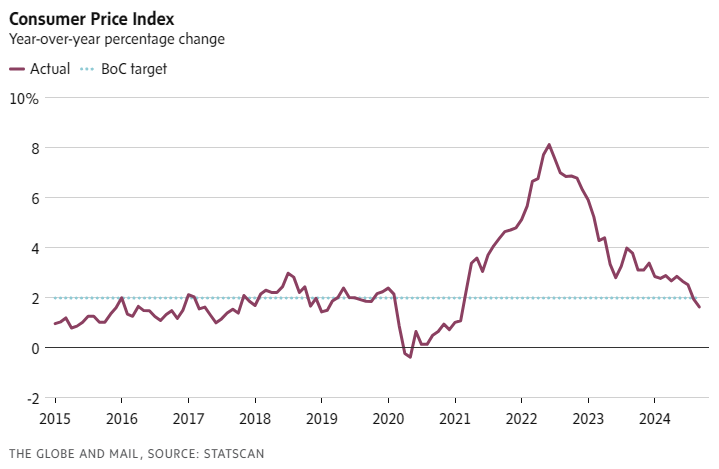
Canada’s inflation rate dropped below 2 per cent in September for the first time in more than three years, the latest sign of price stability that potentially tips the Bank of Canada to a larger interest-rate cut next week.
The consumer price index (CPI) rose at an annual rate of 1.6 per cent in September, down from a 2-per-cent pace in August, Statistics Canada said Tuesday in a report. Financial analysts were expecting a slowdown to 1.8 per cent. On a monthly basis, consumer prices fell 0.4 per cent.
This marked the weakest inflation rate since early 2021, when Canada was in the throes of a pandemic that momentarily resulted in tepid price increases, but gave way to the largest upswing in consumer prices in four decades.
The surprisingly softresults in Tuesday’s report were heavily influenced by gasoline prices, which fell 7.1 per cent in September from August. Excluding gas, the CPI rose at an annual pace of 2.2 per cent, matching the increase in August.
The inflation fight is effectively over, a milestone for the Canadian economy after CPI growth peaked in 2022, prompting central bankers to jack up interest rates to cool demand. Because of the progress to date, the Bank of Canada has delivered three consecutive rate cuts since June, taking its policy rate to 4.25 per cent from 5 per cent.
In recent weeks, economists and investors have debated whether the central bank will cut rates by another quarter-point at its next decision on Oct. 23, or opt for a larger half-point reduction.
However, after the inflation report was published, investors are more heavily leaning toward a larger cut. Markets are pricing in a 75-per-cent chance that the BoC lowers its benchmark interest rate by 50 basis points next, compared to roughly 50-50 odds before the report, according to Bloomberg data. (A basis point is 1/100th of a percentage point.)
“The Bank of Canada needs to do something to revive the economy and stop inflation from falling too far,” said Royce Mendes, head of macro strategy at Desjardins Securities, in a client note. “Our view is that a 50-basis-point rate cut is the right dose of medicine.”
Inflation came in lower than Bank of Canada estimates in the third quarter, and it’s been generally soft this year. Weaker household spending, more resilient supply chains and lower commodity prices have all helped to quell consumer price increases. Because of higher borrowing costs, many households have been forced to tighten their budgets.
Housing costs rose by an annual 5 per cent in September, down from 5.3 per cent in August. Rents rose by 8.2 per cent – quite elevated by historical standards, but down from 8.9 per cent in August. Other data sources are indicating that rents are declining in some cities.
Grocery prices rose 2.4 per cent in September, year over year, matching the increase in August. Clothing and footwear prices have dropped 4.4 per cent over the past year.
On a three-month annualized basis, the Bank of Canada’s core measures of inflation – which strip out volatile movements in the CPI – slowed to 2.1 per cent in September from 2.3 per cent in August.
The Bank of Canada has recently warned that inflation could drift below its 2-per-cent target. And while the BoC is unlikely to be alarmed by one month of below-target inflation – especially when the results are heavily influenced by volatile gas prices – it has stressed that economic activity needs to pick up to ensure this doesn’t become a trend.
Several analysts have said that inflation could pick up in the coming months, particularly with gas prices rising in October. The Bank of Canada is projecting a sustainable return to the 2-per-cent inflation target in 2025, although its economic forecasts will be updated next week.
Bank of Montreal chief economist Doug Porter said the drop in the annual inflation rate below 2 per cent was a “watershed moment.”
“It’s a close call, but we suspect that the big improvement in inflation, the still-high unemployment rate, and the still-sour consumer and business sentiment will be enough to prompt the Bank of Canada to opt for a 50 [basis point] rate cut later this month,” he said in a client note. “After all, the BoC has dovishly signalled that they are now more concerned about downside risks to the economy and the possibility that inflation may drop too low.”