
- Officials in Poland and Bulgaria say Russia is suspending their countries’ natural gas deliveries starting on Wednesday.
- The suspensions would be the first since Russian President Vladimir Putin said last month that “unfriendly” foreign buyers would have to pay the state-owned Gazprom in rubles instead of other currencies.
- Poland’s energy supplies are secure, Poland’s climate ministry said on Tuesday.
Author: Consultant
-
Russia is suspending gas supplies to Poland, Bulgaria
-
Google parent Alphabet misses sales estimates
Google parent Alphabet Inc on Tuesday reported first-quarter revenue below expectations as YouTube sharply missed Wall Street targets and ad sales were pressured by supply-chain and inflation concerns and the war in Ukraine.
The world’s largest provider of search and video ads has been a big winner of the shift to online commerce over the past two years, but the results suggest it is struggling in the latest economic phase of the pandemic, which is bringing elevated interest rates, higher transport costs and shortages of products from couches to cars to infant formula.
Alphabet shares were down 6.5% in after-hours trading.
“Alphabet has been seen as one of the most insulated companies in the advertising space relative to peers, but sometimes you can still own the best house in the worst neighbourhood,” said David Wagner, portfolio manager at Aptus Capital Advisors.
YouTube advertising sales of $6.9 billion missed Wall Street’s target of $7.5 billion, according to Factset.
Google’s chief business officer, Philipp Schindler, said YouTube direct response ads grew more moderately during the quarter.
Alphabet said first-quarter sales were $68.01 billion, 23% higher than last year but below the average estimate of $68.1 billion among financial analysts tracked by Refinitiv, its first miss since the fourth quarter of 2019 before the pandemic. Alphabet’s total costs also increased 23%.
Analysts said Google’s ad sales were in line with expectations overall, but that YouTube’s advertising growth was less than expected. Cloud sales grew at a slower pace than a quarter ago, and Google’s “other” revenue, which includes app, hardware and subscription sales, were $6.8 billion, below estimates of $7.3 billion.
Last week, Snap Inc warned that inflation, labour shortages and other economic challenges could pressure ad revenue.
Facebook parent Meta Platforms Inc, the second-biggest online advertising platform with an expected 21.4% share of the global market in 2022, reports earnings on Wednesday. Its shares fell 3.3% on Tuesday after Alphabet’s results.
Google is expected to grab 29%, or the leading share, of the $602 billion global online ad market in 2022, at least the 12th straight year it has been on top, according to Insider Intelligence.
Product changes by Google to resolve antitrust concerns and rising competition from companies such as Amazon.com Inc and ByteDance’s TikTok are chipping away at ad sales. Google also cut advertising offerings and other services in Russia following the invasion of Ukraine during the first quarter.
Still, travel and entertainment advertisers are ramping up again, and it is better positioned than rivals to withstand economic shocks because Google’s advertising tools tend to be among the last abandoned by advertisers as they are well known, easy to use and reach more users than alternatives.
Quarterly profit was $16.44 billion, or $24.62 per share, missing expectations of $25.76 per share.
Though Alphabet shares were down over 17% this year entering Tuesday, they have risen nearly 90% over the past two years.
Alphabet bought back over $81 billion in shares over the last two years and on Tuesday said its board had authorized an additional $70 billion in repurchases.
High on the list of risks faced by the company are numerous lawsuits and investigations into whether Google has engaged in anticompetitive conduct through its advertising and other businesses.
The newest scrutiny has been on its pending $5.4 billion acquisition of cybersecurity services provider Mandiant, which the U.S. Department of Justice is reviewing closely. Google has said it still expects to close the deal this year.
Google Cloud, the unit that would contain Mandiant, increased revenue in the first quarter by 44% compared with a year ago to $5.82 billion.
-
CN Rail profits dip amid supply chain snarls
CN Rail profits dip amid supply chain snarls
Canadian National Railway Co. is lowering its earnings forecast for the year after profits sagged in its first quarter.
Citing tough operating conditions and “worldwide economic uncertainty,” the Montreal-based company now predicts adjusted diluted earnings per share growth of between 15 and 20 per cent, versus its target of 20 per cent at the start of the year.
CN is also aiming for an operating ratio – a measure of the railway’s efficiency that divides operating expenses by net sales – of just under 60 per cent, compared to its more ambitious January goal of 57 per cent.
The country’s largest railroad operator says revenues for the quarter ended March 31 rose five per cent year over year to $3.71 billion compared to $3.54 billion a year earlier.
Higher freight rates and coal and U.S. grain export volumes boosted revenue, but a smaller overall grain crop, fewer West Coast container shipments, global supply snarls and harsher winter weather all contributed to a net earnings drop of six per cent to $918 million last quarter.
On an adjusted bases, diluted earnings per share rose to $1.32 from $1.23 in the same period last year, slightly below analyst expectations of $1.38, according to financial data firm Refinitiv.
-
Bank of Canada faces ‘delicate balance’ as it raises rates, Macklem says
Bank of Canada faces ‘delicate balance’ as it raises rates, Macklem says
The Bank of Canada faces a “delicate balance” as it tries to bring inflation back down without slowing the economy too much and triggering a recession, Governor Tiff Macklem said on Monday.
The Canadian economy is in a relatively good position to handle rising interest rates, Mr. Macklem said in an appearance before the federal finance committee. But he acknowledged that pushing the cost of borrowing sharply higher to try to quell rising consumer prices has some risks, particularly given the high level of household debt in Canada.
“Getting this soft landing is not going to be easy,” Mr. Macklem said, although he added that there are “some good reasons” to believe the economy will continue to grow as consumer prices decline.
The point of higher interest rates is to tamp down demand in the Canadian economy to bring it back in line with the country’s supply capacity. But raising rates too fast and too high could trigger a housing market correction, choke off business investment and erode consumer confidence.
The Bank of Canada is in the early stages of an aggressive campaign to bring borrowing costs back up to normal levels after holding them at record lows for much of the pandemic. Two weeks ago, the bank’s governing council raised the benchmark policy rate by 50 basis points to 1 per cent – the first oversized increase in two decades. It usually moves in quarter-point increments.
Mr. Macklem said on Monday that the governing council will likely consider another hike of 50 basis points for the June 1 rate decision. He said an even larger increase was possible, although such a move would be “very unusual,” and reiterated that the bank intends to get its policy rate back up to between 2 and 3 per cent relatively quickly.
Robert Hogue, assistant chief economist at Royal Bank of Canada, said the possibility of a housing market correction “is not a big stretch,” given how much real estate prices have increased over the past two years.
“The kind of [interest rate] increases that we’re contemplating and the market is now pricing in … would constitute a fairly significant change for the market to adjust to and to absorb,” Mr. Hogue said in an interview.
“As central bankers, they have to be mindful of not just triggering a correction, but something that’s deeper, and could be destabilizing.”
Mr. Macklem told the finance committee there are several reasons to believe the Canadian economy will be able to continue growing over the coming years while also bringing inflation down. Many of the factors driving inflation – which hit an annual rate of 6.7 per cent in March – are the result of global supply chain disruptions caused by the COVID-19 pandemic and spikes in commodity prices resulting from Russia’s invasion of Ukraine.
“If oil prices stop going up … and these global supply chain pressures begin to abate, we should see some natural reduction in inflation provided we keep inflation expectations well anchored,” Mr. Macklem said.
He also suggested that there’s room to cool the overheated job market without too many people actually losing their jobs. Right now, the country has a huge number of job vacancies; Statistics Canada said employers were actively recruiting for more than 800,000 vacant positions in January.
“I won’t pretend it isn’t delicate,” Mr. Macklem said. “But with an economy that is in excess demand with a labour market that’s got very high levels of vacancies, if we can get this right, we can reduce those vacancies, keep strong employment and get inflation back to target.
“That’s our aim. Are there some risks? Yes, there are some risks.”
Mr. Macklem and his team are hoping that Canadian consumers will do much of the heavy lifting to keep the economy out of recession even as monetary policy gets tighter. Household balance sheets are in relatively good shape, with many Canadians having built up savings over the past two years. The Bank of Canada estimates that Canadian households have built up around $200-billion in “excess savings,” compared with what they would have saved before the pandemic, which could support robust consumer spending even in the face of higher interest rates.
At the same time, Mr. Macklem acknowledged that the Bank of Canada does not have a good line of sight into global supply problems, which makes economic forecasting extremely difficult.
And he admitted the bank was wrong on a number of things over the past year.
“We got a lot of things right, we got some things wrong. We are responding,” Mr. Macklem said.
Mr. Hogue of RBC said his base case for the next two years does not include a recession. That said, the longer inflation remains elevated, the higher the risk that the Bank of Canada will need to raise rates to punishing levels.
“If the inflation rate over the next few months starts to come down, then maybe the risk might start to shift. But right now, things don’t look necessarily good, especially after the March [inflation] numbers that caught more or less everybody by surprise. … It does raise a higher risk of a harder landing at large in the economy,” Mr. Hogue said.
-
RBC and CIBC join banking group helping to finance Elon Musk’s bid for Twitter
RBC and CIBC join banking group helping to finance Elon Musk’s bid for Twitter
Royal Bank of CanadaRY-T -0.87%decrease and Canadian Imperial Bank of CommerceCM-T -0.32%decreaseare lining up behind Elon Musk’s US$44-billion takeover of Twitter Inc., with the two Canadian banks putting US$1.15-billion into the lowest-risk loan to the Tesla Inc. chief executive officer.
Mr. Musk announced a deal to buy social-media platform Twitter on Monday using US$25.5-billion borrowed from a dozen banks, led by Morgan Stanley. The world’s richest person, with a net worth of more than US$250-billion, will tap his own capital for the remainder of the purchase price.
The largest element of the Twitter financing is a US$12.5-billion loan backed by a portion of Mr. Musk’s 17-per-cent stake in Tesla, which is currently worth about US$170-billion.
RBC and CIBC are among 12 banks involved in this loan, according to regulatory filing. RBC pledged US$750-million and CIBC put up US$400-million. The lead bank on the entire financing, Morgan Stanley, promised US$2-billion.
The package also includes an unsecured US$3-billion bridge loan – money borrowed with no collateral – and a US$6.5-billion seven-year term loan. The risks that come with each level of debt are reflected in the interest rates the banks are charging Mr. Musk.
On the loan secured by his Tesla shares, Mr. Musk will pay an interest rate that is three percentage pointsover the benchmark secured overnight financing rate (SOFR), which was about 1.04 per cent on Monday. The banks also charged Mr. Musk a US$62.5-million fee to set up the loan.
The Canadian banks’ funding is the lowest-cost debt in the Twitter financing package, and therefore the least risky loan. In the worst-case scenario, with Mr. Musk defaulting on the loan and the banks seizing his Tesla shares, lenders are likely to be repaid in full. RBC’s analyst who follows Tesla currently has a US$1,175-per-share target price on the auto maker, which is 18 per cent higher than where Tesla shares were trading on Monday.
Canadian banks are conspicuous in their absence from the remainder of Mr. Musk’s loans, which come at far higher interest rates. The $6.5-billion term loan pays 4.75 percentage points over SOFR and there is a US$3-billion secured bridge loan with a rate set at 6.75 percentage points over the benchmark. Mr. Musk is pledging his stake in Twitter as collateral for both loans.
The most expensive debt, a US$3-billion unsecured one-year bridge loan, sees Mr. Musk pay 10 percentage points over SOFR to seven banks, including two Japan-based lenders – MUFG and Mizuho – and two banks from France, BNP Paribas and Société Générale.
Buyers typically move quickly to pay down bridge loans after takeover. However, Mr. Musk is not a typical dealmaker. At a conference in Vancouver earlier this month, Mr. Musk said his offer to buy Twitter is “not a way to make money” and stated “I don’t care about the economics at all.”
In announcing an agreement with the Twitter board on Monday, Mr. Musk said in a press release: “Free speech is the bedrock of a functioning democracy, and Twitter is the digital town square where matters vital to the future of humanity are debated.”
Mr. Musk, who studied at Queen’s University in Kingston for two years before earning degrees at U.S. schools, said he wants to improve Twitter “by enhancing the product with new features, making the algorithms open source to increase trust, defeating the spam bots, and authenticating all humans.”
Along with Morgan Stanley, Mr. Musk’s financial advisers are BofA Securities and Barclays. Goldman Sachs & Co. LLC, J.P. Morgan, and Allen & Co. are serving as financial advisers to Twitter.
-
Canada PM Trudeau announces investigation into Freedom Convoy protest ‘evolution,’ emergency order
Canada PM Trudeau announces investigation into Freedom Convoy protest ‘evolution,’ emergency order
Canadian Prime Minister Justin Trudeau announced Monday a new commission tasked with investigating his historic use of emergency powers to quell the Freedom Convoy protest months ago.
Trudeau announced Monday the establishment of the Public Order Emergency Commission, an independent public inquiry following the invocation of the Emergencies Act.
The commission will examine the circumstances that led to the declaration being issued and the measures taken in response to the emergency, including what Trudeau categorized as “the evolution of the convoy, the impact of funding and disinformation, the economic impact, and efforts of police and other responders prior to and after the declaration.”
CANADA POLITICIAN CHARGED BY OTTAWA POLICE OVER FREEDOM CONVOY TRUCKERS’ PROTEST

Trucks parked in Ottawa on the 19th day of the Freedom Convoy protest (Fox News Digital/Lisa Bennatan)
Trudeau evoked the Emergencies Act for the first time in Canada’s history during February’s Freedom Convoy protest in the capital city of Ottawa. In doing so, he granted the federal government temporary powers to quell truckers and others protesting COVID-19 vaccine mandates and other pandemic-related restrictions and freeze the bank accounts of those suspected of supporting the convoy.
The emergency powers were lifted on Feb. 23.
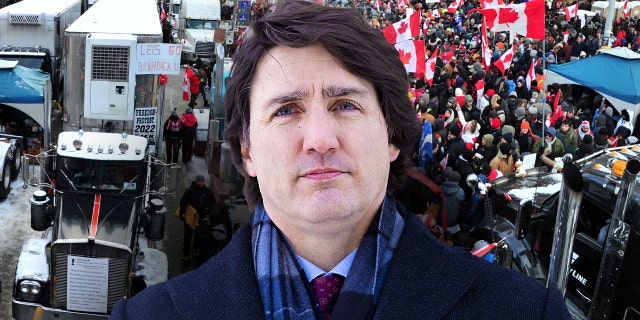
Supporters and truckers front the Parliament Hill during a protest in downtown of Ottawa, Canada, on February 12, 2022. Justin Trudeau, Canada’s prime minister, during a news conference from the National Capital Region in Canada on Monday, Jan. 31, 2022. (Photo by Mohamed Kadri/NurPhoto via Getty Images | Adrian Wyld/The Canadian Press/Bloomberg via Getty Images)
Trudeau appointed Judge Paul S. Rouleau as commissioner of the Public Order Emergency Commission. Rouleau is expected to submit a final report to the Canadian government of his findings and recommendations, which must be tabled in the House of Commons and Senate by Feb. 20, 2023. Under Part I of the federal Inquiries Act, the commissioner has the power to summon witnesses under oath and require them to provide documents or other items the commissioner considers necessary to carry out their work, according to Trudeau’s office.
CBC reported that a special joint committee of seven Members of Parliament and four senators had already begun reviewing the use of the Emergencies Act in March but has not yet released its findings.
CLICK HERE TO GET THE FOX NEWS APP
This comes after CTV News reported Sunday that the Canadian federal government will cover the approximately $35 million price tag for policing costs during the three-week-long Freedom Convoy.
The federal government will receive additional funding through its National Capital Extraordinary Policing Costs program to offset all costs incurred by the Ottawa Police Service during the protest. The Royal Canadian Mounted Police, Ontario Provincial Police and several municipal police forces were deployed to clear trucks and other vehicles from downtown Ottawa near Parliament Hill.
-
Twitter accepts Musk’s $44 billion deal
Twitter accepts Musk’s $44 billion deal
Twitter shares popped over 5% on Monday after the company’s board unanimously accepted Tesla CEO Elon Musk‘s $44 billion offer to take the social media giant private.https://af168a0c02007e11bfbf640a35cc9ebc.safeframe.googlesyndication.com/safeframe/1-0-38/html/container.html
ELON MUSK TAKES TO TWITTER TO EXPLAIN ‘WHAT FREE SPEECH’ MEANS
Under the terms of the agreement, Twitter stockholders will receive $54.20 in cash for each share of common stock that they own upon closing of the proposed transaction. The purchase price represents a 38% premium to Twitter’s closing stock price on April 1, the last trading day before Musk disclosed a 9.2% stake in the company.
Ticker Security Last Change Change % TWTR TWITTER INC. 51.70 +2.77 +5.66% Musk has secured approximately $46.5 billion to finance the transaction, including $25.5 billion of fully committed debt and margin loan financing and $21 billion in equity financing. The transaction is expected to close in 2022, subject to the approval of Twitter stockholders, the receipt of applicable regulatory approvals and the satisfaction of other customary closing conditions.
Twitter independent board chairman Brett Taylor said the company “conducted a thoughtful and comprehensive process to assess Elon’s proposal with a deliberate focus on value, certainty, and financing.”
TWITTER RE-EXAMINES MUSK’S BID AFTER TESLA CEO SECURES FINANCING: REPORT
Musk, a self-described “free-speech absolutist,” has been critical of the platform and its chief executive Parag Agrawal’s approach to free speech.
“Free speech is the bedrock of a functioning democracy, and Twitter is the digital town square where matters vital to the future of humanity are debated,” Musk said in a statement. “I also want to make Twitter better than ever by enhancing the product with new features, making the algorithms open source to increase trust, defeating the spam bots, and authenticating all humans. Twitter has tremendous potential – I look forward to working with the company and the community of users to unlock it.”https://af168a0c02007e11bfbf640a35cc9ebc.safeframe.googlesyndication.com/safeframe/1-0-38/html/container.html

Elon Musk: Reuters Parag Agrawal: Twitter (Reuters/Twitter / Reuters Photos)
Though Musk was initially invited to join Twitter’s board, he later declined the offer. If he joined, Musk would have been unable to own more than 14.9% of Twitter’s stock while serving on the board or for 90 days after. Musk’s board term would have expired at Twitter’s 2024 annual meeting.
Following Musk’s offer, Twitter adopted a limited duration shareholder rights plan, commonly referred to as a poison pill, to prevent him or any other entity or group from acquiring beneficial ownership of 15% or more of Twitter’s outstanding common stock in a transaction not approved by the board.
Along with Musk’s announcement that he lined up financing for a potential deal, he revealed that he was considering a tender offer to acquire all of Twitter’s outstanding common stock.
CLICK HERE TO READ MORE ON FOX BUSINESS
The agreement comes ahead of Twitter’s first quarter earnings report on Thursday before the market open. In light of the pending transaction, Twitter will not hold a corresponding conference call.
Musk told the TED2022 conference earlier this month that he intends to keep as many shareholders on board as possible through a private company.
-
At the open: North American markets continue to fall on global slowdown fears
APRIL 25
Canada’s main stock index hit a two-month low on Monday, dragged down by energy and material stocks, as worries about the fallout from China’s COVID-19 outbreak knocked oil and metal prices lower.
At 09:30 a.m. ET, the Toronto Stock Exchange’s S&P/TSX composite index was down 287.21 points, or 1.36%, at 20,899.17.
Wall Street’s main indexes opened lower on Monday as fears over China’s COVID-19 outbreaks spooked investors already concerned about aggressive U.S. interest rate hikes.
The Dow Jones Industrial Average fell 79.75 points, or 0.24%, at the open to 33,731.65.
The S&P 500 opened lower by 16.44 points, or 0.38%, at 4,255.34, while the Nasdaq Composite dropped 90.12 points, or 0.70%, to 12,749.17 at the opening bell.
The worries reverberated across world markets, with Chinese shares marking their biggest slump since a pandemic-led selling in February 2020 and European stocks falling to their lowest in over a month on fears of strict restrictions in China.
“China lockdowns are getting worse. It slows general economic growth and also creates supply chain issues that will continue to make inflation bad and lower earnings growth in the United States,” said Christopher Grisanti, chief equity strategist at MAI Capital Management in New York.
“I don’t think we’ve seen the bottom yet. We haven’t had that big sell off yet where we have huge volume and huge down side.”
The CBOE Volatility index, known as Wall Street’s fear gauge, hit its highest level since mid-March of 29.76.
Investors were also on edge at the start of a week that will see megacap companies like Google-parent Alphabet Inc, Microsoft Corp, Amazon.com Inc and Apple Inc publish quarterly results.
STORY CONTINUES BELOW ADVERTISEMENT
Disappointing results from pandemic darling Netflix along with surging bond yields pummeled high-growth stocks last week, bringing year-to-date losses in the tech-heavy Nasdaq to 17.9%. Meanwhile, the benchmark S&P 500 is down 10.4% so far this year.
Traders are pricing in big moves by the Federal Reserve this year to control inflation after a series of hawkish remarks from policymakers. Fed Chair Jerome Powell last week gave a “go” sign to a half-point rate hike in May and signaled he would be open to “front-end loading” the U.S. central bank’s retreat from super-easy monetary policy.
Money markets expect the Fed to raise interest rates by a half point at the central bank’s next two meetings.
Twitter Inc jumped 4% in early trading after sources told Reuters it was set to accept Tesla Inc chief Elon Musk’s ‘best and final’ offer of $54.20 per share in cash.
Asian markets had suffered their worst day in over a month overnight on fears that Beijing was about to go back into a COVID-19 lockdown.
The bashing continued in Europe. Despite relief that Macron had eased past far-right challenger Marine Le Pen on Sunday, the STOXX 600 index fell back to mid-March lows, weighed down by 1.5% and 1.0% drops in French and German shares, respectively.
The euro slid as much 0.75% as well, to its lowest since the initial COVID panic of March 2020.
“The reality is there is more to the French election story than Macron’s win yesterday,” said Rabobank FX strategist Jane Foley.
Not only are there parliamentary elections still to come in France in June, but Macron also seems likely to keep the pressure up for a Europe-wide ban on Russian oil and gas imports, which would cause serious economic pain, at least in the short term.
“We had German officials saying last week that if there was an immediate embargo of Russian energy then it would cause a recession in Germany. And if there was a recession in Germany, that would drag the rest of Europe down and have knock-on effects for the rest of the world,” Foley said.
MSCI’s broadest index of world shares was down 0.7% to a six-week low. Oil fell over 4% and the Beijing worries saw the yuan skid to a one-year low.
State television in China had reported that residents were ordered not to leave Beijing’s Chaoyang district after a few dozen COVID cases were detected over the weekend.
The China-sensitive Australian dollar fell as much as 1.2% while the U.S. dollar climbed unhindered to a two-year high, hitting $1.0707 against the euro and 1.2750 versus Britain’s pound in the process.
Much focus on is on how fast and far the Federal Reserve will raise U.S. interest rates this year and whether that, along with all the other current global strains, will help tip the world economy into recession.
This week is also a packed one for corporate earnings. Almost 180 S&P 500 index firms are due to report. Big U.S. tech will be the highlight, with Microsoft and Google on Tuesday, Facebook on Wednesday and Apple and Amazon on Thursday.
In Europe, 134 of the Stoxx 600 will also put out results, including banks HSBC, UBS and Santander on Tuesday, Credit Suisse on Wednesday, Barclays on Thursday and NatWest and Spain’s BBVA on Friday.
“I wonder whether just meeting expectations will be enough, it just feels like maybe we’ll need a bit more,” said Rob Carnell, ING’s chief economist in Asia, referring to jitters about big tech following a dire report from Netflix last week.
“It’s guidance about the future which will be as important as anything and I suspect most of these firms are going to be coming out and saying it all looks rather uncertain, which I don’t think is going to really help.”
Monday’s earlier selloff in Asia also saw Hong Kong’s Hang Seng fall 3.7% and the Shanghai composite index slide over 5%.
China’s central bank had fixed the mid-point of the yuan’s trading band at its lowest level in eight months, seen as an official nod for the currency’s recent slide, and the yuan was sold further, to a one-year low of 6.5092 per dollar.
Metals were mangled too. Dalian iron ore fell more than 9%. Copper, a bellwether for economic growth, dropped 2.2% and Brent crude futures fell 4.5% to a two-week low of $101.78 a barrel.
Palm oil whipsawed and the Indonesian rupiah slid following a ban on exports from Indonesia that further stoked worldwide food price pressure.
The higher dollar pushed spot gold 0.8% lower to $1,913 an ounce. Cryptocurrency Bitcoin dropped to a six-week low of $38,202.
The bond markets got some relief at least. The benchmark 10-year yield was back at 2.8217% in early U.S. trading while Germany’s 10-year yield, the benchmark for Europe , dipped as far as 0.87%. France’s 10-year yield was also down around 7 basis points at 1.35%.
Money markets are now pricing in a 1 percentage point increase in U.S interest rates at the Federal Reserve’s next two meetings and at least 2.5 points for the year as a whole, which would be one of the biggest annual increases ever seen.
This week will also see the release of U.S. growth data, European inflation figures and a Bank of Japan policy meeting, which will be watched for any hints of a response to a sharp fall in the yen, which has lost 10% in about two months.
Reuters
-
Twitter set to accept Elon Musk’s US$43-billion offer for social media company: report
Twitter set to accept Elon Musk’s US$43-billion offer for social media company: report
Twitter Inc TWTR-N +3.64%increase is poised to agree a sale to Elon Musk for around $43-billion in cash, the price the chief executive of Tesla Inc TSLA-Q -0.28%decrease has called his “best and final” offer for the social media company, people familiar with the matter said.
Twitter may announce the $54.20-per-share deal later on Monday once its board has met to recommend the transaction to Twitter shareholders, the sources said. It is always possible that the deal collapses at the last minute, the sources added.
Elon Musk says he has secured $46.5-billion in funding for Twitter bid
What is a poison pill? How Twitter’s plan to block Elon Musk’s hostile takeover bid would work
Musk, the world’s richest person according to a tally by Forbes, is negotiating to buy Twitter in a personal capacity and Tesla is not involved in the deal.
Twitter has not been able to secure so far a ‘go-shop’ provision under its agreement with Musk that would allow it to solicit other bids once the deal is signed, the sources said. Still, Twitter would be allowed to accept an offer from another party by paying Musk a breakup fee, the sources added.
The sources requested anonymity because the matter is confidential. Twitter and Musk did not immediately respond to requests for comment.
Twitter shares were up 4.5 per cent in pre-market trading in New York on Monday at $51.15.
Musk has said Twitter needs to be taken private to grow and become a genuine platform for free speech.
The deal would come just four days after Musk unveiled a financing package to back the acquisition. This led Twitter’s board to take the deal more seriously and many shareholders to ask the company not to let the opportunity for a deal to slip away, Reuters reported on Sunday.
The sale would represent an admission by Twitter that its new chief executive Parag Agrawal, who took the helm in November, is not making enough traction in making the company more profitable, despite being on track to meet ambitious financial goals the company set for 2023. Twitter’s shares were trading higher than Musk’s offer price as recently as November.
Musk’s negotiating tactics – making one offer and sticking with it – resembles how another billionaire, Warren Buffett, negotiates acquisitions. Musk did not provide any financing details when he first disclosed his offer for Twitter, making the market skeptical about its prospects.