
Author: Consultant

  • July 12 -The close: TSX hits 16-month low as energy stocks tumble

    July 12 -The close: TSX hits 16-month low as energy stocks tumble

    Canada’s main stock index fell on Tuesday to its lowest level in 16 months as crude oil prices tumbled more than 7% and the U.S. yield curve inverted the most since March 2010, further signals that global investors are bracing for a possible recession.

    Wall Street also ended in negative territory as recession jitters kept buyers out of the equities market ahead of a key U.S. inflation report. The data could help guide expectations for further aggressive interest rate hikes by the Federal Reserve.

    “For several months we’ve swung back and forth between inflation fears and recession fears, almost on a daily basis,” said Brent Schutte, chief investment officer at Northwestern Mutual Wealth Management Company, in Milwaukee, Wisconsin. “We have really confused investors who have chosen to go on a buyers strike,” Schutte added. “I don’t hear many people saying ‘buy the dip.’”

    While the U.S. CPI report is expected to show inflation gathered heat in June, the so-called “core” CPI, which strips away volatile food and energy prices, is seen offering further confirmation that inflation has peaked, which could potentially convince the Federal Reserve to ease on its policy tightening in autumn.

    Paul Kim, chief executive officer at Simplify ETFs in New York, expects year-on-year topline CPI to “be in the high eight or potentially even nine percentage range, and with inflation that high, the Fed has only one thing in mind.”

    Worries that overly aggressive moves by the Fed to reign in decades-high inflation could push the economy over the brink of recession were exacerbated by the steepest inversion of the 2 year and 10 year Treasury yields since at least March 2010.

    The market expects the central bank to raise the key Fed funds target rate by 75 basis points at the conclusion of its July policy meeting, which would mark its third consecutive interest rate hike.

    Canada’s central bank is expected to tighten by three-quarters of a percentage point on Wednesday, which would be its biggest hike in 24 years.

    The Toronto Stock Exchange’s S&P/TSX composite index ended down 138.16 points, or 0.7%, at 18,678.64, its lowest closing level since March 2021.

    The energy sector fell 3.4% as U.S. crude prices settled 7.9% lower at $95.84 a barrel, with demand-sapping COVID-19 curbs in top crude importer China adding to fears of a global economic slowdown.

    Oil prices are facing extreme pressure “as a defensive posture continues with consumer sentiment still in a depressed mode along with a COVID re-surface in China,” said Dennis Kissler, senior vice president for trading at BOK Financial.

    A record high dollar is triggering more selling liquidation, Kissler added. Oil is generally priced in U.S. dollars, so a stronger greenback makes the commodity more expensive to holders of other currencies.

    The dollar index, which tracks the currency against a basket of six counterparts, on Tuesday climbed to 108.56, its highest level since October 2002. Investors tend to view the dollar as a safe haven during market volatility.

    Investors have been dumping petroleum-related derivatives at one of the fastest rates of the pandemic era as recession fears intensify. Hedge funds and other money managers sold the equivalent of 110 million barrels in the six most important petroleum-related futures and options contracts in the week to July 5.

    The Dow Jones Industrial Average fell 192.51 points, or 0.62%, to 30,981.33, the S&P 500 lost 35.63 points, or 0.92%, to 3,818.8 and the Nasdaq Composite dropped 107.87 points, or 0.95%, to 11,264.73.

    All 11 major sectors in the S&P 500 fell, with energy shares suffering the largest percentage loss.

    The second-quarter reporting season will hit full stride later in the week as JPMorgan Chase & Co, Morgan Stanley , Citigroup and Wells Fargo & Co post results.

    As of Friday, analysts saw aggregate annual S&P earnings growth of 5.7% for the April to June period, down from the 6.8% forecast at the beginning of the quarter, according to Refinitiv.

    PepsiCo got the ball rolling this week by beating its quarterly earnings estimates and announced it could increase prices amid resilient demand.

    Shares of Boeing Co jumped 7.4% after the plane maker’s June aircraft deliveries hit the highest monthly level since March 2019.

    That news, along with falling energy prices, helped the S&P 1500 Air Lines index rise 6.1%.

    Apparel retailer Gap Inc fell 5.0% following its announcement that its CEO would step down, and that margins would stay under pressure in the second quarter due to input costs.

    Software provider Service Now plunged 12.7% after its CEO’s remarks about macro headwinds and currency pressures. Other software companies, including Salesforce.com, Paycom Software, Intuit and Microsoft, were also down.

    Declining issues outnumbered advancing ones on the NYSE by a 1.37-to-1 ratio; on Nasdaq, a 1.19-to-1 ratio favored decliners. The S&P 500 posted one new 52-week high and 30 new lows; the Nasdaq Composite recorded 13 new highs and 145 new lows. Volume on U.S. exchanges was 9.86 billion shares, compared with the 12.79 billion average over the last 20 trading days.

    In credit markets, the Canadian government bond yields were lower across the curve, tracking the move in U.S. Treasuries. The 10-year yield eased 5.7 basis points to 3.187%.
  • Consumer inflation is expected to have been even hotter in June, but it could be peaking

    Consumer inflation is expected to have been even hotter in June, but it could be peaking

    • Consumer prices continued to shoot higher in June, with the headline consumer price index expected to reach 8.8% year over year, according to Dow Jones.
    • But economists say that considering the falloff in gasoline prices, June’s headline CPI could be the peak of inflation for now.
    • Core inflation, excluding gasoline and food, is expected to go from 6% in May to 5.7%, the third month in a row of slowing.

    https://www.cnbc.com/2022/07/12/consumer-inflation-is-expected-to-have-been-even-hotter-in-june-but-it-could-be-peaking.html

  • ‘Toronto housing market cooling fast’: Scotiabank

    ‘Toronto housing market cooling fast’: Scotiabank

    Scotiabank strategist Jean-Michel Gauthier detailed the rapid slowdown in Toronto real estate values in a Friday research report,

    “June data from the Toronto Real Estate Board highlighted a rapidly decelerating housing market in Toronto. Sales were down 8.7% month-over-month on a deseasonalized basis (-59% from 2021 high) with the median house selling price down 4.2% sequentially as well (-14% from the February 2022 all-time high). Looking at measures of market tightness also reveals rapidly declining buying interest: … The average house selling price as a % of the listing price has plunged back to 100% from an all-time high of 116% hit in February. In other words, as recently as 4 months ago, buyers were engaged in generalized bidding wars that saw the average home go 16% above its listing price. For comparison, that ratio was 95% at the depth of the housing trough in 1995/1996 and 96% at the worst of the financial crisis, while the previous high stood at 111% in early 2017 ahead of the imposition of a tax on foreign buyers. The average number of days on the market has also sharply risen, albeit from a low base.”

    “Scotiabank: “Toronto Housing Market Cooling Fast “” – (research excerpt) Twitter

  • Another hot inflation report and the start of earnings season make for a challenging week ahead

    Another hot inflation report and the start of earnings season make for a challenging week ahead

    • Consumer inflation data and the start of the second-quarter earnings season could set the course for markets and result in volatile trading in the week ahead.
    • The June consumer price index on Wednesday is expected to show headline inflation, including food and energy, rising above May’s 8.6% level.
    • “The street has not really changed the [earnings] estimates. Revenue growth has ticked down. Margins are compressing. Analysts are leaving their estimates unchanged,” said one strategist. “If there’s going to be a readjustment, this is the time.”

    https://www.cnbc.com/2022/07/08/another-hot-inflation-report-q2-earnings-make-for-difficult-week-ahead.html

  • Economic Calendar: July 11

    Economic Calendar: July 11

    Monday July 11

    China CPI, PPI, aggregate yuan financing, new yuan loans and money supply

    Japan core machine and tool orders

    —

    Tuesday July 12

    China trade surplus

    Germany ZEW economic sentiment survey

    (6 a.m. ET) U.S. NFIB small business economic trends survey for June.

    Earnings include: PepsiCo Inc.

    —

    Wednesday July 13

    Euro zone industrial production

    Germany CPI

    (8:30 a.m. ET) Canada’s census household data for 2021

    (8:30 a.m. ET) U.S. CPI for June. The Street is projecting an increase of 1.1 per cent from May and up 8.8 per cent year-over-year.

    (10 a.m. ET) Bank of Canada policy announcement and monetary policy report (with press conference to follow).

    (2 p.m. ET) U.S. budget balance for June.

    Earnings include: Cogeco Inc.; Cogeco Communications Inc.; Delta Air Lines Inc.; Progressive Corp.

    —

    Thursday July 14

    Japan industrial production

    (8:30 a.m. ET) Canada’s manufacturing sales and new orders for May. Estimates are declines of 2.5 per cent and 3.0 per cent from April, respectively.

    (8:30 a.m. ET) Canada’s construction investment for May.

    (8:30 a.m. ET) U.S. initial jobless claims for week of July 9. Estimate is 235,000, unchanged from the previous week.

    (8:30 a.m. ET) U.S. PPI Final Demand for June. Consensus is a rise of 0.8 per cent from May and 10.8 per cent year-over-year.

    Earnings include: Cintas Corp.; First Republic Bank; Goodfood Market Corp.; JPMorgan Chase & Co.; Morgan Stanley; Theratechnologies Inc.

    —

    Friday July 15

    China GDP, retail sales, industrial production and fixed asset investment

    Japan department store sales and tertiary industry index

    Euro zone trade deficit

    (8:30 a.m. ET) Canada’s wholesale trade for May.

    (8:30 a.m. ET) Canada’s new motor vehicle sales for May. Estimate is a year-over-year decline of 8.5 per cent.

    (8:30 a.m. ET) Canada’s international securities transactions for May.

    (9 a.m. ET) Canada’s existing home sales for June. Estimate is a decline of 25 per cent year-over-year with average prices rising 4 per cent.

    (8:30 a.m. ET) U.S. retail sales for June. Consensus is an increase of 0.9 per cent from May.

    (8:30 a.m. ET) U.S. import prices for June. The Street expects a rise of 0.7 per cent month-over-month and 11.3 per cent year-over-year.

    (8:30 a.m. ET) U.S. Empire State Manufacturing Survey for July.

    (9 a.m. ET) Canada’s MLS home price index for June. Estimate is an increase of 16.5 per cent from the same period a year ago.

    (9:15 a.m. ET) U.S. industrial production for June. Consensus is unchanged from May with capacity utilization sliding 0.3 per cent to 80.5 per cent.

    (10 a.m. ET) U.S. business inventories for May. The Street expects an increase of 1.1 per cent from April.

    (10 a.m. ET) U.S. University of Michigan consumer sentiment for May.

    Also: G20 finance ministers and governors meeting in Jakarta (through Saturday).

    Earnings include: Bank of NY Mellon; Blackrock Inc.; Citigroup Inc.; PNC Financial Services Group Inc.; State Street Corp.; UnitedHealth Group Inc.; U.S. Bancorp.; Wells Fargo & Co.

  • Rogers customers reporting service outages across Canada

    Rogers customers reporting service outages across Canada

    Rogers Communications Inc customers across Ontario and in other areas across the country were reporting outages Friday morning.

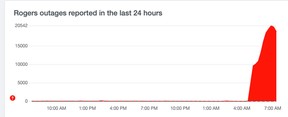
    According to online tracker Downdetector Canada, there were more than 20,000 reports as of 6:45 a.m. Users were reporting problems related to internet, TV and Wi-Fi connections.

    Rogers outages reported on the online tracker site Downdetector Friday.
    Rogers outages reported on the online tracker site Downdetector Friday. PHOTO BY DOWNDETECTOR

    While the highest concentration came from Ontario, there were also reports of outages in Montreal, Winnipeg and Edmonton.

    Early this morning Toronto police tweeted that some people would have trouble calling 911 because of Rogers’ technical difficulties.

    The outages also appeared to be impacting Interac and wholesale re-sellers of Rogers services, the CBC reported.

    Rogers did not immediately respond to Reuters’ request for comment.

    Additional Reporting by Reuters

  • Japan’s former PM Shinzo Abe dies from injuries after being shot

    Japan’s former PM Shinzo Abe dies from injuries after being shot

    • Shinzo Abe, the former prime minister of Japan, died Friday after being shot.
    • The former prime minister was shot while delivering a speech in the city of Nara, near Kyoto.
    • The incident has sent shockwaves through Japan, a country where gun violence is extremely rare.

    https://www.cnbc.com/2022/07/08/japans-former-pm-shinzo-abe-dies-from-injuries-after-being-shot-nhk-reports.html

  • European markets close 2% higher; UK’s Johnson resigns as prime minister

    European markets close 2% higher; UK’s Johnson resigns as prime minister

    • Investors were digesting the latest Fed minutes, in which the central bank’s officials reiterated a tough stance against inflation.
    • U.K. Prime Minister Boris Johnson resigned on Thursday, after more than 50 resignations from his government in light of a string of scandals.

    https://www.cnbc.com/2022/07/07/european-markets-open-to-close-fed-minutes-data-and-earnings.html