Category: Uncategorized

  • Ottawa, Alberta agree on carbon pricing to advance plan for new oil pipeline

    Alberta officials expect to see first oil move through a new pipeline to the West Coast by 2033 or 2034, after the province and Ottawa signed a long-awaited deal on carbon pricing and emissions reductions in the energy sector.

    The agreement was inked on Friday by Prime Minister Mark Carney and Premier Danielle Smith at the McDougall Centre in Calgary. It finalizes the fine print of a memorandum of understanding they signed last year, which tied Ottawa’s support for a potential pipeline to Alberta increasing the carbon price it imposes on oil producers and reducing greenhouse gas emissions through carbon capture and storage, also called CCS.

    The two governments have agreed to an effective carbon price of $130 per tonne by 2040 by instituting annual benchmarks for the headline carbon price – or policy price – including $115 by 2030 and $130 by 2035.

    Under Friday’s agreement, Alberta will submit an application for a new oil pipeline to the West Coast to Ottawa’s Major Projects Office on or before July 1. The federal government will then look to designate the pipeline as a project of national interest by Oct. 1.

    If that designation is successful, Canada will assess the project under the Building Canada Act to determine the conditions required for construction and development of the pipeline.

    “Provided that duty to consult obligations with Indigenous Peoples have been met, Canada intends to make best efforts to provide the conditions document by September 1, 2027 to enable commencement of construction of the pipeline,” it says.

    Under the agreement, both governments will establish a trilateral discussion with British Columbia on the oil pipeline application, and Ottawa will continue working with B.C. “on other projects of national interest in their jurisdiction.”

  • Canadian Tire Corporation Reports First Quarter 2026 Results

    FIRST-QUARTER HIGHLIGHTS

    • Consolidated Comparable sales were down 1.0%, with growth at SportChek and Mark’s offset by a decline at CTR.
      • CTR Comparable sales1 were down 2.3%. Fixing categories grew, while Seasonal and Gardening led the decline. Western Canada outperformed, with seasonal weakness impacting Ontario and Quebec. Automotive retail sales were up for the 23rd consecutive quarter.
      • SportChek Comparable sales1 were up 3.3%, marking the seventh consecutive quarter of sales growth. The quarter saw strong performance from fanwear, athletic footwear and hard goods.
      • Mark’s Comparable sales1 were up 1.2% on higher casualwear sales. New-concept Bigger Bolder Better (BBB) stores remained a key driver.
    • Loyalty sales outpaced non-loyalty sales, reflecting growth in active Triangle Rewards members, including increasing contributions from the Company’s loyalty partnerships with RBC and WestJet launched in Q1. 
    • Retail Revenue growth was strong, up 2.9% or 5.0% excluding Petroleum, reflecting higher shipments to support the Q2 spring/summer season and replenishment at CTR.
    • Consolidated Income before income taxes (IBT) was $169.1 million, up $117.5 million, mainly reflecting prior year restructuring expense, and up $3.4 million on a normalized basis1. Retail IBT1 of $50.9 million was stable year-on-year on a normalized basis; Retail gross margin dollars increased on higher Retail Revenue, offset by higher IT and variable compensation expenses.

    Earnings Call Summary

    Q4 2025

    Earnings Call Date:Feb 18, 2026| % Change Since:-6.78%|

    Earnings Call Sentiment | Positive

    The call presented a majority of positive operational and financial developments: healthy sales growth, strong margin expansion, substantial EPS and IBT gains, meaningful loyalty and partnership traction, disciplined capital allocation and clear strategic investments (AI/MOSaiC, store refreshes). The principal cautions relate to a 53rd week that materially boosted results, elevated inventory, bank-level investment pressures and some banner/category-specific softness (CTR living, discretionary). Management articulated concrete plans to sustain momentum (loyalty, partnerships, DaiVID rollout, MOSaiC commercialization) and quantified savings and capital priorities. On balance, the highlights are stronger and more numerous than the lowlights, and the business appears to be executing through transformation while acknowledging near-term modeling caveats.

    Company Guidance

    Management reiterated True North long-term goals of annual retail sales growth of 3–5% with earnings growing faster than sales and a “North Star” retail gross margin rate of 35%+, while flagging 2026-specific expectations: operating CapEx of $500–$550 million (2025 OpEx was $502 million), continued share repurchases after >$440 million bought in 2025 (share count down ~5%), and a push to realize $100 million of restructuring savings (with $30 million recognized in Q4). They warned of tough weather and patriotic‑purchasing comps in H1 2026, said Q1 had started well but noted the bank will face some SG&A/headwind in H1 from ongoing investments (although not the same profitability hit as 2025), and signaled key program timing—DaiVID rollout to SportChek/Mark’s in late 2026 and MOSaiC commercialization in H2 2026—while pointing to 2025 metrics that underpin guidance (ROIC up to 11%, extra retail week in 2025 added ~$287M sales ex‑Petroleum and ~$40M IBT, and loyalty/partnership momentum such as 9.8M active members and eCTM issuance of $329M).

    https://www.newswire.ca/news-releases/canadian-tire-corporation-reports-first-quarter-2026-results-826611042.html

  • The number of Canadians filing for insolvency is picking up – and fast

    Canadians are filing for insolvencies at levels unseen in more than a decade as rising costs and uncertainty around housing and employment put more strain on consumers, according to the latest data from the Office of the Superintendent of Bankruptcy.

    The number of Canadians who filed for insolvency jumped 8.5 per cent year-over-year in the first quarterof 2026 to 37,121, the highest quarterly volume since 2009, the OSB recorded in statistics released on Monday.

    But the accelerating pace of insolvencies may be more concerning than the volume, said Doug Hoyes, a licensed insolvency trustee and co-founder of Hoyes, Michalos & Associates.

    Insolvencies rose 4.2 per cent year-over-year in the 12-month period ending March 31 and the number of monthly insolvencies rose 17.5 per cent between January and March.

    “It’s the canary in the coal mine,” he said.

    Although insolvencies reached their highest quarterly volume since 2009, Mr. Hoyes said the numbers cannot be easily compared. That’s owing to the change inpopulation levels, updates to the insolvency filing process and the global financial crisis at the time.

    In the OSB data, British Columbia posted the highest overall spike in consumer insolvencies – bankruptcies and consumer proposals combined – rising 16.2 per cent year-over-year.

    A consumer proposal, Mr. Hoyes said, is a deal that allows someone in debt to avoid losing assets by agreeing to repay their creditors more over time. A bankruptcy means individuals may be required to forfeit assets to pay the debt.

    Consumer proposals are more common among people who feel relatively stable or optimistic about their future finances, Mr. Hoyes said.

    In Ontario, consumer insolvencies rose 14.7 per cent, but the province held a far bigger share of bankruptcies, which grew more than 25 per cent compared with 8.6 per cent in B.C.

    Mr. Hoyes said some of the bankruptcy spike in Ontario may be tied to the bigger economic impact of U.S. tariffs in the province, as it has a large manufacturing sector.

    Worsening economic conditions mean the trend in insolvencies could be sustained over a longer period.

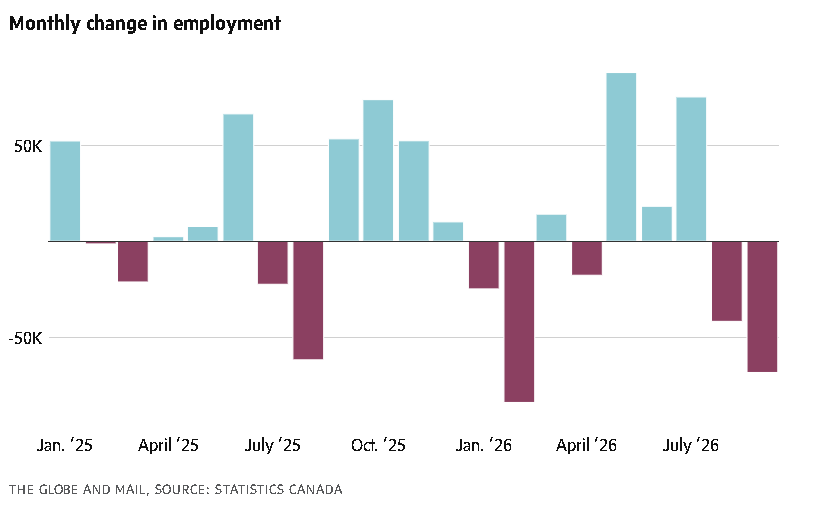
    Across Canada, the unemployment rate in April rose to 6.9 per cent compared with 6.7 per cent in March as the economy shed 18,000 jobs.

    But the biggest strain on Canadians are expenses that are increasing faster than incomes, especially as the price of fuel sends costs at the pump soaring. Food, which uses fuel at almost every stage of production and delivery, has also been hit hard by gasoline costs.

    In March, grocery prices were 35 per cent higher than just before the pandemic, BMO Economics reported last week.

    While the bulk of insolvency filings are made by renters, according to Mr. Hoyes, homeowner insolvencies are gradually rising as well.

    February report from his firm found that homeowner insolvencies are now 8 per cent of filings compared with 5 per cent in 2024. The proportion of two-income households reaching insolvency also spiked to 23 per cent, the highest level since 2017.

    André Bolduc, a licensed insolvency trustee who was speaking on behalf of the Canadian Association of Insolvency and Restructuring Professionals, said that the three main factors driving insolvencies are expenses related to housing, auto loans and food.

    As consumers are amortizing their car payments over longer periods, with payments reaching as many as seven years now, their shortfalls become higher when they default or trade in their car early.

    Mr. Bolduc says he has seen shortfalls on cars that range from $10,000 to $30,000. “That really adds up,” he said.

    He said while Canadians have carried higher levels of household debt than the rest of the G7 for more than a decade, rising housing costs and employment pressure could push Canadians who have long been on the brink of insolvency closer to the edge. He said he wouldn’t be surprised if the trend continues for a while.

    “Insolvency is kind of a lagging indicator,” Mr. Bolduc said. “It’s not the problem per se. It’s a symptom of what’s happened in the past.”

  • Hydro One’s first-quarter profit and revenue rises

    Hydro One Ltd. H-T -0.63%decrease reported its first-quarter profit and revenue rose compared with a year ago, boosted by higher rates and increased peak demand.

    The power utility says it earned $391-million in net income attributable to common shareholders or 65 cents per diluted share for the quarter ended March 31.

    The result compared with a profit of $358-million or 60 cents per diluted share in the same quarter last year.

    Revenue totalled $2.65-billion, up from $2.41-billion in the first quarter of 2025.

    In February, Hydro One announced chief operating officer Megan Telford would become chief executive on June 9.

    Telford will replace David Lebeter, who is retiring from the top job.

  • Oil price spike turmoil far from over, IEA says as inventories are depleted at “record pace”

    • Oil prices could rise further over the summer as rapidly depleting inventories pile more pressure on the market, the IEA said.
    • The energy agency also flagged further demand destruction as a result of the war, forecasting a contraction of 420 thousand barrels per day by the end of 2026.
    • Despite the loss of demand, the authors still expect the oil market to end the year in a deficit.

    https://www.cnbc.com/2026/05/13/oil-price-spike-turmoil-iea-iran-war.html

  • US: Wholesale inflation jumps 6% in April on annual basis, biggest increase since 2022

    • The producer price index rose a seasonally adjusted 1.4% for the month, much higher than the 0.5% Dow Jones consensus forecast and the upwardly revised 0.7% March increase.
    • Energy was at the root of the unexpectedly high gain in producer prices, though there was evidence that the price pain is extending beyond the gas pump.
    • The services index accelerated 1.2%, the biggest gain since March 2022. Two-thirds of the move was attributed to a 2.7% gain in trade services, a sign that tariff costs could be starting to have a larger impact on prices.

    https://www.cnbc.com/2026/05/13/ppi-inflation-report-april-2026-.html

  • Franco-Nevada: Q1 Earnings Snapshot

    Franco-Nevada Corp. (FNV) on Tuesday reported first-quarter net income of $468.6 million.

    The Toronto-based company said it had net income of $2.43 per share. Earnings, adjusted for non-recurring gains, were $2.38 per share.

    The results beat Wall Street expectations. The average estimate of three analysts surveyed by Zacks Investment Research was for earnings of $2.09 per share.

    The precious metals streaming and royalty company posted revenue of $650.7 million in the period.

    _____

    This story was generated by Automated Insights (http://automatedinsights.com/ap) using data from Zacks Investment Research.

    Access a Zacks stock report on FNV at https://www.zacks.com/ap/FNV

  • Exchange Income Corporation (TSX: EIF) 

    Q1 Financial Highlights

    • Record first quarter Revenue of $867 million, an increase of $198 million or 30% compared to the prior period.
    • Record Adjusted EBITDA of $166 million, representing growth of $36 million or 28% over the prior period.
    • Free Cash Flow first quarter record of $120 million representing growth of 48% compared to the prior period of $81 million.
    • Net Earnings of $28 million compared to the prior period of $7 million, an increase of 287%, and Net Earnings per share of $0.50 compared to the prior period of $0.14 or an increase of 257%.
    • Record Adjusted Net Earnings of $34 million compared to the prior period of $14 million, an increase of 139%, and Adjusted Net Earnings per share of $0.61 compared to the prior period of $0.28.
    • Record Free Cash flow less Maintenance Capital Expenditures of $41 million compared to $26 million in the prior period.
    • Trailing Twelve Month Free Cash Flow less Maintenance Capital Expenditures Payout Ratio 1 improved to 57% compared to the prior period of 63% and Trailing Twelve Month Adjusted Net Earnings Payout Ratio 1 improved to an all-time record of 67% compared to the prior period of 84%. The payout ratios significant declines included period over period increases in weighted average number of shares outstanding of 11% along with the 5% increase in dividend during the fourth quarter of fiscal 2025.
    • Announced the extension and expansion of the Credit Facility to $3.5 billion while increasing the flexibility as the facility changed from a secured to unsecured facility.
    • Announced an investment grade corporate rating and the issuance of $600 million of 4.324% senior unsecured notes due March 13, 2031 with the proceeds used to repay existing indebtedness under the Credit Facility.
    • Announced the acquisition of Mach2 and the extension and expansion of the commercial agreement with Air Canada.
    • Announced the renewal of the Normal Course Issuer Bid for Common Shares.