Category: Uncategorized

  • Canadian Tire results show consumer shift from discretionary purchases

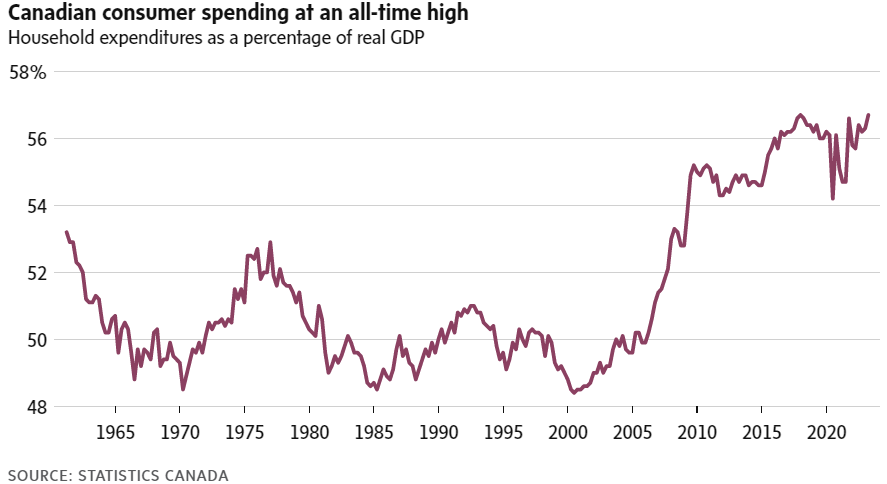
    Consumers feeling the sting of inflation are cutting back on non-essential purchases, as they face higher interest rates on their mortgages and steep prices for basic necessities such as groceries.

    What is emerging in the retail landscape is in many ways a reversal of the trends seen during the COVID-19 pandemic – when supply chains struggled to keep up with surging demand for big-ticket items such as appliances and furniture, as well as for products such as bicycles and outdoor gear to keep people entertained when travel was restricted.

    Canadian Tire Corp. Ltd. CTC-A-T -2.47%decrease was just the latest retailer to point to these trends on Thursday, reporting that demand for discretionary products has weakened, and that shoppers have begun to seek out lower-priced essential products.

    The company’s credit card data revealed that overall consumer spending has slowed for the first time since 2020, chief executive officer Greg Hicks told analysts on a conference call to discuss first-quarter financial results. And data from Canadian Tire’s loyalty program showed spending declining at stores across all income groups.

    “The current high inflation rates have led customers to prioritize essential products over higher-ticket discretionary ones,” Mr. Hicks said on the call, adding that shoppers are “mindful” of their spending as they renew mortgages at higher interest rates, and also return to spending money in areas that declined during the pandemic, such as travel and restaurant dining.

    Other companies have noted similar trends. Last month, Whirlpool Corp. WHR-N -0.82%decreasereported a revenue decline as shifting consumer sentiment led to fewer big-ticket appliance purchases.

    And United Parcel Service Inc. UPS-N -1.73%decrease reported that it saw buying behaviours change, with discretionary purchases softening as overall U.S. retail sales contracted in March. Food is making up a larger percentage of household budgets and American consumers are directing their disposable income “away from goods to services,” UPS chief executive Carol Tomé told analysts on a call in April to discuss the company’s earnings.

    Across the shipping industry, freight rates have fallen and demand for shipping hard goods has dropped sharply in recent months, as inventories climb. Canadian Tire recently exited a dedicated ocean freight contract at a one-time $13.5-million cost, as the company expects to lock in more favourable ocean freight costs in the near future.

    Inventory levels in spring and summer products are elevated across the retail industry, TJ Flood, president of Canadian Tire Retail, told analysts on Thursday’s call. Mr. Flood said that promotional intensity is likely to heat up, particularly in discretionary categories.

    While purchases of essential items such as pet food and automotive products remained relatively strong in the first quarter, Canadian Tire reported on Thursday that its earnings were affected by changing consumer behaviours, as well as an unusually warm winter and a slow start to spring that contributed to weakened demand for seasonal products.

    Canadian Tire to rebrand gas stations in new Petro-Canada partnership

    Canadian Tire commits half its sponsorship dollars to women’s professional sports

    Canadian Tire reported its overall revenue declined by 3.4 per cent in the 13 weeks ended April 1, to $3.7-billion.

    Comparable sales – an important metric that tracks sales growth not tied to new store openings – fell by 4.8 per cent at Canadian Tire stores. Comparable sales at the company’s Mark’s chain grew by 4.8 per cent, and were up by 3.7 per cent at Sport Chek on higher sales of athletic and casual clothing. Revenue for the Helly Hansen brand grew by 22.9 per cent compared with the prior year.

    Revenue in Canadian Tire’s financial services segment grew by 11.5 per cent to $38.1-million.

    As weather has turned more favourable following the end of the first quarter, business has improved, with sales up 3 per cent at the end of April, Mr. Flood said.

    Canadian Tire reported its net income fell to 42.8-million, or 14 cents a share, in the first quarter, compared with $217.6-million, or $3.05 a share, in the same period last year. The company reported that roughly 87 cents of the hit to its earnings was related to costs from the fire that broke out on March 15 at one of its largest distribution centres in Brampton, Ont. Normalized earnings excluding those costs amounted to $1 per diluted share, which fell short of analysts’ expectations.

    The company recorded $67.7-million in costs related to the fire in the quarter – including for cleanup and building repairs – which have not yet been offset by the payout of insurance claims. The company continues to incur costs and expects to recognize insurance recoveries in future quarters.

    The retailer lost millions of dollars worth of inventory in the fire, and experienced a roughly $20-million decrease in income because of delayed shipments and disruptions to its supply chain. On Thursday, executives said the facility should return to full operations in the second half of the year. In the meantime, Canadian Tire has been forced to shift important products to other distribution centres and to set up temporary facilities to manage shipments to stores.

  • China’s biggest chipmaker posts first quarterly revenue fall in 3 years as semiconductor woes persist

    • China’s biggest semiconductor manufacturing firm SMIC on Friday posted its first decline in quarterly revenue in more than three years.
    • SMIC Is China’s most important chipmaking company.
    • It’s seen as a key hope to Beijing’s ambitions to boost its domestic semiconductor industry and catch up with rivals like Taiwan’s TSMC.
    • SMIC has been hit with U.S. sanctions that have cut the company off from key chipmaking tools to manufacture the most advanced semiconductors.

    China’s biggest chipmaker SMIC posts first revenue fall in 3 years (cnbc.com)

  • Nutrien May Slow Potash Ramp-Up Plans As Earnings, Sales Down

     Thu May 11, 11:56AM CDT

    CALGARY — The CEO of Canadian fertilizer giant Nutrien Ltd. said Thursday the company may consider slowing down its previously announced plan to ramp up potash production, in light of falling prices and lower sales volumes.

    The comments come as the Saskatoon-based company — the world’s largest fertilizer producer — lowered its earnings guidance for the year to between $6.4 billion and $8.0 billion, down from a previously announced range of $8.4 billion to $10 billion.

    The company’s net earnings for the third quarter were US$576 million, down 58 per cent from US$1.4 billion a year earlier, and its sales for the quarter ended March 31 were US$6.1 billion, down 20 per cent from US$7.7 billion a year earlier.

    “Yes, we would consider slowing down. We’re really, as we talked about earlier this year, watching the market,” CEO Ken Seitz told analysts on a conference call to discuss the company’s disappointing first-quarter financial results.

    “If we see that the market’s not there, then we’ll pace our capital accordingly.”

    It has been a volatile period for Nutrien, which achieved record earnings in 2021 and then saw fertilizer prices spike in March of 2022 as the Russia-Ukraine war shook up global agricultural markets and reduced supplies of fertilizer from Eastern Europe.

    To meet increased global demand, Nutrien announced in June of last year a plan to ramp up potash production by 40 per cent compared with 2020 production levels — an increase of more than five million tonnes.

    The company said it would achieve this by investing in expansions at its existing Saskatchewan mines, including the hiring of approximately 350 people.

    But by the second half of 2022, Nutrien had suffered what it called a “historic” decline in the pace of its potash shipments. In North America and Brazil in particular, farmers appeared to be postponing fertilizer purchases in the face of high prices.

    As a result, in February of this year, the company announced it would slightly delay its expansion plans, targeting 2026 instead of 2025 to reach its potash production target of 18 million tonnes.

    While Seitz said Thursday the company is open to slowing its plans further, he said he remains bullish on the longer-term outlook for fertilizer. He said Nutrien anticipates increased global potash demand in the second half of the year as a result of lower-than-expected inventories and improved affordability for farmers compared with 2022.

    He added that historically, periods of lower-than-normal demand have been followed by years of strong demand growth — and he expects that to happen again.

    “The reality is again that we are in a market that’s growing,” Seitz said.

    “We believe that’s going to carry on for the absolute foreseeable future — a two and a half to three per cent annual growth rate. New supply’s going to be required to meet that growing demand.”

    Nutrien’s share price tumbled Thursday on the company’s first-quarter results, trading down almost five per cent on the Toronto Stock Exchange as of mid-day.

    The company’s diluted net earnings per share for the quarter were US$1.14, down 54 per cent from US$2.49 a year earlier.

    This report by The Canadian Press was first published May 11, 2023.

  • Apple versus the world: The iPhone maker is bigger than almost any stock market in the world

    Dimensional’s Matrix Book is an annual review of global returns that highlight the power of compound investing. It’s a fascinating document: you can look up the compounded growth rate of the S&P 500 for every year going back to 1926. 

    Buried on page 74 is a chapter on “World Equity Market Capitalization,” listing the market capitalization of most of the world, country by country. No surprise, the U.S. is the global leader in stock market value. The $40 trillion in stock market wealth in the U.S. is almost 60% of the value of all the equities in the world. 

    Global market capitalization, by country

    (in trillions, with % of global share)

    • U.S.                         $40 trillion  (59%)
    • Japan                     $4.1t (6%)
    • United Kingdom   $2.6t (4%)
    • China                     $2.5t (4%)
    • Canada                  $2.1t (3%)
    • France                    $1.8t (3%)
    • Switzerland           $1.6t (2%)
    • India                       $1.4t (2%)
    • Australia                $1.4t (2%)
    • Germany                $1.3t (2%)

    Source:  Dimensional Funds, 2023 Matrix Book

    Here’s where it gets fun. My friend Ben Carlson pointed out that Apple’s current market capitalization of about $2.7 trillion this week exceeds the entire market capitalization of the United Kingdom, the third biggest stock market in the world. 

    Apple vs. the world

    (market capitalization)

    • Apple:                    $2.7 trillion
    • UK :                        $2.6t  (595 companies)
    • France:                  $1.8t  (235 companies)
    • India:                     $1.4t  (1,242 companies)
    • Germany:              $1.3t  (255 companies)

    Source:  Dimensional Funds, 2023 Matrix Book 

    Not only is Apple bigger than all 595 companies that list in the United Kingdom, it’s bigger than all the companies in France (235 companies), and India (1,242 companies). 

    Apple is twice the size of Germany’s entire stock market, with 255 companies. 

    In part, this reflects the extreme values that are being given to companies that are: 1) successful, and 2) growth-oriented.  

    That orientation toward tech and growth can influence the character of a country’s market. 

    Germany, for example, is by far the largest country in Europe by GDP, yet its stock market is smaller than the U.K, France and Italy.  In part this reflects the fact that there are fewer companies listed than the U.K., but also because Germany has more value-oriented companies.  As a result, its market multiple — the price investors pay for a dollar or a euro’s worth of profit — is considerably lower than that of the U.S. 

    Regardless: Apple is bigger than the entire U.K. stock market? Twice as big as all of Germany? That is amazing. 

  • Inflation rate eases to 4.9% in April, less than expectations

    • The consumer price index rose 0.4% last month, pushed higher by rising shelter, used vehicle and gas prices. The increase was in line with Wall Street expectations.
    • On an annual basis, the inflation rate was 4.9%, slightly less than the estimate and providing some hope that the trend is lower.
    • For workers, real average hourly earnings, adjusted for inflation, rose 0.1% for the month but were still down 0.5% from a year ago.

    https://www.cnbc.com/2023/05/10/cpi-inflation-april-2023.html

  • China’s exports rose 8.5%, continuing its growth streak at a slower pace

    • China’s exports grew 8.5% in April in U.S. dollar terms, marking a second-straight month of growth.
    • Economists polled by Reuters estimated exports would rise 8% in April, while imports were forecast to remain unchanged.
    • China’s inflation is expected to slow down to a 0.3% rise year-on-year in prices when the data is released on Thursday, according to a Reuters poll.

    https://www.cnbc.com/2023/05/09/china-exports-imports-april-trade-data.html

  • Suncor Energy’s Adjusted Earnings Decline 34 Per Cent Year-Over-Year

    Suncor Energy Inc. says it earned $2.05 billion in the first quarter of 2023, down from $2.95 billion in the same quarter of 2022.

    The Calgary-based energy giant’s net earnings included a $302-million gain on the sale of the company’s wind and solar assets, which the company recently sold to Canadian Utilities Ltd. for $730 million.

    On an adjusted basis, Suncor says its operating earnings for the first quarter were $1.81 billion, or $1.36 per common share, a 34-per-cent decrease year-over-year.

    The company says the decrease in earnings was primarily due to decreased crude oil realizations, increased operating expenses, lower upstream production and refinery throughput and weakening crude oil prices.

    Suncor’s total upstream production was 742,100 barrels of oil equivalent per day in the first quarter of 2023, compared to 766,100 boe/d in the prior year’s quarter.

    Refinery crude throughput was 367,700 barrels per day and refinery utilization was 79 per cent in the first quarter of 2023, compared to 436,500 barrels per day and 94 per cent in the prior year quarter.

    This report by The Canadian Press was first published May 8, 2023.

  • Watch for this buying opportunity in Canadian banks

    “Fed hiking cycles always break something,” wrote BofA Securities investment strategist Michael Hartnett on Friday. This time, he said, it’s the U.S. regional banking system.

    The crisis in U.S. regional banks has seen a flight of capital from this sector move into money market funds that have unusually attractive returns. All this is threatening financial stability and future economic growth.

    U.S. commercial bank assets have declined by US$960-billion, or 5.3 per cent, of their total assets since the peak in April of 2022, noted Jefferies strategist Christopher Wood in his newsletter this week.

    By contrast, money market assets increased by US$794-billion, or 18 per cent, for the same period. These funds, thanks to the latest Federal Reserve rate hike, can use the central bank’s reverse repurchase agreement facility to provide investors with yields over 5 per cent annually.

    Mr. Hartnett might be overstating the case by calling the U.S. regional banking sector “broken.” The risk of further bank runs of the type that sunk Silicon Valley Bank and First Republic Bank are possible, although less so now that the Fed has provided emergency loan guarantees to meet deposit flight.

    More generally, U.S. smaller and medium-sized banks are in a no-win situation. Their options are to either watch assets leave or raise deposit interest in a profit-crimping effort to compete with money market funds.

    Canada’s banks have been largely unaffected by instability down south. The past year has seen the S&P/TSX Bank Index fall 7 per cent which, while not ideal, is much better than the U.S. KBW Bank Index’s 34 per cent decline. Both indexes hold both large and small banks.

    The dominance of the major banks within the Canadian economy means they are unlikely to experience any U.S.-style instability. A buying opportunity could potentially arise if domestic bank stocks sell-off further in sympathy with developments in the U.S.

  • Mexico poised to enter global liquefied natural gas industry and surpass Canada

    Mexico is poised to catch the next wave of demand for liquefied natural gas and surpass Canada in the global race to be a new entrant for exporting the fuel.

    Momentum for LNG exports from Mexico increased after Europe experienced an energy crunch that was triggered by Russia’s invasion of Ukraine in February, 2022.

    While Mexico’s exports would start out relatively modest, it is on track to handily beat Canada.

    How the U.S. became a global leader in LNG – and why Canada has fallen behind

    Analysts forecast that the United States will be the top LNG exporterin 2023, followed by either Australia or Qatar. If most of the Mexican LNG projects and proposals get built, Mexico could eventually become the world’s fourth-largest exporter of the fuel.

    Canada recently ranked the world’s sixth-largest producer of natural gas, but it doesn’t have any LNG export terminals yet.

    TC Energy Corp. TRP-T +0.27%increase is a key infrastructure player in Mexico. The Calgary-based company already operates seven pipelines in Mexico and has plans for an offshore natural gas line called Southeast Gateway, to be built along the Gulf Coast.

    “Mexico has been very focused on developing their natural gas infrastructure because it’s been a key element of their own transition away from higher-carbon fuels,” said Jennifer Pierce, president of TC Energy’s TC Energia business unit in Mexico.

    Last August, Mexico’s state-owned electrical utility, Comision Federal de Electricidad (CFE), disclosed plans to collaborate with TC Energy for the US$4.5-billion Southeast Gateway pipeline project within Mexico. An important goal of the project is to secure U.S. natural gas for Mexican electricity generation.

    Mexico imports the vast majority of its natural gas through pipelines originating in the United States.

    “This is the precursor for Mexico’s energy transition,” Ms. Pierce said in an interview from Mexico City. “They have a tremendous renewable capability, particularly in the area of solar.”

    CFE has an ambitious vision for exporting LNG from the Mexican state of Veracruz. Southeast Gateway’s 715-kilometre route could deliver additional supplies to the port city of Coatzacoalcos in Veracruz, for supercooling natural gas into liquid form.

    In effect, Mexico is keen to tap further into U.S. reserves, notably in the prolific Permian Basin in Texas and New Mexico.

    By contrast, Canada has faced major challenges to export LNG. It has been hamstrung by the high costs to expand pipeline capacity, especially on the East Coast, where lofty LNG plans fizzled earlier this year. Ottawa said last summer that LNG proponents in New Brunswick and Nova Scotia must stand on their own merits and move forward without federal financing.

    Two Canadian-based producers – Tourmaline Oil Corp. TOU-T -1.28%decreaseand ARC Resources Ltd. ARX-T -1.33%decrease– have deals to supply natural gas to Cheniere Energy Inc.’s Corpus Christi LNG export terminal in Texas, though Canada-U. S. pipeline capacity constraints remain.

    “Without sufficient pipeline capacity to the U.S. or Eastern Canada, or LNG to international markets, the value of Canadian gas resources will continue to be diminished,” according to a report by Royal Bank of Canada RY-T +0.21%increase.

    LNG proposals in British Columbia had a major head start over Mexico, with early-stage planning dating back more than a decade ago in B.C.

    Shell PLC-led LNG Canada selected Kitimat, B.C., as its terminal site in 2012. Today, the Kitimat terminal is the only LNG export facility under construction in Canada. The joint venture’s Phase 1 is hoping to start shipping 14 million tonnes a year of the fuel to Asia, beginning in 2025.

    LNG Canada’s proposed expansion hinges on economic viability of switching to lower-carbon technology

    Proponents of Mexican LNG exports have short timelines for their projects, with one of them leap-frogging ahead of Canada. In August, New Fortress Energy Inc. plans to start exporting LNG from the Altamira project in the Mexican state of Tamaulipas along the Gulf Coast, earmarking deliveries for Europe.

    Last year, CFE forged a strategic alliance with New Fortress for the Altamira export hub on the Mexican Gulf Coast, with the first phase situated offshore. New York-based New Fortress is aiming to initially export 1.4 million tonnes a year of LNG to Europe, followed by expansions that could triple the annual export capacity to 4.2 million tonnes by the end of 2024.

    Also being lined up is the Lakach floating LNG project near Veracruz.

    Natural gas is already imported from the U.S. for electricity generation in Tamaulipas and Veracruz, flowing through the existing Sur de Texas-Tuxpan marine pipeline, which is led by TC Energy.

    On Mexico’s West Coast, the first phase of the Energia Costa Azul project, led by San Diego-based Sempra, is under construction. Exports to Asia from that LNG terminal are slated to start in 2025.

    The Sempra-led Costa Azul project is initially targeting three million tonnes a year of LNG exports to Asia. The project has ambitious plans for expansion for a second phase that would add 12 million tonnes a year from the site in the Mexican state of Baja California.

    Other LNG proposals along Mexico’s western coastline include Mexico Pacific, Vista Pacifico, Amigo and Salina Cruz.

    While it’s unclear how many of the plans will forge ahead, there are criticisms about Mexico’s belated but aggressive move into LNG exports. The Institute for Energy Economics and Financial Analysis (IEEFA), a U.S.-based research group, expressed concerns in a March filing to the U.S. Department of Energy’s Office of Fossil Energy and Carbon Management.

    IEFFA was responding to an application by Mexico Pacific for increasing its authorized amount of imports of U.S. natural gas.

    Seven U.S. LNG export terminals are currently operating and at least another five U.S. facilities, including expansions at three existing sites, are likely to open by 2028.

    “The potential for excess supply over demand must be considered,” IEEFA said in its filing.

    In addition to IEEFA questioning the economics of expanding LNG exports, environmental groups warn that LNG is a fossil fuel contributing to global emissions of greenhouse gases when the focus should be on renewable energy.

    There had been two LNG proposals in Oregon for exporting to Asia, but they failed to gain traction amid community opposition.

    In Kitimat, LNG Canada recently received the 199th of 215 modules that were ordered for its Phase 1. The final large modules from the Qingdao fabrication yard in China arrived last month for installation in Kitimat, while smaller units will come from the Zhuhai facility, also located in China.

    LNG Canada’s Phase 1 will become the first terminal in Canada dedicated to exporting the commodity on purpose-built LNG vessels.

    Shell and the four other co-owners of LNG Canada have not yet decided on whether to approve a Phase 2 expansion.

    Teresa Waddington, LNG Canada’s vice-president of corporate relations, said Phase 1 is now more than 80 per cent completed. “We see an opportunity to build on our early Phase 1 successes and the benefits it is providing British Columbians and Canadians,” she said in a statement.

    TC Energy owns 35 per cent of the contentious Coastal GasLink pipeline project, which will transport natural gas from northeast B.C. to Kitimat. The 670-kilometre route is 87 per cent completed.

    Besides LNG Canada’s potential Phase 2, four other projects for exports using tankers remain active in B.C., including Cedar LNG, which would rely on Coastal GasLink for supplies of natural gas.

    About 190 kilometres of the pipeline route cross the Wet’suwet’en Nation’s unceded traditional territory. Wet’suwet’en hereditary chiefs who oppose Coastal GasLink say they have jurisdiction over that territory.