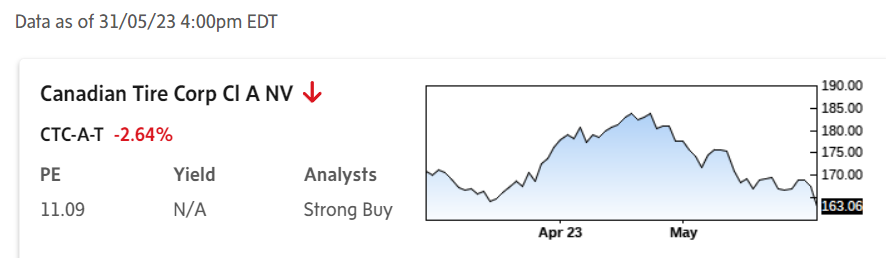
Canadian Tire CTC-A-Trallied from $67.15 in March 2020 to $213.85 in May 2021 (A-B) and then had a one-half correction within a falling parallel channel over a period of two years (dotted lines).
The recent rise above the top of this channel signaled the end of the correction and the start of a new uptrend toward higher targets (C). The stock is currently in the midst of a minor correction for a good entry-level.
Behaviour indicators including the rising 40-week Moving Average (40wMA) and the rising trendline (solid line) confirm the bullish status. There is good support near $164-165 and then again near ±$160; only a sustained decline below the latter would be negative.
Point & Figure measurements provide targets of $210 and $225. Higher targets are visible.
Money markets and economists have grown more convinced that the Bank of Canada will make at least one more hike to interest rates this year in the wake of stronger-than-expected gross domestic product data Wednesday. Some even suggest the central bank could hike rates as soon as next week – and that might not be the end of them for this tightening cycle.
Canada’s economy grew at an annualized rate of 3.1% in the first quarter, exceeding analysts’ expectations as well as the Bank of Canada’s projection.
Real GDP was unchanged in March, and likely rose 0.2% in April, Statistics Canada said.
Analysts surveyed by Reuters had forecast annualized growth of 2.5% in the quarter and a decline of 0.1% in March.
The increase was more robust than the Bank of Canada’s 2.3% growth projection, and could pressure the bank to hike interest rates after other data this month also showed the economy was hotter than anticipated.
The central bank has hiked its key overnight rate by 425 basis points to 4.5% between March of last year and January. It has since kept rates on hold, but warned that rates could go higher.
The Canadian dollar is up about a quarter of a U.S. cent since the data was released, to 73.48 cents US, as money markets show greater conviction the Bank of Canada will take action once more to tighten monetary policy. (The loonie is still lower on the day, however, as weaker oil prices and soft Chinese manufacturing data weigh on the currency.)
Interest rate probabilities based on trading in swaps markets now show an almost 75% chance of a further Bank of Canada quarter-point rate hike by the end of this summer. They are currently placing 38% odds of a rate hike at the bank’s policy meeting next week.
Here’s a detailed look at how money markets were pricing in further moves in the Bank of Canada overnight rate just prior to the 830 am ET data, according to Refinitiv Eikon data. While the bank moves in quarter point increments, credit market implied rates fluctuate more fluidly and are constantly changing. Columns to the right are percentage probabilities of future rate moves.
MEETING DATE
EXPECTED TARGET RATE
CUT
NO CHANGE
HIKE
7-Jun-23
4.5648
0
74.1
25.9
12-Jul-23
4.6499
0
48.9
51.1
6-Sep-23
4.7112
0
36.9
63.1
25-Oct-23
4.7097
0.2
36.9
62.9
6-Dec-23
4.72
0.2
35.4
64.4
And here’s where probabilities stood at 9 a.m. ET following the report:
MEETING DATE
EXPECTED TARGET RATE
CUT
NO CHANGE
HIKE
7-Jun-23
4.5958
0
61.7
38.3
12-Jul-23
4.6863
0
39.4
60.6
6-Sep-23
4.7708
0
26.1
73.9
25-Oct-23
4.779
0
25.2
74.8
6-Dec-23
4.7885
0
24.2
75.8
Similarly, economists are cautioning the Bank of Canada could soon lift its pause on moves in its trend-setting overnight rate. How’s how they are reacting:
Royce Mendes, managing director & head of macro strategy, Desjardins Securities
The facts on the ground have indeed changed, so a change to our Bank of Canada call is now necessary. We had previously believed that the 4.50% policy rate would be enough to cool the economy and rein in excess inflationary pressures. But, so far, it’s proven ineffective. The unemployment rate has been hovering at near-record lows for five months. Economic growth is outperforming expectations. And three-month annualized rates of core inflation are stuck between 4% and 5%.
We entered the year very bearish on the Canadian economy. Our work on variable-rate mortgages suggested a majority of borrowers with those products had already hit their trigger rates. However, somewhat surprisingly to us, many lenders began allowing those mortgage holders to simply add the extra interest owed to the principal loan amount rather than forcing borrowers to make any extra payments. That has materially blunted the potential non-linear impacts of higher interest rates and, therefore, has removed significant downside risk. As a result, we’ve become more bullish on the near-term prospects for the Canadian economy, even as we’ve become more bearish on the medium-term outlook given the risks at renewal for the many mortgages originated in 2020 and 2021.
The question now is one of timing. Central bankers will seriously consider raising rates next week. According to the Summary of Deliberations, they already did so before ultimately deciding to hold rates steady in April. Policymakers could, therefore, justify pushing rates higher a week from now by arguing that Canadians were adequately warned. Indeed, despite the market still pricing in less than a 50% chance of a move next week, the Bank of Canada’s penchant for surprising traders means that nothing can be ruled out. Still, there are valid reasons to expect that central bankers will want a little more time before restarting the rate-hiking engines.
Most importantly, after seeing the latest inflation numbers, Governor Macklem didn’t seem like he was in any hurry to push rates higher. That might have been because of the ongoing debt ceiling shenanigans in the US at the time. But, even now, there’s lingering uncertainty about how liquidity conditions will evolve in light of the US government’s actions to replenish the Treasury General Account. Central bankers in both Canada and the US might want to skip raising rates on their upcoming announcement dates to monitor liquidity for at least a brief period.
We’re, therefore, leaning towards a rate hike in July assuming liquidity conditions don’t deteriorate too much. That said, we certainly can’t rule out a move next week given the dataflow.Furthermore, after coming off of the sidelines in either June or July, the door would be wide open to a subsequent increase. It’s unlikely central bankers would see a single 25bp rate hike as the difference between controlling inflation and not. So expect a near-term rate increase to precipitate firmer pricing for another one. …
Canadians should expect a very hawkish-sounding central bank seven days from today and brace themselves for a further tightening in financial conditions this summer.
Stephen Brown, deputy chief North American economist, Capital Economics
As GDP growth and CPI inflation have both surprised to the upside of the Bank of Canada’s forecasts, we now judge that it will raise interest rates next week rather than wait until July.
Since announcing its “conditional pause” in January, the Bank has been clear that it is prepared to raise rates again if the data surprised to the upside or cast doubt on the idea that policy is “sufficiently restrictive to…return inflation to the 2% target”. ….
Admittedly, some of the arguments used to justify keeping policy unchanged in April still stand. The upside surprise to first-quarter GDP growth was partly due to temporary factors, including easing supply shortages and the unseasonably mild winter weather, which will soon fade. While growth should surpass the Bank’s forecasts this quarter, it will likely still be below potential and the forward-looking indicators continue to point to a further slowdown.
Labour market conditions have also eased. The job vacancy rate fell to a two-year low of 4.5% in March and the Indeed.ca job listings data suggest it has fallen further since then, boosting the Bank’s confidence that wage growth will ease later this year. The drop in the WTI oil price below $70 – compared to the Bank’s recent assumption that it would average $80 for the next couple of years – has also reduced the upside risks to headline inflation.
But the other key concerns for the Bank are the housing market and inflation expectations. House prices jumped by 1.6% m/m in April and the surge in the sales-to-new listing ratio implies that there are further large gains to come. As house prices feed into two components of shelter prices that make up 9% of the CPI, that will directly boost headline inflation. It also risks inflation expectations declining even more slowly, as the Bank’s research shows that consumers’ inflation expectations are heavily influenced by house prices.
While we will have to wait until July to see how consumers’ and firms’ inflation expectations develop in the Bank’s quarterly surveys (the Bank already has the results), the recent rebound in the CFIB Business Barometer measure of selling price expectation also suggests that they will remain elevated.
In short, while it is still possible to argue that “pressures on demand, inflation and labour markets” are “likely to ease”, it’s not clear that the easing will be enough to get inflation to 2%. ….
We judge that market pricing is underestimating the extent to which the Bank might raise rates. According to Refinitiv, overnight index swaps imply a 38% probability of a 25bp hike next week and show that 27bp of hikes are priced in by the September meeting. If the Bank hikes by 25bp next week, to 4.75%, and presents a hawkish statement, we assume the Bank will follow with another 25bp hike in July – although we’ll wait for the meeting next week before making that call official.
Douglas Porter, chief economist, BMO Capital Economics
Perhaps the biggest eye-opener in today’s report was the flash estimate for April GDP at +0.2%, despite the public sector strike in the second half of the month. We estimate that the strike likely trimmed at least a couple of ticks from growth (albeit with a wide range of uncertainty). The main point is that there’s more underlying momentum in the economy than anticipated, and we will be revising up our Q2 GDP forecast from what had been a small drop (-0.5% annual rate) to a small positive.
Bottom Line: Each of the main figures here are better than expected—Q1, March and April GDP—and the details were solid for Q1 as well. The run of sturdy data undoubtedly raises the odds that the Bank of Canada needs to go back to the well of rate hikes, and even puts some chance on a move as early as next week’s policy decision. However, given the uncertain backdrop and the possibility that inflation took a big step down in May, the BoC could opt to remain patient for a bit longer and signal that it’s open to hiking in July if the strength persists.
Jay Zhao-Murray, forex analyst at Monex Canada, a commercial foreign exchange specialist
Two weeks ago, we argued that the Bank of Canada would likely be forced to hike rates on June 7th, largely because upward momentum in inflation pressures had picked up sharply and downside risks were beginning to fade out of the picture. A few days after we made that call, Governor Macklem tried to downplay the uncomfortably strong inflation data when asked by a journalist, buying himself a bit of time by suggesting that he would wait for today’s GDP report and then take all of the information together before making a decision. With the final piece of the puzzle also suggesting that the economy has more excess demand than the Bank of Canada thought,the stars are aligned for a resumption in the hiking cycle. We are now at a stage where, should the Bank lack the conviction to act in June, the history books likely won’t look kindly upon the decision.
The BoC has needed to considerably revise its growth forecasts, having anticipated a mere 0.5% reading for the quarter back in January. Even after lifting its forecast to 2.3% in April, the estimate fell 8 tenths of a percent short of the actual data. The breakdown by expenditure component makes it clear that both domestic and foreign demand were strong, with household consumption and exports delivering virtually all of the growth in the quarter. …
Adding more fuel to the fire, today’s GDP report showed no slowdown in wage growth, with total compensation accelerating by 1.7% in Q1 and picking up steam from Q4′s 1.2% print. In goods-producing industries, wages and salaries rose 2.3%, whereas in services they rose by 1.6%. Annualising the total reading for the quarter would lead to a growth rate of 7.0%—Macklem has expressed worries that inflation would get caught above target if wage growth remained in the 4 to 5% range, but it is clearly well beyond that now.
While much of the growth in GDP was delivered in January, the Canadian economy didn’t contract throughout the remainder of the first quarter, expanding slightly in February and remaining broadly unchanged in March. This ran contrary to the Bank of Canada’s expectations and the market consensus, both of which foresaw the Canadian economy slipping back at the end of Q1. Preliminary estimates suggest that the economy grew by 0.2% in April, which would annualize to 2.4%. With a strong first month to set the tone for the second quarter, we believe the Bank will probably revise up its 1.0% quarter over quarter annualised forecast for Q2 as well.
Despite today’s report coming in much stronger than the Bank of Canada had expected, policymakers could point to a few slight areas of weakness in the March data if they choose to pass up a June hike. Specifically, activity within services was much softer than the 0% month over month aggregate reading suggests. Economic activity contracted in the industries most exposed to consumer discretionary spending, namely retail trade, wholesale trade, and food and accommodation. For wholesale and retail trade, March’s contraction in output marked the second consecutive month of decline, which may signal the beginning of a trend. Furthermore, the 2.2% contraction in accommodation and food services follows a sharp decline in growth in February, which itself was a reversal from January’s monstrous 4.2% increase. …
Combined with the fact that the economy entered what may well be a stagnant period of growth with much more momentum than the BoC had factored in, the latest round of data adds weight to our view that the Bank will need to conduct an insurance rate hike at either of its next two meetings. In our view, given the BoC’s flawed decision in January 2022 to delay the start of its hiking cycle and its preference thereafter to frontload hikes, we believe markets are underpricing the risk that the Bank acts sooner rather than later.
Derek Holt, vice-president & head of capital markets economics, Scotiabank
GDP data is the latest in a string of evidence supporting my long held view that the BoC quit its hiking cycle prematurely in January and needs to return with further tightening now. …
The Bank of Canada needs to exhibit a sense of urgency in next Wednesday’s decision by hiking the overnight rate by at least 25bps as per our forecast. They should leave the door open to further increases as the real policy rate is not yet restrictive enough for the idiosyncratic factors that continue to drive Canada’s economy and Canadian inflation. On this list are immigration, the terms of trade, ongoing fiscal expansion, strong corporate balance sheets, still pent-up services demand, an undervalued C$ etc.
GDP growth is outpacing the BoC’s April MPR projections which indicates that the economy is in a deeper state of excess demand than they had judged at the time. …
The details behind the Q1 growth numbers were arguably more impressive than the headline print of 3.1% and in a way that indicates that the Q1 rebound was about much more than just reversing the distortions to 2022Q4 GDP. Key is that despite all the overly gloomy consensus talk, the Canadian consumer remains alive and kicking and by enough to have contributed 3.0 ppts to the 3.1% GDP gain in Q1 in weighted terms. …
The BoC is getting clear signals that its policy stance is not yet restrictive enough with each piece of evidence that showcases how core inflation is unacceptably high, that growth is resilient as indicated in today’s numbers, that consumers are doing quite well on balance amid obscenely exaggerated concerns about a minority of them, that housing is on a tear again and that the job market is still strong. Roughly 20 months into a bond market tightening cycle that preceded the commencement of policy rate hikes should be marked by greater evidence of the damage being done through lag effects that have been given long enough to work by now.
Furthermore, households and businesses don’t believe the BoC’s 2% inflation target as evidenced in the BoC’s own surveys. Prominent strike action resulting in aggressive settlements signals that workers don’t believe the BoC either. It’s time for Governor Macklem to take the gloves off and prove that he’ s serious with concrete action instead of just talk. …
If the US House of Representatives passes the debt ceiling agreement this evening as expected, then there is no good reason why the BoC should dither any longer. A hike was considered in April and the case for hiking has since grown. … A 25bps hike would prove that the BoC is serious when it says it is thinking of further tightening and against cutting anytime soon in a signalling sense, but it would probably be insufficient.
Nathan Janzen, analyst, RBC Capital Markets
The jump in GDP early in Q2 means output is potentially running substantially above prior expectations. Labour markets have remained very firm, and inflation also surprised on the upside in April. There are still early signs that cracks are forming in the economic backdrop – job vacancies are declining, consumer delinquency rates are edging higher and households are saving less. And headwinds from higher interest rates will continue to build. But the economy’s resilience will put pressure on the BoC to raise interest rates further. Governing Council will actively discuss a hike next week, but we think they’ll wait until July to see if more evidence accumulates in favour of a rate increase.
Andrew Grantham, senior economist with CIBC Capital Markets
Overall, the headline reading, composition of growth and handoff to Q2 were all slightly stronger than we had expected, raising the odds of another Bank of Canada rate hike. However, we still expect that they will want to wait to see more data and revise their forecasts (in the July Monetary Policy Report) before making a final decision on whether to raise rates again, rather than hike next week.
James Orlando, director and senior economist, TD
The Bank of Canada’s next interest rate decision is next week, and while today’s report might not force a move off the sidelines, it may be used as rationale for a hike later this summer. Thus far, the BoC’s rhetoric has focused on its expectation for a quick deceleration in economic growth over the remainder of the year. That slowdown still seems likely, but if the data keep coming in hot, the BoC may be compelled to move once again.
Matthieu Arseneau and Alexandra Ducharme, economists at National Bank Financial
The performance of consumer spending was eye-catching, with growth of 5.7%, the strongest in three quarters. We knew that consumers had assets at their disposal, notably a savings rate that remained above its pre-pandemic level, and thus an accumulation of excess savings that seemed to have been put to good use. Growth in the first quarter was therefore stronger than the Bank of Canada had anticipated in its latest Monetary Policy Report. However, we need to put things into perspective. Like us, the central bank probably underestimated the economy’s potential GDP, which is currently being boosted by an unprecedented demographic boom. If the unemployment rate and falling job vacancy rates in the economy are any guide, this growth does not seem to be pushing the economy further into excess demand. In light of this morning’s data, we do not change our view that the economy will slow significantly over the next four quarters as interest rate hikes continue to weigh on the economy. The third consecutive quarter of declines in corporate profits and investment does not suggest that the appetite for hiring will continue in the months ahead. A softer labor market is also likely to dampen the enthusiasm of consumers, who have been able to afford high levels of consumption despite a decline in disposable income, a situation that will not last much longer with the savings rate now back to pre-pandemic levels.
Tiffany Wilding, managing director and economist, PIMCO
The stronger-than-expected real GDP growth tracking, coupled with signs that the housing market is stabilizing and firmer inflation, taken together suggest the economy may be more resilient than anticipated. However, other recent indicators muddy the picture. Weakness in the April retail sales flash estimate points to negative real consumption growth, and weaker survey data that tends to lead economic activity raise questions about the durability of the recent economic strength.
Recent economic strength make further Bank of Canada rate hikes a real possibility. However, given the mixed picture, we think the Bank of Canada will prefer to wait until July for any possible hike, at which point it will have two additional labour force surveys, April’s GDP release and May’s Consumer Price Index data with which to judge the strength of this resilience.
Laurentian Bank of Canada LB-T -0.10%decrease raised its quarterly dividend as it reported a second-quarter profit of $49.3-million, down from $59.5-million a year ago.
The Montreal-based bank says it will now pay a quarterly dividend of 47 cents per share, up a penny from 46 cents.
The increased payment to shareholders came as Laurentian says it earned $1.11 per diluted share for the quarter ended April 30, down from $1.34 per diluted share in the same quarter last year.
Revenue for the quarter totalled $257.2-million, down from $259.6-million in the second quarter of 2022, while the bank’s provision for credit losses amounted to $16.2-million, up from $13.0-million a year earlier.
On an adjusted basis, Laurentian says it earned $1.16 per diluted share in its most recent quarter, down from an adjusted profit of $1.39 per diluted share a year earlier.
Analysts on average had expected an adjusted profit of $1.12 per share, based on estimates compiled by financial markets data firm Refinitiv.
National Bank of Canada posted a drop in profit on higher costs and rising reserves for potentially sour loans as the threat of a recession drags on results across the banking sector.
National Bank NA-T is the final major Canadian bank to report earnings for the fiscal second quarter, joining most of its peers in undergoing slower growth. A worsening economic outlook has weighed on bank earnings as high interest rates squeeze margins and concerns over loan losses mount.
“The economy is adjusting to a higher-rate environment and much uncertainty remains around the path of interest rates and inflation,” National Bank chief executive officer Laurent Ferreira said during a conference call with analysts.
National Bank earned $847-million or $2.38 a share in the three months that ended April 30, compared with $889-million or $2.53 in the same quarter last year.
The bank said its adjusted earnings, which account for one-time items, also came in at $2.38 a share.That fell just below the $2.39 analysts expected, according to Refinitiv, evading the steeper misses of many of the other large Canadian lenders.
National Bank’s shares fell 2.8 per cent on Wednesday, leading bank stocks lower as investors continue to sour on the near-term challenges putting pressure on the sector.
“While [National Bank] could not avoid the same pressures on top-line growth and expense inflation, it navigated better than most of its peers,” Barclays analyst John Aiken said in a note to clients. “However, we do note that its earnings were supported by better-than-forecast [loan loss] provisions.”
The rest of the Big Six banks reported results last week, with Canadian Imperial Bank of Commerce CM-T -1.86%decrease beating analyst expectations while Royal Bank of Canada RY-T -1.36%decrease, Toronto-Dominion Bank TD-T -0.83%decrease, Bank of Nova Scotia BNS-T -1.26%decrease and Bank of Montreal BMO-T -0.72%decrease posted worse-than-expected results.
In the quarter, National Bank set aside $85-million in provisions for credit losses – the funds banks set aside to cover loans that may default. That was lower than analysts anticipated, and included $27-million against loans that are still being repaid, based on models that use economic forecasting to predict future losses.
In the same quarter last year, National Bank booked $3-million in provisions, as loan loss reserves edged higher from reversals in prior periods when defaults were low.
The bank’s net interest margin – the difference between the amount lenders pay on deposits and charge on loans – fell 10 basis points from the previous period, but that was in part owing to a few one-time items that boosted its results in the first quarter. (One hundred basis points equal one percentage point.) Excluding those items, margins were relatively flat.
National Bank expects margin pressure to continue in the coming quarters as high interest rates push customers to move their cash from cheaper chequing accounts to costlier fixed-term savings products. This means that banks have to pay clients more in interest to maintain those deposits, putting pressure on their net interest margins.
Higher interest rates are also easing loan demand – especially in mortgage lending – further squeezing margins.
Total revenue rose 2 per cent to $2.48-billion in the quarter, but expenses climbed 6 per cent to $1.37-billion, which the bank said was driven by an increase in hiring last year, wage inflation and technology expenses.
Profit from personal and commercial banking was $335-million, up 14 per cent from a year earlier, as revenue growth was slightly offset by rising costs and provisions for credit losses. Personal loans grew 4 per cent and commercial lending increased 13 per cent year over year.
The wealth management division generated $178-million of profit, up 9 per cent on higher net interest income.
Net income in the financial markets unit fell 7 per cent to $268-million as employee and operational costs rose. And profit from the bank’s U.S. arm dropped to $128-million from $152-million in the same quarter a year earlier, as higher costs and provisions for credit losses offset stable revenue.
National Bank raised its quarterly dividend by 5 cents to $1.02 a share for the quarter ending July 31.
An average hurricane season produces 14 named storms and seven hurricanes. Out of the hurricanes, three usually strengthen into major storms with winds of at least 115 mph. The season’s first tropical cyclone will be named Arlene followed by Bret, Cindy, Don and Emily.
North American stocks fell on Wednesday as a deal to raise the federal debt ceiling headed toward a crucial vote in Congress, while unexpectedly strong reports on the U.S. labour market and the Canadian economy rattled investors who feared more central bank rate hikes are on the way.
The House of Representatives is expected to vote in the evening on a bill to lift the $31.4 trillion debt limit, a critical step to avoid a destabilizing default that could come early next week without congressional approval.
House passage would send the bill to the Senate, where debate could stretch to the weekend, just before the June 5 date when the government could start to run out of money.
But most analysts foresee the bill’s approval and U.S. President Joe Biden said on Wednesday he expected the debt ceiling bill on his desk by next Monday.
“The bond market liked that there was some fiscal discipline and the equity market liked that it’s not going to hurt growth,” said Brad Conger, deputy chief investment officer at Hirtle Callaghan & Co in Conshohocken, Pennsylvania.
“I don’t think we could have asked for a better outcome.”
However, equity valuations are stretched considering interest rates are high, the economy is slowing and inflation needs to decline further, Conger said.
“Quite frankly, if we’re really slowing down, the market is not offering a free lunch,” he said. “It’s going to be a struggle if inflation is not perceived to be ebbing, which is where we are.”
The Labor Department reported that U.S. job openings unexpectedly rose in April, reflecting persistent labor market strength that suggests pressure on wages and inflation.
Futures traders raised to 70% the probability of a 25 basis points hike at the Fed’s June 13-14 policy meeting. But that likelihood fell to about 32% after comments by Fed officials who are leaning to what some call a “hawkish pause.”
Fed Governor and vice chair nominee Philip Jefferson said skipping a rate hike in two weeks would provide policymakers time to see more data before making a decision. Philadelphia Fed President Patrick Harker also said on Wednesday that for now he is inclined to support a “skip” in rate hikes.
“The recent economic data has not really favored a pause in rate hikes,” said Tim Ghriskey, chief investment strategist at Inverness Counsel in New York. “But we’ve had a number of Fed governors coming out this afternoon and saying a pause is either likely or certainly possible.”
The Labor Department’s closely watched May unemployment report, due on Friday, could decide whether a rate hike occurs.
The major indices pared some losses after the comments by Fed officials.
The Dow Jones Industrial Average fell 134.51 points, or 0.41%, to 32,908.27; the S&P 500 lost 25.69 points, or 0.61%, at 4,179.83; and the Nasdaq Composite dropped 82.14 points, or 0.63%, to 12,935.29.
For the month, the S&P 500 rose 0.26%, the Dow lost 0.3.48% and the Nasdaq gained 5.80%.
The Toronto Stock Exchange’s S&P/TSX composite index ended down 167.46 points, or 0.9%, at 19,572.24, its lowest closing level since March 24. For May, it lost 5.2%, its biggest monthly decline so far in 2023.
“The overriding theme remains inflation and interest rates,” said Michael Sprung, president at Sprung Investment Management.
“It certainly sounds like another increase in the U.S. would not be out of the question and that would put Canada in a position where it would have to follow suit.”
Separate data showed that Canada’s economy grew 3.1% in the first quarter, faster than expected, bolstering bets for another BoC rate hike.
“The one bright light is that you can pick up some pretty attractive yields right now, particularly on the financials and a number of the utilities,” Sprung said.
Heavily weighted financials fell 1.1%, with National Bank of Canada down 2.8% after the bank missed earnings estimates.
Energy lost 2% as weak economic data from top oil importer China pressured crude prices. U.S. crude oil futures settled nearly 2% lower at US$68.09 a barrel.
Shares of Centerra Gold Inc surged 9.8% after the bullion miner said it received an official approval for its Öksüt mine in Turkey.
Teck Resources Ltd shares gained 2.3% after a report saying that Glencore Plc was working on a potential improvement to its bid for the Canadian miner.
Technology-led gains have put the Nasdaq on track for its best performance in May since 2020.
The Federal Deposit Insurance Corporation said U.S. banks’ total deposits declined by a record 2.5% in the first quarter after two large bank failures.
The S&P 500 financial sector index fell 1.1%, with banks taking the brunt with a 2.0% slide.
Advance Auto Parts Inc plunged 35.0%, falling the most on the S&P 500, after the auto parts retailer cut its full-year forecasts.
Shares of other autoparts makers including Genuine Parts Co , Autozone and O’Reily Automotive fell 5.6%, 2.8% and 2.7%, respectfully.
Hewlett Packard Enterprise Co slipped 7.1% after missing Wall Street estimates for second-quarter revenue.
Nvidia Corp’s shares fell 5.7% a day after hitting a record high that briefly boosted its market value above $1 trillion on Tuesday, fueled by bets on the AI boom.
Intel Corp was the biggest gainer on the S&P 500, jumping 4.8% as the chipmaker said it was on track to hit the upper end of its second-quarter revenue forecast.
Intel has risen 14.7% in its biggest three-day rally since March 2009.
Declining issues outnumbered advancing ones on the NYSE by a 1.39-to-1 ratio; on Nasdaq, a 1.37-to-1 ratio favored decliners. The S&P 500 posted four new 52-week highs and 23 new lows; the Nasdaq Composite recorded 36 new highs and 182 new lows.
The compromise bill to raise the debt ceiling passed its first major test in the 13-member House Rules Committee.
A key Republican swing vote, Rep. Tom Massie, supported the bill, which had been briefly imperiled earlier after two other conservatives said they planned to vote against it.
Congress faces a Monday deadline to address the debt ceiling or the U.S. government will default.

:format(jpeg)/cloudfront-us-east-1.images.arcpublishing.com/tgam/4B7OVYIHCVFFHDIB2TV33GMTHQ.jpg)