Category: Uncategorized

  • Loblaw president Galen Weston leaving role, European retail exec Per Bank named new CEO

    Galen Weston will step back from day-to-day operations at Loblaw Cos. Ltd. L-T -1.09%decrease by early next year, the company announced on Tuesday, saying it has hired European retail executive Per Bank to take over as president and chief executive officer.

    Mr. Bank is currently the CEO of Salling Group A/S, Denmark’s largest retailer with roughly $13-billion revenue in 2021, the most recent year for which figures were available. Salling operates 1,700 grocery stores in three countries as well as department stores. Loblaw, Canada’s largest retailer, operates more than 2,400 stores across various grocery banners as well as the Shoppers Drug Mart chain, with $56.5-billion in revenue last year.

    Mr. Weston will continue in his role as chairman of Loblaw’s board, as well as chair and CEO of parent company George Weston Ltd. In that capacity, he will continue to oversee the “vision, strategy and capital allocation” of the family-controlled companies, he said on a conference call Tuesday to discuss the announcement.

    “I’m not leaving. I’m stepping back into what I consider to be my natural role as controlling shareholder,” Mr. Weston told analysts on the call.

    The search for a new CEO began in August, 2022, precipitated by the planned retirement of chief operating officer Robert Sawyer at the end of this year.

    Loblaw board says Galen Weston is underpaid, boosts compensation

    Mr. Sawyer came out of retirement to join the company in 2021, when Mr. Weston returned as president following the departure of Sarah Davis. At the time, Loblaw also replaced chief financial officer Darren Myers with George Weston CFO Richard Dufresne, who will continue as CFO of both companies.

    Since then, the executive team has been working to boost Loblaw’s performance, undertaking a strategic review of its operations designed to narrow the company’s focus and get back to what Mr. Weston referred to as “retail fundamentals.”

    “The plan was always that Robert would only be with us for a couple of years,” Mr. Weston wrote in an internal memo to Loblaw staff on Tuesday. He said that the appointment does not signal any intention to change the company’s strategic direction.

    “The intent is to continue to execute against the strategic path that has been developed by Richard, myself and Robert,” Mr. Weston said on the call.

    Over the past two years, that leadership team has also seen Loblaw through a time of soaring food inflation that has contributed to higher revenues and profits in the grocery industry. Mr. Weston, along with other industry executives, has faced questions about whether retailers are doing enough to mitigate the sharp rise in the cost of basic necessities.

    Loblaw Cos. Ltd. has appointed Per Bank as president and CEO.

    Mr. Weston, as a public figure representing the billionaire Weston family and as advertising spokesman for the retailer, has been in the line of fire over the issue. But that was not a factor in his decision to step back, Loblaw spokesperson Catherine Thomas said.

    “At the end of the day, this will be nearly a two-year process. To think that it is at all reactionary would be wrong,” Ms. Thomas said. She added that Mr. Weston has made fewer appearances in Loblaw ads over the past year, but did not say whether he would continue as spokesperson in future. “That is a decision for another day,” she said.

    On the call Tuesday, Mr. Weston alluded to Mr. Bank’s experience in a highly public CEO role, saying it would help him navigate the position Loblaw occupies in Canada.

    “He has been leading an organization that has an outsized cultural and financial place inside his country, and that’s the case for Loblaw,” Mr. Weston said. “We’re a big company in a small country, and that comes with different leadership challenges and opportunities.”

    On Tuesday, Statistics Canada reported that inflation began to cool in March, including some improvements in the price of groceries, which rose by 9.7 per cent compared with the prior year, down from increases of more than 11 per cent in recent months. But food is still outpacing the overall inflation rate, which was 4.3 per cent in March compared with the prior year.

    In that climate, Loblaw has benefitted from a shift to discount grocery stores such as No Frills, which make up roughly 60 per cent of the retailer’s store network.

    “Mr. Bank will be taking the helm of a Loblaw enjoying strong momentum and results, well-positioned against the backdrop of high prices and value-seeking, cash-squeezed consumers,” RBC Capital Markets analyst Irene Nattel wrote in a research note on Tuesday.

    In Mr. Bank, Loblaw has also hired an executive with experience serving as CEO of a family-controlled company with a long history. Salling was founded in 1906, and over the course of 94 years, the company was led by just two CEOs, the founder and his son. Mr. Bank became the fourth CEO in Salling’s history in 2012, growing the retailer’s market share by more than 20 per cent, and leading a number of acquisitions, including the Polish operations of Tesco and Toys “R” Us in Denmark.

    Historically, as with Ms. Davis, the top role at Loblaw did not include the title of CEO, and reported to Mr. Weston directly; Mr. Bank adds that title and will report to the board.

    “There’s important symbolism in that. Having said that, this is a controlled company,” Mr. Weston said. “… And the long-term strategic vision of the company – it’s essential that there’s a high level of alignment between myself and any chief executive or any key operating executive.”

    Mr. Weston also noted that Mr. Bank has experience beyond running retail stores, including sitting on the board of the Bank of Denmark, providing the central bank with perspectives on consumer behaviour.

    Mr. Bank will join Loblaw by the first quarter of 2024.

  • Calendar: April 17 – April 21

    Monday April 17

    (8:30 a.m. ET) Canadian wholesale trade for February. Analyst estimate is a month-over-month decline of 1.6 per cent.

    (8:30 a.m. ET) Canadian international securities transactions for February.

    (8:30 a.m. ET) U.S. Empire State Manufacturing Survey for April.

    (10 a.m. ET) U.S. NAHB Housing Market Index for April.

    Earnings include: Charles Schwab Corp.; JB Hunt Transport Services Inc.; PrairieSky Royalty Ltd.; State Street Corp.

    Tuesday April 18

    China GDP, industrial production, retail sales and fixed asset investment

    Euro zone trade deficit

    (8:30 a.m. ET) Canadian CPI for March. The Street is expecting an increase of 0.6 per cent from February and up 4.3 per cent year-over-year.

    (8:30 a.m. ET) Canadian new motor vehicle sales for February. Estimate is a year-over-year rise of 7.0 per cent.

    (8:30 a.m. ET) U.S. housing starts for March. Consensus is an annualized rate decline of 3.1 per cent.

    (8:30 a.m. ET) U.S building permits for March. Consensus is an annualized rate drop of 6.1 per cent.

    (11:30 a.m. ET) Bank of Canada Governor Tiff Macklem and Deputy Governor Carolyn Rogers appear before the House Standing Committee on Finance.

    Earnings include: Bank of America Corp.; Bank of New York Mellon; Goldman Sachs Group Inc.; Johnson & Johnson; Netflix Inc.; Prologis Inc.; United Airlines Holdings Corp.

    Wednesday April 19

    Japan industrial production

    Euro zone CPI

    (8:15 a.m. ET) Canadian housing starts for March. Estimate is an annualized rate decline of 3.7 per cent.

    (8:30 a.m. ET) Canadian industrial product and raw materials price indexes for March. Estimates are month-over-month declines of 0.3 per cent and 0.5 per cent, respectively.

    (8:30 a.m. ET) Canadian consumer and mortgage credit for February.

    (2 p.m. ET) U.S. Beige Book is released.

    Earnings include: Abbott Labratories; Alcoa Corp.; Baker Hughes Co.; IBM; Kinder Morgan Inc.; Metro Inc.; Morgan Stanley; Nasdaq Inc.; Rio Tinto ADR; Tesla Inc.; U.S. Bancorp.

    Thursday April 20

    Japan trade deficit and machine tool orders

    Euro zone consumer confidence

    Germany producer prices

    (8:30 a.m. ET) U.S. initial jobless claims for week of April 15. Estimate is 240,000, up 1,000 from the previous week.

    (8:30 a.m. ET) U.S. Philadelphia Fed Index for April.

    (10 a.m. ET) U.S. existing home sales for March. Consensus is an annualized rate decline of 1.8 per cent.

    (10 a.m. ET) U.S. leading indicator for March.

    (11:30 a.m. ET) Bank of Canada Governor Tiff Macklem and Deputy Governor Carolyn Rogers appear before the Senate Standing Committee on Banking Commerce and the Economy.

    Earnings include: American Airlines Group Inc.; American Express Co.; Blackstone Group Inc.; CSX Corp.; Philip Morris International Inc.; Taiwan Semiconductor Manufacturing Co. Ltd.; Union Pacific Corp.

    Friday April 21

    Japan CPI

    Euro zone manufacturing and services PMI

    (8:30 a.m. ET) Canadian retail sales for February. Estimate is a decline of 0.6 per cent from January.

    Earnings include: Freeport-McMoran Inc.; HCA Healthcare Inc.; Procter & Gamble Co.; Schlumberger NV

  • Crude Oil Futures Settle Modestly Higher After IEA Forecasts Record Demand

    Published: 4/14/2023 3:12 PM ET

    Crude oil futures settled modestly higher on Friday, lifted by the International Energy Agency’s forecast that global crude demand will grow to a record 101.9 million barrels per day this year.

    West Texas Intermediate Crude oil futures for May ended higher by $0.36 or about 0.4% at $82.52 a barrel.

    Brent crude futures were up $0.16 or 0.19% at $86.25 a barrel a little while ago.

    The International Energy Agency (IEA) said in its monthly oil market report that oil demand will grow by 2 million barrels per day in 2023, driven mostly by stronger Chinese consumption after the lifting of COVID restrictions.

    The IEA expects supply to remain tight, and sees a drop of 400,000 barrels per day by the end of the year.

    Earlier this week, data from China showed that the world’s second largest economy saw its crude oil imports rise by 12.4 million barrels per day in March, up from 10.7 million barrels in February. The March volume was the largest since June 2020.

    Data from Baker Hughes showed the total number of total active drilling rigs in the United States fell by 3 this week, after falling 4 last week.

    The total rig count fell to 748 this week. Oil rigs dropped by 2 this week to 588, while gas rigs fell by 1 to 157.

  • China expands wartime military draft to include veterans and college students

    Beijing this week announced revisions to its conscription policy and said that should China enter a state of war, veterans and educated college students can expect to be on top of the list to be drafted. 

    China has positioned these changes as a necessary step to modernize the People’s Liberation Army (PLA) and to bolster its combat effectiveness. 

    However, adding the nation’s most educated as priority draftees runs counter not only to traditional Western conscription practices, but China’s as well. 

    Chinese honor guard arrive for the welcoming ceremony for French President Emmanuel Macron and China's President Xi Jinping in Beijing on April 6, 2023.

    Chinese honor guard arrive for the welcoming ceremony for French President Emmanuel Macron and China’s President Xi Jinping in Beijing on April 6, 2023. (LUDOVIC MARIN/AFP via Getty Images)

    CHINA SANCTIONS US LAWMAKER FOR HIS VISIT TO TAIWAN, CLAIMING HE VIOLATED ‘ONE CHINA’ PRINCIPLE

    “It fits into the context of PLA modernization,” Heino Klinck, former deputy assistant secretary of defense for East Asia and military attaché to China, told Fox News Digital. “The PLA has historically been a military based on conscripts from the countryside. I think Chinese President Xi Jinping is trying to further bolster his communist bona fide by ensuring that all segments of Chinese society are a part of the national military buildup.”

    Several of China’s top universities already have military departments included in their institutions where students can combine their studies with military training. 

    One top official in China’s Central Military Commission told a PLA newspaper this week that colleges and universities play an essential role in recruiting and that there is a particular interest in female and male students or graduates with a background in science, technology, engineering and mathematics.

    China also plans to instate a new standardized recruitment processes that will implement steps to improve the physical, mental and political assessments of recruits.

    Ultimately, Beijing hopes to “provide institutional guarantees for consolidating national defense and building strong armed forces” by “recruiting more high-caliber soldiers,” according to a government announcement Wednesday.

    Chinese honor guard arrive for the welcoming ceremony for French President Emmanuel Macron and China's President Xi Jinping in Beijing on April 6, 2023.

    Chinese honor guard arrive for the welcoming ceremony for French President Emmanuel Macron and China’s President Xi Jinping in Beijing on April 6, 2023. (LUDOVIC MARIN/AFP via Getty Images)

    CHINA’S DEFENSE MINISTER SET TO MEET WITH RUSSIAN COUNTERPART, OTHER MILITARY OFFICIALS IN MOSCOW

    Klinck explained that the revisions to China’s conscription policies were not necessarily a surprise, though their timing has prompted some pause for concern. 

    “I don’t know what’s worse: that they are tone-deaf or are they intentionally messaging?” he questioned. 

    The announcement came just days after top U.S. lawmakers traveled to Taiwan in a show of “deterrence” against Chinese aggression, which occurred simultaneously with a trip by Taiwanese president Tsai Ing-wen to the U.S., where she met with House Speaker Kevin McCarthy. 

    Beijing responded by launching large-scale combat exercises around Taiwan that simulated sealing off the island — similar to drills it launched last year after then-House Speaker Nancy Pelosi traveled to Taipei. 

    Klinck described the conscription announcement as “arrogant” and noted his concern that Beijing is “recklessly making policy announcements with a total disregard to how the international community will interpret them.”

    “The Chinese are usually pretty good when it comes to messaging and consistency,” he added. “I think that this is once again an indication that we should not anticipate the Chinese Communist Party softening its stance on Taiwan, softening its stance on the South China Sea or any other contentious geopolitical issue of concern.”

    It is unclear how many fighting-age men China’s latest policy changes would add to its more than 2 million-strong ranks, or how its army could hold up to top militaries like the U.S. 

    https://2882a2a7b826e999997a8c32bb6dc7e6.safeframe.googlesyndication.com/safeframe/1-0-40/html/container.html
    A boat moves through the water at the 68-nautical-mile scenic spot, the closest point in mainland China to the island of Taiwan, in Pingtan in southeastern China's Fujian Province on Aug. 5, 2022.

    A boat moves through the water at the 68-nautical-mile scenic spot, the closest point in mainland China to the island of Taiwan, in Pingtan in southeastern China’s Fujian Province on Aug. 5, 2022. (AP Photo/Ng Han Guan)

    Western defense officials have warned that Beijing plans to invade Taiwan by 2027, and last year President Biden raised eyebrows after he said he would send boots on the ground to defend the island from a Chinese attack. 

    CLICK HERE TO GET THE FOX NEWS APP

    “The U.S. needs to speak softly and carry a big stick,” Klinck advised regarding U.S.-Chinese relations. “We need to be very clear that we want a positive relationship with China, but on mutually beneficial terms.”

    “It cannot be a relationship where we want it more than the Chinese do. And any attempt to engage with the Chinese at all costs is not in our national interests,” he added. 

  • 18 oil and gas stocks with healthy dividends and attractive valuations

    What are we looking for?

    My team member, Allan Meyer, recently attended the Canadian Association of Petroleum Producers (CAPP) conference hosted in Toronto by Bank of Montreal. He came back impressed. As a result, we decided to analyze oil and gas producers using our investment philosophy, which focuses on safety and value, and see what the numbers say. We’d also like to remind investors that this sector can be cyclical and volatile, so we tend to target very limited to no exposure to it in our client portfolios.

    The screen

    We started with Canadian-listed oil and gas companies with a market capitalization of $1-billion or more, sorted from largest to smallest. This is a safety factor, as large companies tend to be more stable and liquid than small ones.

    Dividend yield is the projected annual dividend per share divided by the share price. Allan and I like to get paid while we wait for capital appreciation, and dividends generally reflect safety and stability. So, we limited our search to dividend payers.

    Debt/equity is our final safety measure. A smaller number is better and implies lower relative risk. It’s difficult to go bankrupt if you have little or no debt.

    Price/cash flow is the share price divided by the projected annual cash flow per share. It’s a valuation metric, and the lower the number, the better the value. In the oil and gas sector, cash flow is often considered more reliable than earnings-based financial ratios because of the high costs in the sector related to non-cash items such as depreciation, amortization and deferred taxes.

    Enterprise Value/EBITDA is known as the “takeover multiple.” It is a measure of the company’s total value divided by earnings before interest, taxes, depreciation and amortization (a proxy that’s like cash flow). Unlike many common valuation metrics, it accounts for the undertaking of debt by an acquirer. Smaller numbers mean a company is less expensive (i.e. better value).

    We’ve also included the 52-week total return to track performance, and the average and median numbers to allow for better comparability within the group.

    What we found

    Oil and gas stocks with strong dividends

    COMPANYTICKERMARKET CAP ($B)DIV. YLD. (%)D/E (%)P/CFEV/EBITDA
    Canadian Natural Resources LtdCNQ-T87.84.534.05.54.5
    Suncor Energy IncSU-T56.94.839.73.82.8
    Cenovus Energy IncCVE-T45.81.842.23.93.5
    Imperial Oil LtdIMO-T42.62.418.56.33.8
    Tourmaline Oil CorpTOU-T19.61.74.64.32.9
    ARC Resources LtdARX-T9.93.726.83.12.2
    Whitecap Resources IncWCP-T6.55.437.13.43.2
    Crescent Point Energy CorpCPG-T5.63.924.12.32.4
    Enerplus CorpERF-T4.51.424.13.62.2
    Vermilion Energy IncVET-T2.92.333.92.01.6
    Parex Resources IncPXT-T2.85.70.42.51.6
    Topaz Energy CorpTPZ-T2.86.334.18.79.1
    Tamarack Valley Energy LtdTVE-T2.33.656.52.53.9
    Freehold Royalties LtdFRU-T2.37.216.57.86.7
    Peyto Exploration & Development CorpPEY-T2.210.641.92.52.5
    Birchcliff Energy LtdBIR-T2.29.96.03.72.6
    Headwater Exploration IncHWX-T1.56.20.24.74.7
    Cardinal Energy Ltd (Alberta)CJ-T1.29.73.94.23.4
    AVERAGE16.65.124.74.23.5
    MEDIAN3.74.725.53.83.1

    Source: Refinitiv Eikon & Wickham Investment Counsel Inc.

    Parex Resources PXT-T +1.44%increase scores well for safety and value, and has the lowest EV/EBITDA ratio; one wonders if the company is a takeover candidate. Birchcliff Energy BIR-T +0.73%increase also looks interesting. Vermilion Energy VET-T +1.10%increase is the least expensive on both of our valuation metrics, while Peyto Exploration & Development PEY-T +1.58%increase has the highest dividend and is attractively priced. Headwater Exploration HWX-T -0.31%decrease has almost no debt and pays a nice dividend. In general, the list offers attractive valuations, light debt loads and healthy dividend yields.

    The BMO Canadian Oil and Gas ETF and the iShares Energy ETF are options for investors who like the sector, but want to diversify away individual security risk.

    Investors should contact an investment professional or conduct further research before buying any of the companies or ETFs listed here.

  • Just about everywhere in Canada, unemployment rates are falling fast

    Canada is experiencing a labour boom – and it extends to just about every corner of the country. In March, eight provinces had unemployment rates below 6 per cent, which has never happened before. The national rate of 5 per cent is hovering near all-time lows, a reflection of tight labour market conditions.

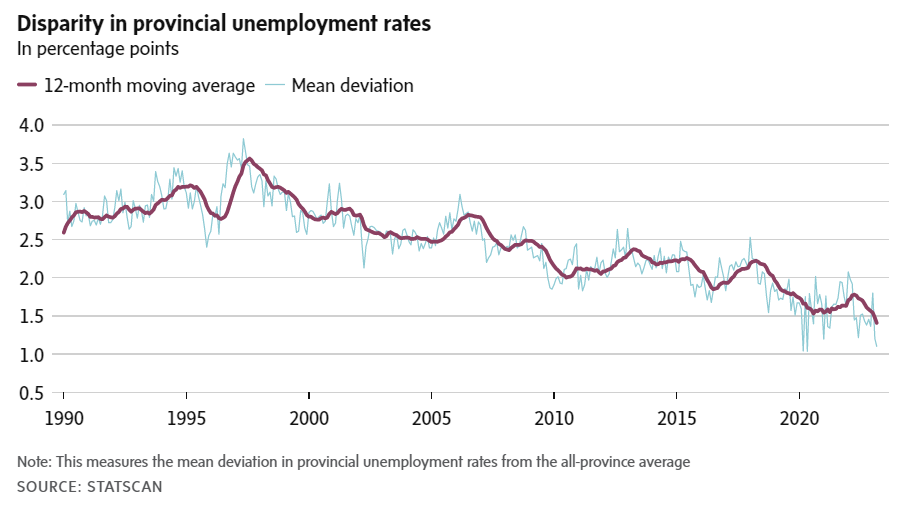
    Over more than two decades, the disparities between provincial unemployment rates have been shrinking, and now those differences are especially small. Despite having very different economies, Alberta and Nova Scotia enjoy jobless rates of 5.7 per cent. Quebec boasts the lowest, 4.2 per cent, although B.C. isn’t far behind at 4.5 per cent.

    “Canada often sees stark variation in job-market conditions across different regions of the country, but that is not the case today,” wrote Robert Kavcic, senior economist at Bank of Montreal, in a recent client note.

    “This can be seen as a good thing. We’ve often vouched for policy measures that improve the mobility of labour in this country (to help counter regional imbalances). It can also be seen as evidence that the economy is very broadly hot, not powered by any particular region or industry.”

    It’s possible for unemployment rates to fall if jobless people leave the labour force by no longer actively looking for work. At that point, they would not meet Statistics Canada’s definition of unemployed.

    But that’s not what’s happening here. The labour participation rate – the proportion of the country that is working or searching for a job – was 65.6 per cent in March, about the same as five years earlier.

    “We’re seeing very low discouraged [job] searchers right now,” Andrew Fields, a senior analyst at Statscan, recently told The Globe and Mail.

  • Citigroup shares rise after first-quarter revenue tops expectations

    • Personal banking revenue rose 18% year over year, reflecting higher interest rates.
    • Fixed income markets revenue climbed 4% year over year, though that was offset by declines in investment banking and equity market revenue.

    Citigroup (C) earnings Q1 2023 (cnbc.com)

  • JPMorgan Chase posts record revenue on higher interest rates; shares jump 7%

    • Here’s how the bank did: Adjusted earnings of $4.32 per share vs. $3.41 estimate
    • Revenue of $39.34 billion vs. $36.19 billion estimate
    • The bank also boosted a key piece of guidance: Net interest income will be about $81 billion this year, about $7 billion more than their previous forecast.

    JPMorgan Chase (JPM) earnings 1Q 2023 (cnbc.com)

  • U.S. jobless claims rise but remain at historically low levels

    U.S. applications for jobless benefits rose to their highest level in more than a year, but remain at relatively low levels despite efforts by the Federal Reserve to cool the economy and job market in its battle against inflation.

    Jobless claims in the U.S. for the week ending April 8 rose by 11,000 to 239,000 from the previous week, the Labor Department said Thursday. That’s the most since January of 2022 when 251,000 people filed for unemployment benefits.

    The four-week moving average of claims, which evens out some of the week-to-week fluctuations, rose by 2,250 to 240,000. That’s the most since November of 2021.

    Last week, the Labor Department unveiled revised estimates of the number of weekly applications for jobless benefits under a new formula it is using to reflect seasonal adjustments. The new formula, which led to an increase in its weekly tally, is intended to more accurately capture seasonal patterns in job losses.

    Applications for unemployment benefits are broadly seen as reflective of the number of layoffs in the U.S.

    The job market seems to be finally showing some signs of softening, more than a year after the Federal Reserve began an aggressive campaign to cool inflation by raising its benchmark borrowing rate nine times in about a year.

    America’s employers added a solid 236,000 jobs in March, suggesting that the economy remains on solid footing despite the nine interest rate hikes the Federal Reserve has imposed over the past year in its drive to tame inflation. The unemployment rate fell to 3.5%, just above the 53-year low of 3.4% set in January.

    In its latest quarterly projections, the Fed predicts that the unemployment rate will rise to 4.5% by year’s end, a sizable increase historically associated with recessions.

    Also last week, the Labor Department reported that U.S. job openings slipped to 9.9 million in February, the fewest since May 2021.

    Some details from Friday’s Labor Department report raised the possibility that inflationary pressures might be easing and that the Fed might soon decide to pause its rate hikes. Average hourly wages were up 4.2% from 12 months earlier, down sharply from a 4.6% year-over-year increase in February.

    Also Thursday, the government reported that wholesale prices fell sharply in March. One day earlier, the government said consumer prices rose just 0.1% from February to March, down from 0.4% from January to February and the smallest increase since December. However, prices are still rising fast enough to keep the Federal Reserve on track to raise interest rates at least once more, beginning in May.

    Layoffs have been mounting in the technology sector, where many companies hired aggressively during the pandemic. IBM, Microsoft, Salesforce, Twitter and DoorDash have all announced layoffs in recent months. Amazon and Facebook have each announced two sets of job cuts since November.

    About 1.81 million people were receiving jobless aid the week that ended April 1, a decrease of 13,000 from the week before. That number is close to pre-pandemic levels.