U.S. consumer confidence fell to a nine-month low in April led by a darkening outlook that augers a recession beginning in the near future, a survey showed on Tuesday.
The Conference Board said its consumer confidence index fell to 101.3 – the lowest since July 2022 – from a revised 104.0 in March. Economists polled by Reuters had expected the index to be unchanged from March at 104.0.
“While consumers’ relatively favorable assessment of the current business environment improved somewhat in April, their expectations fell and remain below the level which often signals a recession looming in the short-term,” said Ataman Ozyildirim, senior director of Economics at The Conference Board.
The share of consumers viewing jobs as “plentiful” ticked up to 48.4 per cent from a downwardly revised 47.9 per cent a month earlier, and the share of those describing them as “hard to get” edged down 11.1 per cent from an upwardly revised 11.4 per cent in March.
Consumers’ 12-month inflation expectations slipped to 6.2 per cent from 6.3 per cent last month.
Thirteen billion dollars in government subsidies are going to Volkswagen to build an electric vehicle battery plant in Ontario. That’s what the Liberal government calls a “business case.” Thirteen billion dollars to build a $7-billion factory. Of course such a massive payout — bribe? — would only be provided for a “green” business case.
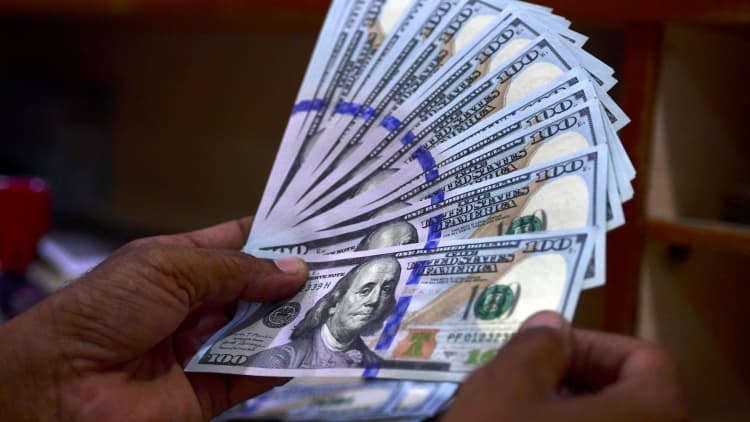
More and more countries — from Brazil to Southeast Asian nations — are calling for trade to be carried out in other currencies besides the U.S. dollar.
To be clear, the U.S. dollar remains dominant in global forex reserves even though its share in central banks’ foreign exchange reserves has dropped from more than 70% in 1999, IMF data shows.
Geopolitical risks and economic dynamics have accelerated the trend to move away from the U.S. dollar.
Calls to move away from relying on the U.S. dollar for trade are growing.
More and more countries — from Brazil to Southeast Asian nations — are calling for trade to be carried out in other currencies besides the U.S. dollar.
The U.S. dollar has been king in global trade for decades — not just because the U.S. is the world’s largest economy, but also because oil, a key commodity needed by all economies big and small, is priced in the greenback. Most commodities are also priced and traded in U.S. dollars.
But since the Federal Reserve embarked on a journey of aggressive rate hikes to fight domestic inflation, many central banks around the world have raised interest rates to stem capital outflows and a sharp depreciation of their own currencies.
WATCH NOW
VIDEO08:47
Why a strong U.S. dollar is bad for ‘the rest of the world’
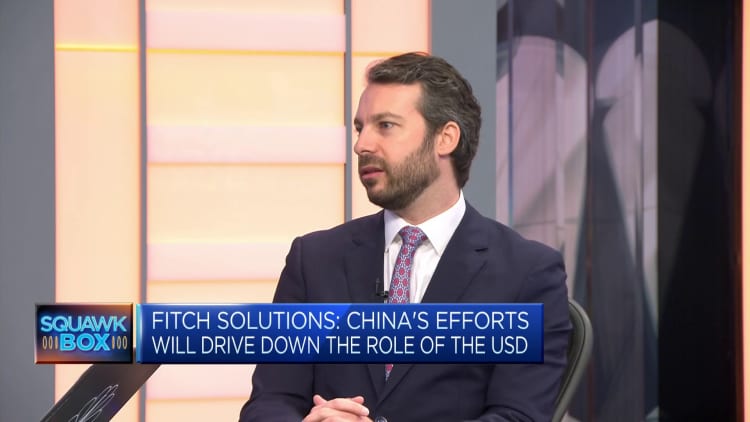
“By diversifying their holdings reserves into a more multi-currency sort of portfolio, perhaps they can reduce that pressure on their external sectors,” said Cedric Chehab from Fitch Solutions.
To be clear, the U.S. dollar remains dominant in global forex reserves even though its share in central banks’ foreign exchange reserves has dropped from more than 70% in 1999, IMF data shows.
The U.S. dollar accounted for 58.36% of global foreign exchange reserves in the fourth quarter last year, according to data from the IMF’s Currency Composition of Foreign Exchange Reserves (COFER). Comparatively, the euro is a distant second, accounting for about 20.5% of global forex reserves while the Chinese yuan accounted for just 2.7% in the same period.
Based on CNBC’s calculation of IMF’s data on 2022 direction of trade, mainland China was the largest trading partner to 61 countries when combining both imports and exports. In comparison, the U.S. was the largest trading partner to 30 countries.
“As China’s economic might continues to rise, that means that it’ll exert more influence in global financial institutions and trade etc,” Chehab told CNBC last week.
WATCH NOW
VIDEO03:18
Loss of U.S. dollar dominance would be a ‘slow erosion’: Fitch Solutions
China — long among the top 2 foreign holders of U.S. Treasurys — has been steadily reducing its holdings of U.S. Treasury securities.
In early April, Indian media widely reported that theMinistry of External Affairs (MEA) had announced that India and Malaysia were starting to settle their trade in the Indian rupee.
Economic benefits
Analysts say changing global economic dynamics are driving the co-called de-dollarization trend which can benefit local economies in a number of ways.
Trading in local currencies “allow exporters and importers to balance risks, have more options to invest, to have more certainty about the revenues and sales,” former Brazilian ambassador to China, Marcos Caramuru, told CNBC last week.
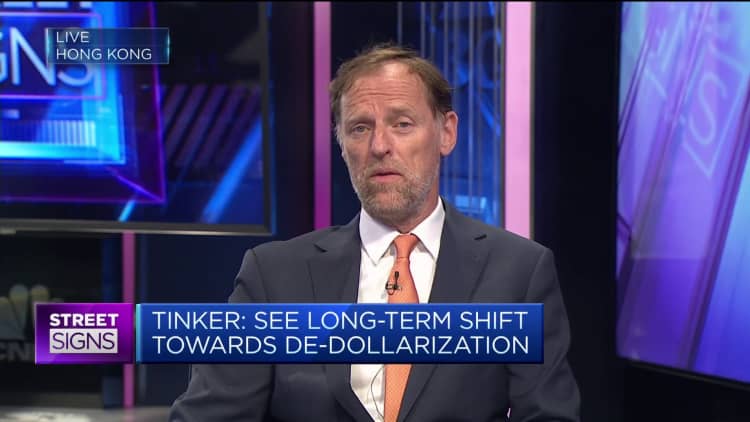
Another benefit for countries moving away from using the dollar as the middle man in bilateral trade, is to “help them move up the value chain,” said Mark Tinker from ToscaFund Hong Kong told CNBC “Street Signs Asia” early April.
“It isn’t about selling cheap stuff to Walmart, keeping down the prices for American consumers in order to earn dollars to buy its energy. This is now about actually a completely bilateral trade bloc,” Tinker said.
WATCH NOW
VIDEO04:22
De-dollarization shows that U.S. growth is no longer the only story that matters
Meanwhile, growth of non-U.S. economic blocs also encourage these economies to push for wider use of their currencies. The IMF estimates that Asia could contribute more than 70% to global growth this year.
“U.S. growth might slow, but U.S. growth isn’t what it’s all about anymore. There is a whole non-U.S. block that’s growing,” said Tinker. “I think there is going to be a re-internationalization of flows.”
Geopolitical concerns
Geopolitical risks have also accelerated the trend to move away from U.S. dollar.
“Political risk is really helping introduce a lot of uncertainty and variability around how much of a safe haven that U.S. dollar really is,” said Galvin Chia from NatWest Markets told “Street Signs Asia” earlier.
Tinker said what accelerated the calls for de-dollarization was the U.S. decision to freeze Russia’s foreign currency reserves after Moscow invaded Ukraine in February 2022.
The yuan has reportedly replaced the U.S. dollar as the most traded currency in Russia, according to Bloomberg.
So far, the U.S. and its western allies have frozen more than $300 billion of Russia’s foreign currency reserves and slapped multiple rounds of sanctions on Moscow and the country’s oligarchs. This forced Russia to switch trade toother currencies and increase gold in its reserves.
Although analysts don’t anticipate a complete break away from dollar-denominated oil trade over the short-term, “I think what they’re saying more is, well, there’s another player in town, and we want to look at how we trade with them on a bilateral basis using yuan,” said Chehab.
Dollar is still king
Despite the slow erosion of its hegemony, analysts say the U.S. dollar is not expected be dethroned in the near future — simply because there aren’t any alternatives right now.
“Euro is somewhat an imperfect fiscal and monetary union, the Japanese yen, which is another reserve currency, has all sorts of structural challenges in terms of the high debt loads,” Chehab told CNBC.
The Chinese yuan also falls short, Chehab said.
“If you look at the yuan reserves as a share of total reserves, it’s only about 2.5% of total reserves, and China still has current account restrictions,” Chehab said. “That means that it’s going to take a long time for any other currency, any single currency to really usurp the dollar from that perspective.”
Data from IMF shows that as of the fourth quarter of 2022, more than 58% of global reserves are held in U.S. dollar — that’s more than double the share of the euro, the second most-held currency in the world.
The international reserve system “is still a U.S.-reserve dominated system,” said NatWest’s Chia.
“So long as that commands the majority, so long as you don’t have another currency system or economy that’s willing to step up to that international reach, convertibility and free floating and the responsibility of a reserve currency, it’s hard to say dollar will be displaced over the next 3 to 5 years. unless someone steps up.”
— CNBC’s Joanna Tan and Monica Pitrelli contributed to this report.
On today’s TSX Breakouts report, there are 15 stocks on the positive breakouts list (stocks with positive price momentum), and 12 stocks are on the negative breakouts list (stocks with negative price momentum).
Discussed today is stock that may surface on the positive breakouts list later this year – Saputo Inc. (SAP-T +1.03%increase). For the stock to breakout of its current trading range, investors will be waiting to see continued earnings improvement and margin expansion. Consequently, the stock is best suited for consideration by patient investors.
A brief outline on Saputo is provided below that may serve as a springboard for further fundamental research when conducting your own due diligence.
The company
Quebec-based Saputo produces and distributes dairy products under several brands, including Saputo, Dairyland, Neilson, Armstrong. With 67 plants worldwide, the company’s products are sold in over 60 countries.
The company has four main reporting segments. In fiscal 2022, 43 per cent of company’s revenue and 25 per cent of adjusted EBITDA stemmed from the U.S., 28 per cent and 41 per cent from Canada, 23 per cent and 22 per cent was from its international sector (Argentina and Australia), and 6 per cent and 12 per cent from its Europe sector (the U.K).
In fiscal 2022, 46 per cent of revenue stemmed from cheese, 28 per cent from dairy products, 12 per cent from milk, 8 per cent from by-products and ingredients and 6 per cent from non-dairy products.
The company serves three main markets. In 2022, retail represented 50 per cent of revenue, foodservice accounted for 30 per cent of revenue and industrial represented 20 per cent of revenue.
SAPUTO INC
35.47+1.95 (5.82%)
YEAR TO DATE
JAN. 17, 2023
DEC. 29, 2022
33.52
APRIL 21, 2023
35.47
SOURCE: BARCHART
Investment thesis
Seasoned management. Focused on prudent, disciplined growth and execution on its Global Strategic Plan. On the last earnings call, management indicated that in the near-term it remains focused on cost savings given high inflationary pressures across its supply chain as well as on wages.
Market leadership. The company is one of the top 10 dairy processors worldwide. In the U.S., the company is one of the top three cheese producers.
Healthy balance sheet to fund its growth. Net debt-to-adjusted EBITDA (earnings before interest, taxes, depreciation and amortization) stood at 2.74 as of Dec. 31. Management targets a long-term leverage ratio of 2.25 times.
Earnings and margin recovery. Adjusted EBITDA fell to $1.155-billion in fiscal 2022 (fiscal year-end is March 31), down from $1.471-billion reported in fiscal 2021.The consensus EBITDA estimates are $1.55-billion in fiscal 2023, $1.79-billion in fiscal 2024, and $2-billion in fiscal 2025. Focus on continued adjusted EBITDA margin improvement, which stood at 9.7 per cent in the third-quarter of fiscal 2023, up from 6.6 per cent reported in the fourth-quarter of fiscal 2022.
Attractive valuation.
Potential risks to be aware of include: 1) fluctuating commodity prices; 2) inflationary pressures (higher costs); 3) labour shortages, particularly in the United States; and 4) persistent supply chain challenges.
Quarterly earnings results
After the market closed on Feb. 9, the company reported better-than-expected third-quarter fiscal 2023 financial results.
Adjusted EBITDA was $445-million, surpassing the consensus estimate of $409-million and up 38 per cent year-over-year. Adjusted earnings per share came in at 53 cents, above the Street’s forecast of 47 cents, and up from 33 cents reported during the same period last year. The share price rallied 5 per cent the following day.
On the earnings call, chairman, president and chief executive officer Lino Saputo remarked on management’s Global Strategic Plan, “Several capital investments and consolidation initiatives in our U.S. sector were announced last week to further optimize our manufacturing footprint and enhance operational agility. This includes the construction of a new state-of-the-art cut-and-wrap facility in Franklin, Wisconsin [cost of Cdn. $240-million and expected to operate at full capacity by the third-quarter of fiscal 2025], and the expansion of string cheese operations on the West Coast. This has led to the decision to permanently close our Big Stone, South Dakota, Green Bay, Wisconsin, and South Gate, California, facilities. As a result, we will increase operating efficiencies translating into lower cost, further consolidate our production capacity in world-class facilities, and increase capacity and capabilities for higher margin value-added products to meet growing demand. Specifically, we expect to yield financial benefits beginning in Q4 [fourth-quarter] fiscal 2024, and reaching its full potential of approximately Cdn $74-million [$55-million after-tax] annually by the end of fiscal ‘27.”
On April 2, Saputo announced the sale of two of its fresh milk processing facilities in Australia for roughly $95-million.
On June 8, the company will be releasing its fourth-quarter fiscal 2023 financial results. The consensus EBITDA and earnings per share estimate are currently $390-million and 41 cents, respectively.
Dividend policy
The company pays its shareholders a quarterly dividend of 18 cents per share or 72 cents per share yearly, equating to a current dividend yield of 2 per cent.
The dividend has been maintained at this level since the third quarter of 2021.
Analysts’ recommendations
There are 10 analysts who actively cover this consumer staples stock, of which six analysts have buy recommendations, three analysts have neutral recommendations, and one analyst (Erin Lash, the analyst at Morningstar) has a “sell” recommendation.
The 10 firms providing research on the company are: ARC Independent Research, BMO Nesbitt Burns, CIBC World Markets, Desjardins Securities, Edward Jones, Morningstar, National Bank Financial, RBC Dominion Securities, Scotiabankand TD Securities.
Revised recommendations
After the company released its third-quarter earnings results in February, eight analysts revised their targets.
ARC Independent Research’s Jim Marrone to $38 from $37.
CIBC’s Mark Petrie to $43 from $39.
Desjardins Securities’ Chris Li to $43 from $39.
Morningstar’s Erin Lash to $26.50 (the low on the Street) from $26.
National Bank Financial’s Vishal Shreedhar to $43 from $42.
RBC’s Irene Nattel to $45 from $40.
Scotiabank’s George Doumet to $39 from $38.
TD’s Mike Van Aelst to $46 (the high on the Street) from $44.
Financial forecasts
Earnings are expected to recover from the steep decline in fiscal 2022. In fiscal 2020 and 2021, adjusted EBITDA was $1.468-billion and $1.471-billion, respectively. In fiscal 2022, adjusted EBITDA fell to $1.155-billion.
The consensus EBITDA estimates are $1.55-billion in fiscal 2023, $1.79-billion in fiscal 2024, and $2-billion in fiscal 2025. Management targets EBITDA of $2.125-billion in fiscal 2025. The consensus earnings per share estimates are $1.74 in fiscal 2023, $2.03 in fiscal 2024, and $2.47 in fiscal 2025.
Earnings estimates have been rising. Three months ago, the Street was expecting EBITDA of $1.495-billion in fiscal 2023 and $1.75-billion in fiscal 2024. The consensus earnings per share estimates were $1.60 for fiscal 2023 and $1.97 for 2024.
Valuation
According to Bloomberg, the stock is trading at a price-to-earnings multiple of 17.5 times the fiscal 2024 consensus estimate, well below its five-year historical average of 21.4 times. Its lowest forward P/E multiple over the past five years was 15 times reached back in May 2022. The stock is trading at an enterprise value-to-EBITDA multiple of 10.5 times the fiscal 2023 consensus estimate, well below its five-year historical average of 12.5 times and near its trough level of roughly 10 times during this time period.
The average one-year target price is $40.72, suggesting the stock has 14 per cent upside potential over the next year. Individual target prices provided by nine firms are: $26.50 (from Morningstar’s Erin Lash), $38, $39, four at $43, $45, and $46 (from TD’s Mike Van Aelst).
Insider transaction activity
Between Feb. 24 to March 3, chief human resources officer Gaétane Wagner exercised her options, receiving a total of 67,318 shares at a cost per share of $25.55, and sold 67,318 shares at an average price per share of approximately $36.51 with 42,047 shares remaining in this particular account. Net proceeds exceeded $738,000, excluding any associated transaction charges.
Chart watch
Year-to-date, the share price is up 6 per cent, relatively in-line with the S&P/TSX composite index, which is up 7 per cent as well as the S&P/TSX consumer staples (sector) index, which is up 7 per cent.
Since mid-2022, the share price has been trading sideways, largely between $32 and $36. The share price is currently trading at the upper end of this trading band.
In terms of key technical resistance and support levels, there is an initial ceiling of resistance between $38 and $40. After that, the share price has major resistance between $45 and $46. Looking at the downside, there is initial technical support around $34, near its 200-day moving average (at $33.85). Failing that there is strong technical support around $30.
ESG Risk Rating
According to Sustainalytics, Saputo has an environmental, social and governance (ESG) risk rating of 29.7 as of April 13, 2023. A rating of between 20 and 30 reflects ‘medium’ risk.
The Breakouts file is a technical analysis screen intended to identify companies that are technically breaking out. In addition, this report highlights a company’s dividend policy, analysts’ recommendations, financial forecasts, and provides a brief technical analysis for a security to provide readers with more information.
Oil prices were steady on Monday as concern over rising interest rates, the global economy and the outlook for fuel demand were balanced by the prospect of tightening supplies.
Brent crude slipped 22 cents, or 0.3 per cent, to $81.44 a barrel by 1135 GMT. U.S. West Texas Intermediate crude was down 13 cents, or 0.2 per cent, at $77.74.
Both contracts fell more than 5 per cent last week for their first weekly declines in five as U.S. implied gasoline demand fell from a year earlier.
Weak U.S. economic data and worse than expected corporate earnings from the technology sector sparked growth concerns among investors, CMC Markets analyst Tina Teng said. The stabilising U.S. dollar and climbing bond yields are also adding pressure on commodity markets, she added.
Central banks from the United States to Britain and Europe are all expected to raise interest rates when they meet in the first week of May, seeking to tackle stubbornly high inflation.
China’s bumpy economic recovery after the COVID-19 pandemic is also clouding the oil demand outlook, though Chinese customs data showed on Friday that the world’s top crude importer brought in record volumes in March. China’s imports from leading suppliers Russia and Saudi Arabia topped 2 million barrels per day (bpd) each.
Refining margins in Asia, meanwhile, have weakened on record production from top refiners China and India, curbing the region’s appetite for Middle East supplies loading in June.
Yet analysts and traders remained bullish about China’s fuel demand recovery towards the second half of 2023 and potential supply tightness owing to additional supply cuts planned by the OPEC+ producer group from May.
“Planned output cuts by the OPEC+ alliance and a strong demand outlook from China could provide a fillip to prices in the coming days”, said independent oil analyst Sugandha Sachdeva.
“Brent is likely to find key support around $79 a barrel, while for WTI crude support is aligned at $75,” she said.
Wall Street futures were weaker early Monday with earnings from big tech names set to dominate this week. Major European markets turned mixed after a weaker start. TSX futures were little changed.
In the early premarket period, futures linked to the Dow, S&P and Nasdaq were all lower. All three saw gains on Friday but declines for the week. The S&P/TSX Composite Index closed Friday up and managed a 0.55-per-cent advance for the week.
“This week is all about the U.S. tech giants, which will be reporting and setting the tone for trading,” Naeem Aslam, chief investment officer with Zaye Capital Markets, said.
“There is no doubt that the earnings from the U.S. banks have been somewhat better than expected (if you look at the overall picture). This kept the trading sentiment positive among traders, but what matters now is how well the US tech giants will perform.”
Alphabet and Microsoft are set to report Tuesday. Amazon, Intel and Meta are among the companies reporting later in the week.
In this country, Canadian National Railway reports results after Monday’s close. Canadian Pacific Kansas City Ltd. reports after Wednesday’s close.
On the economic side, Canadians will get a snapshot of the country’s broad economic health with the release of GDP figures for February on Friday from Statistics Canada. Statscan’s early estimate suggested growth of 0.3 per cent for the month. The report will also include an early look at expected growth in March.
“RBC Economics expects the increase in February monthly GDP to be weaker than Statscan’s initial flash estimate of 0.3 per cent (RBC 0.1 per cent) given a large 2.4-per-cent drop in manufacturing sale volumes and declines in wholesale (-1.8%) and retail sales (-0.7%) volumes,” Alvin Tan, Asia FX strategist with RBC, said.
“March GDP growth is expected to remain on the slow side as hours worked rose less than in January and February, and the monthly manufacturing PMI slipped back into contractionary territory.”
He also said the current strike by federal workers could be enough to push GDP growth into negative territory in April.
Overseas, the pan-European STOXX 600 was up 0.06 per cent in late morning trading. Britain’s FTSE 100 slid 0.0.06 per cent. Germany’s DAX and France’s CAC 40 advanced 0.05 per cent and 0.07 per cent, respectively.
In Asia, Japan’s Nikkei finished up 0.10 per cent. Hong Kong’s Hang Seng lost 0.58 per cent, giving up gains seen earlier in the session.
Commodities
Crude prices were choppy in early trading with rate concerns ahead of next month’s Federal Reserve policy meeting and growth worries weighing on sentiment.
The day range on Brent is US$80.48 to US$81.87 in the predawn period. The range on West Texas Intermediate was US$76.72 to US$77.98.
“The recent stress in the U.S. banking sector has heightened concerns around the growth trajectory, triggering a shift from a market heavily focused on inflation last year to growth concerns,” Stephen Innes, managing partner with SPI Asset Management, said.
“Oil markets have particularly suffered from growth worries and slowing inflation, with areas of the economy showing signs of reset, such as housing and wages.”
From the policy perspective, he said, the main risk to growth and oil markets is if the Fed signals a rate hike beyond May.
Currently, the markets have priced in a quarter point rate hike by the Fed next month.
Elsewhere, gold prices were trading in a narrow range early Monday.
Spot gold was little changed at US$1,982.34 an ounce while U.S. gold futures were up 0.1 per cent at US$1,991.30.
Currencies
The Canadian dollar was fairly steady in early trading while its U.S. counterpart edged higher against a group of world currencies.
The day range on the loonie was 73.11 US cents to 73.94 US cents in the early premarket period. The Canadian dollar is up nearly 1 per cent against the greenback over the past month.
Canadian investors get February GDP figures on Friday. Ahead of that, the Bank of Canada releases deliberations from its most recent meeting on Wednesday.
Overseas, the U.S. dollar index, which weighs the currency against a group of world counterparts, was up 0.12 per cent at 101.8, according to figures from Reuters
The index hit a one-year low of 100.78 by mid-April as markets speculated on the future direction of interest rates.
The pound slid 0.2 per cent to US$1.2420 and the euro fell 0.1 per cent at US$1.09775, with neither currency having been able to hold respective multi-month highs above US$1.25 and US$1.10 reached in mid April, Reuters reported.
In bonds, the yield on the U.S. 10-year note was slightly lower at 3.541 per cent in the predawn period.
More company news
Coca-Cola Cobeat Wall Street estimates for quarterly revenue on Monday, as demand for its sodas remained resilient in the face of multiple price increases. The company said net revenue rose to US$11-billion from US$10.49-billion in the first quarter, compared with analysts’ average estimate of US$10.80-billion, according to Refinitiv data. –Reuters
Bed Bath & Beyond — one of the original big box retailers known for its seemingly endless offerings of sheets, towels and kitchen gadgets — filed for bankruptcy protection, following years of dismal sales and losses and numerous failed turnaround plans. The beleaguered home goods chain made the filing Sunday in U.S. District Court in New Jersey and said it will start an orderly wind down of its operations, while seeking a buyer for all or some of its businesses. In the bankruptcy filing, the retailer said it anticipates closing all of its stores by June 30. Shares were down about 40 per cent in premarket trading. -The Associated Press
NBCUniversal Chief Executive Jeff Shell is leaving after acknowledging an inappropriate relationship with a woman in the company, following a complaint that prompted an investigation, parent company Comcast Corp said on Sunday. “I had an inappropriate relationship with a woman in the company, which I deeply regret,” Shell said in a statement. His departure is effective immediately. Shell, previously chairman of NBCUniversal Film and Entertainment, took over as CEO in 2020, replacing Steve Burke. –Reuters
Economic news
(8:30 a.m. ET) U.S. Chicago Fed National Activity Index for March.
Near the Gulf Coast just east of Texas’ oil-rich Permian Basin, nearly 2,000 ExxonMobil contractors are making sure the company’s latest project – which includes 26 miles of piping, 35 miles of electrical wiring and 875 tons of steel – is pumping oil at full capacity.
After launching America’s largest oil refinery expansion in over a decade, ExxonMobil’s senior vice president of global operations detailed how the company’s Beaumont complex is not only fueling U.S. energy supply but also the economy.
“When you put it all together and you look at this particular location, what I love about it, it allows us to buy what I consider to be very much needed, affordable energy, and in a very reliable supply to fuel the economy that we have here in Texas, the U.S. and, I say, across the globe,” Janet Matsushita told Fox News Digital.
After beginning construction in 2019, the Beaumont refinery startup broke ground just over one month ago and added 250,000 barrels per day to its oil output, increasing its total processing capacity to more than 630,000 barrels daily. To put things into perspective, this equates to a sizable 4 million gallons per day, providing enough fuel to power 61,000 long-haul trucks in a single day.
The project’s reported hefty $2 billion price tag was no match for Exxon, who completed the expansion on time and on budget, earning the facility two consecutive Gold Energy Star acknowledgments from the Environmental Protection Agency (EPA), according to Matsushita.
ExxonMobil’s Beaumont refinery expansion adds 250,000 barrels per day to the oil company’s processing capacity. (Fox News)
“It is actually the equivalent of building a brand-new refinery. It is a big expansion, it is not a minor expansion,” she said contently. “When we built this project, we actually leveraged some of the best energy technology available so that when we operate this new project itself, it is one of the most energy-efficient versus industry standard.”
“And [what’s] really nice to see, we’re actually connected to the U.S. Permian crude,” she continued, “which is right here in our Texas backyard, and that is also a very energy-efficient operation in terms of how we perform. And it has an aspiration to actually be net-zero by 2030.”
(8:30 a.m. ET) Canada’s new housing price index for March. Estimate is a decline of 0.2 per cent from February and unchanged year-over-year.
(8:30 a.m. ET) Canadian wholesale trade for March.
(8:30 a.m. ET) U.S. Chicago Fed National Activity Index for March.
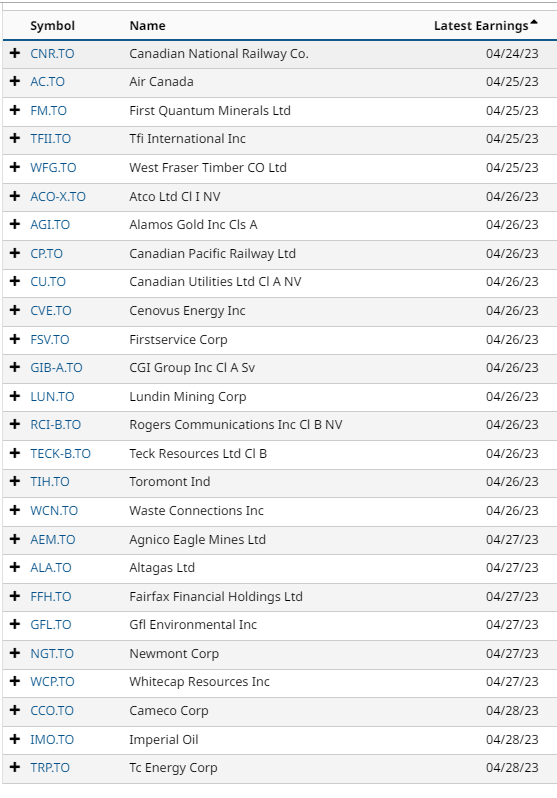
Earnings include: Canadian National Railway Co.; Choice Properties REIT; Coca-Cola Co.
—
Tuesday April 25
Japan department store sales
(9 a.m. ET) U.S. S&P CoreLogic Case-Shiller Home Price Index (20 city) for February. The Street is projecting a decline of 0.4 per cent from January and down 0.2 per cent year-over-year.
(9 a.m. ET) U.S. FHFA House Price Index for February. Consensus is a drop of 0.2 per cent from January and up 3.4 per cent year-over-year.
(10 a.m. ET) U.S. new home sales for March. The Street is forecasting an annualized rate decline of 1.3 per cent.
(10 a.m. ET) U.S. Conference Board Consumer Confidence Index for April.
Earnings include: Aecon Group Inc.; Alphabet Inc.; Danaher Corp.; General Electric Co.; General Motors Co.; Halliburton Co.; McDonald’s Corp.; Microsoft Corp.; PepsiCo Inc.; Texas Instruments Inc.; United Parcel Service Inc.; Verizon Communications Inc.; Visa Inc.; West Fraser Timber Co. Ltd.; Winpak Ltd. 3M Co.
—
Wednesday April 26
Germany consumer confidence
(8:30 a.m. ET) Canadian manufacturing sales for March.
(8:30 a.m. ET) U.S. goods trade deficit for March.
(8:30 a.m. ET) U.S. wholesale and retail inventories for March.
(8:30 a.m. ET) U.S. durable and core orders for March. The Street expects month-over-month increases of 0.7 per cent and 0.2 per cent, respectively.
(1:30 p.m. ET) Bank of Canada summary of deliberations for April 12 decision.
Earnings include: Alamos Gold Inc.; Allied Properties REIT; AltaGas Ltd.; Boeing Co.; Canadian Pacific Kansas City; Celestica Inc.; Cenovus Energy Inc.; CGI Inc.; FirstService Corp.; Glencore ADR; Meta Platforms Inc.; Methanex Corp.; New Gold Inc.; Precision Drilling Corp.; Rogers Communications Inc.; Teck Resources Ltd.; Vale ADR; Waste Connections Inc.
—
Thursday April 27
Bank of Japan monetary policy meeting (through Friday)
Euro zone economic and consumer confidence
(8:30 a.m. ET) Canada’s Survey of Employment, Payrolls and Hours for February.
(8:30 a.m. ET) U.S. initial jobless claims for week of April 22. Estimate is 250,000, up 5,000 from the previous week.
(8:30 a.m. ET) U.S. real GDP for Q1. Consensus is an annualized rate rise of 2.0 per cent.
(10 a.m. ET) U.S. pending home sales for March. The Street predicts an increase of 1.0 per cent from February.
Japan jobless rate, industrial production and retail sales
Euro zone and Germany GDP
(8:30 a.m. ET) Canada’s monthly real GDP. Consensus is an increase of 0.2 per cent from January.
(8:30 a.m. ET) U.S. personal spending for March. The Street expects a decline of 0.1 per cent with personal income rising 0.2 per cent.
(8:30 a.m. ET) U.S. Core PCE Price Index for March. Consensus is a rise of 0.3 per cent from February and up 4.5 per cent year-over-year.
(8:30 a.m. ET) U.S. Employment Cost Index for Q1. The Street is projecting an increase of 1.1 per cent from Q4 and up 4.8 per cent year-over-year.
(9:45 a.m. ET) U.S. Chicago PMI for April.
(10 a.m. ET) U.S. University of Michigan Consumer Sentiment for April.
Earnings include: Advantage Oil & Gas Ltd.; Cameco Corp.; Chevron Corp.; Colgate-Palmolive Co.; Exxon Mobil Corp.; First National Financial Corp.; TC Energy Corp.