Category: Uncategorized

  • Oil slips on U.S. stock build, trading in narrow range

    Oil prices edged lower on Thursday after a large build in U.S. crude inventories but continued to trade in a narrow range as hopes for a Chinese demand recovery remained in focus.

    Brent crude futures fell 36 cents, or 0.42%, to $85.02 a barrel by 1042 GMT. U.S. West Texas Intermediate (WTI) crude futures were down 29 cents, or 0.37%, at $78.30.

    Prices were pressured by last week’s larger than expected build in U.S. crude oil stocks. Stocks rose to the highest level since June 2021, the Energy Information Administration (EIA) said on Wednesday.

    The build was largely because of a data adjustment, which analysts said muted the impact on oil prices.

    “Brent failed again to move above the 100-day moving average this week. Together with a large crude build in the U.S., prices remain under downward pressure,” said UBS analyst Giovanni Staunovo.

    The Brent benchmark has been swinging within an $80-$90 a barrel range for the past six weeks while WTI has ranged between $72 and $83 since December.

    “Oil prices are very choppy at the moment, with traders having a lot to take in,” OANDA analyst Craig Erlam said in a note, pointing to Russia’s 500,000 bpd cut to oil production in March, a strong Chinese economic recovery and an uncertain global economic outlook.

    China will account for almost half of global oil demand growth this year after relaxing its COVID-19 curbs, the International Energy Agency (IEA) said on Wednesday.

    On the supply side, the market is keeping a close eye on Russian oil production.

    “It is open for interpretation how the country’s oil production will be affected by international sanctions or to what extent the invader would go to use oil as leverage,” said Tamas Varga of oil broker PVM.

    Russian oil exports were down in January by only 160,000 bpd from levels before the war in Ukraine, but about 1 million bpd of production will be shut in by the end of the first quarter, the IEA said.

    The market will look for economic clues from a host of Fed and ECB officials due to speak on Thursday.

  • Sanctions on Russian oil are having the ‘intended effect,’ IEA says

    • The European Union’s embargo on Russian oil products came into effect on Feb. 5, building on the $60 oil price cap implemented by the G-7 (Group of Seven) major economies on Dec. 5.
    • China, India and Turkey in particular have ramped up purchases to partially offset a fall in Russian crude exports to Europe of 400,000 barrels a day in January.
    • Russian net oil output was down by only 160,000 barrels a day from pre-war levels in January, with 8.2 million barrels of oil shipped to markets worldwide, according to the IEA’s oil market report.

    https://www.cnbc.com/2023/02/16/sanctions-on-russian-oil-are-having-the-intended-effect-iea-says.html

  • A ‘cocktail’ of sticky inflation and a tight labor market boosts Bank of England rate hike bets

    • The market probability of a further 25 basis point increase at the Monetary Policy Committee’s next meeting nudged up past 73% on Wednesday, according to Refinitiv data.
    • The U.K. annual inflation rate dipped for a third straight month to 10.1% in January, landing below consensus forecasts, even as high food and energy prices continue to squeeze British households.
    • Tuesday’s employment figures for December offered little indication that the labor market is beginning to ease.

    https://www.cnbc.com/2023/02/16/a-cocktail-of-sticky-inflation-and-a-tight-labor-market-boosts-bank-of-england-rate-hike-bets.html

  • Canadian Tire sales flat as inflation-weary consumers spend on essentials but cut back elsewhere

    Retail sales were flat in the fourth quarter for Canadian Tire Corp. Ltd., as the company’s automotive business continued to offset declines in demand for products such as home improvement and entertainment products.

    On Thursday, the Toronto-based retailer reported that comparable sales were up 0.3 per cent across its store banners in the fourth quarter, and down 0.1 per cent at the flagship chain, citing declines in categories it refers to as “playing” and “fixing.”

    The results for the 13 weeks ended Dec. 31 – including the all-important holiday period – showed that sales held steady at Canadian Tire CTC-A-T +0.48%increase compared to a strong period the prior year when comparable sales grew by nearly 10 per cent. But the purchasing trends still pointed to an ongoing shift in consumer behaviour across the country, as inflation-weary shoppers continue to spend on essential products such as tires and pet supplies, while cutting back on non-essential expenses.

    Comparable sales at Sport Chek were down by 1.6 per cent, as demand waned across categories and especially in outerwear. At Mark’s, sales grew 4.4 per cent as customers continued to stock up on casual clothing and footwear, and industrial items.

    Revenue at the company’s financial services segment grew by 14.3 per cent in the quarter on higher interest income and fees related to growth in credit card sales.

    Overall, Canadian Tire’s profits were up as revenues increased and gross margins improved in its retail segment. The company reported net income of $562.6-million, or $9.13 per share in the quarter, compared to $535.7-million or $8.40 per share in the same period the prior year.

    Total revenue in the 13 weeks ended Dec. 31 grew by 3.9 per cent to $5.3-billion.

    At an investor presentation last March, Canadian Tire announced a four-year growth strategy with the goal of growing its comparable sales by 4 per cent on average annually – not including fuel sales at its gas stations – and to improve its e-commerce operations and supply-chain efficiency. For the full year 2022, comparable sales grew by 2.7 per cent. The fourth-quarter report to shareholders acknowledged that the company “is now operating in a more challenging environment in 2023″ than expected at the time the growth strategy was announced, and that some of the assumptions behind those goals “could be challenged” if consumer spending patterns continue to be affected by inflation. “While the company remains committed to achieving its financial aspirations outlined at investor day, by continuing to invest in its building blocks for the longer term, the pacing will be different than originally planned,” the report stated.

  • Auto Industry Leaders Emphasize Urgency Of Canadian EV Response As U.S. Cash Flows

    The Canadian Press – Canadian Press – Wed Feb 8, 10:24AM CST

    TORONTO — Automotive industry leaders say the need for Canada to take action on the electric vehicle transition has taken on significantly greater urgency as money starts to flow in the U.S. from massive government incentives.

    Speaking at an electric vehicle conference in Toronto Wednesday, GM Canada president Marissa West says that sense of urgency can’t be understated as the company looks to secure its mineral and manufacturing capabilities for the years ahead.

    West says Canada has a significant advantage thanks to renewable energy supplies, but that the speed of project approvals and inconsistent policies between provincial and federal governments are barriers.

    Both West and Linamar Corp. chief executive Linda Hasenfratz emphasized the need for government support to balance the funding being provided by the Inflation Reduction Act in the U.S.

    The Canadian industry is set to benefit from many aspects of the U.S. act, but West says that areas like manufacturing capacity will especially require the Canadian government to step in.

    Unifor President Lana Payne says the urgency comes as manufacturers look to restructure whole supply chains to be closer to home, which along with the shift to electric vehicles creates risks and opportunities for Canadian workers.

    This report by The Canadian Press was first published Feb. 8, 2023.

    Companies in this story: (TSX:LNR)

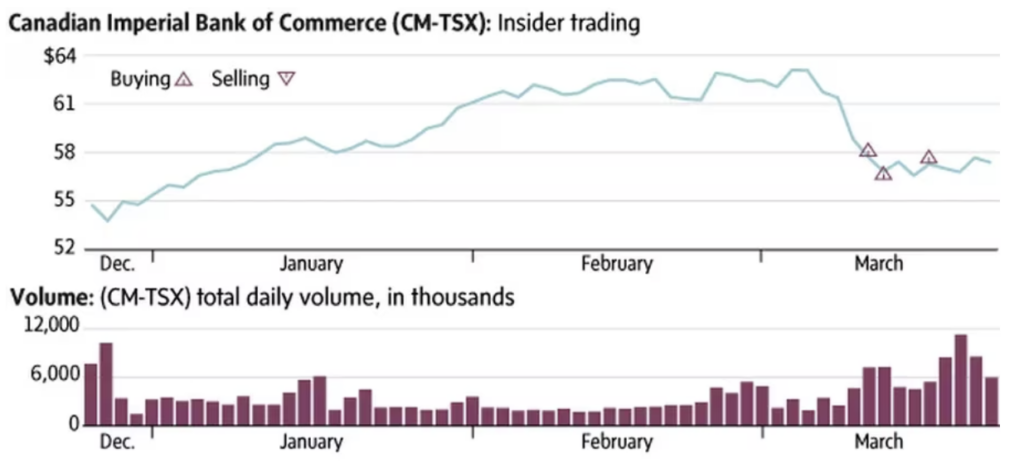
  • Magna shares drop as CIBC lowers stock on VW exposure

    Magna International (TSE:MG) fell on Wednesday after CIBC downgraded North America’s largest auto-parts supplier in the wake of the Volkswagen emissions scandal. 

    Shares were trading at $61.06, down 2.1%, at 1:07 p.m. in Toronto.

    CIBC lowered the stock to “sector perform” from “sector outperform” and cut its target price to $52 from $62.50.

    Analyst Todd Coupland noted that Magna doesn’t make diesel engines, but it does make many parts that end up in VW vehicles.

    Magna’s VW sales were $4.26bn in 2014, $3.6bn of which were in Europe.

    VW’s emissions rigging scandal continues to broaden. Chief executive officer Martin Winterkorn resigned on Wednesday as the automaker admitted that as many as 11 million cars could be affected. 

    Since 48% of VW’s European vehicle sales are diesel, Coupland assumes the same ratio applies to Magna. That works out to an estimated $1.75bn of sales in 2014.

  • UPDATED THU, FEB 9 2023

    European markets higher as investors weigh up economic outlook

    European markets were higher Thursday as investors weighed up the economic outlook and interest rate trajectory.

    https://www.cnbc.com/2023/02/09/european-markets-live-updates-stocks-data-earnings-and-news.html

  • Microsoft looks to revolutionize search and challenge Google

    Morgan Stanley analyst Keith Weiss described the stakes,

    “New Bing features four key innovations (detailed in a company blog post):

    1. New Bing runs on a new large language model (LLM) developed with OpenAI, but more powerful than ChatGPT and customized specifically for search. 2. Microsoft Prometheus Model developed as a proprietary method of interacting with the large language model to best support the search modality. This innovation improves relevancy, annotates answers, provides more up-to-date. answers and works to best understand geolocation… 3. Applying AI model to core search algorithm which drives step-function improvement in relevancy, the largest increase in relevancy Microsoft has seen in over a decade. 4. Improved user experience as search, browser and chat are pulled together into a single unified experience; this primes New Bing to answer more complex queries and more seamless enable workflows (e.g. like making travel arrangements). .. With a revenue run rate exceeding $210 billion, Microsoft continually assesses large market opportunities to enable growth going forward, and at a $570 billion TAM [total addressable market], the digital advertising market looks to be an increasingly interesting focal point.”

  • Brookfield Asset Management forecasts rapid growth as it attracts new investments

    Brookfield Asset Management Ltd. BAM-A-T -0.57%decrease is looking to buck the trend in a tough market for fundraising with plans to raise significant capital to invest in its areas of focus, including infrastructure, renewable energy and private credit.

    The asset manager reported earnings for the first time as a standalone entity on Wednesday after it was spun off from parent Brookfield Corp. in December. The company raised US$93-billion in capital in 2022, including US$14-billion in the fourth quarter, which was its best fundraising year on record.

    Even as available capital becomes more scarce while investors grapple with the uncertainty caused by high inflation and spiking interest rates, Brookfield is betting that it can continue to attract flows of institutional money that are increasingly going to only the largest asset managers with the broadest reach. It is also betting that its strength in asset classes that are most in demand because they generate stable income in volatile times will give it an edge.

    “We’re increasingly seeing large institutional [limited partners] looking to concentrate their capital amongst a smaller number of managers, but those managers who can offer them a greater diversity of products,” said Connor Teskey, president of Brookfield Asset Management, on a Wednesday conference call.

    “We do expect this to continue in the coming years and perhaps this is one of the reasons why we have such a robust and positive outlook for fundraising in 2023 when we know that there are some pockets of weakness for other market participants,” Mr. Teskey said.

    Fundraising helped Brookfield Asset Management boost its fee-bearing capital to US1$418-billion, up 15 per cent over the past year. During the fourth quarter, the company closed new funds for its fifth flagship infrastructure fund, which now stands at US$22-billion, and its sixth flagship private equity fund, which reached US$9-billion.

    After Brookfield quickly deployed about half of a $15-billion, climate-focused fund that launched in 2021 to make large investments in the global transition to a net zero economy, Mr. Teskey said Wednesday that it is intended to be only the first in a series of such funds. Brookfield plans to bring a second, “meaningfully larger” transition fund to market “sooner rather than later,” he said.

    In a letter to shareholders, Brookfield chief executive Bruce Flatt and Mr. Teskey said the company expects to have three flagship funds in the market in 2023. And they predicted that the asset manager’s earnings should “at least double over the next five years.”

    Brookfield Asset Management, which was spun off in December, reported higher earnings from fees in the fourth quarter, largely shrugging off the volatility in roiling markets.

    Overall profit was down 9.5 per cent to US$504-million in the final three months of the year, including US$84-million earned from the spinoff on Dec. 9 to the end of the year.

    But full-year profit was up 3 per cent to US$1.92-billion. And fee-related earnings increased nearly 8 per cent in the quarter to US$576-million, while distributable earnings – which adjust for items such as taxes and share-based compensation – rose 5.5 per cent to US$569-million.

    For the full year, fee-related earnings were US$2.1-billion. The company now has approximately US$800-billion of assets under management.

    The asset manager’s board declared a quarterly dividend of 32 US cents a share.

    Analysts probed the company on Wednesday about its appetite for mergers and acquisitions, but Mr. Flatt said any larger deal would need to “hit a very high test,” adding: “We don’t have any expectations of something happening in 2023.”

    On Wednesday, Brookfield Reinsurance – a subsidiary of Brookfield Corp. – announced a US$1.1-billion, all-cash deal to acquire specialty insurer Argo Group International Holdings Ltd., helping expand Brookfield’s U.S. insurance operations. Argo shareholders will have the right to receive US$30 in cash per share at closing, which is a 6.7-per-cent premium to the company’s closing share price on Feb. 7.