Canadian retail sales jumped 2.2% in May, beating economists’ expectations. Good news right? Well, not really. The gain was driven more by higher prices, especially for gas, than by higher volumes.
Moreover, a preliminary estimate from Statistics Canada suggests weakness to come with sales seen rising just 0.3% in June from the month before, which CIBC economist Katherine Judge says would represent a decline in volumes.
“Indeed, with consumption to shifting towards services, while inflation erodes consumer purchasing power, demand for discretionary goods will be under more pressure ahead,” she wrote.
Newmont’s (NEM) Earnings and Revenues Lag Estimates in Q2
Newmont Corporation NEM reported net income from continuing operations of $379 million or 48 cents per share in second-quarter 2022, down from $640 million or 80 cents per share in the year-ago quarter.
Barring one-time items, adjusted earnings were 46 cents per share that missed the Zacks Consensus Estimate of 60 cents.
Newmont reported revenues of $3,058 million, almost flat year over year. The figure missed the Zacks Consensus Estimate by 0.5%. Higher average realized gold prices and copper sales volume were partly offset by reduced average realized co-product metal prices.
Newmont Corporation Price, Consensus and EPS Surprise
Newmont Corporation Price, Consensus and EPS Surprise
Newmont’s attributable gold production in the second quarter increased roughly 3.4% year over year to around1.5 million ounces in the quarter.
Average realized prices of gold rose 0.7% year over year to $1,836 per ounce.
The company’s costs applicable to sales (CAS) for gold were $932 per ounce, up 23.4% year over year. The increase was mainly driven by higher direct operating costs resulting from higher labor costs and increased commodity inputs, including higher fuel and energy costs.
All-in sustaining costs (AISC) for gold were up 15.8% year over year to $1,199 per ounce, mainly due to higher CAS per gold equivalent ounce.
Regional Performance
North America: Second-quarter attributable gold production in North America was 316,000 ounces, down 20% year over year. Gold CAS in the region was $1,124 per ounce, up 46% year over year.
South America: Attributable gold production in South America was 210,000 ounces, up 11% year over year. Gold CAS in the region rose 36% on a year-over-year basis to $982 per ounce.
Australia: Attributable gold in the region was 366,000 ounces, up 22% year over year. Gold CAS in the region was down 7% year over year to $710 per ounce.
Africa: Production in the region totaled 243,000 ounces of gold in the quarter, up 20% year over year. Gold CAS was $838 per ounce, up 10% year over year.
Nevada: Production totaled 290,000 ounces of gold in the quarter, up 2% year over year. Gold CAS was $1,035 per ounce, up 37% year over year.
Financial Position
The company ended the quarter with cash and cash equivalents of $4,307 million, down 6% year over year. At the end of the quarter, the company had long-term debt of $5,568 million, up 11.6% year over year.
Net cash from continuing operations amounted to $1,033 million. Free cash flow totaled $514 million in the second quarter.
Outlook
For 2022, Newmont expects attributable gold production of 6 million ounces. The company also expects gold CAS to be $900 per ounce and AISC to be $1,150 per ounce.
Newmont’s cost guidance reflects the impact of lower production volumes and higher direct operating costs related to labor, energy, consumables and supplies due to sustained inflationary pressures.
Price Performance
Newmont’s shares have declined 14.9% in the past year compared with a 29.5% fall of the industry.
Newmont Corporation (NYSE: NEM, TSX: NGT) (Newmont or the Company) today announced second quarter 2022 results.
SECOND QUARTER 2022 RESULTS
Produced 1.5 million attributable ounces of gold and 330 thousand attributable gold equivalent ounces (GEO) from co-products, an increase of more than 130 thousand total gold equivalent ounces from the first quarter
Generated $1.0 billion of cash from continuing operations and $514 million of Free Cash Flow (97 percent attributable to Newmont)*
Reported gold Costs Applicable to Sales (CAS)* of $932 per ounce and All-In Sustaining Costs (AISC)* of $1,199 per ounce
Adjusted Net Income (ANI) of $0.46 per share and Adjusted EBITDA of $1,149, impacted by increasing costs and declining metal prices
Updated full-year guidance of 6.0 million ounces of attributable gold production, CAS of $900 per ounce and AISC of $1,150 per ounce; reaffirmed original guidance of 1.3 million gold equivalent ounces from copper, silver, lead and zinc with updated co-product cost guidance of $750 per GEO of CAS and $1,050 per GEO of AISC**
Updated full-year guidance for development capital spend to $1.1 billion; Provided trends on development capital costs and timeline related to Tanami Expansion 2 and Ahafo North
Declared second quarter dividend of $0.55 per share, consistent with the previous seven quarters***
$1 billion share repurchase program to be used opportunistically in 2022, with $475 million remaining***
Ended the quarter with $4.3 billion of consolidated cash and $7.3 billion of liquidity with a net debt to adjusted EBITDA ratio of 0.3x*
Advancing profitable near-term projects, including Tanami Expansion 2, Ahafo North and Yanacocha Sulfides
Completed acquisition of Sumitomo Corporation’s 5 percent interest in Yanacocha, increasing ownership in Sulfides project to 100 percent
Maintained a clear focus on managing the critical controls that must be in place at all times to prevent fatalities; 155 thousand critical control verifications completed by leaders in the field
Published our 2021 Sustainability Reporting Suite, including our second Annual Climate Report, prepared in accordance with the Task Force for Climate Disclosure (TCFD) framework, detailing the pathway to achieve 2030 carbon emissions reduction targets and 2050 goal
“Newmont delivered a solid second quarter performance, producing 1.5 million gold ounces and generating $514 million in free cash flow. Through our industry-leading portfolio of assets and projects, our proven integrated operating model, our balanced and disciplined approach to capital allocation and our values-driven commitment to our purpose of creating value and improving lives through sustainable and responsible mining, Newmont remains well-positioned to safely manage through the evolving and unprecedented challenges that face our industry and the world at large.”
– Tom Palmer, Newmont President and Chief Executive Officer
Japan slashes fiscal year GDP growth forecast to 2% on global demand slump
Japan’s government slashed its economic growth forecast for this fiscal year largely due to slowing overseas demand, highlighting the impact of Russia’s war in Ukraine, China’s strict COVID-19 lockdowns and a weakening global economy.
The forecast, which serves as a basis for compiling the state budget and the government’s fiscal policy, included much higher wholesale and consumer inflation estimates as surging energy and food costs and a weak yen push up prices.
The world’s third-biggest economy is now expected to expand about 2.0% in price-adjusted real terms in the fiscal year ending in March 2023, according to the Cabinet Office’s projections, presented at the Council on Economic and Fiscal Policy – the government’s top economic panel.
That marked a sharp downgrade from the government’s previous forecast of 3.2% growth released in January. The cut largely stemmed from weaker exports, which the government expects to expand 2.5% compared to 5.5% in the previous assessment.
The government projected 1.1% growth for the following fiscal year starting April 2023.
It released its projections days after the Bank of Japan downgraded expectations for growth for this fiscal year to March 2023 to 2.4% from 2.9% three months ago, and underscored the central bank’s stance to maintain massive stimulus even as several other economies have started to hike rates to curb inflation.
The government forecast overseas demand to subtract real gross domestic product by 0.3 percentage point for the current fiscal year, compared to an expected 0.2 percentage point boost seen previously.
It projected overall consumer inflation, which includes volatile fresh food and energy costs, at 2.6% for this fiscal year compared to 0.9% expected in the previous assessment in January.
Wholesale inflation was estimated at 9.8% for this fiscal year, much higher than 2.0% projected in January, as higher oil and food prices and a weaker yen pushed up raw material cost.
The higher consumer inflation was not expected to weigh greatly on private consumption as stronger spending on services such as travel was seen boosting this fiscal year’s economic growth, a Cabinet Office official said.
For fiscal 2022 and fiscal 2023, the Cabinet Office forecast nominal economic growth of 2.1% and 2.2%, respectively. Higher nominal growth estimates point to government expectations for greater tax revenue.
General Motors Co and Ford Motor Co are about to replay a script they have played out many times before – trying to convince investors they can get through a recession without skidding into the red.
Analysts have been cutting share price targets and profit estimates for the Detroit automakers over the past several weeks, in tandem with downbeat outlooks for the global economy. High energy prices, rising interest rates, inflation, snarled supply chains and stubborn persistence of the COVID virus all bode ill for automaker profits, analysts said.
FORD MOTOR COMPANY
12.85-7.92 (-38.16%)
GENERAL MOTORS COMPANY
34.69-23.94 (-40.84%)
YEAR TO DATE
-38.16%-40.84%
DEC. 30, 2021
JULY 25, 2022
SOURCE: BARCHART
At the same time, some analysts say a recession could be mild, and demand for vehicles could recover more swiftly than in the past. One big difference from past slowdowns is that GM and Ford’s U.S. dealers are not sitting on big inventories of unsold vehicles that would have to be discounted to sell.
“We believe the set-up over a multi-year horizon is skewing more positively,” Bank of America analyst John Murphy wrote in a note, citing lean inventories and pent-up demand from consumers who held off buying as vehicles became scarce and expensive.
Both GM and Ford also have healthy balance sheets, certainly compared to the period leading up to the 2008-2009 financial market crisis that pushed GM into bankruptcy.
GM, which reports results on Tuesday morning, has stuck to its full-year profit guidance, even after disclosing that it had 95,000 vehicles in stock that it could not ship during the second quarter because of missing parts. GM said earlier this month it expects second quarter net income of $1.6 billion to $1.9 billion, below analysts’ expectations of $2.56 billion, as per Refinitiv data.
Ford also kept to its outlook for full-year operating profit of between $11.5 billion and $12.5 billion.
However, Ford is still wrestling with high costs for recalls, and heavy investments to develop more electric vehicles. Bloomberg reported last week that Chief Executive Jim Farley could order that as many as 8,000 jobs be cut from the payroll, largely in operations that support combustion vehicles.
Ford has not commented on the report. But Farley has said several times in recent months that Ford has too many people and is spending too much on quality problems.
More than a cultural icon: New report shows Canadian Tire has tremendous impact on country’s economy
Retailer is a successful business story that generated $18-billion of income for Canadians in 2021
Not many companies in Canada make it to their 100th anniversary – and even fewer do so with the respected reputation and quantifiable community impact of Canadian Tire.
“There are so many moving parts when analyzing the company’s 100-year history, which is an increasingly rare example of a successful Canadian business story,” says Philip Cross, senior fellow at the Fraser Institute, a public policy think-tank.
Cross independently reviewed Public First’s Canadian Tire Corporation Economic Impact Report, which analyzes Canadian Tire Corporation (CTC) and its Associate Dealers. CTC commissioned the report from Public First, a global strategic consultancy, to mark its centenary and explore and quantify the company’s impact on Canadian consumers, businesses, workers and communities. Data in the report was sourced by polling individuals across Canada, CTC financial statements and disclosures, and other information supplied by the corporation and its Associate Dealers.
Cross spent 36 years at Statistics Canada, the last few years as its chief economic analyst. “I’ve expressed a lot of concern in my work on the Canadian business community about the decline in innovation, and [the decline] of Canada’s business presence on the world stage,” says Cross, who wrote the foreword to the report. “We’ve seen so many iconic Canadian firms falter over the past decade. So it was a pleasure to be part of a story that highlights how Canadians can innovate and succeed.”
Cross referenced major Canadian businesses that have faltered or gone out of business entirely, such as Nortel Networks Corporation, Eaton’s and Bombardier Inc., noting that Canadian Tire, on the other hand has flourished, consistently positioned at the forefront of the country’s retail industry, even amid the arrival of U.S.-based retail giants such as Walmart Inc., Home Depot and Target Corporation.
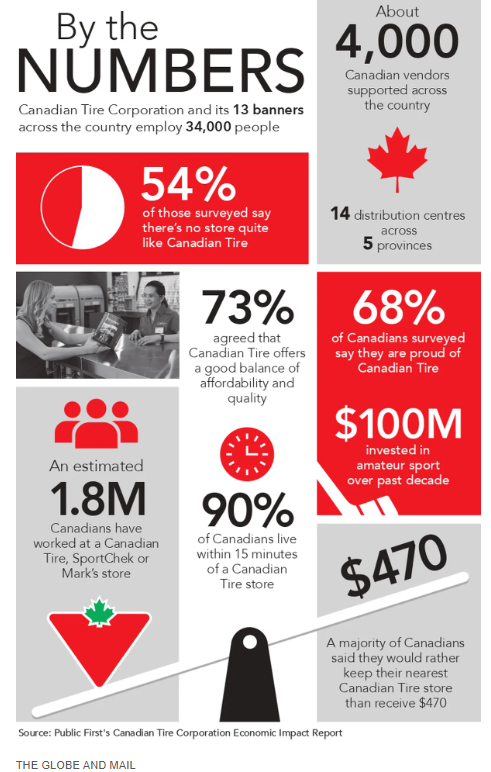
According to the findings of the Economic Impact Report, an estimated $150-billion in economic impact over the past decade has been generated by Canadian Tire Corporation and its Associate Dealers.
Today, more than 500 stores across Canada are run by a network of independent entrepreneurs known as Associate Dealers, who are responsible for creating a retail plan, hiring staff and building a business with products that meet the needs of the communities they serve. This has resulted in a significant number of Canadians finding employment; the report estimates that 1.8 million Canadians have worked at a Canadian Tire, a SportChek or a Mark’s store (both of which are part of the CTC Group of Companies) in the past.
THE GLOBE AND MAIL
And Canadian Tire stores are a hub of support for other entrepreneurs and small- to medium-sized businesses. Approximately 58 per cent of Canadian Tire store customers surveyed say that they regularly shop at another business while visiting a Canadian Tire store. In total, CTC supports more than 4,000 Canadian businesses across the country. And, for every $1 in profit earned by CTC in 2021, an estimated $14 was generated for other businesses and workers across the Canadian economy.
What really stood out for Cross was the $18-billion in gross value added (GVA) in 2021, which is equivalent to approximately one per cent of gross domestic product.
“That’s significant,” he says. “Basically, it says Canadian Tire generates $18-billion of income for Canadians. To give you an appreciation of how much that is, that’s more than all of the arts, entertainment and recreation industry in this country, which is $14-billion. It’s about the same as all the crops this country produces: $17.7-billion. Auto assemblies, including parts in this country, generate $12.5-billion of income. For one company to drive that is impressive and shows just how much Canadian Tire has worked itself into the Canadian economy.”
The numbers are one way to measure the retailer’s impact. But the report also highlights the deep connection between Canadians and Canadian Tire.
From its humble beginnings in 1922 – when two young Toronto brothers, J.W. and A.J. Billes, launched their own business in car parking – Canadian Tire is one of Canada’s most beloved companies. With more than 500 retail locations nationwide, it remains the go-to destination for Canadians who are preparing for a trip outdoors, looking for new sports equipment, needing to service their car or taking on a home renovation project.
In the report’s customer testimonials, people talked about how their father bought their first bike using Canadian Tire money, or the time they got their first pair of skates, or how their local Canadian Tire is the place to find uniquely Canadian gifts for friends and family.
“I mean, obviously, being a statistician, the numbers strike me first,” Cross says. “But just as important in reading the testimonials is how much Canadian Tire has become an integral part of the fabric of Canadian life. And that’s something that you really can’t capture in numbers … just the way people identify with it as a symbol of Canada. There’s not a lot of business symbols in this country that are symbolic of Canada.”
In the report, 54 per cent of Canadians surveyed agree there is no store quite like Canadian Tire. And when people were asked which stores listed in the survey they would miss if they moved away from Canada, almost half (47 per cent) chose Canadian Tire stores.
Sixty-eight per cent say they are proud of Canadian Tire as a Canadian company. Consumers see it as one of the last remaining truly Canadian companies, a company committed to stocking its shelves with Canadian-made or -designed products, scoring high under words or statements such as “trustworthy” and “care about Canadians.”
“I mean, that’s getting under people’s fingernails,” Cross says. “That’s really connecting with people on an individual and local level.”
CTC’s commitment to responsible retailing, in particular its connection to supporting amateur sports, is a big factor in that. Hockey is Canada’s national game, and Canadian Tire is the largest hockey retailer in Canada. But sports are equally fundamental to the company’s community outreach.
In 2021, CTC and its Associate Dealers helped generate $36.7-million in charitable donations for Canadian Tire Jumpstart Charities (Jumpstart), which is dedicated to helping kids overcome barriers to accessing sport and recreation.
In the report’s polling, more than 2.5 million Canadians say that they know someone who has benefitted from Jumpstart, which has raised more than $200-million in funds since 2005.
In providing equal and inclusive access to local sports, helping communities grow and thrive, and helping children become more active, healthy and confident, the charity has contributed to the positive view Canadians have of the company.
“Being ‘Canadian’ is nice, but it isn’t enough,” Cross says. “People are not going to buy your products just because you’re Canadian. You can’t just plant a flag out front and say, this is going to make us a successful retailer.
“Canadians also want value for their money. They’re going to want you to back up the products that you sell and they’re going to want it at that competitive price. And you have to deliver on all those fronts.”
According to the report, it is estimated that Canadian Tire stores in total create $14.6-billion in consumer surplus – a measure used by economists that looks at what consumers would have been willing to pay for a product and still felt that they were getting their money’s worth.
“Canadians feel that what they are buying from Canadian Tire is giving them value almost twice as much as what they’re paying,” Cross says. “That’s value for money. That’s more than getting your money’s worth. And it’s because of that large consumer surplus that there’s this feeling that, yes, I got a real bargain, and I got more than I paid for. That’s why people go back. That’s the basis of successful retailing.”
Markets face what could be the most important week of summer with Fed, earnings and economic data
The busiest — and what could be the most important — week of the summer is coming up, with the Federal Reserve expected to deliver another three-quarter point rate hike.
Second-quarter GDP and other economic reports could provide more clues as to whether the economy is heading for recession, and earnings are expected from Apple, Microsoft, and Alphabet, among others.
“For me, the real tell will be whether the attitude of investors continues to be that the earnings season is better than feared,” said one strategist.
There’s a head-spinning amount of news for markets to navigate in the week ahead, the biggest of which will be the Federal Reserve’s midweek meeting.
The two largest U.S. companies — Microsoft and Apple — report Tuesday and Thursday, respectively. Google parent Alphabet releases results Tuesday, and Amazon reports Thursday. Meta Platforms, formerly Facebook, reports Wednesday. In all, more than a third of the S&P 500 companies are reporting.
On top of that are several hefty economic reports, which should add fuel to the debate on whether the economy is heading toward, or is already in, a recession.
“Next week, I think, is going to be the most important week of the summer between the economic reports coming out, with respect to GDP, the employment cost index and the Fed meeting — and the 175 S&P 500 companies reporting earnings,” said Leo Grohowski, chief investment officer at BNY Mellon Wealth Management.
Second-quarter gross domestic product is expected Thursday. The Fed’s preferred personal consumption expenditures inflation data comes out Friday morning, as does the employment cost index. Home prices and new home sales are reported Tuesday and consumer sentiment is released Friday.
“I think what those bigger companies say about the outlook will be more important than the earnings they post. … When you combine that with the statistical reports, which will be backward looking, I think it’s going to be a volatile and important week,” Grohowski said.
The run-up to the Fed’s meeting on Tuesday and Wednesday has already proven to be dramatic, with traders at one point convinced a full point rate hike was coming. But Fed officials pushed back on that view, and economists widely expect a second three-quarter point hike to follow the one last month.
“Obviously a 75 basis point hike is baked in the cake for next week,” said Grohowski. “I think the question is what happens in September. If the Fed is continuing to stay too tight for too long, we will need to increase our probability of recession, which currently stands at 60% over the next 12 months.” A basis point equals 0.01%.
The Fed’s rate hiking is the most aggressive in decades, and the July meeting comes as investors are trying to determine whether the central bank’s tighter policies have already or will trigger a recession. That makes the economic reports in the week ahead all the more important.
GDP report
Topping the list is that second-quarter GDP, expected to be negative by many forecasters. A contraction would be the second in a row on top of the 1.6% decline in the first quarter. Two negative quarters in a row, when confirming declines in other data, is viewed as the sign of a recession.
The widely watched Atlanta Fed GDP Now was tracking at a decline of 1.6% for the second quarter. According to Dow Jones, a consensus forecast of economists expects a 0.3% increase.
“Who knows? We could get a back-of-the-envelope recession with the next GDP report. There’s a 50/50 chance the GDP report is negative,” Grohowski said. “It’s the simple definition of two down quarters in a row.” He added, however, that would not mean an official recession would be declared by the National Bureau of Economic Research, which considers a number of factors.
Diane Swonk, chief economist at KPMG, expects to see a decline of 1.9%, but added it is not yet a recession because unemployment would need to rise as well, by as much as a half percent.
“That’s two negative quarters in a row, and a lot of people are going to say ‘recession, recession, recession,’ but it’s not a recession yet,” she said. “The consumer slowed quite a bit during the quarter. Trade remains a huge problem and inventories were drained instead of built. What’s interesting is those inventories were drained without a lot of discounting. My suspicion is inventories were ordered at even higher prices.”
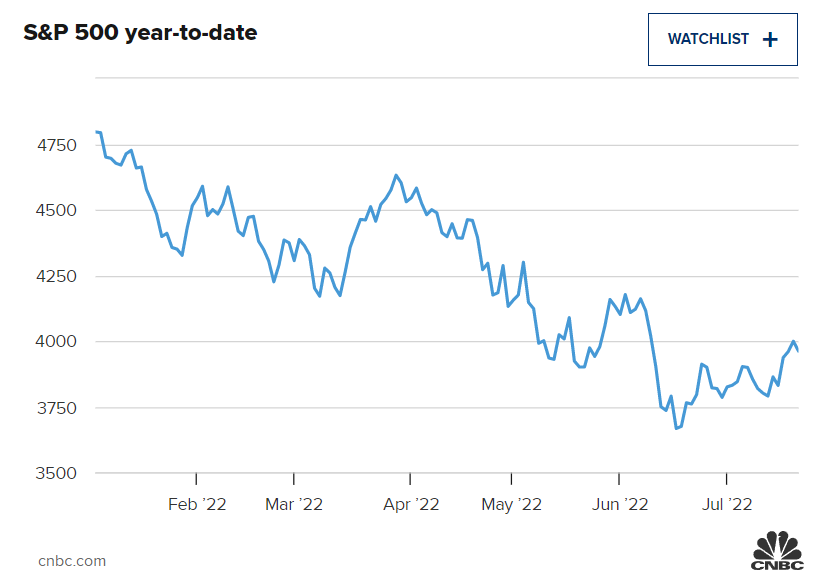
Stocks in the past week were higher. The S&P 500 ended the week with a 2.6% gain, and the Nasdaq was up 3.3% as earnings bolstered sentiment.
“We’re really shifting gears in terms of what’s going to be important next week versus this week,” said Art Hogan, chief market strategist at National Securities. “We really had an economic data that was largely ignored. Next week, it will probably equal the attention we pay to the household names that are reporting.”
Better-than-expected earnings?
Companies continued to surprise on the upside in the past week, with 75.5% of the S&P 500 earnings better than expected, according to I/B/E/S data from Refinitiv. Even more impressive is that the growth rate of earnings for the second quarter continued to grow.
As of Friday morning, S&P 500 earnings were expected to grow by 6.2%, based on actual reports and estimates, up from 5.6% a week earlier.
“We have kind of a perfect storm of inputs, pretty deep economic reports across the board, with things that have become important, like consumer confidence and new home sales,” said Hogan “For me, the real tell will be whether the attitude of investors continues to be that the earnings season is better than feared.”
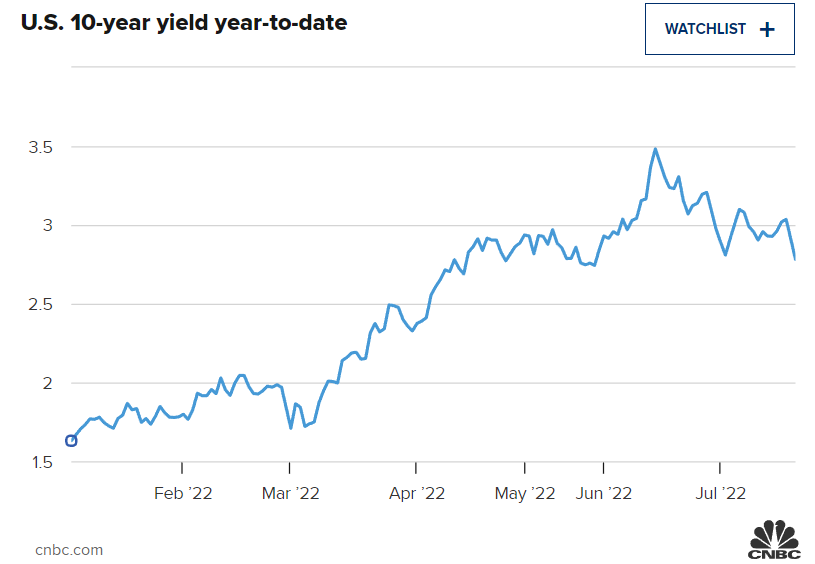
While stocks gained in the past week, bond yields continued to slide, as traders worried about the potential for recession. The benchmark 10-year Treasury yield fell to 2.76% Friday, after weaker PMIs in Europe and the U.S. sent a chilling warning on the economy. Yields move opposite price.
“I do think the market is pivoting,” said Grohowski. “I do think our concerns at least are quickly shifting from persistent inflation to concerns over recession.”
The potential for volatility is high, with markets focused on the Fed, earnings and recession worries. Fed Chair Jerome Powell could also create some waves, if he is more hawkish than expected.
“There are a lot of signs out there about slowing economic growth that will bring down inflation. Hopefully, the Fed doesn’t stay too tight for too long,” said Grohowski. “The chance of a policy error by the Fed continues to increase because we continue to get signs of a rapidly cooling — not just cooling — economy.”
(9 a.m. ET) U.S. S&P CoreLogic Case-Shiller Home Price Index for May. The Street is expecting a rise of 1.6 per cent from April and up 20.9 per cent year-over-year.
(9 a.m. ET) U.S. FHFA House Price Index for May. Consensus is a rise of 1.6 per cent from April and up 18.6 per cent year-over-year.
(10 a.m. ET) U.S. new home sales for June. The Street is projecting an annualized rate slide of 4.5 per cent.
(10 a.m. ET) U.S. Conference Board Consumer Confidence Index for July.
Also: U.S. Fed meeting begins
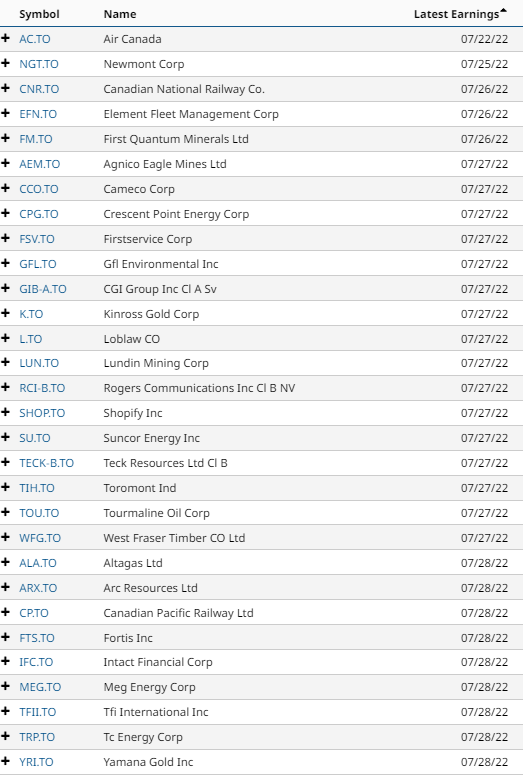
Earnings include: Alphabet Inc.; Canadian National Railway Co.; Coca-Cola Co.; First National Financial Corp.; First Quantum Minerals Ltd.; General Electric Co.; General Motors Co.; McDonald’s Corp.; Microsoft Corp.; Raytheon Technologies Corp.; Texas Instruments Inc.; Topaz Energy Corp.; Toromont Industries Ltd.; United Parcel Service Inc.; Visa Inc.; West Fraser Timber Co. Ltd.; 3M Co.
—
Wednesday July 27
Germany consumer confidence
(8:30 a.m. ET) U.S. durable goods orders for June. The Street expects a decline of 0.4 per cent month-over-month.
(10 a.m. ET) U.S. pending home sales for June. Consensus is a drop of 0.3 per cent from May.
(2 p.m. ET) U.S. Fed announcement with Chair Jerome Powell’s press briefing to follow.
Earnings include: Agnico Eagle Mines Ltd.; Alamos Gold Inc.; Allied Properties REIT; Automated Data Processing Inc.; Baytex Energy Corp.; Boeing Co.; Bristol-Myers Squibb Co.; Cargojet Inc.; CGI Inc.; Crescent Point Energy Corp.; FirstService Corp.; Ford Motor Co.; GFL Environmental Holdings Inc.; Kinross Gold Corp.; Loblaw Companies Ltd.; Lundin Mining Corp.; Meta Platforms Inc.; Methanex Corp.; Norfolk Southern Corp.; Qualcomm Inc.; Rogers Communications Inc.; Secure Energy Services Inc.; Spin Master Corp.; Teck Resources Ltd.; West Fraser Timber Co. Ltd.
—
Thursday July 28
Euro zone consumer and economic confidence
Germany CPI
(8:30 a.m.) Canada’s Survey of Employment, Payrolls and Hours for May.
(8:30 a.m. ET) U.S. initial jobless claims for week of July 23. Estimate is 253,000, up 2,000 from the previous week.
(8:30 a.m. ET) U.S. Real GDP for Q2. Consensus is for annualized economic growth of 0.4 per cent.
Earnings include: AltaGas Ltd.; Amazon; Apple Inc.; Atco Ltd.; Cameco Corp.; Canadian Pacific Railway Ltd.; Canadian Utilities Ltd.; Canfor Corp.; Caterpillar Inc.; Cenovus Energy Inc.; Comcast Corp.; Constellation Software Inc.; Fortis Inc.; George Weston Ltd.; iA Financial Corp. Inc.; Intact Financial Corp.; Intel Corp.; Mastercard Inc.; MEG Energy Corp.; Merck & Company Inc.; Pfizer Inc.; TC Energy Corp.; TFI International Inc.; Thermo Fisher Scientific Inc.; T-Mobile US Inc.; TMX Group Ltd.; Whitecap Resources Inc.; Yamana Gold Inc.
—
Friday July 29
Japan jobless rate, retail sales, industrial production and consumer confidence
Euro zone GDP and COI
Germany CPI and employment
(8:30 a.m. ET) Canada’s monthly GDP for May. The Street is projecting economic contraction of 0.2 per cent.
(8:30 a.m. ET) U.S. personal income and consumption for June. Consensus estimates are increases of 0.9 per cent and 0.5 per cent from May, respectively.
(8:30 a.m. ET) U.S. core PCE price index for June. The Street expects a rise of 0.5 per cent from May and 4.7 per cent year-over-year.
(8:30 a.m. ET) U.S. employment cost index for Q2. Consensus is an increase of 1.2 per cent from Q1 and 4.9 per cent year-over-year.
(9:45 a.m. ET) U.S. Chicago PMI for July.
(10 a.m. ET) U.S. University of Michigan Consumer Sentiment Index for July.
Earnings include: AbbVie Inc.; ARC Resources Ltd.; Chevron Corp.; Definity Financial Corp.; Enbridge Inc.; Exxon Mobil Corp.; Imperial Oil Ltd.; Magna International Inc.; Procter & Gamble Co.; Telus International Inc.



:format(jpeg)/cloudfront-us-east-1.images.arcpublishing.com/tgam/S53VD5LZAZGFXOCBCXCQID4SVI.jpg)