Jolted by the Ukraine war and China’s aggression, Japan looks to boost its defense capability
Japan “will not rule out any options, including so-called ‘counterstrike capabilities,’ and will realistically consider what is necessary to protect the lives and livelihoods of our people,” Japanese Prime Minister Fumio Kishida said at the Shangri-La Dialogue in Singapore.
The threat of China is brought close to home because of Taiwan’s proximity to Japan, deputy cabinet secretary in the Japanese prime minister’s office Koichiro Matsumoto told CNBC.
North American stock markets tumble as global recession fears intensify after Fed rate hike
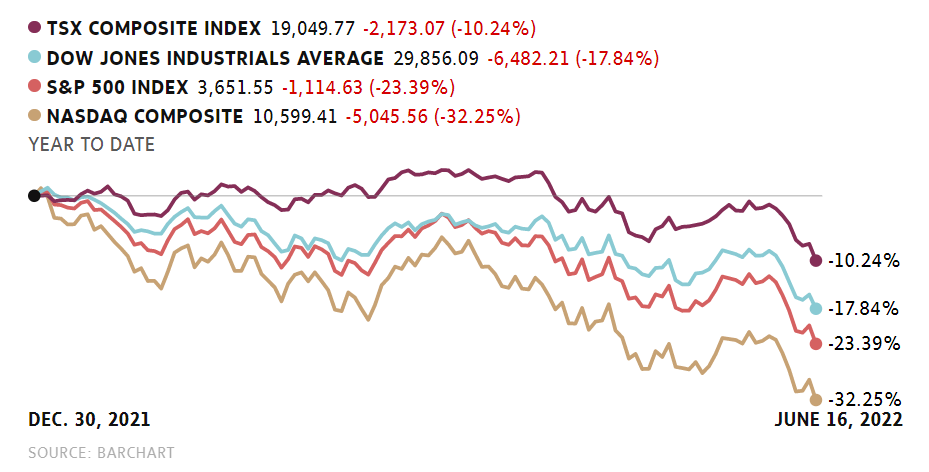
Markets worldwide are back to tumbling on Thursday, and Wall Street is down roughly 3% in a widespread wipeout as worries about a fragile economy roar back to the fore.
In Toronto, the S&P/TSX composite index was down 2.84%, or 560.87 points, at 19,050.69 at 2 p.m. ET.
The energy sector dropped 4.5% as oil prices reversed earlier losses after the United States announced new sanctions on Iran, and as supply concerns remain at the forefront of energy markets. U.S. crude rose 0.9% to $116.35 per barrel and Brent rose 0.35% to $118.9.
The S&P 500 was 3.1% lower in afternoon trading, more than reversing its blip of a 1.5% rally from a day before. Analysts had warned of more big swings given deep uncertainties about whether the Federal Reserve and other central banks can tiptoe the narrow path of hiking interest rates enough to get inflation under control but not so much that they cause a recession.
The Dow Jones Industrial Average was down 687 points, or 2.2%, at 29,980, and the Nasdaq composite was 3.9% lower. The S&P 500 was on track for its sixth loss in the last seven days, and all but five of the 500 companies in the index were lower.
TSX COMPOSITE INDEX
19,049.77-2,173.07 (-10.24%)
DOW JONES INDUSTRIALS AVERAGE
29,856.09-6,482.21 (-17.84%)
S&P 500 INDEX
3,651.55-1,114.63 (-23.39%)
NASDAQ COMPOSITE
10,599.41-5,045.56 (-32.25%)
YEAR TO DATE
-10.24%-17.84%-23.39%-32.25%MAY 26, 2022
DEC. 30, 2021
JUNE 16, 2022
SOURCE: BARCHART
North American markets fell with stocks across Europe after central banks there followed up on the Federal Reserve’s interest-rate hike on Wednesday. The Bank of England raised its key rate for the fifth time since December, though it opted for a more modest 0.25 percentage points than the 0.75-point hammer brought by the Fed.
Switzerland’s central bank, meanwhile, raised rates for the first time in years, a half-point hike. Taiwan’s central bank raised its key rate by an eighth of a point. Japan’s central bank began a two-day meeting on policy, though it’s held out on raising rates and making other economy-slowing moves that investors call “hawkish.”
“The clear read-through here is the FOMC (Fed) has unleashed the central bank Hawkish Genie from the bottle, and we should expect more aggressive follow-through from other central banks except those who are economically challenged,” Stephen Innes of SPI Asset Management said in a commentary.
Such moves and expectations for plenty more around the world have sent all kinds of investments tumbling this year, from bonds to bitcoin. Higher interest rates slow the economy by design, in hopes of stamping out inflation. But they’re a blunt tool that can choke off the economy if used too aggressively.
“Another concern is that with the change in policy, there’s been weakening economic data already,” said Bill Northey, senior investment director at U.S. Bank Wealth Management. “That raises the odds of a recession in the latter part of 2022 into 2023.”
The worries dragged the S&P 500 into a bear market earlier this week, meaning it had dropped more than 20% from its peak. It’s now more than 23% below its record set early this year, and it’s back to where it was in late 2020.
Not only is the Federal Reserve hiking short-term rates, it also this month began allowing some of the trillions of dollars of bonds it purchased through the pandemic to roll off its balance sheet. That should put upward pressure on longer-term interest rates.
The U.S. economy is still largely holding up, driven in particular by a strong jobs market. Fewer workers filed for unemployment benefits last week than a week before, a report showed on Thursday. But more signs of trouble have been emerging.
On Thursday, one report showed homebuilders broke ground on fewer homes last month. Rising mortgage rates resulting directly from the Fed’s moves are digging into the industry. A separate reading on manufacturing in the mid-Atlantic region also unexpectedly fell.
“Corporate earnings estimates have not yet changed to reflect some of the softening economic data and that could lead to the second leg of this repricing,” Northey said.
More economists are considering the possibility of a U.S. recession. At Deutsche Bank, economists have in recent months moved up their forecast for when a recession may hit. They see it occurring around mid 2023.
Treasury yields were swinging on Thursday, with the 10-year yield down to 3.33% from 3.39% late Wednesday. It had climbed as high as 3.48% earlier in the morning, near its highest level since 2011.
Higher rates have been delivering the hardest hits to the investments that soared the most through the pandemic, benefiting from the easy, ultralow rates. That includes bitcoin and high-growth technology stocks.
Drops for Apple, Amazon, Tesla and other big tech-oriented stocks provided some of the heaviest weights on the S&P 500. Each fell at least 3.4%.
But the sharpest losses came for stocks whose profits depend more on the strength of the economy and whether customers can keep up their purchases amid the highest inflation in decades.
Cruise operator Carnival fell 9.9%, and Capital One Financial dropped 6.4%.
It’s all a sharp turnaround from a day earlier, when stocks rallied on Wall Street immediately after the Fed’s biggest hike to rates since 1994. Analysts said investors seemed to latch onto a comment from Fed Chair Jerome Powell, who said mega-hikes of three-quarters of a percentage point would not be common.
Powell said Wednesday the Fed is moving “expeditiously” to get rates closer to normal levels after last week’s stunning report that showed inflation at the consumer level unexpectedly accelerated last month, which dashed hopes that inflation may have already peaked.
The Fed is “not trying to induce a recession now, let’s be clear about that,” Powell said. He called Wednesday’s big increase “front-end loading.”
“Despite their assurance, it’s unclear to me whether the Fed has the tools they say they do to tamp down prices,” said Jason Brady, CEO of Thornburg Investment Management. He also said that even after its mega-hike on Wednesday, which was triple the usual amount, “the Fed is still behind.”
Even without recession, higher interest rates make investors less willing to pay high prices for investments, particularly those seen as the most expensive or the most risky.
Bitcoin has been threatening to drop to $20,000 after setting a record at nearly $69,000 late last year. It was at $21,280 in afternoon trading, down 2.3% over the last 24 hours, according to CoinDesk.
Bank of Canada likely to mirror 0.75% Fed hike next month, say economists
The Federal Reserve raising its key interest rate by three-quarters of a percentage point – its largest hike since 1994 – increases the odds of the Bank of Canada following suit next month, economists say.
The U.S. bank authority announced the Wednesday move will shift the country’s benchmark rate to a range between 1.5 per cent and 1.75 per cent as it tries to tame soaring inflation.
While the Bank of Canada recently upped its interest rate by a half point two times in recent months, taking it to 1.5 per cent in June, governor Tiff Macklem has hinted he is prepared to act “more forcefully.”
Josh Nye, a senior economist with RBC Economics, believes Macklem is now even more likely to mirror the Fed.
“One of the top arguments against the bank acting more aggressively was just that the Fed wasn’t expected to be that aggressive because before this week the Fed had taken those larger hikes off the table,” he said.
“If that was generally seen as reducing the odds that the Bank of Canada would do a larger hike, with the Fed now moving more aggressively with 75 basis points today, I think that really increases the odds that the Bank of Canada does the same.”
As soon as people began to predict the Fed would take a larger hike last week, Nye said he saw pricing for the next two Bank of Canada meetings moving up too and bond yields increasing.
CIBC economists Avery Shenfeld and Andrew Grantham feel similar about the odds of a three-quarters of a percentage point hike in Canada.
They see the Bank of Canada getting to 2.75 per cent this year, before a deceleration in growth and inflation convinces the bank to lay off hikes, they said in a note to investors.
Nye has also predicted the rate getting up to 2.75 per cent this year, but if inflation is not slowing, could see it even hitting three per cent.
Wealthsimple cuts 13% of workforce as tech job woes deepen
Online bank challenger Wealthsimple Technologies Inc. has laid off 13 per cent of its employees as market conditions rock the technology sector, prompting a flood of job cuts in recent weeks.
During a company-wide meeting on Wednesday, Wealthsimple chief executive officer Michael Katchen announced that 159 employees, out of 1,262 who work for the company, would be laid off by the end of the day.
Wealthsimple was one of the most conspicuous beneficiaries of soaring valuations and venture capital interest during the pandemic. It became one of Canada’s most valuable private technology companies when it raised $750-million last year at a $5-billion valuation.
In 2020, Wealthsimple nearly doubled its assets under management to $9.7-billion over the previous year. But Mr. Katchen says clients are now “living through a period of market uncertainty they’ve never experienced before.”
As a result of the market conditions, Mr. Katchen said in a memo to employees after the meeting, the company must be “laser focused” on its core businesses, such as investing and banking. He also stressed the importance of Wealthsimple’s cryptocurrency offerings, even though crypto markets have plummeted and the price of bitcoin has dropped by 65 per cent since November.
At the same time, Mr. Katchen said, the company will reduce investments in areas such as peer-to-peer payments, and tax and merchant services, and will restructure teams in recruiting, marketing, client success and research.
Wealthsimple put a hold on hiring last week, and just over a month ago, its largest shareholder, IGM Financial, revealed it had written down the value of its stake in the company by 20 per cent as the sell-off of publicly traded technology stocks spread to private markets.
The layoffs are part of a sector-wide trend globally in which a number of unprofitable tech companies – particularly in the United States – slash operating expenses in an attempt to prolong the amount of time they can fund operations with existing capital. Additionally, a shortage of workers in the tech industry led to sharp increases in compensation.
According to website Layoffs.fyi, which tracks tech-sector layoffs globally, the second quarter has already been the biggest three-month period for staff reductions since early in the pandemic, with 169 rounds of cuts, resulting in 28,774 job losses as of Wednesday. Many U.S. tech companies have frozen hiring, including Facebook parent Meta Platforms Inc., Salesforce Inc. and Intel Corp.
In Canada, Toronto-based Swyft Technologies Inc., an e-commerce delivery startup backed by Shopify Inc., laid off about 30 per cent of its staff this week, adding to a wave of Canadian startups that stopped hiring or laid off workers this month.
Wealthsimple is the first major tech company in Canada to announce layoffs that surpass 150 employees. Unlike some of its peers, however, Wealthsimple is backed by one of the country’s largest financial institutions – IGM Financial, a subsidiary of Power Corp. of Canada, which holds a 23-per-cent stake in the company. This could help ease the pain for many of the laid-off workers.
Power Corp. was one of Wealthsimple’s first public investors in 2015. Over the years, Power Corp – through IGM and another subsidiary, Canada Life – has supported Wealthsimple’s growth in additional rounds of funding. (Power Corp. did sell a $500-million stake back to Wealthsimple in the latest round last year, reducing its overall equity interest.)
Now, IGM and Canada Life are stepping in to assist those impacted by the layoffs, guaranteeing job interviews to those interested in working for them.
In its staff memo, Wealthsimple also said employees would be offered “generous” severance, extended health and dental coverage, and accelerated vesting of equity for those who have not reached required timelines. They will also be allowed to keep their company laptops and home office equipment.
Canadian home sales, prices fall for second consecutive month in May as ‘new interest-rate reality’ sinks in
Canadian home prices and sales dropped in May in a second straight month, as a sharp jump in borrowing costs rattled the market and made it harder for homebuyers to get a mortgage.
The national home price index, which adjusts for pricing volatility, fell 0.8 per cent to $822,900 on a seasonally adjusted basis, according to the Canadian Real Estate Association (CREA), with bigger declines in what had been some of the country’s hottest markets – Southern Ontario and Chilliwack, B.C.
The number of home resales dropped 8.6 per cent from April to May on a seasonally adjusted basis, bringing the level of activity back in line with prepandemic times, CREA said. Sales were down in three-quarters of the country, with double-digit declines in places such as the Vancouver region, Victoria, Calgary and Ottawa.
CREA said it had predicted that the housing market would eventually slow when interest rates started to rise, but it did not expect rates and mortgage costs to climb so quickly.
“What is surprising is how fast we got here,” said Shaun Cathcart, the association’s senior economist, in a news release. “That cooling off of sales and prices seems to have mostly played out over the last two months.”
The interest rate on a five-year fixed mortgage reached 4.41 per cent last week, according to data from the Bank of Canada. That compares with 2.99 per cent in early March and 2.21 per cent a year ago. Borrowing costs will continue to rise as the central bank continues to hike interest rates to combat runaway inflation.
Samantha Brookes, the chief executive of brokerage firm Mortgages of Canada, said borrowers are shocked when they see fixed-rate mortgages above 4 per cent and are asking about their options. “They’re like, ‘Well, I have a 1.75 per cent right now.’ I’m like, ‘Well, you’re going to have a 4.19 per cent soon,’ ” she said.
Robert Kavcic, senior economist with Bank of Montreal, said this new interest-rate reality is starting to fully sink in with borrowers. “A correction in Canadian housing is well under way across a number of markets, and a long, cold summer likely lies ahead,” he said in a research note.
That correction is taking place in Ontario’s suburbs and less populated cities, which saw some of the biggest gains over the first two years of the pandemic. Cambridge’s home price index was down 4.6 per cent from April to May. Guelph and London, Ont., were down more than 3 per cent. Brantford and Kitchener-Waterloo dropped more than 2 per cent.
Over the past three months, Cambridge’s home price index has fallen 13.5 per cent, while London and the Toronto suburb of Oakville-Milton are down just over 9 per cent.
Ms. Brookes said some homeowners who bought during the peak this January and February are contemplating selling. “They can’t afford it. So they’re thinking that they need to sell, but they may take a loss,” she said.
New listings climbed 4.5 per cent from April to May as more homeowners either put their homes up for sale or had to relist their properties.
Compared with a year ago, the home price index was up 20 per cent; in January and February, the year-over-year increase neared 30 per cent.
Heat, humidity kill at least 2,000 Kansas cattle, state says
Extreme heat and humidity killed thousands of cattle in Kansas in recent days.
The deaths add pain to the U.S. cattle industry as producers have reduced herds due to drought and grappled with feed costs that climbed as Russia’s invasion of Ukraine tightened global grain supplies.
Kansas is the third largest U.S. cattle state behind Texas and Nebraska, with more than 2.4 million cattle in feedlots.
Bank of England set for fifth straight rate hike as growth and the pound wobble
At its May meeting, the Bank raised its base rate by 25 basis points to 1%, its highest level for 13 years, but warned that the British economy risks falling into recession.
U.K. inflation soared to a 40-year high of 9% annually in April as food and energy prices spiraled, and the country faces a major cost of living crisis.
Fed raises interest rate by 75-basis points in historic move to fight inflation
The Federal Reserve on Wednesday raised its benchmark interest rate by 75-basis points for the first time in nearly three decades as policymakers intensify their fight to cool red-hot inflation, a move that threatens to slow U.S. economic growth and exacerbate financial pressure on Americans.