President Donald Trump, announcing the plan Sunday on Truth Social, slammed Iran for refusing to give up its nuclear ambitions and accused Tehran of “WORLD EXTORTION” by continuing to throttle traffic through the strait.
The U.S. blockade, set to begin at 10 a.m. ET, will apply to “any and all Ships trying to enter, or leave, the Strait of Hormuz,” Trump said.
The U.S. Central Command later added the caveat that American forces “will not impede freedom of navigation for vessels transiting the Strait of Hormuz to and from non-Iranian ports.”
China’s aggregate yuan financing, new yuan loans and trade surplus
(8:30 a.m. ET) Canadian building permits for February.
(10 a.m. ET) U.S. existing home sales for March. The Street is projecting an annualized rate decline of 0.7 per cent.
Earnings include: Fastenal Co. and Goldman Sachs Group Inc.
Tuesday April 14
Japan’s industrial production
(6 a.m. ET) U.S. NFIB Small Business Economic Trends Survey for March.
(8:30 a.m. ET) U.S. PPI for March. Consensus is a gain of 1.1 per cent from February and up 4.6 per cent year-over-year.
Earnings include: AGF Management Ltd., BlackRock Inc., Citigroup Inc., Johnson & Johnson, JP Morgan Chase & Co. and Wells Fargo & Co.
Wednesday April 15
Japan’s core machine orders
Euro zone’s industrial production
(8:30 a.m. ET) Canadian manufacturing sales and new orders for February. The Street is projecting month-over-month increases of 3.8 per cent and 5.0 per cent, respectively.
(8:30 a.m. ET) Canada’s wholesale trade for February.
(8:30 a.m. ET) U.S. import prices for March. Consensus is a rise of 1.7 per cent from February and 3.4 per cent year-over-year.
(10 a.m. ET) U.S. NAHB Housing Market Index for April.
(2 p.m. ET) U.S. Beige Book is released.
Earnings include: Bank of America Corp., JB Hunt Transport Services Inc., Morgan Stanley, PNC Financial Services Group Inc. and Progressive Corp.
Thursday April 16
China’s GDP, retail sales, industrial production and fixed asset investment
Euro zone’s CPI
(8:30 a.m. ET) Canada’s existing home sales and average prices for March. Estimates are year-over-year declines of 1.5 per cent for each.
(8:30 a.m. ET) Canada’s MLS Home Price Index for March. Estimate is a drop of 5.0 per cent year-over-year.
(8:30 a.m. ET) Canadian new motor vehicle sales for February. Estimate is a gain of 1.0 per cent from the same period a year ago.
(8:30 a.m. ET) U.S. initial jobless claims for week of April 11. Estimate is 214,000 down 5,000 from the previous week.
(9:15 a.m. ET) U.S. industrial production and capacity utilization for March.
Also: G20 finance ministers and central bank governors meet in Washington
Earnings include: Abbott Laboratories, Bank of New York Mellon Corp., Charles Schwab Corp., Kraken Robotics Inc. Netflix Inc., PepsiCo Inc., Prologis Inc., Taiwan Semiconductor Manufacturing and U.S. Bancorp
Friday April 17
Euro zone’s trade surplus
(8:15 a.m. ET) Canadian housing starts for March. Estimate is an annualized rate rise of 1.6 per cent.
(8:30 a.m. ET) Canada’s international securities transactions for February.
(8:30 a.m. ET) Canada’s household and mortgage credit for February.
Earnings include: Fifth Third Bancorp, State Street Corp. and Truist Financial Corp.
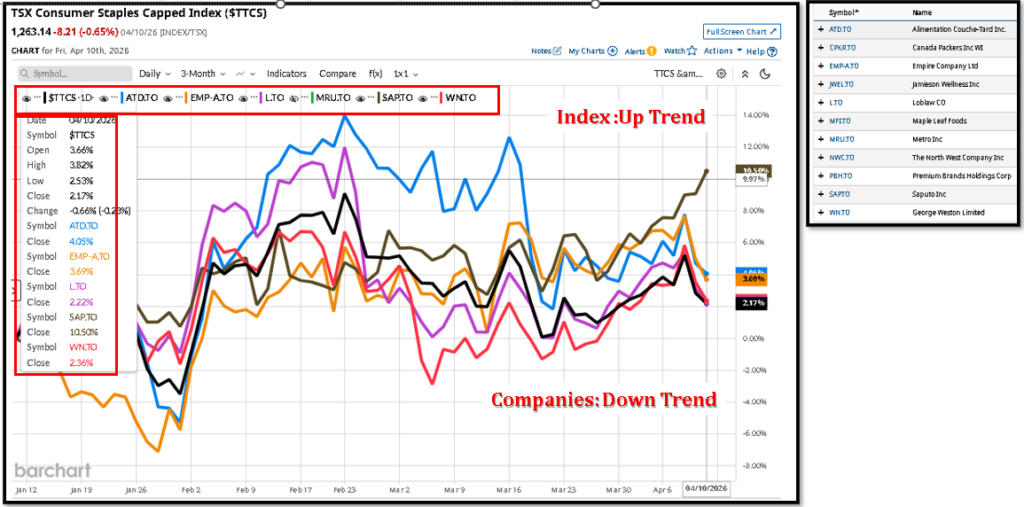
S&P/TSX Consumer Staples Index moving opposite companies in 3 month daily chart
Consumer Staples is a small sector on the TSX (only ~3.3% of the composite), so a handful of large-cap movers like Couche-Tard (ATD) and Loblaw (L) dominate the index weight. If those two move in one direction and mid-caps like Saputo or Jamieson move in another, the index can appear to diverge from most of its members — a weighted average masking dispersion underneath.
The United States and Iran began negotiations Saturday in Pakistan, days after a fragile, two-week ceasefire was announced, as the war that has killed thousands of people and shaken global markets entered its seventh week.
Iran’s state-run news agency said three-party talks had begun after Iranian preconditions, including a reduction in Israeli strikes on southern Lebanon, were met, and after U.S. and Iranian officials met separately with Pakistani Prime Minister Shehbaz Sharif. There were no immediate further details, nor U.S. comment.
The U.S. delegation led by Vice President JD Vance and the Iranian delegation led by Parliament Speaker Mohammad Bagher Qalibaf were discussing how to advance the ceasefire already threatened by deep disagreements and Israel’s continued attacks against the Iranian-backed Hezbollah in Lebanon.
“I cannot say whether they are sitting in the same room or in separate rooms, but talks have started and are progressing well,” said one Pakistani official with knowledge of the peace efforts, speaking on condition of anonymity because they were not authorized to talk to the media.
Iran sets ‘red lines’ including compensation for strikes
Iran doubled down on parts of its earlier proposal, with its delegation telling Iranian state television it had presented some of the plan’s ideas as “red lines” in meetings with Sharif. Those included compensation for damage caused by the U.S.-Israeli strikes that launched the war on Feb. 28 and releasing Iran’s frozen assets.
A man visits the grave of a friend who was killed in an Israeli airstrike in Tyre, Lebanon. So far the war has killed at least 1,953 in Lebanon alone.Chris McGrath/Getty Images
The war has killed at least 3,000 people in Iran, 1,953 in Lebanon, 23 in Israel and more than a dozen in Gulf Arab states. Iran’s chokehold on the vital Strait of Hormuz has largely cut off the Persian Gulf and its oil and gas exports from the global economy, sending energy prices soaring. Attacks have caused lasting damage on infrastructure in half a dozen countries in the Middle East.
In Tehran, residents told The Associated Press they were skeptical yet hopeful about the talks after weeks of airstrikes left destruction across their country of some 93 million people. Some said the path to recovery would be long.
“Peace alone is not enough for our country, because we’ve been hit very hard, there have been huge costs,” 62-year-old Amir Razzai Far said.
Meanwhile, Israel pressed ahead with strikes in Lebanon after saying there is no ceasefire there. Iran and Pakistan have disagreed. The Lebanese state-run news agency reported at least three people killed. There were no reported strikes in the afternoon.
Officials posture over key issues ahead of talks
U.S. and Iranian officials claimed leverage and issued new demands and preconditions as talks approached. U.S. President Donald Trump posted repeatedly on social media leading up to Saturday, saying Iranian officials “have no cards” to negotiate with.
“The only reason they are alive today is to negotiate!” he wrote.
He accused Iran of using the Strait of Hormuz, a key artery for global energy supplies, for extortion, and told reporters Friday it would be opened “with or without them.”
On Saturday, Trump said on social media that the U.S. had begun “clearing out” the strait, but it was unclear whether he was referring to the reported use of mines there or Iran’s broader ability to control the area.
Major roads in Islamabad are closed on Saturday as U.S. and Iranian officials arrive to hold separate talks with Pakistan’s prime minister.Akhtar Soomro/Reuters
Islamabad was deserted as security forces sealed roads and authorities urged residents to stay inside.
Vance said Friday that the U.S. was optimistic about the talks, but warned: “If they’re going to try and play us, then they’re going to find that the negotiating team is not that receptive.”
Iranian Foreign Minister Abbas Araghchi had said Tehran was entering negotiations with “deep distrust” after strikes on Iran during previous rounds of talks. Araghchi, who is part of Iran’s delegation in Pakistan, said Saturday that his country was prepared to retaliate if attacked again.
Iran and the United States outlined competing proposals ahead of the talks reflecting the wide gulf on key issues.
Iran’s 10-point proposal called for a guaranteed end to the war and sought control over the Strait of Hormuz. It included ending fighting against Iran’s “regional allies,” explicitly calling for a halt to Israeli strikes on Hezbollah.
The United States’ 15-point proposal includes restricting Iran’s nuclear program and reopening the strait.
Israel and Lebanon will have direct negotiations
Smoke rises following an airstrike in Lebanon, as seen from Israeli side of the border on Saturday.Amir Cohen/Reuters
Negotiations between Israel and Lebanon are expected to begin Tuesday in Washington, Lebanese President Joseph Aoun’s office said Friday, after Israel’s surprise announcement authorizing talks despite the countries lack of official relations.
Israel wants the Lebanese government to assume responsibility for disarming Hezbollah, much like was envisaged in a November 2024 ceasefire. But it is unclear whether Lebanon’s army can confiscate weapons from the militant group, which has survived efforts to curb its strength for decades.
Israel’s insistence that the ceasefire in Iran does not include a pause in its fighting with Hezbollah has threatened to sink the deal. The militant group joined the war in support of Iran in the opening days. Israel followed up with airstrikes and a ground invasion.
The day the Iran ceasefire deal was announced, Israel pounded Beirut with airstrikes, killing more than 300 people in the deadliest day in Lebanon since the war began, according to the country’s Health Ministry.
Mourners pray at the funeral of a family that was killed Wednesday in Israeli strikes on Beirut, before they are buried in the village of al-Sour, northeastern Syria, on Saturday.Ghaith Alsayed/The Associated Press
Strait of Hormuz remains a sticking point
Iran’s closure of the Strait of Hormuz has proved its biggest strategic advantage in the war. Commercial vessels have avoided the strait, effectively blocking the passage of oil, natural gas and fertilizer.
The spot price of Brent crude, the international standard for oil prices, was above $94 on Saturday, up more than 30% since the war started.
Before the conflict, around a fifth of the world’s traded oil typically passed through the strait on more than 100 ships a day. With the ceasefire in place, only 12 have been recorded transiting.
Iran has floated the idea of charging ships passing through as part of a peace deal, though the idea has been widely rejected by countries including the United States and Iran’s neighbor Oman.
Trump posts about ‘clearing’ Strait of Hormuz
Trump on Saturday posted on social media that the United States military has started to clear the Strait of Hormuz, and that all of Iran’s minelaying ships have been sunk. “We’re now starting the process of clearing out the Strait of Hormuz,” Trump wrote in a Truth Social post, adding that “all 28” of Iran’s “mine dropper boats are also lying at the bottom of the sea”.
Minutes before Trump’s post, reports started to emerge about the presence of U.S. naval ships in the strait.
An Axios journalist, citing an unnamed U.S. official, posted that “several” U.S. ships had crossed the strait on Saturday, though Iranian state TV soon after reported a denial from an official with Iran’s military.
Trump has repeatedly said that American forces have destroyed Iran’s navy and air force while crippling its ballistic missile and nuclear programs.
But fear of Iranian attacks on shipping over the past several weeks has effectively closed the Strait of Hormuz, a critical conduit for global oil supplies. Throttling the strait has disrupted global energy markets.
U.S. gasoline prices have spiked even though most of the oil that flows through the waterway does not go to the United States.
Canada’s economy added a modest 14,000 jobs in March, Statistics Canada said on Friday, clawing back a fraction of the sharp job losses seen during the first two months of the year.
The data agency’s previous Labour Force Survey from February showed a loss of 84,000 jobs, a result that was largely a surprise to economists and analysts.
Given the earlier losses, “no one is going to mistake this small back-up as a sign of strength,” wrote Douglas Porter, chief economist at Bank of Montreal, in a note to clients.
“Still, even a small plus sign is a positive, as is the stable jobless rate,” wrote Porter. The unemployment rate was unchanged at 6.7 per cent, and there was little variation in the number of full- and part-time employees in March.
Employment was up in the natural resources industry and the “other services” industry, which includes sectors like personal and repair services. Jobs declined in finance, insurance, real estate, rental and leasing.
The number of private and public sector workers was little changed, though the number of workers in the public sector has been growing at a faster rate on a yearly basis.
Average hourly wages were up 4.7 per cent, or $1.68, for a total average hourly wage of $37.73, which Statistics Canada noted is the highest growth rate for wages since October 2024.
“The only really new news here is that wages seemingly popped, which the Bank of Canada will keep on eye on, particularly as it is already on high alert for signs of any spillover from higher energy prices to broader inflation,” wrote Porter.
The Bank of Canada’s next interest rate announcement is on April 29.
Introduced in 2009, the Tax-Free Savings Account (TFSA) is available to Canadian residents age 18 or older. In addition to cash, a TFSA can hold several other investments such as bonds, stocks, and mutual funds. Any interest income, dividends or capital gains earned in the account are not taxed and withdrawals can be made tax-free. There is an annual TFSA contribution limit of $7,000 for 2026, and any unused contributions from one year can be carried forward to the next year. Your contribution room, the maximum amount you can deposit to your TFSA, consists of the current year’s contribution limit, any unused contribution room that you have accumulated from previous years and the total value of withdrawals made in the previous year. Any contribution made to a TFSA beyond the maximum amount is considered an over-contribution, and the Canada Revenue Agency (CRA) will charge a penalty of 1 per cent per month on the excess contribution until it is withdrawn.
Use the TFSA Limit calculator to determine your 2026 TFSA contribution room limit.