
Markets update
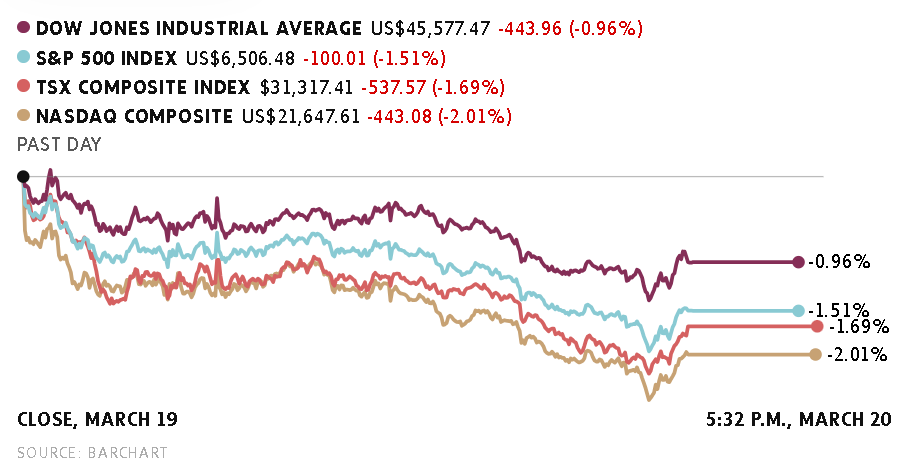
- Stocks ended sharply lower, as the U.S.-Israeli war against Iran entered its fourth week, deepening worries about inflation and the potential for higher interest rates. The U.S. military was deploying a large amphibious assault ship with thousands of additional Marines and sailors to the Middle East, while Iran’s new supreme leader hailed Iran’s “unity” and “resistance.”
- The S&P 500 declined 1.51% to end the session at 6,506.48 points, its lowest since September. The Nasdaq slumped 2.01% to 21,647.61 points, leaving it down almost 10% from its record high close on October 29. The Dow Jones Industrial Average declined 0.96% to 45,577.47 points.
- The S&P/TSX composite index was down 1.69%, at 31,317.23. All major sectors on the TSX were in negative territory, with materials leading losses, down 3.1%. Energy stocks fell 0.6%. The TSX fell 3.8% this week and closed at its lowest level since December, extending its total decline since the Iran war began to nearly 9%.
- Short-term bond yields were sharply higher in both the U.S. and Canada. Money markets are now fully pricing in a quarter-point interest rate hike by the Bank of Canada by this July’s policy meeting. Almost three quarter-point rate hikes are priced in by the end of this year. Canada’s 2-year bond yield, sensitive to central bank policy moves, was up 23 basis points by late afternoon to its highest level in more than a year. For the Fed, interest-rate futures were pricing around a 25% chance of a rate hike by December.
- Oil prices jumped to their highest in nearly four years, as Iraq declared force majeure on all oilfields developed by foreign oil firms. Brent futures for May settled up $3.54, or 3.26%, to $112.19 a barrel, the highest since July 2022. U.S. West Texas Intermediate crude futures for April, which expired on Friday, settled up $2.18, or 2.27%, at $98.32.
- Gold prices fell nearly 2 per cent as the U.S. dollar strengthened.
Leave a Reply
You must be logged in to post a comment.