
In last year’s federal budget, Prime Minister Mark Carney promised to shrink the public service and boost defence spending.
We’re starting to see how those policies are playing out across Canada’s economy.
When Statistics Canada this week released gross domestic product numbers for April, which showed a healthy rebound after months of sluggish growth, the agency noted the public sector contributed to the lift. Federal public administration, excluding defence, posted its first month-over-month increase since December, it said.
Despite that gain, the sector experienced the sharpest yearly decline in real GDP since Statscan began publishing such data in 1997, shrinking by nearly 10 per cent from April, 2025.
At the same time, federal defence real GDP is rising at its fastest pace ever.
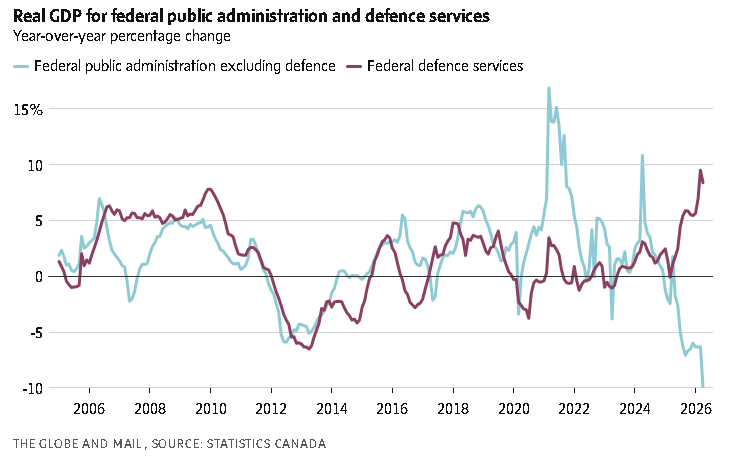
Measuring the economic output of public administration isn’t as straightforward as other sectors such as retail or manufacturing because government services aren’t bought and sold in a marketplace that establishes price and value.
As such, Statscan relies heavily on public service compensation to gauge activity, and at the federal level, employee head counts are tumbling.
In fiscal 2025-26, which ended March 31, federal employment fell by 3.5 per cent from the year before, the steepest drop since the round of job cuts implemented by then-prime-minister Stephen Harper in 2012-13, according to numbers released last week by the Treasury Board of Canada Secretariat.
And that decline occurred despite a nearly 10-per-cent jump in employment at National Defence from the year before, as Canada ramped up military spending to meet the North Atlantic Treaty Organization’s defence expenditure target of 2 per cent of GDP.
While the monthly uptick in federal public administration GDP in April could mean the sector is stabilizing, the Carney government likely isn’t done downsizing. Last year’s budget set a target for federal employment of 330,000 by fiscal 2028-29, another 4.4-per-cent drop from current levels.
Leave a Reply
You must be logged in to post a comment.