
On July 20, 2026, President Trump signed three separate proclamations under Section 338 of the Tariff Act of 1930, adding a 50% tariff on select Canadian goods, taking effect August 19, 2026.
The mechanism is unusual. Section 338 lets the President impose duties up to 50% on a country found to discriminate against U.S. commerce, without requiring an ITC investigation or a national-security finding — the process Section 232 tariffs go through. It had last been used in 1949, so this is effectively its first modern use, and trade lawyers are calling it untested legal territory.
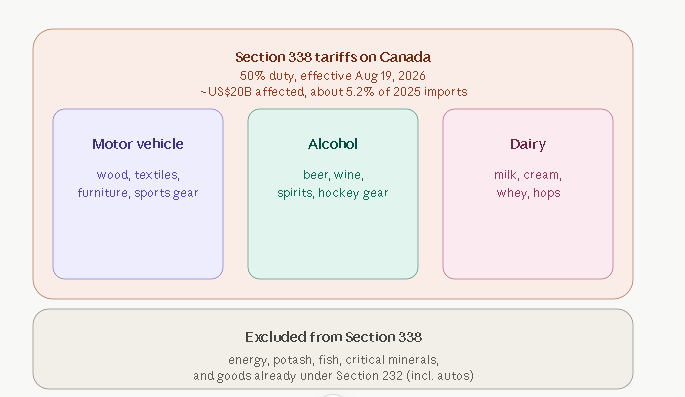
Despite the name, “motor vehicle proclamation” doesn’t tax cars. Canadian autos and auto parts are already covered by existing Section 232 tariffs, so they’re excluded here. Instead, that proclamation’s annex covers wood, plywood, furniture, textiles, and sporting goods — the auto dispute is the stated justification, but the actual tariffed products are unrelated. The alcohol proclamation similarly reaches beyond beer, wine, and spirits into odd inclusions like hockey sticks. The dairy proclamation covers milk, cream, whey, and hops.
Scale: the U.S. Trade Representative puts total exposure at roughly $20 billion — about 5.2% of the $382 billion in goods the U.S. imported from Canada in 2025. So this is broad in the number of product categories hit, but narrow relative to total trade.
What’s excluded: energy, potash, fish, critical minerals, civil aircraft parts, and anything already under Section 232 (including autos).
One detail catching importers off guard: these tariffs apply even to goods with a valid USMCA certificate of origin — unlike most other tariff actions, USMCA-qualifying status doesn’t exempt you here.
The stated grievances are Canadian dairy supply management, provincial restrictions on U.S. alcohol, and retaliatory Canadian auto tariffs — but many Canadian measures were themselves retaliation against earlier U.S. steel and aluminum tariffs, so there’s a circular dynamic. The 30-day window before the tariffs bite is widely read as a negotiating device ahead of a possible USMCA renegotiation, not a fixed, permanent policy.
Why This Tariff?
President Trump signed three separate proclamations under Section 338 of the Tariff Act of 1930 (an old authority allowing up to 50% punitive tariffs against countries deemed to discriminate against U.S. commerce). This is reportedly its first modern use for this purpose.
The stated rationale is to offset Canada’s “discriminatory” practices against U.S. products in three areas:
- Motor vehicles: Canada’s 25% tariffs/quotas on certain U.S. cars (not fully USMCA-eligible) and policies that allegedly favor non-U.S. producers or pressure U.S. firms to produce in Canada.
- Alcoholic beverages: Most Canadian provinces/territories restricted or halted U.S. beer, wine, and spirits sales/distribution (a retaliation to prior U.S. actions).
- Dairy: Canada’s supply management system and tighter tariff-rate quotas on U.S. cheese/dairy compared to the EU.
These build on ongoing tensions, including earlier Section 232 national security tariffs (e.g., steel/aluminum at 50%) and disputes tied to border issues. The new tariffs apply on top of existing duties and override USMCA preferences for covered goods (no carve-out for originating products).
Estimated impact: Covers roughly $20 billion in Canadian exports (about 5% of total U.S. imports from Canada). There is a 30-day window for potential negotiations.
Exemptions
- Energy products (oil, gas, etc.)
- Potash
- Critical minerals
- Fish
- Goods already subject to Section 232 tariffs (e.g., certain steel, aluminum, autos, lumber, copper)
Impacted Sectors and Goods
The tariffs are structured across the three proclamations, with broad lists (hundreds of HTSUS codes, over 400–550 subheadings total). The “Motor Vehicles” proclamation is the broadest and covers mostly non-auto items as retaliation.
Here are the main affected sectors and examples:
1. Alcoholic Beverages Proclamation (tied to booze restrictions):
- Beer, wine, sparkling wine, cider, vermouth, sake, ethyl alcohol, brandy, whisky, rum, gin, vodka, liqueurs, tequila.
- Related items: Grapefruit essential oils, wooden tableware, certain papers/paperboard, bamboo products, ice hockey and field hockey equipment (including sticks).
2. Dairy Proclamation (tied to dairy protectionism):
- Milk, cream (powdered, concentrated), whey and whey protein concentrates, lactose, casein, milk albumin, gelatin, and dairy-derived ingredients.
- Some sugar/molasses products linked to dairy quotas.
3. Motor Vehicles Proclamation (broadest retaliation basket, not primarily vehicles):
- Building materials: Cement (e.g., Portland cement), plywood, wood products.
- Agricultural/animal products: Honey, seeds/bulbs, down feathers, animal bones/horns, certain pharma-related animal products.
- Consumer goods: Furniture, apparel/textiles (clothing, T-shirts, sweaters), toys, sporting goods, swimming pools, fishing rods, Christmas ornaments, wigs, decorative glassware, jewelry, fine art/antiques, leather goods/luggage.
- Industrial/manufactured: Machinery, electronics, hand tools, lighting, chemicals, plastics, paper products, cosmetics.
Overall: Over 400–550 tariff lines spanning agriculture, food/beverages, building materials, consumer products, sporting goods, apparel, machinery, and more. It hits both consumer-facing items (wine, hockey gear, dairy) and industrial ones (cement, furniture, paper).
Key Context and Effects
- Who pays? U.S. importers (ultimately often passed to businesses and consumers via higher prices).
- Broader trade war: This escalates existing tariffs. Canada has retaliated in the past and may respond again. Integrated North American supply chains (especially autos, though partially exempted here) mean ripple effects.
- Goal: Pressure Canada into better market access for U.S. goods and concessions in USMCA renegotiations.
This is a protectionist negotiating tactic typical of Trump’s approach—using tariffs for leverage on specific disputes while exempting strategically important flows like energy. Impacts will vary by sector; exporters in hit categories face higher barriers, while exempted ones (energy) are shielded. For the latest official lists, check the White House proclamations and annexes.
Leave a Reply
You must be logged in to post a comment.