
Telus Corp. T-T -11.27%decrease surprised investors Friday with a higher-than-expected 55-per-cent dividend cut while lowering its financial guidance for the year as new chief executive officer Victor Dodig reorients the telecom and technology company in a bid to improve its finances.
The company was widely expected to cut its quarterly dividend, but analysts did not expect it to fall to 18.75 cents per share from 41.84 cents previously.
In a Friday morning note to investors, TD Cowen analyst Vince Valentini said the dividend cut and changes to the financial guidance for the rest of the year “were much worse than expected.”
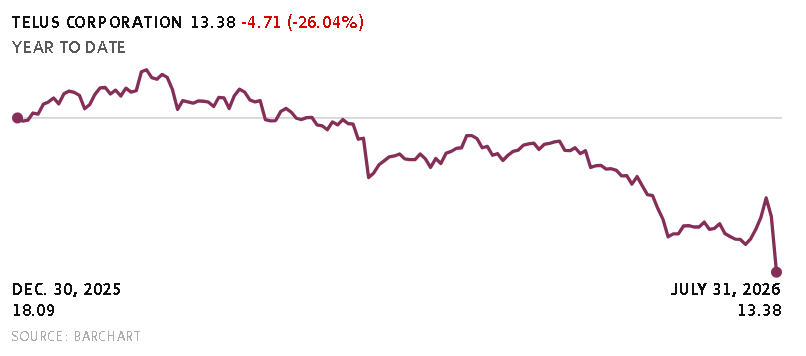
Telus shares closed down more than 11 per cent to $13.38 on the Toronto Stock Exchange as investors digested the news. Including the latest drop, the shares have fallen almost 52 per cent over the last five years, and almost 26 per cent since the beginning of the year.
“We’re resetting the company for the long term,” Mr. Dodig said in an interview with The Globe on Friday morning.
He acknowledged that the dividend reset was widely anticipated by investors. “We believe that it’s something that was necessary,” he said. “We now have the ability to invest as we grow our company.”
Mr. Dodig said the company’s decision to push back its debt-reduction target by a year to the end of 2028, and lower its financial guidance for 2026, reflect “what we see as the reality,” as the company pursues sales of some of its assets and undertakes a shift in strategy. He said the company has plans to grow revenue faster, simplify its business and redirect spending to the highest areas of growth.
The shifts announced Friday represent an “abbreviated detour as we reset,” Mr. Dodig said. “I’m confident in the way forward.”
Analysts have been raising concerns about Telus’s dividend growth plans since last year, when some called its previous plans to continue increasing its dividend unsustainable. Telus paused dividend growth last November, but has faced ongoing pressure from Bay Street to cut the payout.
The company said Friday the dividend cut is expected to generate about $2.7-billion in cash savings through 2028, which will be used to reduce its long-term debt.
In another early note Friday, Bank of Nova Scotia analyst Maher Yaghi said the dividend cut was needed to restore the company’s financial flexibility.
“The action is the right one, but the size of the guidance reduction shows it was not discretionary,” he said.
The company also reported a net loss of $1.8-billion in the second quarter after recording a $2.1-billion writedown for its Telus Digital unit.
“Some of the growth and spending that we’re seeing from clients going forward has abated somewhat. The goodwill writedown reflects all of that,” Mr. Dodig said.
Outgoing Telus CEO presents sunny view of his tenure, despite stock price challenges
Telus said it expects revenue for the year to be flat or fall up to 2 per cent, compared to prior guidance in May of a revenue increase of 2 to 4 per cent. The company said its adjusted earnings before interest, taxes, depreciation and amortization (EBITDA) is now expected to fall by 2 to 4 per cent for the year, compared to prior guidance of growth of 2 to 4 per cent. Full-year cash flow is expected to be $1.8-billion this year, down from the prior estimate of $2.45-billion or by about 27 per cent.
Telus also said it plans to reduce its net debt to EBITDA ratio to about three times by the end of 2028 – a debt-reduction target it had previously expected to reach by the end of 2027.
Telus also said Friday it will eliminate the discount it offers investors who use the company’s dividend reinvestment plan (DRIP). The plan allowed shareholders to receive their dividend payments in shares priced below current market value. The change will be effective Oct. 1.
Friday’s announcements mark a turning point for the company’s financial strategy under the new leadership. Darren Entwistle, who retired at the end of July after 25 years at the helm, told The Globe last month that he would have “stayed the course” on the dividend, but acknowledged at the time that his successor, Mr. Dodig, may do otherwise.
On Bay Street, Mr. Dodig became known for turning around the financial performance and share price of The Canadian Imperial Bank of Commerce, which was underperforming its peers when he began as CEO.
Now, he is taking on Telus in the middle of major transformation amid a challenging time for the industry as a whole, as population growth has slowed and wireless prices have been forced down by greater competition.
Telus makes first leadership changes under new CEO Dodig
In addition to a dividend cut, analysts have suggested Telus could divest of a range of non-core assets – from its venture portfolio and surplus real estate to a greater proportion of its health business, which it is currently attempting to monetize.
The company did not share significant details on the progress of those attempts. Mr. Dodig said the company is waiting for the right investor who recognizes an asset’s full value. “We are not out there to sell anything at any price,” he said.
Mr. Dodig told analysts on a call Friday that he will focus on retaining the company’s “crown jewels” and will announce asset sales going forward. “I think you’ll see a much more simplified Telus over time.”
He said Telus Health, Telus Digital and Telus Agriculture are all good businesses, but he will focus “on those we believe should be monetized because they’re better off in the hands of another owner, and do that in a thoughtful manner.”
In a July note to investors, Mr. Valentinicalculated that the company could hypothetically make upward of $8-billion and significantly lower its debt leverage if it were to divest of all its non-core assets, although he said this was an “extreme scenario.” He estimated the company would cut its dividend by 30 per cent.
Mr. Yaghi said in a note earlier in the month that a roughly 50-per-cent dividend cut “would create the financial flexibility needed to begin repairing the balance sheet and reset the equity story on a more sustainable footing.”
It’s not the only dividend cut that Canadian investors have witnessed recently. Last year, rival telecom BCE Inc. BCE-T unchno change slashed its own dividend by more than 50 per cent in order to allocate that cash elsewhere.
Editor’s note: A previous version of the story included incorrect information about the current dividend yield based on today’s share price, which has been removed. The article was further corrected to state that last year BCE cut its dividend by more than 50 per cent, and to correct the spelling of TD Cowen.
Sign up for our new Business Brief newsletter.
A daily look at the most
Leave a Reply
You must be logged in to post a comment.