
Summary
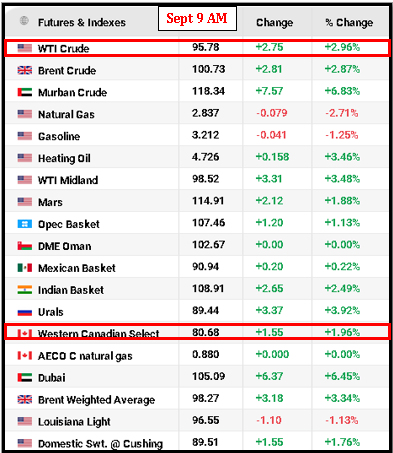
- WTI is approximately US$95–96/bbl as of September 9, 2026, driven mainly by escalating U.S.–Iran conflict and impaired Middle East shipping.
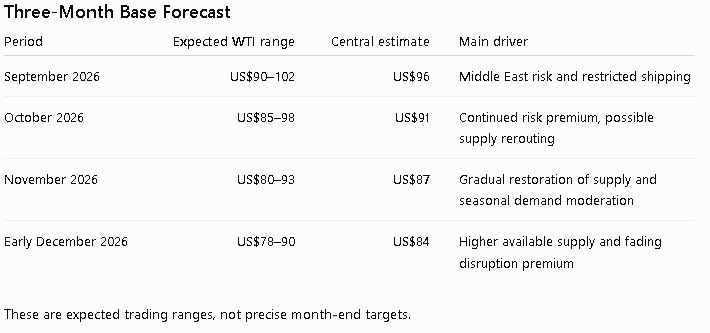
- My base case is for the geopolitical premium to decline gradually, taking WTI toward US$80–90 by early December.
- Estimated average over the next three months: US$86–92/bbl.
- Futures support a declining path: October is near US$96, November US$92 and December US$89—strong backwardation.
- The forecast carries unusually high uncertainty because developments around Iran, Saudi infrastructure and the Strait of Hormuz outweigh normal supply-demand factors.
Key Drivers
1. Strait of Hormuz and Iran — dominant short-term driver
WTI has risen roughly 20% over the past month. The immediate cause is concern about Middle East oil production, tanker movements and attacks on regional infrastructure. WTI traded near US$95.70, while Brent moved above US$100 on September 9. Reuters
A ceasefire or material improvement in tanker traffic could remove US$10–20/bbl of risk premium relatively quickly. Damage to major Saudi or Gulf infrastructure could instead push WTI above US$110.
2. Futures curve anticipates lower prices
| Contract | Approximate price, September 9 |
|---|---|
| October 2026 | US$95.72 |
| November 2026 | US$92.45 |
| December 2026 | US$88.96 |
The downward curve indicates that the market expects current shortages and geopolitical risks to ease. It does not guarantee that outcome. MarketWatch futures data
3. EIA expects supply recovery
The U.S. Energy Information Administration expects Brent to average approximately US$78/bbl in Q4 2026, based on recovering Strait of Hormuz traffic, restarted production and eventually rebuilding inventories. WTI normally trades below Brent, although the spread is unusually uncertain during shipping disruptions. U.S. EIA
My base forecast is higher than the EIA model because the current conflict remains active and December WTI futures are still close to US$89.
4. Demand and OPEC+
OPEC currently forecasts only about 0.6 million barrels per day of global demand growth in 2026, limiting fundamental support once the geopolitical premium fades. OPEC Monthly Oil Market Report
OPEC+ could support prices by delaying production increases. Conversely, increased Gulf production or weak Chinese demand would accelerate a decline.
Scenarios
| Scenario | Probability | Three-month WTI outcome | Conditions |
|---|---|---|---|
| Bull | 25% | US$105–125 | Hormuz disruption worsens; Saudi/Gulf facilities damaged; OPEC+ cannot compensate |
| Base | 50% | US$80–90 by December | Shipping gradually improves; outages recover; conflict remains contained |
| Bear | 25% | US$65–78 | Ceasefire, rapid supply restoration, weaker global demand and inventory rebuilding |
TSX Implications
| WTI level | Likely Canadian market effect |
|---|---|
| Above US$100 | Strong cash flow for CNQ, SU and IMO; positive for the TSX Energy sector, but inflation and interest-rate risks rise |
| US$80–90 | Still constructive for major producers; supports dividends and buybacks without as severe an inflation shock |
| Below US$70 | Pressure on smaller, higher-cost producers; integrated producers and pipelines remain relatively more resilient |
What Would Disprove the Base Case
- WTI holds above US$100 for several weeks despite attempted supply restoration.
- Strait of Hormuz traffic deteriorates rather than improves.
- Verified damage materially reduces Saudi or other Gulf production.
- December futures move above October futures, signalling expected shortages rather than normalization.
- Conversely, a ceasefire combined with rapid inventory rebuilding could push WTI below the base range much sooner.
Base conclusion: WTI is likely to remain elevated and volatile during September, but the balance of evidence points toward US$80–90 by early December, with a three-month average around US$89/bbl.
Educational analysis only; geopolitical developments can invalidate commodity forecasts quickly.
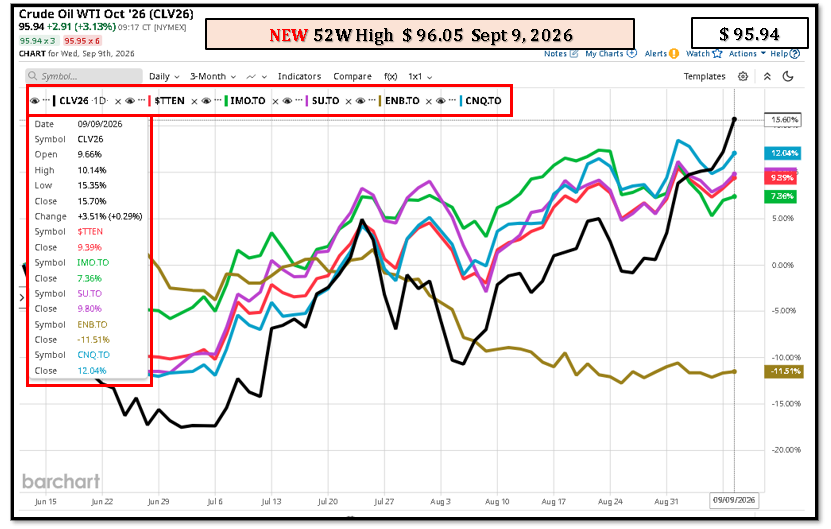
Crude Oil – NEW 52W High
Leave a Reply
You must be logged in to post a comment.