Canada’s economy more than tripled expectations by adding 63,800 jobs in September and wages continued to soar, data showed on Friday, upping the chances for another rate hike.
The jobless rate stayed at 5.5 per cent for a third consecutive month, Statistics Canada said. Analysts polled by Reuters had forecast a net gain of 20,000 jobs and for the unemployment rate to edge up to 5.6 per cent from 5.5 per cent in August.
The average hourly wage for permanent employees rose 5.3 per cent from September 2022, up from the 5.2 per cent annual rise in August.
“That employment report today really blew away market expectations. Wage growth is also beating market expectations,” said Michael Greenberg, a portfolio manager for Franklin Templeton Investment Solutions.
“Despite the aggressive rate hikes by the Bank of Canada, clearly demand remains strong and companies continue to hire. This suggests we could well see another rate hike in November or December,” Greenberg said.
The central bank, which has hiked rates 10 times in the past 18 months, has stressed that it will be hard to fully curb inflation if wages maintain their current patterns of rising between 4 per cent and 5 per cent annually.
The monthly, seasonally adjusted and annualized gain for average hourly wages on permanent employees was 8.3 per cent in September, said Derek Holt, vice president of capital markets economics at Scotiabank.
“Wages are just going off the charts,” Holt said. “With wage numbers like this and the fact that we haven’t had a soft patch on core inflation measures in Canada like they’ve had in the U.S., I would think we’re still in hike mode in October.”
Money markets increased bets for a rate increase later this month after the jobs figures were published. They now see about a 38 per cent chance for a hike later this month compared to a 28 per cent chance before the data.
The Canadian dollar edged 0.1 per cent lower to 1.3718 per greenback, or 72.90 U.S. cents, as U.S. job growth also beat expectations.
The Canadian 10-year yield was up 12 basis points at 4.255 per cent, trading near a 16-year high.
Canada’s labour market, supported by strong immigration, has been resilient even as the Bank of Canada raised its key overnight rate to a 22-year high of 5 per cent to cool the economy.
“The upward trend in employment continues to occur in the context of the highest rate of population growth since 1957,” Statscan said, noting that the population aged 15 and older increased by 82,000 in September.
The Bank of Canada make its next policy announcement and updates its economic forecasts on Oct. 25.
With September’s robust gains, the economy is averaging 30,000 monthly employment growth this year, up from 25,000 a month earlier.
Part-time employment growth, which has been outpacing a rise in full-time work this year, drove the gains in August with a net 48,000 positions added in the month, Statscan said.
Employment in the services sector increased by a net 74,300 jobs, mostly in educational services, and more than offset 10,500 positions lost in the goods sector.
ADP reported that private job growth totaled just 89,000 for the month, down from an upwardly revised 180,000 in August and below the 160,000 estimate from Dow Jones.
Job gains came almost exclusively from services, which contributed 81,000 to the total.
The report comes a day after the Labor Department said job openings unexpectedly rose sharply in August.
It’s turning out to be another weak outing for stocks on Bay Street, with investors pressing sales at several counters across the board on Tuesday, as U.S. Treasury yields rise to 16-year high amid worries about interest rates.
Real estate, technology, financials and healthcare stocks are among the major losers. Several stocks from consumer discretionary, materials and energy sectors are also notably lower.
The benchmark S&P/TSX Composite Index, which dropped to 18,945.79, losing more than 210 points in the process, is down 152.61 points or 0.8% at 19,024.57 a few minutes past noon.
Technology stocks Shopify Inc (SHOP.TO), Celestica Inc (CLS.TO), Lightspeed Commerce (LSPD.TO), Tecsys Inc (TCS.TO), Open Text Corp (OTEX.TO), Kinaxis Inc (KXS.TO), Docebo Inc (DCBO.TO), Enghouse Systems (ENGH.TO) and Descartes Systems (DSG.TO) are down 2 to 4%.
In the financials section, Bank of Nova Scotia (BNS.TO), Royal Bank of Canada (RY.TO), Sun Life Financial (SLF.TO), Canadian Imperial Bank of Commerce (CM.TO), Laurentian Bank (LB.TO) and CDN Western Bank (CWB.TO) are declining 1.7 to 2.5%.
Among other prominent losers, Atco Ltd (ACO.Y.TO) is down nearly 7%. Teck Resources (TECK.A.TO) is down 3.5%. Nutrien (NTR.TO), Goeasy (GSY.TO) and West Fraser Timber (WFG.TO) are down 2 to 3%.
Park Lawn Corporation (PLC.TO) is gaining about 4.2%. Boralex (BLX.TO) and Sprott Inc (SII.TO) are up 2.2% and 1.7%, respectively. Agnico Eagle Mines (AEM.TO), Bombardier Inc (BBD.B.TO), Rogers Communications (RCI.B.TO) and Canadian Pacific Kansas City (CP.TO) are gaining 1 to 1.5%.
Canada’s benchmark stock index closed down 1.8% on Monday to its lowest in almost a year in a selloff that far outpaced Wall Street and inflicted damage on dividend-rich sectors such as utilities and financials in addition to resource stocks.
By contrast, the S&P 500 ended nearly flat, though utilities – an industry that carries considerable debt loads that are vulnerable to higher interest rates – also fell sharply. The Nasdaq edged higher.
Benchmark 10-year U.S. Treasury yields hit 16-year highs, as an agreement to avert a partial government shutdown reduced demand for the debt before key jobs data due later this week.
“U.S. Treasury yields continue to march higher and that’s just crushing the dividend-paying stocks like utilities in Canada,” said Douglas Porter, chief economist of BMO Capital Markets.
Dividend stocks are particularly vulnerable to higher yields as they are relatively less attractive when safer securities such as money market funds are sporting higher interest rate payouts. Meanwhile, higher yields also drive up the U.S. dollar, which in turn puts pressure on commodities that are priced in greenbacks. The TSX has a particularly heavy weighting in both resource and dividend-paying stocks.
The U.S. Congress passed a stopgap funding bill late on Saturday with overwhelming Democratic support after Republican House Speaker Kevin McCarthy backed down from an earlier demand by his party’s hardliners for a partisan bill.
The agreement takes away the risk that the release of government data will be delayed, which would have been likely to keep the Federal Reserve on the sidelines.
“If we had had a shutdown, that really would have put the Fed in a really tough spot for that November meeting,” said Michael Lorizio, senior fixed income trader at Manulife Investment Management in Boston. “You would have essentially had to price out any chance of any sort of Fed action if they had no data to base their next move on.”
The Fed said last month that it may raise interest rates again as it battles to bring inflation closer to its 2% annual target, and that it is likely to hold rates higher for longer.
Fed Chairman Jerome Powell on Monday said that the U.S. central bank is striving to foster a sustained, strong labor market and that price stability is needed in order to achieve that. Fed Governor Michelle Bowman also said Monday that she remains willing to support another increase in the central bank’s policy interest rate at a future meeting if upcoming data shows progress on inflation is stalling or proceeding too slowly.
Fed funds futures traders are pricing in a 26% chance of a rate hike in November, and a 45% likelihood of an increase by December, according to the CME Group’s FedWatch Tool.
Benchmark 10-year Treasury yields reached 4.703%, the highest since October 2007. The yields also rose 48 basis points in September, the largest monthly increase in a year. Canadian bonds largely take their cue from U.S. Treasuries, though the Canadian bond market was closed for a holiday on Monday.
Economic data will be key to when yields are likely to reverse direction, with market participants on the lookout for signs of weakness.
“Deteriorating fundamentals of the U.S. economy is what it will take for rates to materially move lower,” Lorizio said. “There’s reason to believe that if there is evidence of deterioration then all of a sudden U.S. Treasuries become really, really attractive at these elevated rate levels.”
Analysts at JPMorgan said in a report on Friday that the U.S. economy faces “numerous headwinds” in the fourth quarter and “the Fed is most likely done tightening. Against this backdrop, Treasury yields should be finding a peak.”
That said, they added, “we are cognizant that the technical forces driving yields higher over the past few weeks may not yet be behind us.”
This week’s main U.S. economic focus is Friday’s jobs report for September, which is expected to show that employers added 170,000 jobs during the month.
Economic data on Monday showed U.S. factory activity decreased at a shallower-than-expected pace in September, while U.S. construction spending increased in August.
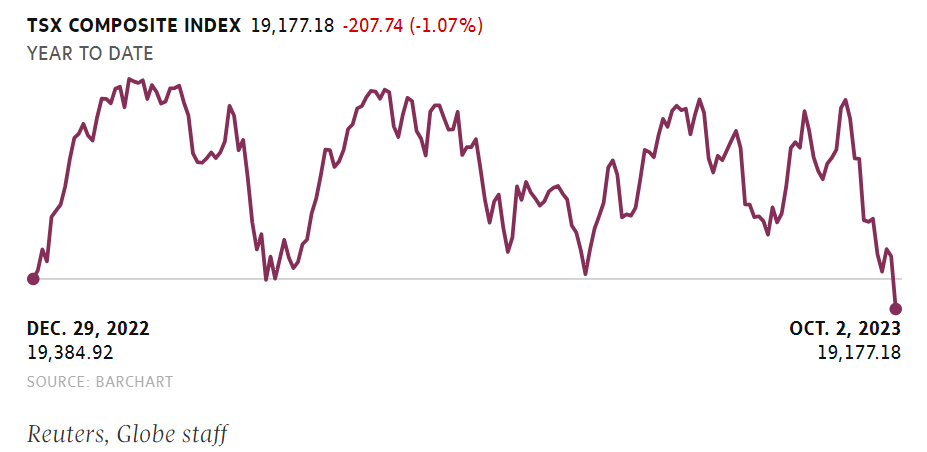
The S&P/TSX composite index was down 364.09 points at 19,177.18, hitting its lowest levels since October of last year. The benchmark index lost 3.7% in September and 3% for the third quarter.
Data showed Canada’s manufacturing sector downturn deepened in September to its lowest level since shortly after the start of the COVID-19 pandemic as weak market demand weighed on production and new orders. The S&P Global Canada Manufacturing Purchasing Managers’ Index (PMI) fell to a seasonally adjusted 47.5 last month, from 48.0 in August.
The TSX materials sector, which includes miners and fertilizer companies, dipped 2.8% as gold extended its decline for the sixth straight session to its lowest since the fourth quarter of last year.
The energy sector dropped 2.4%, tracking a decline in global benchmarks Brent crude oil and U.S. West Texas Intermediate crude futures.
Rate-sensitive utilities fell 3.7% in Toronto. Industrials stocks fell 1.1%.
The financials index declined 1.8%. Shares of Laurentian Bank fell more than 5.9% after the country’s ninth-largest lender named insider Eric Provost as CEO, weeks after announcing it would simplify its organizational structure following its failure to find a buyer during a strategic review.
The Dow Jones Industrial Average fell 74.15 points, or 0.22%, to 33,433.35, the S&P 500 gained 0.34 points, or 0.01%, at 4,288.39 and the Nasdaq Composite added 88.45 points, or 0.67%, at 13,307.77.
S&P 500 companies begin to report third-quarter results later this month, with analysts expecting earnings to have risen 1.6% from the year-ago quarter after falling 2.8% in the second quarter, according LSEG IBES data Friday.
“We ended September with a market that was enveloped by uncertainty,” said Quincy Krosby, chief global strategist at LPL Financial in Charlotte, North Carolina. All three major indexes posted losses for September and the last quarter. “Coming into this month, it’s a market that needs confirmation that earnings are working their way higher. And, what’s crucial for the market is to ascertain where the Fed is headed,” she said.
Rate-sensitive utilities was the day’s worst-performing S&P sector, falling 4.7% in its biggest one-day percentage decline since April 2020. Energy also fell sharply along with lower oil prices, while technology was up 1.3%.
Tesla shares ended up 0.6% even as the electric vehicle maker missed market estimates for third-quarter deliveries.
Among S&P utilities, shares of NextEra Energy fell 9% and hit their lowest level in about 3-1/2 years.
Volume on U.S. exchanges was 10.84 billion shares, compared with the 10.49 billion average for the full session over the last 20 trading days. Declining issues outnumbered advancers on the NYSE by a 4.61-to-1 ratio; on Nasdaq, a 2.43-to-1 ratio favored decliners. The S&P 500 posted two new 52-week highs and 52 new lows; the Nasdaq Composite recorded 24 new highs and 327 new lows.
Canada’s main stock index fell to a near seven-month low as a decline in gold and oil prices dragged commodity-linked shares down, with a sharp rise in benchmark U.S. Treasury yields also taking toll on dividend-paying sectors like utilities.
At 10:53 a.m. ET, the Toronto Stock Exchange’s S&P/TSX composite index was down 287.38 points, or 1.47%, at 19,253.89, hitting its lowest levels since March 16 to begin the final quarter of the year on a dismal note.
The benchmark index lost 3.7% in September and 3% for the third quarter.
Materials sector, which includes miners and fertilizer companies, dipped 2.6% as gold extended its decline for the sixth straight session and silver slid to a more-than-six-month low.
The energy sector dropped more than 2%, tracking a decline in global benchmarks Brent crude oil and U.S. West Texas Intermediate crude (WTI) futures.
Rate-sensitive utilities fell nearly 3%, leading declines amid a dramatic run-up in 10-year U.S. Treasury yields that hit 16-year highs.
“U.S. Treasury yields continue to march higher and that’s just crushing the dividend-paying stocks like utilities in Canada,” said Douglas Porter, chief economist of BMO Capital Markets.
Data showed Canada’s manufacturing sector downturn deepened in September to its lowest level since shortly after the start of the COVID-19 pandemic as weak market demand weighed on production and new orders.
The S&P Global Canada Manufacturing Purchasing Managers’ Index (PMI) fell to a seasonally adjusted 47.5 last month, from 48.0 in August.
Industrials stocks fell 0.8%.
The broader financials index declined 1.4%.
Shares of Laurentian Bank fell more than 4% after the country’s ninth-largest lender named insider Eric Provost as CEO, weeks after announcing it would simplify its organizational structure following its failure to find a buyer during a strategic review.
MSCI’s global index of stocks kicked off fourth-quarter trading with a decline, while U.S. Treasury yields and the dollar rose after a last-minute deal averted a partial U.S. government shutdown.
While U.S. indexes were a mixed bag in morning trading, in Europe stocks lost earlier gains after September PMI data, a key indicator of economic health, showed manufacturing activity remains in a broad-based downturn.
It was enough to nudge the euro back into the red for the day. The single currency fell more than 3% in the third quarter, unable, like many major global peers, to fend off irresistible U.S. dollar strength on ongoing Federal Reserve interest rate rises.
An 11th-hour stopgap funding bill will allow the U.S. government to keep operating through Nov. 17, and means key data releases including Friday’s monthly payrolls report can go ahead on time.
Delayed data could have intensified market uncertainties by keeping the Fed on the sidelines.
“If we had had a shutdown, that really would have put the Fed in a really tough spot for that November meeting,” said Michael Lorizio, senior fixed income trader at Manulife Investment Management in Boston.
“You would have essentially had to price out any chance of any sort of Fed action if they had no data to base their next move on.”
The Dow Jones Industrial Average fell 121.03 points, or 0.36%, to 33,386.47, the S&P 500 lost 5.36 points, or 0.12%, to 4,282.69 and the Nasdaq Composite added 65.87 points, or 0.5%, to 13,285.19.
The pan-European STOXX 600 index lost 1.21% and MSCI’s gauge of stocks across the globe shed 0.56%.
In U.S. Treasuries, benchmark 10-year notes were up 10.3 basis points at 4.674% from 4.571% late on Friday. The 30-year bond was last up 8 basis points to yield 4.7892% from 4.709%.
The 2-year note was last was up 6.4 basis points to yield 5.1104% from 5.046%.
In currencies, the dollar index rose 0.565%, with the euro down 0.69% to $1.0497. The Japanese yen weakened 0.34% versus the greenback at 149.83 per dollar.
“We are closely watching market moves with a strong sense of urgency,” Japanese Finance Minister Shunichi Suzuki told Reuters, referring to the currency nearing the 150 per dollar threshold for a potential intervention.
He declined to comment on whether that was a possibility at this point.
Oil prices pared gains after earlier climbing $1, with questions around global supply and demand, and ahead of comments from the Fed chair that could offer insight on future interest rate moves.
U.S. crude fell 2.07% to $88.91 per barrel and Brent was at $90.84, down 1.48% on the day.
Gold was on track for its sixth consecutive loss, hitting a near seven-month low as a robust dollar and prospects of higher U.S. interest rates took the shine off bullion.
Spot gold dropped 1.1% to $1,828.70 an ounce, while U.S. gold futures fell 0.65% to $1,836.00 an ounce.
The U.S. Senate approved a stopgap spending measure to avert a government shutdown with just three hours to spare in a Saturday night vote. The final vote was 88-9.
The House passed the short-term spending bill to fund the government for another 45 days Saturday afternoon. The bill, also known as a continuing resolution (CR), passed the House 335 to 91, and caused lawmakers to break out into applause amid the pressure of a shutdown.
Sen. Chuck Schumer (D-NY) set up a roll call shortly after 8 p.m. on Saturday night. The Senate needed 60 yeas to pass the bill.
The fiscal year ends at midnight on Oct. 1. Had the Senate rejected the bill to extend funding past midnight, nonessential government programs would have paused and thousands of federal employees would have been furloughed.
Oil prices settled 1% lower on Friday due to macroeconomic concerns and profit taking, but rose about 30% in the quarter as OPEC+ production cuts squeezed global crude supply.
Front-month Brent November futures settled down 7 cents to $95.31 per barrel at the contract’s expiry, up about 2.2% in the week and 27% in the third quarter. The more liquid Brent December contract was settled down 90 cents to $92.20 per barrel.
U.S. West Texas Intermediate crude (WTI) settled down 92 cents to $90.97, up 1% in the week and 29% in the quarter.
With oil futures inching closer to $100 a barrel, many investors took profits on the rally given ongoing macroeconomic concerns.
“WTI has been the belle of the ball, but today it’s losing its luster,” said John Kilduff, partner at Again Capital LLC in New York, citing profit taking and economic concerns.
Oil and gas activity in three U.S. energy producing states has been rising with the latest jump in prices, according to a survey by the Federal Reserve Bank of Dallas.
In July, U.S. crude production grew to its highest since November 2019, according to data from the Energy Information Administration.
Investors looked ahead to a potential partial U.S. government shutdown on Sunday, an “unnecessary risk” to a resilient U.S. economy, top White House economic adviser Lael Brainard said.
Worries about the Chinese economy also intensified as shares of indebted property developer Evergrande Group were suspended until further notice following a report that its chairman had been placed under police watch.
The U.S. oil and gas rig count, an early indicator of future output, fell by seven to 623 in the week to Sept. 29, the lowest since February 2022, energy services firm Baker Hughes said in its closely followed report on Friday.
While the total rig count fell by 51 in the third quarter, the cuts have slowed compared with a reduction of 81 in the second quarter as oil prices have rebounded due to tightening supplies.
Brent is forecast to average $89.85 a barrel in the fourth quarter and $86.45 in 2024, according to a survey of 42 economists compiled by Reuters on Friday.
The OPEC+ ministerial panel meeting will take place on Oct. 4 and there is “increasing probability the voluntary supply cuts by Aramco are reduced,” National Australia Bank analysts said in a client note, referring to Saudi Arabia’s state oil producer.
The supply cuts announced by Saudi Arabia and Russia are expected to dominate oil prices for the remainder of this year.
However, a run towards $100 per barrel could be short-lived because of “the artificial nature of supply shortages in the system, and the fragile macro environment”, said Suvro Sarkar, energy sector team lead at DBS Bank.
Canada’s National Day of Truth and Reconciliation (stock markets open, bond markets closed)
China, China and Euro zone manufacturing PMI
(9:30 a.m. ET) Canada’s S&P Global Manufacturing PMI for September.
(9:45 a.m. ET) U.S. S&P Global Manufacturing PMI for September.
(10 a.m. ET) U.S. ISM Manufacturing PMI for September.
(10 a.m. ET) U.S. construction spending for August. The Street is projecting an increase of 0.6 per cent from July.
(11 a.m. ET) U.S. Fed chair Jerome Powell participates in a roundtable discussion in York, Pa.
==
Tuesday October 3
(8:25 a.m. ET) Bank of Canada on-executive deputy governor Nicolas Vincent speaks on Canada’s economic situation at the Chamber of Commerce of Metropolitan Montreal
(10 a.m. ET) U.S. Job Openings & Labor Turnover Survey for August.
Also: Canadian and U.S. auto sales for September.
Earnings include: McCormick & Co. Inc.; NovaGold Resources Inc.
==
Wednesday October 4
Japan and Euro zone services and composite PMI
(8:30 a.m. ET) U.S. ADP National Employment Report for September. The consensus forecast is an increase of 150,000 jobs from August.
(9:45 a.m. ET) U.S. S&P Global Services PMI for September.
(10 a.m. ET) U.S. factory orders for September. The Street is projecting a month-over-month rise of 0.2 per cent.
(10 a.m. ET) U.S. ISM Services PMI for September.
==
Thursday October 5
Germany trade surplus
(8:30 a.m. ET) Canada’s merchandise trade balance for August.
(8:30 a.m. ET) U.S. initial jobless claims for week of Sept. 30. Estimate is 210,000, up 6,000 from the previous week.
(8:30 a.m. ET) U.S. goods and services trade deficit for August.
(8:30 a.m. ET) Canadian employment for September. The Street is expecting an increase of 0.1 per cent (or 29,600 jobs) from August with the unemployment rate rising 0.1 per cent to 5.6 per cent and average hourly wages rising 4.7 per cent year-over-year
(8:30 a.m. ET) U.S. nonfarm payrolls for September. Consensus is an increase of 170,000 positions from August with the unemployment rate falling 0.1 per cent to 3.7 per cent and average hourly earnings increasing 0.3 per cent month-over-month and 4.3 per cent year-over-year.
The months ahead are set to bring more clarity on China’s economic outlook and any government support — especially for real estate.
“Probably in half a year, we are going to see the housing market stabilize,” Yao Yang, dean of the National School of Development at Peking University in Beijing, told reporters in a briefing Wednesday.
In coming weeks, China’s ruling Communist Party is also due to hold its Third Plenum, a meeting held once every five years which typically focuses on longer-term aspects of the economy.