www.train2invest.com
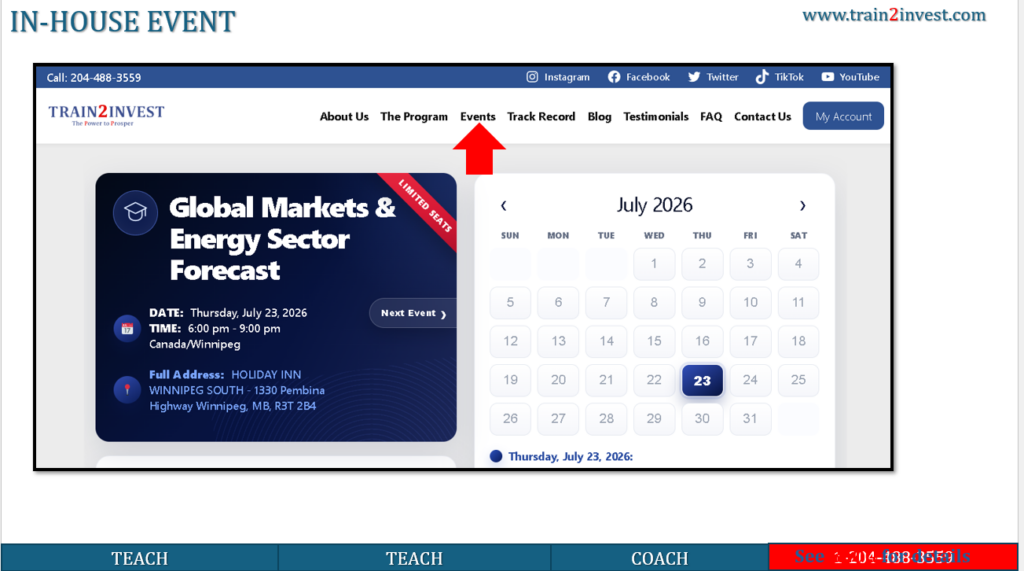
Register under Events

This is the most important domestic event for the TSX this week.
| Result | Likely TSX impact | Sector impact |
|---|---|---|
| Strong jobs, lower unemployment | Mixed to positive | Banks, insurers, consumer discretionary positive; rate-sensitive REITs/utilities may lag |
| Weak jobs, higher unemployment | Mixed to negative | Gold miners and defensives may outperform; banks and cyclicals may weaken |
| In-line jobs | Neutral | TSX likely follows commodities and U.S. Fed signals |
May employment was strong: Canada added 87,800 jobs and unemployment fell to 6.6%, beating expectations. That makes the June report important because markets will test whether May was a rebound or a one-off.
The Fed minutes matter because TSX valuation is sensitive to U.S. bond yields, the Canadian dollar, gold, and global risk appetite.
Recent U.S. payrolls were weak: June nonfarm payrolls rose only 57,000, below expectations, and the unemployment rate fell to 4.2%. Markets interpreted this as reducing the probability of a near-term Fed hike.
TSX read-through:
| Fed tone | TSX effect |
|---|---|
| Less hawkish | Positive for gold, tech, utilities, REITs; supportive for TSX multiple |
| Still hawkish | Negative for gold and rate-sensitive stocks; banks may hold up better |
| Unclear | More volatility; TSX follows commodities |
The TSX rally into July 3 was heavily supported by gold and copper. Reuters reported that the TSX closed at a two-week high on July 3, with mining shares leading as gold and copper gained on lower Fed-hike expectations.
Watch:
Energy is the risk to the upside and downside. Oil has eased as U.S.-Iran peace efforts and partial reopening of Hormuz reduced supply fear. Reuters reported Brent at US$71.94 and WTI at US$68.78 on July 3, with prices nearly unchanged for the week.
OPEC+ is also expected to consider another output-target increase for August, reportedly around 188,000 barrels/day, which could cap crude prices if demand remains soft.
| Oil move | TSX impact |
|---|---|
| WTI rebounds above US$72 | Positive for CNQ, SU, IMO, energy weighting |
| WTI stays US$67–70 | Neutral to mild negative for energy |
| WTI breaks below US$65 | Negative for TSX energy; could offset materials strength |
The U.S. Q2 earnings season begins with companies such as Delta Air Lines and PepsiCo. This matters indirectly for the TSX because it affects North American risk appetite and consumer-demand assumptions. Reuters noted investors are watching early earnings for signs of consumer resilience and whether the rally can broaden beyond tech.
| Date | Event / Data | Why it matters for TSX |
|---|---|---|
| Mon, July 6 | U.S. final services PMI; ISM services | Affects U.S. growth expectations, yields, CAD/USD, cyclicals |
| Wed, July 8 | U.S. wholesale inventories; FOMC minutes; consumer credit | Fed-rate expectations and credit conditions |
| Thu, July 9 | U.S. existing home sales | Read-through to rates, consumer balance sheet, banks |
| Fri, July 10 | Canada employment report; building permits | Direct impact on BoC expectations, banks, housing-linked equities |
| All week | Oil, gold, copper | Direct impact on TSX energy/materials weighting |
Sources: Scotiabank economic calendar and Reuters market reports.
The TSX is close to record territory, so the market needs earnings or rate support to justify further upside. The short-term valuation logic is simple:
| Driver | Valuation effect |
|---|---|
| Lower Fed/BoC rate expectations | Higher acceptable P/E multiples; supports gold, tech, defensives |
| Strong commodities | Higher earnings expectations for materials/energy |
| Weak oil but strong gold/copper | Mixed TSX effect; materials offset energy |
| Strong Canada jobs + sticky inflation concern | Could cap multiple expansion |
| Weak jobs + falling yields | Supports duration-sensitive sectors but hurts banks/cyclicals |
| Scenario | Probability view | TSX direction | Conditions |
|---|---|---|---|
| Bull | Moderate | +0.5% to +1.5% | Canada jobs stable, Fed minutes not hawkish, gold/copper firm, WTI holds near US$70 |
| Base | Highest | -0.5% to +0.5% | Mixed macro, metals consolidate, oil range-bound, no major geopolitical shock |
| Bear | Moderate | -1.0% to -2.0% | Fed minutes hawkish, Canada jobs weak or inflationary, oil breaks lower, miners reverse |
Monday July 6
China’s foreign reserves
Euro zone’s retail sales
Germany’s factory orders
(9:30 a.m. ET) Canada’s S&P Global Services PMI for June.
(9:45 a.m. ET) U.S. S&P Global Services/Composite PMI for June.
(10 a.m. ET) U.S. ISM Services PMI for June.
(11:30 a.m. ET) Bank of Canada’s Business Outlook Survey and Survey of Consumer Expectations for Q2 ins released.
Tuesday July 7
China’s real cash earnings and household spending
Germany’s industrial production
(8:15 a.m. ET) U.S. ADP Employment (four-week average change)
(8:30 a.m. ET) Canada’s merchandise trade balance for May.
(8:30 a.m. ET) U.S. goods and services trade deficit for May.
(10 a.m. ET) U.S. global supply chain pressure index for June.
(10 a.m. ET) Canada’s Ivey PMI for June.
Also: NATO Summit in Ankara, Türkiye through Wednesday.
Wednesday July 8
Japan’s bank lending and trade deficit
(10 a.m. ET) U.S. wholesale inventories for May.
(2 p.m. ET) U.S. Fed minutes from June 16-17 meeting are released.
(3 p.m. ET) U.S. consumer credit for May.
Earnings include: Firan Technology Group Corp.; Levi Strauss & Co.
Thursday July 9
China’s CPI, PPI, aggregate yuan financing and new yuan loans
Japan’s machine tool orders
(8:30 a.m. ET) U.S. initial jobless claims for week of July 4.
(10 a.m. ET) U.S. existing home sales for June.
Earnings include: Aritzia Inc.; PepsiCo Inc.; Progressive Corp.; Richelieu Hardware Ltd.
Friday July 10
Germany’s CPI
(8:30 a.m. ET) Canadian employment for June. The Street is projecting a flat reading (up 10,000 jobs) month-over-month with the unemployment rate remaining 6.6 per cent and average hourly wages growing 3.3 per cent from the same period a year ago.
(8:30 a.m. ET) Canadian building permits for May.
Also: U.S. Fed’s semi-annual Monetary Policy Report is released.
Earnings include: Delta Air Lines Inc.; Hyatt Hotels Corp.
For the past decade or so, Canada’s economy has been flying with one engine down. It sort of worked, but then the second one sputtered out too.
We’re now in that torturous phase while we wait for something to whir back to life. A “transition period,” if we’re trying not to scare people.
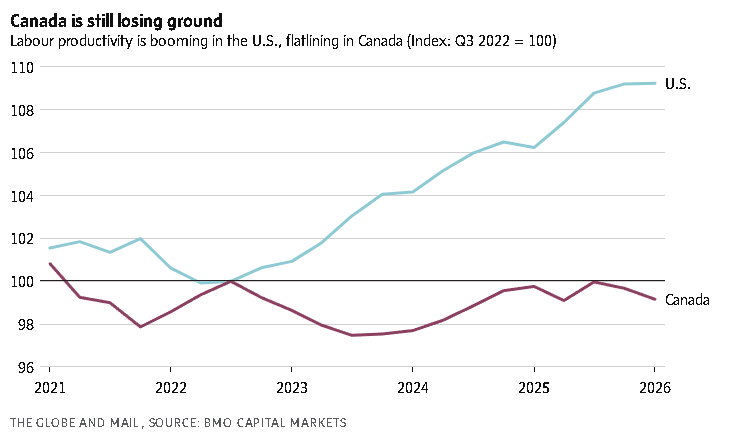
There are two ways an economy can grow over the long term – by increasing the country’s labour force or by improving productivity. More workers or more output per worker. Ideally both. Canada is doing neither.
We’ve been famous laggards on the productivity file forever, especially the past decade. Booming population growth helped mask the problem, giving the illusion of good economic health, at the aggregate level at least.
But immigration curbs put an end to that quick fix.
If the country is to expand its economy, it will have to do so the hard way, by finally cracking the productivity problem.
More than a year after the Carney government set out to build a stronger, more self-reliant economy, the numbers are still moving in the wrong direction.
Labour productivity in the business sector declined by 0.5 per cent in the first quarter, Statistics Canada reported a few weeks ago. It was the second straight quarterly decline.
“That number was very disappointing,” said Sal Guatieri, a senior economist at the Bank of Montreal. “If we don’t see some upturn in Canada’s productivity numbers soon, I’ll be pretty worried about our long-term growth prospects.”
The urgency comes from the fact that the country’s population is now shrinking for the first time on record. The next two years will serve as stress test as to whether the Canadian economy can function without the crutch of heavy immigration.
The course correction on immigration, of course, is meant to reverse pandemic-era policies that drew in an influx of temporary foreign workers and international students. At the peak of the surge, Canada’s immigration rate was four times higher than baseline, for reasons that were never entirely clear.
Now, with restrictions in place until at least the end of 2027, population growth is expected to be roughly zero for the next couple of years.
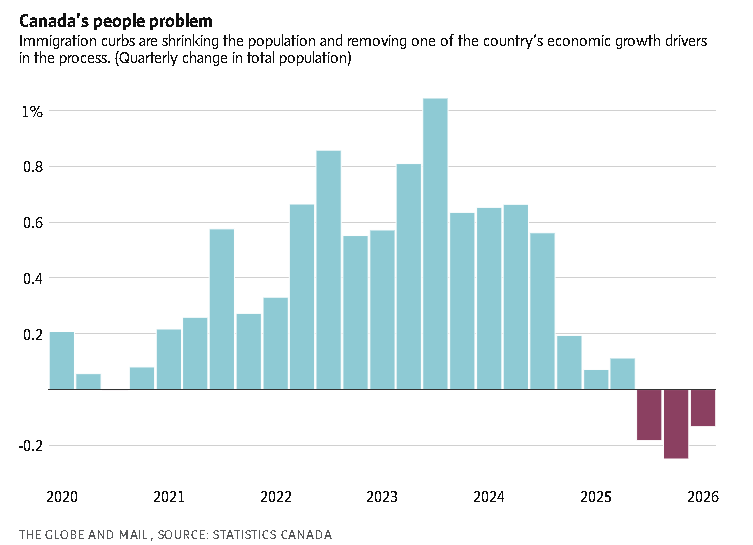
And with that, Canada lost both its drivers of long-term economic growth. So, it’s little surprise that growth has flatlined. Bloomberg’s latest economic survey pegs the consensus GDP growth forecast at just 0.7 per cent for 2026.
Cue the great Canadian economic revival. That’s the idea, anyway. The hostility of the Trump administration toward North American free trade has forced a rethinking of Canada’s economic way of life. Hey, maybe we should finally get around to dealing with that pesky productivity gap.
What is our problem, anyway? We’ve been ruminating on Canadian productivity for years, decades even, and it’s only gotten worse. In 2000, Canada’s output per hour worked was 20 per cent below what the U.S. economy generated. Today, Canada is 30 per cent below the U.S.
There’s the usual list of culprits. Too little competition. Excessive regulation. Maybe not enough fire in our bellies.
It’s really a story of investment. Lack thereof, rather. Canadian companies invest less in their businesses and are less productive as a result. Simple.
Investment in machinery and equipment, for example, is about 20 per cent lower today than it was 10 years ago, on a per-worker basis. Canada also badly trails its peers on research and development spending.
We are currently in the middle of another world-changing wave of innovation with the potential to shape a new age of productivity growth, much like the mass adoption of the internet did in the 1990s.
The early signs already point to Canada falling behind. Artificial intelligence-related spending accounted for around 30 per cent of real GDP growth in the U.S. last year, and just 5 per cent in Canada, according to a recent Desjardins report.
Any way you look at it, the last decade has been a disastrous one for investment in Canada. But we can’t ignore how much a breakdown in the trade relationship with the U.S. is to blame.
Since 2016, employment growth in Canadian industries that cater to U.S. consumers has plateaued at just 2.8 per cent, according to Statistics Canada. All other industries together have had job growth of close to 20 per cent.
Ten years into the protectionist eraU.S. President Donald Trump helped usher in, and Canada is still in the early stages of adapting. The dilemma facing Canada is how to spur investment in a climate designed to stifle it. Mr. Trump is explicit in his desire to lure capital away from Canada.
“The ongoing trade war weighed heavily on today’s productivity numbers, with the largest declines occurring in goods-producing sectors, notably manufacturing, agriculture and construction,” Desjardins economist LJ Valencia said in a note.
There are some indications that corporate Canada is getting on with things. Earnings call transcripts show that tariffs are rarely being discussed any more.
It would be nice to get at least one of the economy’s engines back up and running before gravity does its thing.
When you’re in the middle of a hurricane, the price for umbrellas is going to be expensive, no matter which way the wind is blowing. For stocks, the hurricane is the Nasdaq-100 index, and the direction of winds may be changing.
The spread between Nasdaq 100 1-month implied volatility at 28 and the S&P 500 below 16 is near record highs. It’s been widening all year as the stock market’s returns concentrate around Big Tech winners, but the reason for this latest stretch of the gap is different from a few months ago, when Nasdaq options prices were being skewed by extreme demand for calls.
Today, it’s coming from demand for puts, which have gotten more expensive while premiums for far out-of-the-money calls tapers off. The spread between the implied vol of 25-delta puts in the Nasdaq 100 and S&P 500 – bearish contracts with a one-in-four chance of winning – rose from just 3 points in mid-March to 13.6 today, according to Bloomberg data compiled by Nasdaq. In 2020, the spread reached 13.3. Before that, the only time higher was in September 2008.
“Nobody cared about puts back then, it was all about upside but now that sentiment has shifted,” Kevin Davitt, head of index options content at Nasdaq, said in an interview. “It speaks to potential downside for the high-flying elements of tech.“
The pick-up in demand for puts aligns with slowing momentum in AI stocks that had been consistently rewarding speculators to the upside. The semiconductor ETF (SMH) fell 4.5% Thursday to below $592, a level it first reached in late May.
More than a month of sideways price action in stocks may be piquing interest by bears, but also may not be cause to sound the alarm yet. Call-buying was so intense in the first half of this year that even as the appetite for upside has lessened, it’s still quite high.
Prices for one-standard-deviation out-of-the-money calls on the Nasdaq – contracts with a 16% chance of expiring in-the-money – are currently in the 58th percentile, down from the 99th percentile in May, according to Nations Indexes’ CallDex index.
Another innocuous factor that may be keeping S&P volatility low, adding to the spread: summertime.
“Traders expect the S&P to quiet down, which is normal for the summer,” Scott Nations, president of Nations Indexes, said in a call. “They don’t expect that for the Nasdaq 100, which they think will remain volatile because of the bouncing around in tech.”
SUMMARY:
DETAILS:
North American trade entered a new phase on July 1, with U.S. President Donald Trump declining to renew the United States-Mexico-Canada Agreement for another 16 years.
As part of a mandatory six-year review of the continental trade pact, the three countries had to decide on July 1 whether to extend the USMCA until 2042, or move into a period of annual reviews until 2036, after which the treaty will expire if no extension agreement is reached.
Ottawa and Mexico City asked for the 16-year extension. Washington refused. So what’s the state-of-play and what might happen next?
Does anything change right away?
No. The treaty, which replaced the North American free-trade agreement (NAFTA) in 2020 and sets out the rules for continental trade, remains in force. Likewise, the U.S. tariff carve-out for Canadian and Mexican goods that comply with USMCA rules of origin remains in place.
The tariff landscape stays the same, at least for now. Products that traded tariff-free on June 30 will continue to trade tariff-free on July 2. Meanwhile, U.S. tariffs remain in place on automobiles, industrial metals and wood products, as well as Canadian and Mexican goods that don’t meet USMCA rules of origin.
Is the U.S. withdrawing from the agreement?
No. We’re on the no extension-no withdrawal path.
Any of the three parties can withdraw from the agreement with six months’ notice; that’s always been the case. Mr. Trump may yet threaten to pull out of the agreement if he wants to turn the screws on Ottawa or Mexico City. But as it stands, he has not moved to kill the agreement.
Former top Republican sees ‘Fortress North America’ concept as a winner in USMCA trade talks
It remains unclear whether the President has the power to withdraw from the USMCA unilaterally without approval from Congress. U.S. lawyers have a range of opinions on this issue, and any attempt would likely end up being litigated in the U.S. Supreme Court.
What happens next?
Without a 16-year extension, the agreement moves into a period of annual reviews that will last for a decade. Technically, this is an exit ramp. If no extension agreement is reached by 2036, the USMCA will expire. However, there will be plenty of opportunities to reach an agreement before that final deadline.
In practice, the new phase of annual reviews will feel like a continuation of the status quo, at least in the near term. Trade negotiations that have gotten underway in recent months are expected to continue over the summer.
The three sides can strike a 16-year extension agreement – or some other sort of deal – at any time. If this hasn’t happened by next summer, the three parties will hold another trilateral meeting on July 1, 2027 – and so forth, each year until 2036.
What’s happening with trade negotiations?
So far, the Trump administration has chosen to deal with Canada and Mexico separately, starting with Mexico.
Washington and Mexico City have already held two rounds of bilateral talks about the future of the USMCA: one discussing rules of origin for automobiles, steel and aluminum, and economic security issues; the other focused on agriculture, labour and the environment. The two countries have scheduled a third negotiating round for the week of July 20.
The U.S. team is led by U.S. Trade Representative Jamieson Greer and his No. 2 Jeffrey Goettman, while the Mexican team is led by Economy Secretary Marcelo Ebrard.
Washington and Ottawa have not yet begun formal negotiations about potential changes to the USMCA, although Canada’s chief negotiator Janice Charette and Intergovernmental Affairs Minister Dominic LeBlanc have met Mr. Greer and his team several times in recent months to discuss non-tariff trade barriers.
It’s unclear at this point if and when the separate bilateral trade talks will merge.
Are we heading toward separate bilateral deals?
Quite possibly. Mr. Greer has said he wants to maintain the “load-bearing pillars” of the trilateral deal while layering separate bilateral “protocols” with Canada and Mexico on top. Mr. LeBlanc said at an event in June that bilateral deals were now his baseline assumption.
“I would expect that we’ll have bilateral arrangements between Canada and the United States, between the United States and Mexico, sort of adjacent to the trilateral framework,” Mr. LeBlanc said. “If those agreements resolve issues that all three countries are trying to resolve, I’m hopeful that we might at that point have the extension. But if not, we’ll continue to do what’s necessary to preserve the trilateral framework.”
It’s not yet clear what form these bilateral arrangements would take. They could be side letters to the USMCA, or chapters added to the agreement addressing bilateral issues. They could also be separate arrangements that look more like the “agreements on reciprocal trade” Washington struck with other trade partners, including the European Union, Japan and Britain, last year.
Mr. Trump has a clear preference for negotiating country-to-country, rather than as part of a group. And it may prove easier, from a legal perspective, to make changes to trade rules in a pair of separate side-agreements using executive powers. Substantial changes to the USMCA itself would likely require congressional approval – although lawyers debate this point.
What does non-renewal mean for the Canadian economy and Canadian businesses?
From one perspective, it’s status quo. Most Canadian exports will continue to enter the U.S. tariff-free, while certain sectors – namely steel, aluminum, copper, metal derivative products, automobiles, lumber and furniture – will continue to face hefty tariffs of between 25 per cent and 50 per cent.
On balance, the Bank of Canada estimated in April that the average effective U.S. tariff rate on Canadian goods was 5.1 per cent.
At the same time, non-renewal will extend the period of uncertainty that has weighed on business investment in Canada, leading to five consecutive quarters of falling investment.
“There’s uncertainty about what is going to play out. There is also uncertainty about exactly how the Canadian economy adjusts,” Bank of Canada governor Tiff Macklem said in a press conference last week, when asked about the USMCA review.
“There is no question the Canadian economy is going through an important restructuring. While certainly we hope that trade relations with the United States improve, the severe tariffs on a number of sectors, hopefully those can be scaled back, and we can get more certainty. … If that were to happen, I think you could see some more investment. But there are other outcomes as well.”
How did we get here?
When the three countries negotiated the USMCA as a replacement for NAFTA during the first Trump presidency, the U.S. demanded the addition of a 16-year “sunset clause” with a six-year review. The Trump administration felt that NAFTA had become stale over time and wanted to build in checkpoints and an exit ramp.
U.S. officials also wanted to maintain leverage over Canada and Mexico, giving it the ability to extract concessions at a future date. At the time, Mr. Trump’s son-in-law Jared Kushner, one of the architects of the deal, described the strategy in real estate terms.
“Why lock in today’s market rates if you will be able to charge more in the future?” Mr. Kushner wrote in an op-ed for CNBC in 2020. “The USMCA approach is akin to the United States granting Mexico and Canada a 16-year lease for market access, with a fair market value readjustment clause that is triggered every six years.”
What does the U.S. want?
The Trump administration sees the review of the USMCA as an opportunity to do at least two things: Push Canada and Mexico to change various regulatory, tax and trade policies that Washington believes disadvantage American companies; and to tighten North American supply chains to reduce the amount of Chinese products entering the continental market.
In the first bucket, the U.S. has a long list of grievances with both countries that it outlines every year in its National Trade Estimate Report of Foreign Trade Barriers. For Canada, this includes things like online streaming regulations, provincial bans on U.S. liquor and how dairy quotas are allocated. For Mexico, it includes restrictions on energy investments, intellectual property rules and agriculture.
In the second bucket, the U.S. is looking to tighten rules of origin for automobiles and other “strategic” sectors, which could include industries like semiconductors, pharmaceuticals and aircraft. In the bilateral talks with Mexico, U.S. officials suggested increasing the North American content requirement for cars to 82 per cent from 75 per cent, and adding a requirement that half the vehicle must be made of U.S. parts.
The Trump administration also wants more co-ordination between the three countries on external tariffs, particularly on China. And it has suggested it wants both countries to pay more attention to the sources of capital, with the goal of reducing Chinese investment in North America under the banner of “economic security.”
Canada and Mexico have signalled an openness to this “Fortress North America” approach, although Prime Minister Mark Carney’s decision to break with Washington earlier this year over tariffs on Chinese electric vehicles, and his attempt to court Chinese investment in the Canadian auto industry, could be a sticking point.
What do Canada and Mexico want?
Relief from U.S. sectoral tariffs; the preservation of the tariff carve-out for goods that comply with USMCA rules of origin; and some sense of stability in U.S. tariff policy.
Mexican and Canadian officials have said they don’t expect to return to a zero-tariff world that existed under NAFTA. The goal, according to Ms. Charette, is the “lowest possible tariffs on the narrowest basket of goods with the most market access for Canadian products.”
The priority for Ottawa is getting Mr. Trump to lower the Section 232 sectoral tariffs on steel, aluminum, automobiles and wood products. Before trade talks broke down in the fall, Ottawa and Washington were working on some sort of steel and aluminum deal that involved a combination of lower tariffs and quotas.
Canadian officials have said they’re ready to resume discussions along these lines whenever the Americans are.
Is there any chance a deal could be reached soon?
It depends on who you ask. Some trade watchers believe that the President has an incentive to reach an agreement with Canada and Mexico before the U.S. midterm elections on Nov. 3, so he can present it as a win and help reduce cost-of-living pressures that stem from the tariffs.
Others think trade talks could drag on into the new year, with the possibility that no deal is finalized before the end of Mr. Trump’s term in early 2029. Ultimately, Mr. Trump is in control of the timeline, not Ottawa or Mexico City.
“We prefer the status quo over a bad deal,” Mr. Carney said ahead of the review. But he added that arriving at an updated agreement is a priority. “We are ready to negotiate improvements to this agreement.”
What’s next?
The next date to watch is July 20, when the U.S. and Mexico begin their third round of trade talks.
The other key date is July 24. That’s when the U.S. is expected to introduce its new global tariff regime to replace the tariffs that were struck down by the U.S. Supreme Court in February.
The new tariffs will be imposed using Section 301 of the U.S. Trade Act of 1974, which allows the President to levy tariffs in response to alleged discriminatory foreign trade practices.
The U.S. has already said it will impose tariffs of between 10 per cent and 12.5 per cent on 60 countries, including Canada, for allegedly not doing enough to address forced labour in their supply chains. So far, the Trump administration has said it will maintain the carve-out for USMCA-compliant goods from Canada and Mexico.
Canada’s manufacturing sector expanded further in June as production and employment rose, but not all was positive for the sector as intensifying supply shortages helped lift cost inflation to a near four-year high.
The S&P Global Canada Manufacturing Purchasing Managers’ Index (PMI) edged up to 53.0 last month from 52.9 in May. It marked the sixth straight month that the index was at or above the 50 threshold. A reading above 50 indicates expansion in the sector.
“Canada’s manufacturing economy on the surface enjoyed a positive June, with output and new orders rising at solid rates and supporting an uplift in employment for a third successive month,” Paul Smith, economics director at S&P Global Market Intelligence, said in a statement.
The output index rose to 52.1 from 52.0 in May and the measure of employment was at 51.9, its highest level since October, 2024, as firms added staff to cope with increased workloads.
“Digging deeper below the surface reveals the continuation of some worrying trends, with growth still partly driven by stockpiling as firms and their clients continue to face substantial supply-side disruption,” Smith said.
Suppliers’ delivery times lengthened to the greatest degree since September, 2022, as the war in the Middle East disrupted shipping routes.
High oil prices and increased transportation costs as well as U.S. tariffs contributed to increased input costs. The input price index rose to 67.2 from 66.5 in May, posting its highest level since July, 2022, while a measure of business confidence slipped to a three-month low.
In last year’s federal budget, Prime Minister Mark Carney promised to shrink the public service and boost defence spending.
We’re starting to see how those policies are playing out across Canada’s economy.
When Statistics Canada this week released gross domestic product numbers for April, which showed a healthy rebound after months of sluggish growth, the agency noted the public sector contributed to the lift. Federal public administration, excluding defence, posted its first month-over-month increase since December, it said.
Despite that gain, the sector experienced the sharpest yearly decline in real GDP since Statscan began publishing such data in 1997, shrinking by nearly 10 per cent from April, 2025.
At the same time, federal defence real GDP is rising at its fastest pace ever.
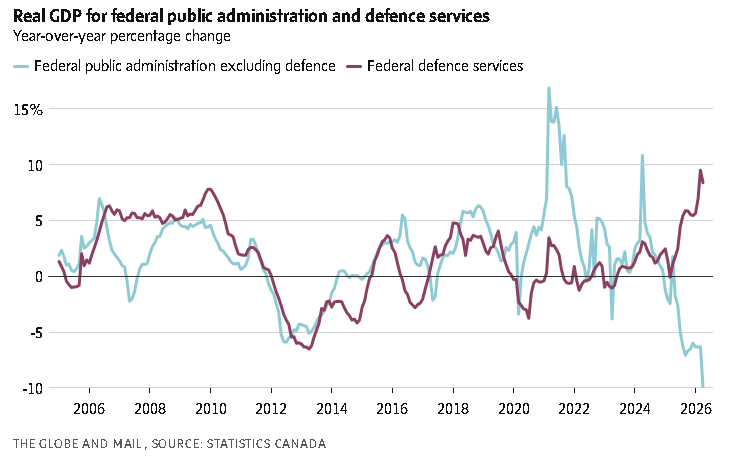
Measuring the economic output of public administration isn’t as straightforward as other sectors such as retail or manufacturing because government services aren’t bought and sold in a marketplace that establishes price and value.
As such, Statscan relies heavily on public service compensation to gauge activity, and at the federal level, employee head counts are tumbling.
In fiscal 2025-26, which ended March 31, federal employment fell by 3.5 per cent from the year before, the steepest drop since the round of job cuts implemented by then-prime-minister Stephen Harper in 2012-13, according to numbers released last week by the Treasury Board of Canada Secretariat.
And that decline occurred despite a nearly 10-per-cent jump in employment at National Defence from the year before, as Canada ramped up military spending to meet the North Atlantic Treaty Organization’s defence expenditure target of 2 per cent of GDP.
While the monthly uptick in federal public administration GDP in April could mean the sector is stabilizing, the Carney government likely isn’t done downsizing. Last year’s budget set a target for federal employment of 330,000 by fiscal 2028-29, another 4.4-per-cent drop from current levels.
Summary: Alberta is proposing a southern route for a new oil pipeline from Alberta to Canada’s West Coast, aimed at expanding crude export capacity to Asian markets and reducing reliance on U.S. export routes [1].
The route reportedly starts near Bruderheim, Alberta, and would run toward the southwest coast of British Columbia [5]. Alberta is expected to submit the initial proposal to Ottawa’s Major Projects Office [2].
The project is still preliminary. It has no confirmed private-sector backing yet, according to reporting that cites Prime Minister Mark Carney’s comments [1][6].
CBC reports the estimated cost could be C$35 billion or more, with possible completion between 2032 and 2034 [4].
Key risks: regulatory approval, Indigenous consultation, B.C. political opposition, financing, construction cost inflation, and uncertain long-term oil demand.
Details:
The Alberta government has proposed a southern route for a new oil pipeline to the West Coast, which will be planned and built by the federally owned Trans Mountain Corp., working with Pembina Pipeline Corp. PPL-T +1.66%increase
Prime Minister Mark Carney and Alberta Premier Danielle Smith announced the plan Thursday evening in Calgary. It represented a stark turnaround for the Premier, who had insisted that a conduit to the Pacific should be routed to B.C.’s northern coast.
However, several First Nations in the area had voiced strong opposition to a pipeline in the region. A northern route would have also required changes to thefederal tanker ban along that part of B.C.’s coast, which is considered a non-starter by that province’s government.
That opposition, as well as numerous environmental challenges, prompted Mr. Carney’s Liberal government to persuade Alberta to change tack and consider building a pipeline that largely follows the right-of-way for the Trans Mountain Pipeline from Edmonton to southern B.C.
“We’ve agreed that the best route for a new pipeline is one that already exists: South through the Trans Mountain corridor to our Pacific coast, the gateway to the world’s fastest growing markets,” Mr. Carney said Thursday.
The project is a major component of a push by the federal government to increase exports around the world in the face of a trade war with the United States and make peace with Alberta over resource development.
In a statement, Pembina characterized its involvement as a non-binding agreement with the provincial and federal governments, Trans Mountain and the Alberta Petroleum and Marketing Commission.
The company said its economic interest through construction would be 10 per cent, with the opportunity for up to an additional 10 per cent once the project enters commercial operation. It said Trans Mountain would serve as the lead proponent on the pipeline, responsible for construction, regulatory processes, stakeholder and Indigenous engagement and operation of the asset.
The announcement between Ottawa and Alberta came hours after B.C. struck a deal on a multibillion-dollar federal commitment for infrastructure projects in the province and no change to the federal tanker ban off B.C.’s North Coast.
Premier David Eby said Thursday that the agreement doesn’t obligate B.C. to support an Alberta pipeline proposal. But he said he also knows his province doesn’t have the constitutional ability to stop a pipeline and won’t fight it.
“That’s why this agreement matters,” Mr. Eby said during an event with Mr. Carney in Vancouver. “It ensures that the northern tanker ban stays in place, and it ensures that if a pipeline goes ahead, that British Columbians are fairly compensated for the environmental risks we would take on any new pipeline project.”
The Prime Minister said that Canada and Alberta would be “equal partners” in the pipeline project, and there would be “a meaningful ownership stake for Indigenous communities.”
Alberta and Ottawa have also agreed to overhaul carbon markets, to make “substantial methane reductions” and to new measures to allow power markets to grow “sustainably and affordably,” he said.
Ms. Smith said that after studying northern and southern route options, her government determined that a pipeline from the Alberta town of Bruderheim to a deep-water port terminal on B.C.’s southwest coast offered “the fastest, most cost-effective path to expanding Canada’s energy exports.”
Mr. Carney said the federal government will now refer the West Coast pipeline project proposal to its Major Projects Office, with consultations to begin immediately with Indigenous communities, provinces and territories. He said the government expects the decision on whether it will be a project of national interest will be made by Oct. 1.
Ottawa had said that the industry must build a massive oil sands carbon-capture project, called Pathways, if the pipeline application was to be fast-tracked by the Major Projects Office.
Oil sands developers had been increasingly concerned about the costs of Pathways, saying it would require major public subsidies. However, Mr. Carney and Ms. Smith said the governments had agreed on the terms to launch the project.
“Critically, we’ve agreed the time for action is now,” Mr. Carney said.
Ms. Smith said that discussions with oil sands companies about the Pathways project would continue, particularly around how the sector can expand its production.
An Alberta-Ottawa memorandum of understanding that laid the groundwork for the pipeline plan, signed in November, said Ottawa may consider adjusting a prohibition on tankers loading and unloading oil along the northern B.C. coast.
The northern pipeline route favoured by Alberta would have required overturning the ban.
The long-awaited pipeline announcement came after a flurry of scheduling changes.
The Alberta government had scheduled a news conference about the pipeline proposal for Thursday morning, but late Wednesday it announced without explanation that the event was postponed. In the end, the Prime Minister’s Office and province announced a press conference late Thursday.
Alberta had set itself a deadline of July 1 to file its application for the new pipeline – a date that was included in the MOU that Mr. Carney signed with Ms. Smith on Nov. 27.
The province had initially proposed a series of options for a pipeline route to the North Coast, as well as various ideas for the location of a marine terminal. Ms. Smith had said she preferred such an export point because it afforded shorter sailing time to Asian markets versus the Vancouver area, and it was deep enough to enable access for the large tankers that are favoured for carrying crude long distances.
The Alberta-Ottawa MOU stipulated that any new pipeline would be constructed and financed by the private sector.
Mr. Carney said that Trans Mountain would “plan and construct the pipeline,” working closely with Pembina “who will bring its private-sector expertise and discipline to the construction and operation of the pipeline.”
However, Trans Mountain is a federal Crown corporation, and Ms. Smith said the share of the private-sector stake remains to be seen.
In October, Alberta tapped three energy infrastructure companies – Enbridge Inc., South Bow Corp. and Trans Mountain Corp. – to provide technical and regulatory expertise on its proposal.
Asked during a May interview whether Trans Mountain would consider becoming the project’s proponent, CEO Mark Maki said the federal government has “expressed a strong desire to have a private proponent move the project forward, but they know very well that we’re here and what we’re capable of doing.”
With a report from Tim Kiladze