West Fraser Timber Co. Ltd. reported a net loss of US$204 million in its third quarter results compared with a net loss of US$83 million during the same period a year earlier. West Fraser says this amounted to a loss of US$2.63 per diluted share compared to a loss of US$1.03 per diluted share a year earlier. The Vancouver-based forestry company, which keeps its books in U.S. dollars, says sales during the third quarter came in at US$1.3 billion compared to US$1.43 billion a year earlier. On an adjusted basis before deductions, the company says it reported a loss of US$144 million, down from US$62 million during the same period last year. West Fraser CEO Sean McLaren says the company faces a challenging backdrop with supply and demand imbalances for wood building products due to lower housing affordability, coupled with new tariffs on Canadian softwood lumber. U.S. President Donald Trump used Section 232 of the Trade Expansion Act of 1962 to impose 10 per cent tariffs on softwood timber and lumber beginning Oct. 14. This report by The Canadian Press was first published Oct. 22, 2025. Companies in this story: (TSX:WFG)
Author: Consultant
-
FirstService: Q3 Earnings Snapshot
FirstService Corp. (FSV) on Thursday reported third-quarter profit of $57.2 million.
On a per-share basis, the Toronto-based company said it had net income of $1.24. Earnings, adjusted for one-time gains and costs, were $1.76 per share.
The results exceeded Wall Street expectations. The average estimate of four analysts surveyed by Zacks Investment Research was for earnings of $1.75 per share.
The property services provider posted revenue of $1.45 billion in the period, falling short of Street forecasts. Four analysts surveyed by Zacks expected $1.46 billion.
This story was generated by Automated Insights (http://automatedinsights.com/ap) using data from Zacks Investment Research. Access a Zacks stock report on FSV at https://www.zacks.com/ap/FSV
-
Oil rises nearly 5% on fresh U.S. sanctions against Russia
Oil prices rose nearly 5 per cent on Thursday after the U.S. imposed sanctions on major Russian suppliers Rosneft and Lukoil over the Ukraine war, extending gains from the previous session.
Brent crude futures were up US$2.98, or 4.8 per cent, at US$65.57 a barrel, while U.S. West Texas Intermediate crude futures were up US$3.01, or 5.2 per cent, at US$61.51.
The U.S. sanctions mean refineries in China and India, major buyers of Russian oil, will need to seek alternative suppliers to avoid exclusion from the Western banking system, according to Saxo Bank analyst Ole Hansen.
The U.S. said it was prepared to take further action as it called on Moscow to agree immediately to a ceasefire in Ukraine.
Britain sanctioned Rosneft and Lukoil last week. EU countries have approved a 19th package of sanctions against Russia that includes a ban on imports of Russian LNG.
Prompt Brent crude futures switched to backwardation as the first-month Brent contract traded at nearly US$2 a barrel above the contract for delivery in six months.
Right after the U.S. sanctions were unveiled, Brent and WTI futures rose by more than US$2 a barrel, with support from a surprise decline in US stockpiles.
The impact of sanctions on oil markets will depend on how India reacts and if Russia finds alternative buyers, said UBS analyst Giovanni Staunovo.
India became the largest buyer of discounted seaborne Russian crude in the aftermath of Moscow’s war in Ukraine.
Indian refiners are likely to sharply curtail imports of Russian oil due to the new sanctions, industry sources said on Thursday.
Privately-owned Reliance Industries, the top Indian buyer of Russian crude, plans to reduce or halt such imports completely, according to two sources familiar with the matter.
But there remains some skepticism in the market about whether the U.S. sanctions would result in a fundamental shift in supply and demand.
“So far, almost all the sanctions against Russia for the past 3-1/2 years have mostly failed to dent either the volumes produced by the country or the oil revenues,” said Rystad Energy analyst Claudio Galimberti.
Oversupply concerns following OPEC+ production increases capped crude’s gains on Thursday. UBS expects Brent to remain between US$60-US$70.
On the demand side, U.S. crude oil, gasoline and distillate inventories fell last week as refining activity and demand strengthened, the Energy Information Administration said on Wednesday.
-
Rogers reports higher revenue, lower adjusted earnings after taking majority stake in MLSE
Rogers RCI-B-T +3.50%increase reported modest revenue growth as it added 111,000 wireless customers in the third quarter, but adjusted earnings dropped in the wake of the company’s move to increase its stake in Maple Leaf Sports and Entertainment.
Total revenue for the third quarter was $5.35-billion, up 4 per cent from a year earlier, meeting analyst consensus estimates. Wireless revenue increased 2 per cent to $2.66-billion, cable revenue was up 1 per cent to $1.98-billion and media revenue jumped 26 per cent to $753-million.
Rogers completed its acquisition of rival BCE Inc.’s 37.5-per-cent stake in MLSE in July for $4.7-billion.
The telecom said the increase in its media division was the result of its larger stake in MLSE and increased Toronto Blue Jays revenue.
The company said its adjusted net income fell by 5 per cent in the third quarter to $726-million, or $1.37 per share, as the company’s earnings before interest, taxes, depreciation and amortization (EBITDA) decreased 1 per cent “primarily as a result of the seasonal results for MLSE, as both the Toronto Maple Leafs and the Toronto Raptors are in their offseasons in the third quarter.”
Rogers signals it may wait to acquire final MLSE stake before seeking outside investors
Rogers reported net income of $5.8-billion, or $10.62 per diluted share. The company said the increase in its net income was primarily the “result of a $5 billion non-cash gain to recognize our existing interest in MLSE at fair value, which was required as a result of the MLSE transaction.”
The company said it now expects to spend $3.7-billion in 2025, compared with its estimate of $3.8-billion from July.
Rogers added 62,000 postpaid wireless subscribers in the third quarter, beating analyst consensus expectations of 59,000, but still down 39 per cent from last year.
The company added 49,000 prepaid phone subscribers, beating the consensus of 45,000, but down 44 per cent from last year.
The telecom cited slowing population growth and a less active market, owing to the federal government’s changed immigration policies, as reasons for the decreases in subscriber adds.
-
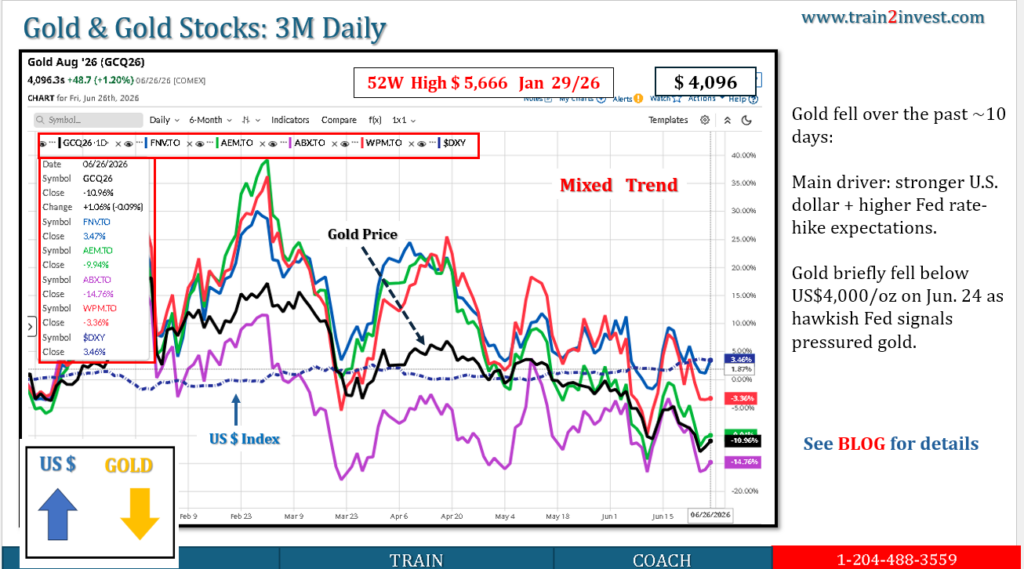
Gold and related stocks are falling for a second day. The metal is off 8% from high
Gold prices fell for a second day on Wednesday, as investors took profits after a weeks-long rally.
Gold futures were last down $61.30, or 1.49%, to $4,053.10 per ounce by 8:25 a.m. ET. Gold mining stocks such as Newmont and Barrick fell more than 4% in premarket trading.
The precious metal sold off sharply Tuesday, losing 5.74% to close at $4,109.10 in its worst performance since 2013. The two-day selloff comes after gold futures hit a intraday record of $4,398 per ounce on Monday.
There is no macroeconomic or geopolitical event driving the pullback in gold prices this week, according to Swiss bank UBS.
“If we look at adjustments to non-commercial positioning, we believe the decline was largely technical,” UBS analysts led by Wayne Gordon told clients Wednesday. “With slowing price momentum and rising option volatility, more speculative investors decided to take profit.”
Gold prices are still up more than 50% this year and nearly 5% this month. The fundamentals that have driven the metal to record highs this year will likely persist, according to UBS. These include inflation, tariffs, threats to Federal Reserve independence and polical instability in the U.S.
“So, importantly, we believe it is premature to turn negative on gold despite the pause in the rally,” Gordon wrote.
-
Brookfield launches its first private equity fund tailored to individual investors in Canada
The private equity arm of Brookfield Asset Management Ltd. BAM-T is launching its first fund in Canada with no fixed end date that is geared toward wealthy investors who are eyeing private assets as they hunt for higher returns.
The Brookfield Private Equity Fund (Canada), announced Wednesday, lets individual investors who meet the necessary threshold for wealth invest in a selection of the asset manager’s private equity buyout strategies.
Unlike traditional private equity funds, it has an open-ended structure that gives investors regular windows to buy in or cash out.
More leading companies are staying private for longer, rather than listing on public stock markets. And individual investors with significant wealth are eyeing private assets, hoping to capture higher returns that the largest global investors such as pension plans, endowments and sovereign wealth funds have reaped for years.
That has set off a rush to create products with exposure to private assets that are tailored to individual investors, who don’t want to be locked into the multiyear fundraising cycles that underpin the institutional market.
Why this money manager is buying Brookfield and Canadian Pacific
Brookfield’s evergreen private equity fund is its latest attempt to secure a foothold in that race. The US$1-trillion asset manager is betting that it can attract a new wave of clients by highlighting its track record of buying essential businesses at low prices, overhauling their operations and boosting profit margins.
“Our strategy – value investing and driving operational transformation – is kind of built for this environment,” Anuj Ranjan, chief executive officer of Brookfield’s private equity business, said in an interview.
At launch, the fund has a high bar to entry. It is only available to accredited investors in Canada, who typically have higher incomes than average or significant assets. Investors will the U.S. will need to meet the qualified purchaser test – a threshold that usually requires an investor or family-owned business to have at least $5-million in investments.
The fund will be sold through advisers at banks and independent wealth managers and has a minimum investment of $25,000, Brookfield said. There are monthly chances to buy in at the fund’s net asset value, and investors can redeem up to 5 per cent of the fund’s net assets each quarter, as long as the fund has enough cash available to meet all requests.
The new fund is targeting double-digit percentage returns. It will mostly invest in traditional company buyouts, but it will also hold minority stakes in companies and keep cash on hand. As much as 20 per cent of the fund will be held in liquid assets that can be used to meet redemptions.
Brookfield to invest $5-billion with Bloom Energy to power AI data centres
Brookfield spent roughly two years designing the fund and seeded it with parts of nine private equity investments held on the company’s balance sheets before asking outside investors for money.
Those investments include stakes worth US$690-million in three of its portfolio companies: vehicle-parts maker DexKo Global Inc., auto dealer software company CDK Global LLC, and construction and civil engineering company BrandSafway.
“It’s not like we’re exiting these positions. They are still very much a part of the funds that we manage,” Mr. Ranjan said.
In time, Brookfield expects its evergreen fund will hold roughly 25 investments, functioning “like an umbrella that sits over the top of all of the private equity strategies,” David Nowak, president of Brookfield’s private equity arm, said in an interview.
The fund will have a right, but no obligation, to buy into any particular Brookfield strategy.
The initial portfolio of assets Brookfield put together was important to establish trust with prospective clients, “so that actual investors could touch it and feel it,” Mr. Nowak said. “It wasn’t just us talking about a strategy.”
Major asset managers around the world anticipate that opening up the gated world of private assets to a broad swath of investors, including individual retirement accounts, is the next big trend in investing.
Market Factors: The best way to invest in private equity
But regulators and skeptics have raised concerns about ordinary investors putting illiquid assets in their portfolios, especially as prominent private debt funds have halted client redemptions.
Some critics have questioned whether evergreen funds can deliver the higher returns investors expect, and justify the fees these funds often charge, especially after a sluggish stretch of deal making has hamstrung returns across the private equity sector.
To assuage those concerns, Brookfield is making a pitch that it has not relied on cheap debt and market tailwinds to boost returns the way some competitors have. Instead, Brookfield says it focused on running its portfolio companies better.
“People are wondering what the forward-looking performance looks like for the asset class, and we say to people, we’re not financial engineers,” Mr. Nowak said. “You can look at our historical track record.”
-
Teck beats profit estimates on higher metals prices as Anglo merger moves ahead
Teck Resources TECK-B-T -0.38%decrease beat third-quarter profit estimates on Wednesday, lifted by higher copper and zinc prices, even as production at its Quebrada Blanca copper mine in Chile remained constrained by tailings work.
U.S.-listed shares of Teck TECK-N -0.26%decrease rose 2 per cent in pre-market trading.
The results come as Teck advances a merger with Anglo American NGLOY -0.13%decrease, announced in September, to form Anglo Teck, a top-five global copper producer headquartered in Canada.
The deal aims to unlock synergies between Teck’s Quebrada Blanca mine and Anglo’s nearby Collahuasi project in Chile and deliver roughly US$800-million in annual savings.
Teck, Anglo dismiss investor concerns over shareholder structure
The Canadian miner reported adjusted earnings of 76 cents per share for the quarter ended Sept. 30, above analysts’ average estimate of 49 cents, according to LSEG data.
Teck said third-quarter profit rose on stronger base metals prices, higher sales from the Red Dog zinc mine in Alaska, lower smelter processing charges and improved performance at its Trail Operations in British Columbia.
Quarterly realized copper prices rose nearly 6 per cent to US$4.45 per pound while zinc prices increased 3.2 per cent to US$1.29 per pound, from last year.
However, copper production dropped 9.1 per cent to 104,100 tonnes in the third quarter, as output at the Quebrada Blanca mine fell 24.6 per cent to 39,600 tonnes, constrained by ongoing work to raise the tailings dam crest.
The company said the development of the tailings management facility at the site remains the main constraint on production, though improvements in sand drainage and dam construction are underway.
Teck maintained its 2025 copper output outlook for the Quebrada Blanca mine at 170,000–190,000 tonnes at net cash costs of US$2.65–$3.00 per pound.
-
Warner Bros. Discovery says it’s open to a sale; shares jump 10%
- Warner Bros. Discovery said it is open to a sale as it expands its strategic review.
- The company had planned to split into two separate entities and is not abandoning those plans.
- WBD said it’s received “unsolicited interest” from multiple parties.
https://www.cnbc.com/2025/10/21/wbd-sale-warner-bros-media.html
-
Canada’s inflation rate quickens to 2.4% ahead of BoC rate decision
Canada’s inflation rate accelerated by more than expected in September, but not enough to deter the Bank of Canada from cutting interest rates next week, according to several analysts.
The Consumer Price Index rose 2.4 per cent in September on an annual basis, up from August’s 1.9-per-cent pace, Statistics Canada said Tuesday. Financial analysts were expecting an inflation rate of 2.2 per cent.
The CPI results were heavily influenced by fluctuations in fuel costs. Year over year, gas prices fell by 4.1 per cent in September, but that was less than a 12.7-per-cent decline in August, putting upward pressure on headline inflation.
Excluding gas, consumer prices have risen by 2.6 per cent over the past year, up from 2.4 per cent in August.

Just after the CPI report, investors were pricing in a 66-per-cent chance that the Bank of Canada will cut interest rates by a quarter-point on Oct. 29, according to Bloomberg data. That’s down from 75-per-cent odds before the report was published.
How today’s inflation report has shifted market and economist predictions for BoC rate cuts
Still, with core measures of inflation remaining in check, several economists on Bay Street said the Bank of Canada was poised to continue cutting rates next week.
“Consumer prices posted surprisingly strong gains in September, but measures of underlying inflation suggest much less cause for concern,” said Royce Mendes, head of macro strategy at Desjardins Securities, in a note to clients.
“While there might be scope for debate about inflation, there should be no disagreement that the economy is weak and in need of support,” he added.
The Bank of Canada resumed cutting rates in September after three consecutive holds, finding that growth and employment concerns outweighed the upside risks to inflation from tariffs. The bank’s benchmark interest rate is now 2.5 per cent.
Bank of Canada finds downbeat businesses and consumers ahead of rate decision
Inflation has picked up in various categories. For example, grocery prices have risen by 4 per cent over the past year, and have been trending higher since April, 2024. Statscan noted that several items – including beef and coffee – have contributed to the upturn.
Still, there are signs that Canada isn’t facing a reignited inflation crisis. The Bank of Canada’s core measures of inflation – which strip out volatile movements in the CPI – rose by an annual average of 3.15 per cent in September, a tad higher than 3.1 per cent in August.
Andrew Grantham, senior economist at CIBC Capital Markets, said in a client note that “core measures of inflation were just subdued enough to support” another quarter-point rate cut, which would bring the policy rate to 2.25 per cent.
Speaking to media last week, Bank of Canada Governor Tiff Macklem said the economic outlook for the rest of the year was tepid.
“It’s going to be growth, but it’s going to be soft growth. It’s not going to feel very good, and it’s certainly not going to be enough to close the output gap,” Mr. Macklem said.
The Canadian economy shrank at an annualized rate of 1.6 per cent in the second quarter as exports to the United States plummeted. The unemployment rate, meanwhile, has risen to 7.1 per cent as companies get cautious on hiring.
Private-sector forecasters expect the economy to eke out growth in the third quarter, but continue to struggle as U.S. tariffs weigh on Canadian exports. The Trump administration has hammered a number of Canadian industries with duties, including steel, aluminum and autos.
The Globe and Mail reported on Tuesday that Canada and the U.S. could sign a trade deal on steel, aluminum and energy later this month, but that automobiles and softwood lumber wouldn’t be part of the agreement.
On Monday, the Bank of Canada published surveys of businesses and consumers that reflected a downbeat mood from both camps. For instance, most companies do not expect to increase the size of their workforce over the next year, according to survey results.
Stephen Brown, deputy chief North America economist at Capital Markets, said he was leaning toward another rate cut next week, despite the upside surprise in the CPI.
“Overall, there’s no clear message from the CPI, although we’re still leaning toward another rate cut this month following Governor Tiff Macklem’s somewhat dovish comments on the growth outlook last week,” he said in a note to clients.