Author: Consultant

  • The number of Canadians filing for insolvency is picking up – and fast

    Canadians are filing for insolvencies at levels unseen in more than a decade as rising costs and uncertainty around housing and employment put more strain on consumers, according to the latest data from the Office of the Superintendent of Bankruptcy.

    The number of Canadians who filed for insolvency jumped 8.5 per cent year-over-year in the first quarterof 2026 to 37,121, the highest quarterly volume since 2009, the OSB recorded in statistics released on Monday.

    But the accelerating pace of insolvencies may be more concerning than the volume, said Doug Hoyes, a licensed insolvency trustee and co-founder of Hoyes, Michalos & Associates.

    Insolvencies rose 4.2 per cent year-over-year in the 12-month period ending March 31 and the number of monthly insolvencies rose 17.5 per cent between January and March.

    “It’s the canary in the coal mine,” he said.

    Although insolvencies reached their highest quarterly volume since 2009, Mr. Hoyes said the numbers cannot be easily compared. That’s owing to the change inpopulation levels, updates to the insolvency filing process and the global financial crisis at the time.

    In the OSB data, British Columbia posted the highest overall spike in consumer insolvencies – bankruptcies and consumer proposals combined – rising 16.2 per cent year-over-year.

    A consumer proposal, Mr. Hoyes said, is a deal that allows someone in debt to avoid losing assets by agreeing to repay their creditors more over time. A bankruptcy means individuals may be required to forfeit assets to pay the debt.

    Consumer proposals are more common among people who feel relatively stable or optimistic about their future finances, Mr. Hoyes said.

    In Ontario, consumer insolvencies rose 14.7 per cent, but the province held a far bigger share of bankruptcies, which grew more than 25 per cent compared with 8.6 per cent in B.C.

    Mr. Hoyes said some of the bankruptcy spike in Ontario may be tied to the bigger economic impact of U.S. tariffs in the province, as it has a large manufacturing sector.

    Worsening economic conditions mean the trend in insolvencies could be sustained over a longer period.

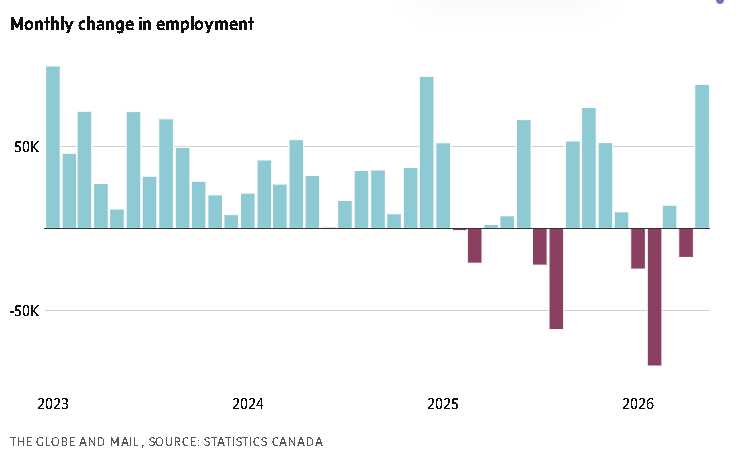
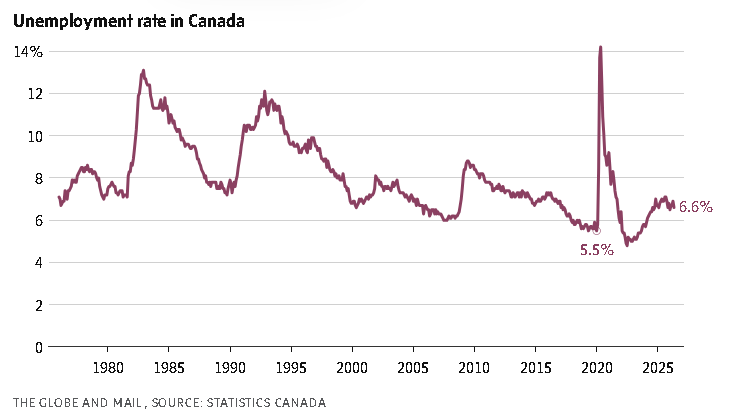
    Across Canada, the unemployment rate in April rose to 6.9 per cent compared with 6.7 per cent in March as the economy shed 18,000 jobs.

    But the biggest strain on Canadians are expenses that are increasing faster than incomes, especially as the price of fuel sends costs at the pump soaring. Food, which uses fuel at almost every stage of production and delivery, has also been hit hard by gasoline costs.

    In March, grocery prices were 35 per cent higher than just before the pandemic, BMO Economics reported last week.

    While the bulk of insolvency filings are made by renters, according to Mr. Hoyes, homeowner insolvencies are gradually rising as well.

    A February report from his firm found that homeowner insolvencies are now 8 per cent of filings compared with 5 per cent in 2024. The proportion of two-income households reaching insolvency also spiked to 23 per cent, the highest level since 2017.

    André Bolduc, a licensed insolvency trustee who was speaking on behalf of the Canadian Association of Insolvency and Restructuring Professionals, said that the three main factors driving insolvencies are expenses related to housing, auto loans and food.

    As consumers are amortizing their car payments over longer periods, with payments reaching as many as seven years now, their shortfalls become higher when they default or trade in their car early.

    Mr. Bolduc says he has seen shortfalls on cars that range from $10,000 to $30,000. “That really adds up,” he said.

    He said while Canadians have carried higher levels of household debt than the rest of the G7 for more than a decade, rising housing costs and employment pressure could push Canadians who have long been on the brink of insolvency closer to the edge. He said he wouldn’t be surprised if the trend continues for a while.

    “Insolvency is kind of a lagging indicator,” Mr. Bolduc said. “It’s not the problem per se. It’s a symptom of what’s happened in the past.”

  • Hydro One’s first-quarter profit and revenue rises

    Hydro One Ltd. H-T -0.63%decrease reported its first-quarter profit and revenue rose compared with a year ago, boosted by higher rates and increased peak demand.

    The power utility says it earned $391-million in net income attributable to common shareholders or 65 cents per diluted share for the quarter ended March 31.

    The result compared with a profit of $358-million or 60 cents per diluted share in the same quarter last year.

    Revenue totalled $2.65-billion, up from $2.41-billion in the first quarter of 2025.

    In February, Hydro One announced chief operating officer Megan Telford would become chief executive on June 9.

    Telford will replace David Lebeter, who is retiring from the top job.

  • Oil price spike turmoil far from over, IEA says as inventories are depleted at “record pace”

    • Oil prices could rise further over the summer as rapidly depleting inventories pile more pressure on the market, the IEA said.
    • The energy agency also flagged further demand destruction as a result of the war, forecasting a contraction of 420 thousand barrels per day by the end of 2026.
    • Despite the loss of demand, the authors still expect the oil market to end the year in a deficit.

    https://www.cnbc.com/2026/05/13/oil-price-spike-turmoil-iea-iran-war.html

  • US: Wholesale inflation jumps 6% in April on annual basis, biggest increase since 2022

    • The producer price index rose a seasonally adjusted 1.4% for the month, much higher than the 0.5% Dow Jones consensus forecast and the upwardly revised 0.7% March increase.
    • Energy was at the root of the unexpectedly high gain in producer prices, though there was evidence that the price pain is extending beyond the gas pump.
    • The services index accelerated 1.2%, the biggest gain since March 2022. Two-thirds of the move was attributed to a 2.7% gain in trade services, a sign that tariff costs could be starting to have a larger impact on prices.

    https://www.cnbc.com/2026/05/13/ppi-inflation-report-april-2026-.html

  • Franco-Nevada: Q1 Earnings Snapshot

    Franco-Nevada Corp. (FNV) on Tuesday reported first-quarter net income of $468.6 million.

    The Toronto-based company said it had net income of $2.43 per share. Earnings, adjusted for non-recurring gains, were $2.38 per share.

    The results beat Wall Street expectations. The average estimate of three analysts surveyed by Zacks Investment Research was for earnings of $2.09 per share.

    The precious metals streaming and royalty company posted revenue of $650.7 million in the period.

    _____

    This story was generated by Automated Insights (http://automatedinsights.com/ap) using data from Zacks Investment Research.

    Access a Zacks stock report on FNV at https://www.zacks.com/ap/FNV

  • Exchange Income Corporation (TSX: EIF) 

    Q1 Financial Highlights

    • Record first quarter Revenue of $867 million, an increase of $198 million or 30% compared to the prior period.
    • Record Adjusted EBITDA of $166 million, representing growth of $36 million or 28% over the prior period.
    • Free Cash Flow first quarter record of $120 million representing growth of 48% compared to the prior period of $81 million.
    • Net Earnings of $28 million compared to the prior period of $7 million, an increase of 287%, and Net Earnings per share of $0.50 compared to the prior period of $0.14 or an increase of 257%.
    • Record Adjusted Net Earnings of $34 million compared to the prior period of $14 million, an increase of 139%, and Adjusted Net Earnings per share of $0.61 compared to the prior period of $0.28.
    • Record Free Cash flow less Maintenance Capital Expenditures of $41 million compared to $26 million in the prior period.
    • Trailing Twelve Month Free Cash Flow less Maintenance Capital Expenditures Payout Ratio 1 improved to 57% compared to the prior period of 63% and Trailing Twelve Month Adjusted Net Earnings Payout Ratio 1 improved to an all-time record of 67% compared to the prior period of 84%. The payout ratios significant declines included period over period increases in weighted average number of shares outstanding of 11% along with the 5% increase in dividend during the fourth quarter of fiscal 2025.
    • Announced the extension and expansion of the Credit Facility to $3.5 billion while increasing the flexibility as the facility changed from a secured to unsecured facility.
    • Announced an investment grade corporate rating and the issuance of $600 million of 4.324% senior unsecured notes due March 13, 2031 with the proceeds used to repay existing indebtedness under the Credit Facility.
    • Announced the acquisition of Mach2 and the extension and expansion of the commercial agreement with Air Canada.
    • Announced the renewal of the Normal Course Issuer Bid for Common Shares.
  • Ovintiv Reports First Quarter 2026 Financial and Operating Results

    Highlights:

    • Generated first quarter cash from operating activities of $1.1 billion, Non-GAAP Cash Flow of $1.2 billion and Non-GAAP Free Cash Flow of $634 million after capital expenditures of $605 million
    • Produced average first quarter volumes of 679 thousand barrels of oil equivalent per day (“MBOE/d”), at the high end of company guidance across all products including 225 thousand barrels per day (“Mbbls/d”) of oil and condensate, 100 Mbbls/d of other NGLs (C2 to C4) and 2,124 million cubic feet per day (“MMcf/d”) of natural gas
    • Closed the acquisition of NuVista Energy Ltd., adding approximately 100 MBOE/d of production, 930 net 10,000-foot equivalent well locations, and approximately 140,000 net acres of land for approximately $2.8 billion
    • Closed the sale of the Company’s Anadarko assets in April for total cash proceeds of approximately $2.85 billion after preliminary closing adjustments
    • Redeemed the Company’s $700 million, 5.65% senior notes due May 15, 2028, on April 20, 2026, using proceeds from the Anadarko divestiture; annualized interest savings to total approximately $40 million
    • Net Debt of less than $3.3 billion as of April 30, 2026; approximately 40% lower than one year prior
    • Resumed share buybacks in March with the repurchase of approximately 1.5 million shares for total consideration of approximately $84 million; year-to-date share buybacks as of April 30, 2026, totaled 3.2 million shares for total consideration of $180 million
    • Released the 2025 Sustainability Report on the Company’s website

    https://www.barchart.com/story/news/1859381/ovintiv-reports-first-quarter-2026-financial-and-operating-results

  • Oil rises as fading hopes of quick end to Iran war reignite supply worries

    Oil prices rose 2 per cent on Tuesday as hopes for ⁠a deal ​to end the U.S.-Israeli war on Iran faded, with stark differences between Tehran and Washington on a peace proposal bringing supply concerns again to the fore.

    Brent crude futures were up US$2, or 1.9 per cent, at US$106.21 per barrel, while U.S. West Texas Intermediate gained US$2.31, or 2.4 per cent, to US$100.38 ​by 3:36 a.m. ET. Both benchmarks climbed nearly 2.8 per cent on Monday.

    U.S. ‌President Donald Trump said on Monday the ceasefire with Iran was “on life support,” pointing to disagreements over several demands, such as the cessation of hostilities on all fronts, the removal of a U.S. naval blockade, the resumption of Iranian oil sales and compensation for war damage.

    Tehran also emphasized its sovereignty over ‌the Strait ​of Hormuz, through which about ‌a fifth of global oil and liquefied natural gas flows.

    “Optimism regarding an imminent (peace) deal seems ​to be fading again and if we don’t see a ⁠deal by the end of May, then upside risks for oil prices ⁠are definitely on the table,” said DBS Bank energy sector team lead Suvro Sarkar.

    Disruptions linked to the near-closure ​of the strait have prompted producers to curtail exports, with a Reuters survey on Monday showing OPEC oil output in April fell to its lowest level in more than two decades.

    “A genuine breakthrough toward a peace deal could trigger a sharp US$8-US$12 correction, while any escalation or renewed blockade threats would quickly push Brent back ⁠toward US$115+,” said Tim Waterer, chief market analyst at KCM Trade.

    Saudi Aramco CEO Amin Nasser warned on Monday that disruptions to oil exports through the strait could delay a return to market stability until 2027, with the loss of about 100 million barrels of oil per week.

    Elsewhere on the supply front, U.S. crude stocks were forecast by analysts in a ⁠Reuters poll to be down by around 1.7 million barrels ​in the previous week.

    The draw comes against “a backdrop of continued strong net waterborne export flows for ⁠crude and products, across the next several weeks,” said Walt Chancellor, an energy strategist at Macquarie Group.

    Meanwhile, market participants were also ‌keeping a close eye on President Trump’s planned meeting with Chinese President Xi Jinping on Thursday and ​Friday, after Washington imposed sanctions on three individuals and nine companies for facilitating Iranian oil shipments to China.

    Tariffs imposed during the U.S.-China trade war have halted most Chinese imports of U.S. oil and LNG, which were worth US$8.4 billion in 2024, the year ​before Trump began his second term.