Author: Consultant

  • Alimentation Couche-Tard Inc. (ATD.TO):

    Executive Summary

    • Alimentation Couche‑Tard (ATD.TO) declined ~8–10% over the past ~10 days (into mid-April 2026).
    • No company-specific negative news → pullback is sentiment/positioning-driven, not fundamental deterioration.
    • Stock had been near highs (Feb peak) → recent move is mean reversion / profit-taking.
    • Underlying fundamentals remain strong (double-digit EBITDA / EPS growth).
    • Market is repricing for consumer softness + fuel demand normalization + valuation compression.

    Key Drivers

    1) Profit-taking after extended run (primary)

    • ATD hit a 52-week high in late Feb 2026
    • Recent drop: ~6–10% from peak levels

    Interpretation:

    • Classic de-risking after momentum phase
    • High-quality compounders like ATD often correct without news when positioning is crowded

    2) Valuation compression (market-driven)

    • Stock still:
      • +15% YoY
      • +3–4% YTD

    Implication:

    • Market shifting from:
      • “growth premium” → “normalized multiple”
    • Even with strong earnings, multiples compress when:
      • Rates remain elevated
      • Defensive rotation fades

    3) Consumer demand normalization (underlying concern)

    • Structural pressure:
      • Fuel volumes + discretionary spend tied to consumer health
    • Evidence (sector-wide, not new):
      • Weak demand trends linked to inflation + reduced travel/activity

    Implication:

    • Market pricing:
      • Slower same-store sales growth
      • Lower fuel margin upside vs prior quarters

    4) Strong earnings already priced in (no upside surprise)

    • Q3 FY2026:
      • EBITDA +14–15% YoY
      • EPS +19% YoY

    Interpretation:

    • Results were strong but not incremental catalyst
    • Stock reaction:
      • “Good results, no new upside → sell the news”

    5) Event-driven uncertainty (secondary)

    • Ongoing strategic narrative:
      • M&A optionality (e.g., large acquisitions)
      • Share buybacks supporting valuation
    • But:
      • Lack of new deal clarity → reduces near-term catalysts

    Data & Evidence

    MetricObservationSignal
    10-day move−8% to −10%Moderate correction
    1-year return~+15%Still positive trend
    Q3 EBITDA+14.7% YoYStrong fundamentals
    EPS growth+19% YoYEarnings intact
    Recent newsNo negative catalystTechnical-driven

    Valuation Logic

    • Pre-pullback: priced for continued margin expansion + M&A upside
    • Post-pullback: pricing:
      • Normalized fuel margins
      • Moderate consumer demand
      • Lower multiple expansion

    Key point:

    • Earnings unchanged → multiple contraction explains most of the move

    Risks Being Priced

    1. Fuel margin normalization (peak behind us)
    2. Consumer slowdown (traffic + basket size)
    3. Execution risk on large acquisitions
    4. FX volatility (USD exposure)

    Scenarios (3-month framing)

    Bull (30%)

    • Fuel margins remain elevated
    • M&A catalyst re-emerges
    • Range: C$82–88

    Base (50%)

    • Stable earnings, lower multiple
    • Range: C$75–82

    Bear (20%)

    • Consumer weakness + margin compression
    • Range: C$68–74

    What Would Disprove This View

    • Material same-store sales decline in next earnings
    • Fuel margin compression beyond expectations
    • Negative guidance revision

    Actionable Takeaways

    • The decline is not driven by deteriorating fundamentals.
    • It reflects valuation reset + positioning unwind, not earnings risk.
    • ATD has shifted from:
      • momentum compounder → consolidation phase
    • Key near-term signals:
      • Same-store sales trends
      • Fuel margins
      • Capital allocation (buybacks vs acquisitions)
  • Canadians are getting a one-time grocery payment this summer. Here’s when

    Canadians will see their one-time groceries benefit payment on June 5, Canada Revenue Agency (CRA) Secretary of State Wayne Long announced Friday.

    It’s part of the government’s new Canada Groceries and Essentials Benefit (CGEB), which will replace the existing GST/HST credit.

    Long cautioned Canadians that they must file their income tax return in order to be eligible for the refund.

    Anyone who was eligible for the existing GST/HST rebate will also be eligible for the CGEB. See this guide if you’re not sure if you qualify.

    How much will you get?

    Qualifying Canadians will receive a payment based on their familial status.

    Single Canadians and single-parent families will get a maximum payout of:

    • $267 with no children
    • $441 with one child
    • $533 with two children
    • $625 with three children
    • $717 with four children

    Married or common-law individuals will get a maximum payment of:

    • $349 with no children
    • $441 with one child
    • $533 with two children
    • $625 with three children
    • $717 with four children

    The one-time payment is in addition to the overall quarterly benefit amount.

    Combined, a family of four could receive up to $1,890 in 2026, and a single person could receive up to $950 in 2026, including the top-up, according to the CRA.

    The benefit will be indexed to inflation, Long added.

    “This means the amounts paid to Canadians each year will increase and be adjusted with the cost of living,” he said.

    “As a society, as a country, and as a government, we should be judged by how we reach out, look after, and protect our most vulnerable.”

    Canadian food prices

    Statistics Canada reported prices on basics at the grocery store have jumped since the start of 2026. A whole chicken cost $8.57 per kilogram on average in February (the most recent reference period), up more than a dollar from the month before.

    Ground beef rose $1.10 per kilogram and bananas were up 14 cents per kilogram. Some prices also fell from January to February. A 500-gram pack of bacon, for example, fell six cents. Chicken drumsticks dropped by 55 cents per kilogram.

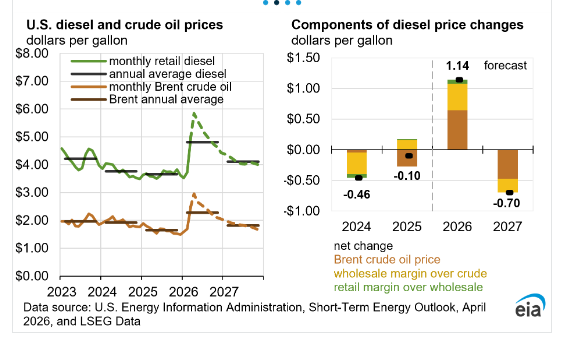
    However, that data does not include the most recent effects on shipping costs caused by the war in Iran, which led to worldwide spikes in gas costs due to the closure of the Strait of Hormuz.

  • Iran declares Strait of Hormuz open to shipping but Trump says U.S. blockade still active

    • Iran’s foreign minister declared the Strait of Hormuz open to all commercial ships during the ceasefire between Israel and Lebanon.
    • President Donald Trump thanked Tehran for opening the strait, but said the U.S. blockade of Iran’s ports remains in effect.
    • Iranian media affiliated with the Revolutionary Guard described a limited reopening of the strait. It will close if the U.S. blockade continues, according to Tasnim News.

    https://www.cnbc.com/2026/04/17/iran-war-hormuz-strait-israel-lebanon-ceasefire.html

  • Apr 16/26: Bank Of Nova Scotia(BNS.TO)

    The Bank of Nova Scotia provides various banking products and services in Canada, the United States, Mexico, Peru, Chile, Colombia, the Caribbean and Central America, and internationally. It operates in four segments: Canadian Banking, International Banking, Global Wealth Management, and Global Banking and Markets. The company offers financial advice and solutions, and day-to-day banking products, including debit and credit cards, chequing and saving accounts, investments, mortgages, loans, and insurance to individuals; and business banking solutions comprising lending, deposit, cash management, and trade finance solutions to small, medium, and large businesses, including automotive financing solutions to dealers and their customers. It also provides wealth management advice and solutions, including online brokerage, mobile investment, full-service brokerage, trust, private banking, and private investment counsel services; and retail mutual funds, exchange traded funds, liquid alternative funds, and institutional funds. In addition, the company offers international banking services for retail, corporate, and commercial customers; and lending and transaction, investment banking advisory, and capital markets access services to corporate customers. Further, it provides online, mobile, and telephone banking services. The company operates a network of 954 branches and approximately 3,766 automated banking machines in Canada; and approximately 1,300 branches and a network of contact and support center internationally. The Bank of Nova Scotia was founded in 1832 and is headquartered in Halifax, Canada.

    How the Company Makes Money

    Scotiabank generates revenue through multiple key streams. The primary source is net interest income, which arises from the difference between interest earned on loans and interest paid on deposits. This includes personal loans, mortgages, and commercial lending. Additionally, the bank earns substantial fees from wealth management services, investment banking activities, and transaction-based services such as account maintenance and credit card fees. Scotiabank also benefits from trading and investment income derived from its capital markets division, which engages in trading securities and providing advisory services. Collaborations with other financial institutions and technology partners enhance Scotiabank’s service offerings and operational efficiencies, contributing to its overall revenue generation. Furthermore, the bank’s international operations, particularly in growth markets, provide additional avenues for earnings, helping to diversify its revenue base.

  • Apr 16 – Mkt. Update : Banks / RY.TO

    Updated 3-Month Forecast (mid-April to mid-July 2026) for Canadian Big 6 Banks (TSX-listed).

    Current approximate prices (as of approx.. April 16, 2026): TD.TO $142 CAD, RY.TO $240 CAD, BMO.TO $204 CAD, BNS.TO $103 CAD, NA.TO $201 CAD, CM.TO $147 CAD.

    Sector setup remains similar: Q1 2026 earnings were strong across the board (all banks beat estimates, collective $$19B profit, driven by revenue/wealth/capital markets strength, stable credit). Valuations are elevated after the 2025 rally and continued gains into 2026, with most stocks trading near or above consensus 12-month targets. Limited upside overall, range-bound trading likely, with dispersion based on U.S. exposure, yield, and domestic vs. international mix.

    Consensus view: Banks near peak multiples; forward returns compressed. Earnings growth mid-single digits expected. Rate path, consumer/housing credit, and loan growth are key watchpoints.

    3-Month Forecast (Range + Bias)

    TickerDirection3M Range (CAD)Basis
    TD.TOFlat to slight down135–148Trading near/above most targets ($C$139–142 consensus). Strong Q1 but already re-rated; U.S. exposure adds volatility.
    RY.TOSlight up / most stable235–255Highest consensus targets ($C$244–253); diversified, wealth/capital markets tailwinds support modest drift.
    BMO.TOFlat195–215Targets cluster $C$205–211; U.S. operations help but valuation caps upside.
    BNS.TOSlight up100–110Yield support + international exposure; targets $C$106–112 provide mild positive bias.
    NA.TOFlat to slight down190–205Strong recent performance and beats, but trading well above some historical/prior targets; mean-reversion risk higher.
    CM.TOFlat140–152Targets $C$144–153; solid but limited room after recent strength.

    Relative positioning: RY and BNS remain better placed for stability/modest gains. NA, CM, and BMO carry higher pullback risk if credit or macro data softens.

    Key Drivers (Next 90 Days)

    • Earnings cycle: Q2 reports in May/June — focus on NIM trends, loan growth, and PCLs (provisions for credit losses).
    • Macro: Any acceleration in rate cuts could pressure NIM; consumer credit stress or housing softness adds downside skew.
    • Capital markets/wealth: Continued strength provides support (as seen in Q1).
    • Valuation: Sector already priced for good outcomes; upside requires consistent beats.

    Valuation Logic Most names sit at 0–5% from 12-month targets → favors trading ranges over trends. Post-2025 rally ($strong gains) + 2026 performance leaves lower expected returns. P/E multiples above long-term averages.

    Risks

    • Higher credit losses (consumer, housing, commercial).
    • Faster NIM compression from rate environment.
    • Weaker loan growth or macro shock (trade, recession signals).
    • Any U.S.-specific issues for TD/BMO.

    Scenarios (Probability)

    • Bull (20%): Continued earnings beats + benign rates/credit → +5–8% sector move.
    • Base (60%): Inline results, stable macro → ±4–6% range-bound.
    • Bear (20%): Credit deterioration or weak data → -8–12% pullback.

    Actionable Takeaways Expect choppy, range-bound action rather than a clear trend. Favor RY and BNS for relative outperformance or defensiveness. NA/CM/BMO more prone to mean reversion. Next earnings cycle is the primary re-rating catalyst — watch for guidance on credit and growth. No major trend expected without a clear macro shift.

    Royal Bank of Canada (RY.TO)

    • Next Earnings Date: May 28, 2026 (est.)
    • Annual Dividend  $ 6.56

    RECOMMENDED FOR RRSP/TFSA based on Dividend Income.

    Royal Bank of Canada operates as a diversified financial service company worldwide. The company’s Personal & Commercial Banking segment offers checking and savings accounts, home equity financing, personal lending, private banking, indirect lending, including auto financing, mutual funds and self-directed brokerage accounts, guaranteed investment certificates, credit cards, and payment products and solutions; and lending, leasing, deposit, investment, foreign exchange, cash management, auto dealer financing, trade products, and services to small and medium-sized commercial businesses. This segment offers financial products and services through branches, automated teller machines, and mobile sales network. Its Wealth Management segment provides a suite of advice-based solutions and strategies to high net worth and ultra-high net worth individuals, and institutional clients. The company’s Insurance segment offers life, health, home, auto, travel, wealth, annuities, and reinsurance advice and solutions; and business insurance services to individual, business, and group clients through its advice centers, RBC insurance stores, and mobile advisors; digital, mobile, and social platforms; independent brokers; and travel partners. Its Investor & Treasury Services segment provides asset servicing, custody, payments, and treasury services to financial and other investors; and fund and investment administration, shareholder, private capital, performance measurement and compliance monitoring, distribution, transaction banking, cash and liquidity management, foreign exchange, and global securities finance services. The company’s Capital Markets segment offers corporate and investment banking, as well as equity and debt origination, distribution, advisory services, sale, and trading services for corporations, institutional investors, asset managers, private equity firms, and governments. The company was founded in 1864 and is headquartered in Toronto, Canada.

    How the Company Makes Money

    RBC makes money primarily by earning net interest income and generating fee-based revenue across its major business lines. 1) Net interest income (banking spread): A core earnings driver is the spread between interest earned on loans and other interest-earning assets (e.g., personal and commercial loans, mortgages, credit cards, and certain securities) and interest paid on deposits and other funding sources. Higher loan balances, favorable deposit mix, and wider spreads generally support this income; credit losses (loan impairments) reduce profitability. 2) Fees and commissions from client services: RBC earns non-interest revenue from service charges and account fees (e.g., certain banking packages and transaction services), card-related fees, payment processing and cash management fees for businesses, and various administrative and transaction fees tied to client activity. 3) Wealth management and asset management fees: Through wealth management activities, RBC earns recurring fees based on assets under management/administration, as well as commissions and advisory fees from brokerage services, financial planning, portfolio management, and related client advice. Earnings in this area tend to be influenced by market levels (which affect client asset values) and net client flows. 4) Capital markets revenue: RBC generates revenue from underwriting and advisory services (investment banking fees), sales and trading, market making, financing, and other capital markets activities. This includes client-driven trading and related revenue, as well as gains/losses from certain market exposures; performance is influenced by market volatility, client activity, and deal volumes. 5) Insurance premiums and investment income: RBC earns money from insurance by collecting premiums (net of claims and policy benefits) and from investment income on the assets held to support insurance liabilities. Results are influenced by claims experience, policy lapses, pricing, and investment returns. 6) Investor and custody services: Through investor services activities, RBC earns fees for custody, fund services, trade settlement, and other institutional client services; revenue depends on client assets, transaction volumes, and service mandates. 7) Other income and factors: Additional earnings can come from foreign exchange and treasury activities, dividends on certain investments, and gains/losses on securities measured at fair value, depending on accounting classification. Overall profitability is also affected by operating expenses, regulatory capital and liquidity requirements, funding costs, and macroeconomic conditions (which influence loan demand and credit quality).

    Company Guidance

    Management’s 2026 guidance highlighted mid‑single‑digit growth in all‑bank net interest income (ex‑trading), with the bulk of the remaining $80m PPA accretion rolling off next quarter (≈ a 4‑bp headwind to Canadian banking NIM); all‑bank NIM was down 7 bps QoQ (ex‑trading NIM +1 bp QoQ) and Canadian banking NIM would have been ~+2 bps excluding the PPA effect. They reiterated low‑ to mid‑single‑digit mortgage growth and commercial loan growth nearer the lower end of mid‑ to high‑single‑digits, expect all‑bank expense growth in the mid‑single‑digit range while still delivering positive all‑bank operating leverage (1–2% for Canadian Banking), see the adjusted non‑TEB effective tax rate moving toward the higher end of the 21–23% band over the next 12 months, expect corporate support losses to trend to the lower end of $100–150m/quarter, foresee a modest ~10‑bp negative CET1 impact next quarter from retail capital parameter changes, and reiterated that full‑year 2026 provisions on impaired loans should remain within prior guidance; they also noted roughly $1bn annual technology/safety spend and continued capital returns (Q1 buybacks ≈4.2m shares / ~$1bn).

    Royal Bank Of Canada (RY) Dividend Data:

    NOTE:

    • Royal Bank Of Canada’s (RY) Moving Averages Convergence Divergence (MACD) indicator is 3.19, suggesting Royal Bank Of Canada is a Sell.
    • Royal Bank Of Canada’s (RY) 20-Day exponential moving average is 230.20, while Royal Bank Of Canada’s (RY) share price is C$240.35, making it a Buy.
    • Royal Bank Of Canada’s (RY) 50-Day exponential moving average is 228.14, while Royal Bank Of Canada’s (RY) share price is C$240.35, making it a Buy.

    RY.TO’s 12-month analyst range is roughly C$203 to C$227, with a consensus around C$211.5 in one major source and C$206.6 in another; both imply only modest upside from recent prices.

    What that means

    • Base case: low-to-mid single-digit upside over 12 months.
    • Bull case: toward C$227 if earnings stay strong and the market keeps paying a multiple premium.
    • Bear case: low C$200s if credit costs rise or the sector de-rates.

    Why the range is tight

    Analysts are split between “quality compounder” and “fully valued bank” because RBC just posted strong Q1 results, but the stock already reflects much of that strength.

    The main debate is whether record earnings and wealth/capital-markets strength justify further multiple expansion, or whether rising impaired loans and integration/capital considerations limit upside.

    Practical takeaway

    For a 12-month horizon, RY looks like a steady hold rather than a big rerating story unless the next few quarters show continued earnings beats without a credit wobble.

    Key risks

    Credit losses rise faster than expected. RBC’s Q1 strength came with rising impaired loans and ongoing normalization in provisions, so a weaker economy would hit earnings and the multiple.

    Canadian slowdown / housing stress. RBC is heavily exposed to Canadian consumers and mortgages, so softer GDP, higher unemployment, or a housing correction would pressure loan growth and credit quality.

    Multiple already rich. Analysts already describe RBC as close to fair value or fully valued, so even good earnings may not drive much upside if the market de-rates banks.

    Capital markets cyclicality. RBC’s strong wealth and trading income can fade quickly if market activity cools, reducing a big support for recent earnings strength.

    HSBC Canada integration / execution. The acquisition helps scale, but integration and cost synergies must keep delivering to justify the premium valuation.

    What matters most

    RY’s 12-month target is most vulnerable to higher credit provisions and a valuation reset, not to a collapse in earnings.

    For valuation, this suggests RY.TO’s credit-loss risk is more about timing and magnitude than a permanent step-change in credit quality. If the economy stays soft, provisions can stay elevated; if conditions stabilize, they can move back down toward more normal levels.

    END

    Reference: March 11, 2026 Royal Bank of Canada .docx

  • Royal Bank – March 11, 2026

    Executive Summary

    • Market capitalization: ~C$320B, the largest bank in Canada and among the largest globally.
    • Profitability: Net income ~C$20.4B in FY2025 with ~16% ROE, reflecting strong earnings growth and scale.
    • Dividend: ~C$6.56 annual dividend (~2.8% yield), with a 10+ year record of growth.
    • Valuation: ~16× P/E and ~2.6× price-to-book, consistent with premium Canadian bank valuation.
    • 6-month outlook: Base case range C$230–260, driven by earnings growth and rate-cycle expectations.

    1. Fundamental Analysis

    Business Model

    Royal Bank of Canada (RBC) is a diversified universal bank with major segments:

    SegmentCore Activities
    Personal & Commercial BankingCanadian mortgages, loans, deposits
    Wealth ManagementInvestment advisory, asset management
    Capital MarketsInvestment banking, trading
    InsuranceInsurance products
    Investor & Treasury ServicesCustody and institutional services

    Key strength: diversified earnings mix, reducing dependence on any single segment.

    Recent earnings growth has been driven by wealth management inflows, capital markets activity, and strong Canadian retail banking margins.

    Financial Performance (Last 3 Fiscal Years)

    CAD billions

    Fiscal YearRevenueNet ProfitNotes
    2023~49.7~14.9Post-pandemic normalization
    2024~55.7~16.9Loan growth, wealth management
    2025~62.2~20.4Record profit, ROE ~16%

    Key takeaway:
    Profit growth is accelerating, driven by higher interest income and stronger capital markets.

    Dividend Profile

    MetricValue
    Annual dividend~C$6.56 per share
    Dividend yield~2.8%
    Quarterly dividend~C$1.64
    Dividend growth~10+ years of increases
    Payout ratio~40–45%

    Interpretation:

    • Payout ratio leaves room for dividend growth
    • Dividend growth historically tracks earnings growth

    Market Capitalization

    MetricValue
    Market capitalization~C$320B
    Shares outstanding~1.4B

    2. Valuation

    MetricRBCInterpretation
    P/E~16×Slight premium to banks
    Price/Book~2.6×Reflects strong ROE
    Net margin~32%Among highest globally
    EPS (TTM)~14.07Growing rapidly

    Premium valuation reflects:

    • dominant domestic franchise
    • strong capital markets
    • high ROE

    3. Technical Analysis

    Current range (2026):

    MetricLevel
    Current price~C$226–232
    52-week high~C$240
    52-week low~C$151

    Trend

    • Strong uptrend through 2025
    • Consolidation near highs

    Support levels

    • C$210 (major institutional support)
    • C$200 (psychological level)

    Resistance levels

    • C$240 (recent high)
    • C$260 (next technical breakout zone)

    Momentum remains neutral-bullish.

    4. Key Drivers (Next 6 Months)

    Macro

    1. Bank of Canada rate path
      • Rate cuts can compress margins but stimulate loan growth.
    2. Canadian housing market
      • RBC has large mortgage exposure.
    3. Capital markets activity
      • M&A and trading revenue affect quarterly earnings.
    4. Wealth management flows
      • Strong equity markets increase AUM.

    5. Risks

    RiskImpact
    Housing downturnHigher loan losses
    Credit cycle deteriorationHigher provisions
    Interest rate compressionNet interest margin decline
    Regulatory changesCapital requirements
    Global recessionCapital markets revenue drop

    Loan loss provisions are the main cyclical risk for banks.

    6. Scenario Forecast (6 Months)

    ScenarioPrice TargetDrivers
    BearC$210Credit losses rise, TSX correction
    BaseC$240–250Earnings growth + stable economy
    BullC$260–275Strong capital markets and wealth flows

    Analyst consensus 1-year target around ~C$245 supports the base scenario.

    7. Investment Quality Assessment

    FactorAssessment
    Balance sheetVery strong
    Earnings stabilityHigh
    Dividend reliabilityHigh
    Market dominanceLeading
    CyclicalityModerate

    Overall quality: Tier-1 global bank franchise

    Strength comes from scale, diversification, and high ROE.

    Actionable Takeaways

    • RBC remains one of the highest-quality financial franchises in Canada.
    • Earnings growth is strong and dividends are well covered.
    • Valuation reflects this quality, trading at a premium to most Canadian banks.
    • Near-term price movement likely tied to rate expectations and credit conditions.

    Canadian Bank Peer Comparison

    Royal Bank of Canada vs Major TSX Banks

    Peers:

    • Royal Bank of Canada (RY.TO)
    • Toronto-Dominion Bank (TD.TO)
    • Bank of Montreal (BMO.TO)
    • Bank of Nova Scotia (BNS.TO)
    • Canadian Imperial Bank of Commerce (CM.TO)

    The objective is to determine whether RBC’s premium valuation is justified relative to Canadian bank peers.


    Executive Summary

    • RBC leads Canadian banks in market capitalization, profitability, and earnings diversification.
    • RBC generates higher ROE (~16%) than most peers, justifying its valuation premium.
    • Dividend yield is lower than peers, reflecting stronger growth rather than income focus.
    • Capital markets and wealth management exposure give RBC higher earnings resilience in rising markets.
    • 6-month base case: C$240–250, with upside if financial conditions remain supportive.

    Peer Financial Comparison

    Key Metrics (Approximate FY2025 data)

    BankMarket Cap (CAD B)Revenue (CAD B)Net Income (CAD B)ROEDividend Yield
    RBC (RY)~320~62~20.4~16%~2.8%
    TD~155~53~11.5~13%~4.7%
    BMO~120~45~7.8~11%~4.9%
    BNS~82~35~8.0~12%~6.2%
    CIBC~78~30~6.3~12%~5.5%

    Interpretation

    RBC dominates in:

    • profitability
    • earnings diversification
    • scale

    BNS and CIBC offer higher yields but lower growth and higher risk exposure.

    Valuation Comparison

    BankP/EPrice/BookComment
    RBC~16x~2.6xPremium valuation
    TD~13x~1.6xRegulatory overhang
    BMO~12x~1.3xIntegration of Bank of the West
    BNS~11x~1.2xEmerging market exposure
    CIBC~11x~1.3xMortgage exposure

    Key Insight

    RBC trades at ~20–40% valuation premium due to:

    • higher ROE
    • stronger capital markets franchise
    • superior earnings stability

    Dividend Comparison

    BankAnnual DividendYieldPayout Ratio
    RBC~$6.56~2.8%~43%
    TD~$4.16~4.7%~50%
    BMO~$6.20~4.9%~50%
    BNS~$4.24~6.2%~60%
    CIBC~$3.96~5.5%~55%

    Interpretation

    • RBC = lower yield, stronger growth
    • BNS / CIBC = higher yield, slower growth

    Structural Strengths of RBC

    1. Diversified Earnings

    Approximate revenue mix:

    SegmentContribution
    Canadian banking~40%
    Wealth management~25%
    Capital markets~25%
    Insurance & others~10%

    This diversification reduces earnings volatility relative to mortgage-heavy peers.

    2. Wealth Management Scale

    RBC wealth assets under management exceed $1.3 trillion, among the largest globally.

    Benefit:

    • fee-based revenue
    • lower capital intensity
    • higher margins

    3. Capital Markets Franchise

    RBC Capital Markets is consistently ranked among the top global investment banks outside the US.

    This segment significantly boosts earnings during strong markets.

    Technical Analysis (RY.TO)

    Current structure (approximate):

    IndicatorLevel
    Current price~C$228–232
    50-day MA~C$224
    200-day MA~C$208
    TrendUptrend

    Key Levels

    Support:

    • C$220
    • C$210

    Resistance:

    • C$240
    • C$260

    Trend remains constructively bullish.

    Key Drivers (Next 6 Months)

    Positive Drivers

    1. Canadian economic stability
    2. Strong capital markets revenues
    3. Wealth inflows
    4. Bank of Canada easing cycle

    Negative Drivers

    1. Housing correction
    2. Credit losses
    3. Global recession
    4. Interest margin compression

    Scenario Forecast (6 Months)

    ScenarioPriceDrivers
    BearC$210credit losses rise
    BaseC$240–250stable earnings growth
    BullC$260–275strong markets + earnings beat

    What Would Disprove the Bullish Thesis

    The investment case weakens if:

    • loan loss provisions rise sharply
    • Canadian housing deteriorates
    • capital markets revenues decline materially
    • ROE falls below 14%

    Investment Quality Assessment

    CategoryRating
    Balance SheetVery Strong
    ProfitabilityBest among Canadian banks
    Earnings StabilityHigh
    Dividend ReliabilityHigh
    Growth PotentialModerate-High

    Overall classification: High-quality financial franchise.

    Actionable Takeaways

    • RBC trades at a premium valuation because it is the highest-quality bank in Canada.
    • Dividend yield is lower but earnings growth and ROE are superior.
    • The stock is technically in an uptrend with resistance near C$240.
    • Over the next 6 months, the most probable trading range is C$230–250.

    Top Analyst Forecasts — Royal Bank of Canada (TSX: RY)

    Below are five widely cited institutional analyst price targets compiled from brokerage reports and analyst aggregators. These are generally 12-month targets, but they provide a reasonable basis for estimating a 6-month trajectory.

    Current price reference: ~C$231–234

    Executive Summary

    • Consensus analyst view: Moderately bullish on RY.
    • Average target: ~C$235–243.
    • High target: ~C$260–270.
    • Low target: ~C$189–220.
    • Implied 6-month trading range: C$220–255 assuming stable macro conditions.

    Analyst surveys indicate 8 Buy, 2 Hold, 2 Strong Buy ratings across coverage firms.


    Top 5 Analyst Price Targets

    Analyst / FirmRatingPrice Target (CAD)Implied UpsideKey Thesis
    Canaccord GenuityBuyC$255~10%Strong capital markets earnings
    National Bank FinancialOutperformC$231~0–3%Stable retail banking growth
    Raymond JamesOutperformC$229~0%Premium valuation justified
    JefferiesHoldC$215~-7%Valuation concerns
    Consensus (11 analysts)BuyC$234–243~2–5%Balanced outlook

    Analyst Target Distribution

    StatisticPrice (CAD)
    Highest forecast~C$260–270
    Average forecast~C$235–243
    Lowest forecast~C$189–220

    The consensus estimate implies limited upside from current levels, indicating analysts believe the stock is close to fair value.

    Translating Analyst Targets to a 6-Month Forecast

    Analyst targets typically reflect 12-month expectations, so a rough midpoint adjustment gives:

    Scenario6-Month Price Estimate
    BearC$210–220
    BaseC$235–245
    BullC$250–260

    Drivers:

    • EPS growth ~8–10% expected in FY2026
    • stable Canadian credit environment
    • capital markets revenue strength

    Key Variables Analysts Are Watching

    Positive

    • wealth management inflows
    • capital markets trading revenues
    • Bank of Canada rate stability

    Negative

    • credit losses from mortgages
    • housing slowdown
    • margin compression if rate cuts accelerate

    What Would Change Analyst Targets

    Targets could be revised upward if:

    • ROE rises above 17%
    • capital markets revenues outperform
    • Canadian housing remains resilient

    Targets could fall if:

    • loan loss provisions increase
    • economic growth weakens materially

    Actionable Takeaways

    • Analyst consensus suggests limited near-term upside but high stability.
    • RBC trades near fair value according to most broker models.
    • The stock is widely viewed as a quality defensive bank rather than a high-growth opportunity.
  • BRP Suspends FY27 Guidance Due to Changes to U.S. Tariff Environment

    VALCOURT, QC, April 14, 2026 /CNW/ – BRP Inc. (TSX: DOO) (NASDAQ: DOO) today announced it is suspending its full-year FY27 guidance following the recent amendment of Section 232 tariffs on Steel, Aluminum and Copper imports into the U.S., which came into effect on April 6, 2026. For BRP, the amendment mainly leads to a 25% tariff on the total value of imported snowmobiles and the majority of ORV models, replacing the previous 50% tariff on applicable metal content only. The Company currently estimates the potential incremental tariff cost related to this amendment to be in excess of $500 million for the remainder of the year, before any mitigation measures that could partially offset these impacts.

    Read more at newswire.ca

  • AtkinsRéalis signs MOU with South Korean submarine maker contending for federal contract

    AtkinsRéalis Group Inc., formerly known as SNC-Lavalin Group Inc.

    SNC-Lavalin’s management teams have been investigated in a number of allegations under the Corruption of Foreign Public Officials Act regarding contracts beginning with the SNC-Lavalin Kerala hydroelectric dam scandal (1995–2008)[58] through to the allegations involving the bribing of Libyan officials between 2001 and 2011.[59]

    SNC-Lavalin Kerala hydroelectric dam scandal (1995–2008)

    Main article: SNC-Lavalin Kerala hydroelectric scandal

    SNC-Lavalin won a large infrastructure contract to renovate and modernize hydroelectric power stations with the Current Chief Minister of Kerala Pinarayi Vijayan Indian government in 1995 which resulted in an alleged net loss to the Indian exchequer of 3745.0 million rupees,[50][60] but led to no charges against the firm. SNC-Lavalin was subsequently accused of bribery and financial fraud related to the contract in 2008. A government investigation resulted in the expulsion of several Indian government officials.[61]

    Montreal’s Jacques-Cartier bridge (early 2000s)

    Former Federal Bridge Corporation CEO Michel Fournier was charged with taking $2.35 million in bribes from SNC-Lavalin in return for the contract to repair the Jacques Cartier Bridge in the early 2000s. Fournier pleaded guilty and sentenced in 2017 to five years for his part in the bribery scheme. The RCMP launched a subsequent investigation called Agrafe 2 into potential criminal charges against the company concerning the bridge contract.[34][35] Two of the company’s subsidiaries and two former executives, Normand Morin and Kamal Francis, were charged in September 2021. The prosecution encouraged the company to negotiate a plea deal, given the top management had completely changed since the offences had occurred.[62] Bribery payments were made through a Lebanese intermediary to Fournier, and were disguised as fictitious work on projects in Algeria and Libya. In May 2022 the company negotiated a deferred prosecution agreement and agreed to pay fines, surcharges and victim compensation totalling $29.6 million to settle the matter.[63]

    Illegal reimbursement of political donations (2004–2011)

    In 2016, commissioner of Canada elections was probing political party donations made by SNC-Lavalin employees. According to the source that provided information to CBC News, the investigation found that SNC-Lavalin reimbursed all of those individual donations—a practice forbidden under the Canada Elections Act—but Elections Canada reached an agreement with the company to avoid prosecution.[64]

    In May 2018, former SNC-Lavalin executive vice president Normand Morin[65] was charged with making illegal donations to Canadian federal political parties, on recommendation from the director of public prosecutions, in the Court of Quebec. The charges allege that from 2004 to 2011, Morin orchestrated and solicited political donations from employees or their spouses to Canadian federal political parties anonymously on behalf of SNC-Lavalin, to be reimbursed afterwards. The amounts paid included about CA$110,000 to the Liberal Party and CA$8,000 to other Canadian political parties.[66][67] In November 2018, Morin pleaded guilty to two of the five charges, and was fined $2,000. The remaining three charges were dropped by the prosecution.[68]

    Libya (2011)

    A 2012 CBC News report, said that the first reports of murky affairs surfaced against the company in 2010 in relation to contracts in Libya.[8] According to a CBC News article, a Libyan bribery and fraud scandal involving crimes that took place from 2001 to 2011 led to charges in “connection with payments of nearly $48 million” to Libyan public officials.[69] In the same article, it was reported that the company was also accused of “defrauding Libyan organizations of an estimated $130 million”.[69][59]

    In 2015, SNC-Lavalin was charged with bribing Libyan officials in exchange for construction contracts between 2001 and 2011.[59] In 2011, the RCMP began an investigation called Project Assistance which was triggered by a tip from Swiss authorities.[70] According to an August 16, 2013 Financial Post article, Michael Novak, who had been the head of SNC International, had “signed several of the contracts between SNC and commercial consultants for work in Africa” having declared that “he believed he was dealing with veritable consultants” [71][72]and having been later cleared of any wrongdoing by investigators, as reported by La Presse.[73] This included a contract with former Libyan dictator Muammar Gaddafi‘s controversial government.[74] By the summer of 2013, police alleged that the “unknown commercial consultants” had never existed and that Ben Aissa had “set up shell companies so he could pocket the [$56 million] himself”.[72][75] By July 2014, Aissa was jailed in Switzerland for “suspicion of corruption, fraud and money-laundering in North Africa”.[76][77][Notes 3] When SNC-Lavalin pulled out of Libya in 2011, it left behind $22.9 million in Libyan banks.[78] In 2013, Roy filed a countersuit for wrongful dismissal, claiming lost wages and damages to his reputation, alleging that he had been framed and scapegoated by higher-level executives whose directives he was obliged to follow.[79][80][81][82][Notes 4]

    By February 2012, SNC-Lavalin investors had found out that audited financial statements had been delayed to accommodate an internal review relating to SNC-Lavalin’s operations. The internal review probed $35 million of unexplained payments in Libya. Prior to the launch of the investigation, there had been months-long media speculation about the company’s work in Libya and its ties to the Muammar Gaddafi family.[83][84][85] In 2012, the RCMP investigated the company on these charges in the Project Assistance investigation and,[86] in 2015, they charged SNC-Lavalin with “fraud and corruption”, which the company indicated they would contest in court.[87]

    On December 18, 2019, SNC-Lavalin Construction Inc. pleaded guilty to fraud contrary to section 380(1) a)[88] of the Canadian Criminal Code. The company stated that, between 2001 and 2011, over $47.5 million had been paid to Al-Saadi Gaddafi. The money was directed through two representative companies, both listing Riadh Ben Aissa as the sole beneficial owner. In return for the bribes, Al-Saadi Gaddafi applied his influence to the construction contract bidding process, ensuring contracts were awarded to SNC-Lavalin Construction. Payments of personal benefits totalling over $73.5 million were also made through the representative companies to Ben Aissa and Sami Bebawi, a former vice-president of SLCI. As part of its plea agreement with the Public Prosecution Service, SLCI was fined $280 million and given a three-year probation order. In exchange, the remaining corruption and fraud charges against SNC-Lavalin Group Inc., SNC-Lavalin Construction Inc. and SNC-Lavalin International Inc. were stayed.[89]

    After the bribes were discovered, the audit committee of the company’s board launched an investigation into the matter, led by directors such as Claude Mongeau, then the CEO at Canadian National Railway.[90][91] During the audit committee investigation, the Financial Post wrote a story critical of full-time CEOs serving on the boards of directors of other companies, calling out Mongeau specifically.[91]

    McGill University; the Arthur Porter kick-back scandal (2011–2014)

    Charges were laid against senior executives from 2014 through 2019 in the bribery cases involving Arthur Porter at the McGill University Health Centre. According to a 2012 article in the Globe & Mail, these reports prompted calls for Canada to tighten bribery laws.[92]

    According to the National Post, SNC-Lavalin employees allegedly were involved in fraud and forgery in relation to a $22.5 million kick-back described as “consulting fees” to Arthur Porter[93][Notes 5] on the contract to build the new $1.3 billion hospital at the McGill University Health Centre‘s CEO in violation of the Quebec Health Act. SNC-Lavalin were awarded the contract even though they were outbid by $60 million.[45] The case led to an investigation by the Charbonneau Commission. Porter resigned from the post on December 5, 2011, in light of substantial public pressure.[94][95][96] Porter was arrested in Panama on fraud charges on May 27, 2013, which alleged that he took part in the kick-back scheme.[97] The CBC called it the biggest fraud investigation in Canadian history.[98][99] SNC-Lavalin CEO, Pierre Duhaime in March 2012,[100][8][101] was arrested on fraud charges by Quebec authorities on November 28, 2012.[102][103][Notes 6][Notes 7][104]

    SNC-Lavalin sued Duhaime for millions of dollars in damages, claiming that he stained its goodwill by means of the McGill University Health Centre superhospital scandal. The company claims that Duhaime “facilitated the execution of the embezzlement” of $22.5 million of company funds. Duhaime was charged with several counts related to the bribe. In February 2019 he pleaded guilty to one count of breach of trust. The prosecution vacated some 15 further charges.[105]

    Padma Bridge (since 2011)

    Further information: Padma Bridge graft scandal

    An investigation into an alleged graft related to 2011 bids for the construction of the 6.51 kilometre (four-mile) USD$3 billion road—rail bridge crossing the Padma River in Bangladesh,[106] resulted in the former SNC-Lavalin employees being cleared of all charges by a Canadian court. In May 2011, two former SNC-Lavalin International Inc. (SLII) employees Ramesh Shah and Mohammad Ismail met government officials in Bangladesh to discuss a bid for the $50-million supervision contract to build the Padma Bridge, a project estimated to be worth US$3 billion.[58] Part of the allegations were related to SLII common practice of list project consultancy costs (PCC), also known as project commercial cost, as a line item in internal budgets documents related to the bidding process.[58][Notes 8] As a result of the original investigation by World Bank investigators who worked with RCMP officers, in September 2013, the World Bank blacklisted SNC-Lavalin and its affiliates from bidding on the World Bank’s global projects.[107] The World Bank had originally offered to fund $1.5 billion of the $3 billion but pulled back following the allegations. However, on February 11, 2017, the Ontario Superior Court found no proof of the Padma bridge bribery conspiracy, dismissed the case, and acquitted the ex-SNC-Lavalin executives.[108] According to the Dhaka Tribune, Justice Ian Nordheimer rebuked the Canadian police, saying: “Reduced to its essentials, the information provided in the [wiretap applications] was nothing more than speculation, gossip, and rumor.”[108]

    SaskPower serious design flaws (2015)

    In 2015, internal documents from SaskPower (the crown corporation that is the principal electric utility in Saskatchewan, Canada), revealed that there were “serious design issues” in the carbon capture and storage system at its coal-fired Boundary Dam Power Station, resulting in regular breakdowns and maintenance problems that caused the unit to be operational only 40% of the time. SNC-Lavalin had been contracted to engineer, procure, and build the facility, and the documents asserted that it “has neither the will or the ability to fix some of these fundamental flaws”.[109] The low productivity of the plant had in turn meant that SaskPower was only able to sell half of the 800,000 tonnes of captured carbon dioxide that it had contracted to sell to Cenovus Energy for use in enhanced oil recovery at a cost of $25 per tonne. In addition to the lost sales, this meant that SaskPower had been forced to pay Cenovus $12 million in penalties.[110] In 2017, Cenovus sold its Saskatchewan operations to Whitecap Resources.[111] By September 2018, “SaskPower and SNC-Lavalin had completed mediation and were headed to binding arbitration”.[69] In July 2018, SaskPower announced, in its annual report, that they would not be proceeding with retrofitting the two aging facilities near Estevan—Boundary Dams 4 and 5 (BD4 and BD5) with carbon capture and storage (CCS).[112] According to a February 11, 2019 CBC News article, SNC-Lavalin has “received about $765,800,000 in [Saskatchewan provincial] government contracts from 2009 to 2018”.[69]

    SNC-Lavalin affair (2019)

    Main article: SNC-Lavalin affair

    Following a 2017 public consultation process, the Government of Canada moved forward with the establishment of a “made-in-Canada version of a deferred prosecution agreement (DPA) regime”, called the “Remediation Agreement Regime”,[113] which was introduced in the March budget and came into effect in June 2018.[Notes 9] By 2019, SNC-Lavalin, still facing criminal charges in regard to several contracts, began investigating the possibility of a DPA under the newly introduced Remediation Agreement Regime, as early as April 2018.[114][113][59] On February 10, 2019, the Toronto Star reported that Opposition Leader Andrew Scheer met with SNC-Lavalin CEO Neil Bruce on May 29, 2018, to discuss the remediation agreement.[115] The director of public prosecutions informed SNC-Lavalin on October 9, that its DPA option was rejected because “is not appropriate in this case”.[116] According to the National Post, “If the company is convicted it would be barred from bidding on federal contracts for 10 years, potentially costing it billions in forgone revenue.”[116] In response, the company’s share prices dropped, leaving it vulnerable to a hostile takeover. According to the Montreal Gazette, Quebec Premier François Legault said that SNC-Lavalin was one of ten publicly traded companies headquartered in Quebec that the province considers to be “strategic” and therefore in need of protection from a takeover that would force the company to leave the province.[117]

    On February 8, 2019, the Globe & Mail reported that sources close to the government said that the Prime Minister’s Office allegedly had attempted to influence Jody Wilson-Raybould‘s decision concerning SNC-Lavalin’s request for a DPA, while she was Minister of Justice and Attorney General. When asked about the allegations, Justin Trudeau said that the story in the Globe was false and that he had never “directed” Wilson-Raybould concerning the case.[118] Wilson-Raybould refused to comment on the matter citing solicitor-client privilege.[119] Under pressure from the Conservative Party of Canada and the New Democratic Party (NDP), on February 11, 2019, the conflict of interest and ethics commissioner launched an inquiry into allegations of political interference and a possible violation of the Conflict of Interest Act in the SNC-Lavalin case.[120][59]

    On February 18, 2019, Gerald Butts, Trudeau’s principal secretary, resigned and denied that he or anyone else in the Prime Minister’s Office attempted to influence Wilson-Raybould.[121]

    On February 27, 2019, Wilson-Raybould spoke about the SNC-Lavalin controversy at a hearing of the House of Commons justice committee. In her first substantial public statement on the matter, she testified that she was inappropriately pressured to prevent the Montreal-based company from being prosecuted in a bribery case.[122]

    On 14 August 2019, Mario Dion, conflict of interest and ethics commissioner, released a report that said Trudeau contravened section 9 of the Conflict of Interest Act by improperly pressuring Wilson-Raybould.[123][124][125][126] The report details lobbying efforts by SNC-Lavalin to influence prosecution since at least February 2016, including the lobbying efforts to enact DPA legislation. The commissioner has also found that Trudeau acted improperly when using his position of authority over Wilson-Raybould in an effort to have her overrule the director of public prosecution’s decision not to negotiate a deal with SNC-Lavalin that would see the company avoid criminal prosecution over charges of corruption and fraud stemming from an RCMP investigation. The report analyses SNC-Lavalin’s interests and finds that the lobbying effort advanced private interests of the company, rather than public interests. The report’s analysis section discusses the topics of prosecutorial independence and Shawcross doctrine (dual role of Attorney General) to draw the conclusion that the influence was improper and a violation of Conflict of Interest Act.[12

    Engineering firm AtkinsRéalis Group Inc. ATRL-T +1.14%increase has signed a memorandum of understanding with Hanwha Ocean, the South Korean shipbuilder hoping to win the contract for the Canadian navy’s next fleet of submarines.

    The companies say the agreement is a first step and creates a framework for long-term collaboration to explore opportunities supporting Canada’s submarine capability.

    Steve SK Jeong, a senior executive vice-president at Hanwha Ocean, says AtkinsRéalis brings strong experience in complex systems and life cycle support, together with a strong understanding of the Canadian environment. 

    Ottawa gives South Korean, German submarine builders opportunity to revise bids

    Jeong says the agreement establishes a basis to explore how the companies can work together in submarine capability, industrial capability development in Canada, and long-term support.

    The South Korean company and ThyssenKrupp Marine Systems, or TKMS, are the finalists in a competition to build a fleet of up to 12 conventionally powered submarines for the Canadian navy.

    Hanwha and South Korean officials have framed the submarine contract as a starting point for a deeper industrial relationship between Canada and Korea.