
A year ago, Ottawa and the provinces were forecasting years-long deficit sprees that would add tens of billions of dollars in debt before the red ink started to turn from a torrent to a trickle. Those were the days.
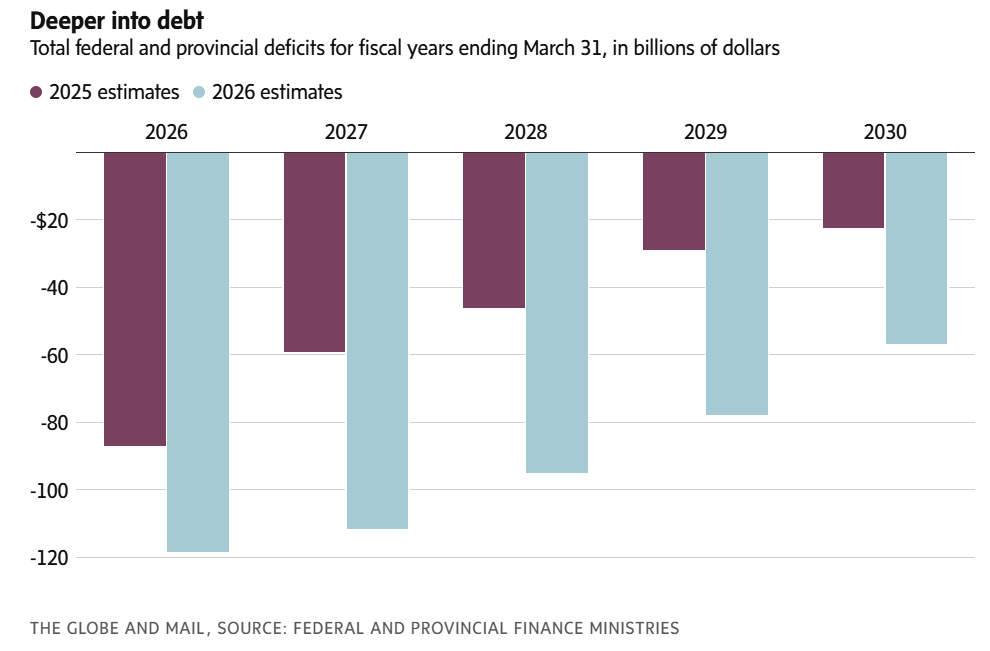
Now, those deficit projections are growing, quickly and dangerously. As the graphic below shows, the collective deficit of the federal and provincial governments projected for the fiscal year just started has risen by an eye-popping 88 per cent, or $52.3-billion compared to last year’s outlook.
The federal government accounts for two-thirds of that new wave of red ink, with its deficit projections rising in the November budget. But, separately, the provinces are now forecasting sharp declines in their fiscal outlooks.
Chief among them is British Columbia, in the process of moving from one of the least indebted provinces to one of the heaviest borrowers. Last year, the B.C. NDP government said the deficit would gradually decline to $9.9-billion in fiscal 2028 from $10.9-billion in fiscal 2026.
But in its most recent budget, the B.C. government said the 2028 deficit would be $12.2-billion. A credit downgrade from Moody’s followed, citing “a deterioration in long-term fiscal management.” And as we’ve previously noted, the province’s fiscal forecasts, grim as they are, rest on a series of implausible assumptions about ultralow growth in health and education spending. As bad as B.C.’s numbers look, they will turn out to be worse.
Nova Scotia, too, was hit with a credit downgrade weeks before tabling its budget on Feb. 23, with S&P Global saying it expected higher deficits than previously forecast. Those worries were justified: Nova Scotia is piling on debt at a much faster pace. The province had forecast that its net debt to GDP would hit 40.9 per cent in fiscal 2029, up from 31.9 per cent in fiscal 2025. But in this year’s budget, that debt ratio is now forecast to hit 44.8 per cent in fiscal 2029.
The broad trend is the same in the rest of the provinces. Ontario has pushed back the timeframe for returning to a balanced budget. Saskatchewan has dropped into deficit and Alberta has sunk deeper into the red (although surging energy prices might change their fiscal outlooks).
The reasons aren’t hard to figure out. Health care costs are rising as the population ages. Economic growth is weakening, most immediately because of trade and geopolitical turmoil but more fundamentally due to declining productivity.
Higher oil prices could drastically reduce Alberta’s budget shortfall
Grim as the immediate forecasts are, the long term outlook is more dire, as University of Calgary economist Trevor Tombe points out in a recent post on The Hub. He concludes that the debt paths for Ottawa and the provinces is unsustainable. Big tax hikes or spending cuts will be needed.
Prof. Tombe estimates Ottawa would need to double the federal GST to close its fiscal gap (or make spending cuts of equal magnitude). Returning the provinces to fiscal sustainability over the next half-century will be even more costly: an extra 15 points of sales tax, or $170-billion in spending cuts.
Neither option is politically feasible. What could work is to reignite economic growth. Prof. Tombe notes that labour productivity growth has plummeted over the last decade, increasing by just 0.2 per cent a year, far lower than the average of 1.3 per cent between 1995 and 2015. Policy changes that returned labour productivity to that higher historical average would eliminate much of the fiscal decay in coming decades. A boost to 1.5 per cent annual productivity growth would put Ottawa and the provinces on a sustainable debt path.
The policy choices needed to reignite productivity growth are well known: reducing taxes on investment, tearing down interprovincial trade barriers and removing regulatory barriers that dampen competition. It’s just that governments are unwilling to do what must be done. And that reveals the most worrying deficit of all in this year’s budgets – a galling shortfall of political courage.
Leave a Reply
You must be logged in to post a comment.