
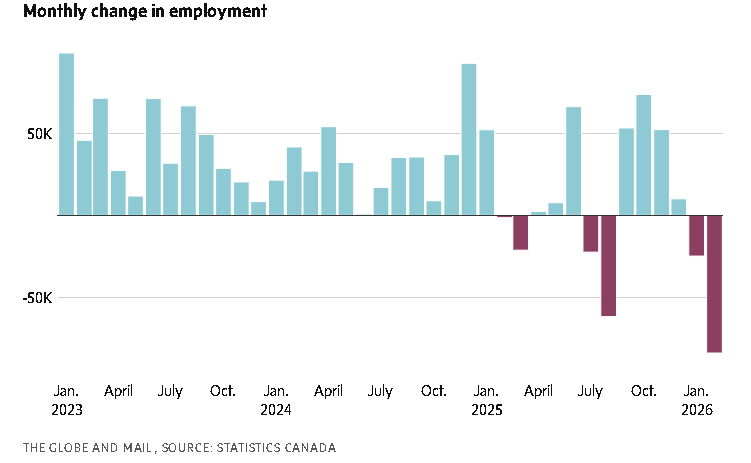
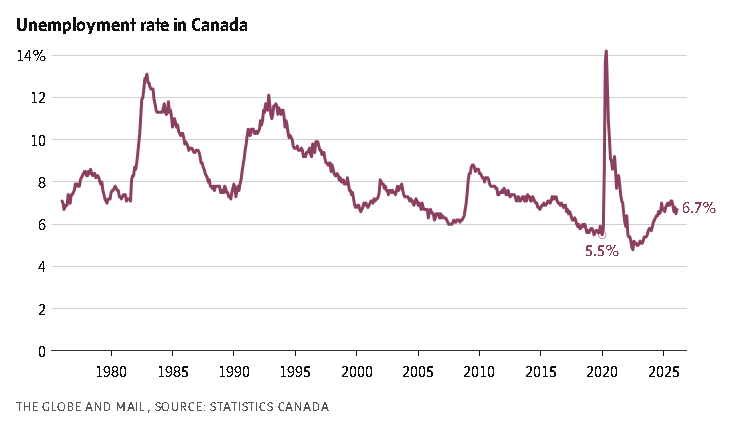
Canada’s economy unexpectedly shed 83,900 jobs in February, driving the unemployment rate up to 6.7 per cent and showing the extent to which trade uncertainty is continuing to weigh heavily on the country’s labour market.
The rise in unemployment was fuelled by a significant drop in full-time jobs, which plunged by 108,000 last month, Statistics Canada said Friday in a report. The number of workers in the private sector fell by 73,000, while part-time employment held steady from January.
The largest decline in jobs was seen in wholesale and retail trade, which lost 18,000 jobs last month, a decline of 0.6 per cent. This sector has been struggling for months, shedding a cumulative 52,000 positions since October. Manufacturing and construction also took a hit, with acombined 21,200 jobs lost in those industries last month.
Quebec led the country in job losses, with employment declining by 57,000 or 1.2 per cent. This was the largest employment decrease in the province in four years, raising the unemployment rate by 0.7 percentage points to 5.9 per cent.
Overall, Friday’s jobs report marked the largest monthly decline in employment since January, 2022, when the economy was facing stringent public-health rules during the COVID-19 pandemic.
The February labour results were substantially worse than economists expected. Heading into Friday, analysts had predicted a gain of 10,000 positions, a partial bounce back from a decline of 25,000 in January.
Canada’s trade deficit widens to $3.65-billion in January on auto weakness
Bank of Montreal chief economist Douglas Porter called February’s job report “weak from head to toe.”
“The bigger picture is that after the surprising strength in jobs last fall, the recent weakness has washed those gains away and leaves overall employment up just 0.2 per cent year over year, that is, almost zero job growth in the past year,” he wrote in a Friday morning note.
Mr. Porter added that if February’s jobs report was indicative of underlying economic conditions, the last thing the Bank of Canada should be considering is a rate hike. The central bank is widely expected to hold interest rates steady at 2.25 per cent on Wednesday for a third consecutive pause.
CIBC Capital Markets senior economist Katherine Judge also said that last month’s jobs numbers were “worrisome” for the Bank of Canada, and showed that labour market slack had increased and economic activity was largely frozen amid trade uncertainty.
The jobs report showed a decrease in the overall labour participation rate, which fell to 64.9 per cent in February from 65 per cent the month prior. But on a year-over-year basis, labour force participation has declined by 0.4 percentage points – most likely because of the drop in the number of temporary residents in Canada and the flatlining of the population.
Youth unemployment also soared back to highs last seen in the fall of 2025. The unemployment rate among this group, ages 15 to 24, rose 1.3 percentage points in February to 14.1 per cent. In September, 2025, youth unemployment peaked at 14.6 per cent, a number that was the highest since 2010 excluding the pandemic years.
“While a tough winter may have exaggerated the weakness at the start of the year, and a shrinking labour force is also weighing heavily on headline employment, the underlying story so far in 2026 is one of weakness,” wrote Mr. Porter. He emphasized that higher energy costs as a result of the war in Iran could further impact the economy.
In a Friday morning note, Toronto Dominion-Bank’s senior economist Andrew Hencic predicted that the labour market would continue to be weak in 2026, as a slowdown in population growth affects labour supply and soft economic momentum limits hiring.
“The wildcard to all of this is how big the inflation shock from the ongoing conflict in the Middle East will be. The duration of the supply disruption remains highly uncertain, but its length will impact inflation and, thereafter, consumer spending and the economy at large,” he added.
Leave a Reply
You must be logged in to post a comment.