
Category: Uncategorized

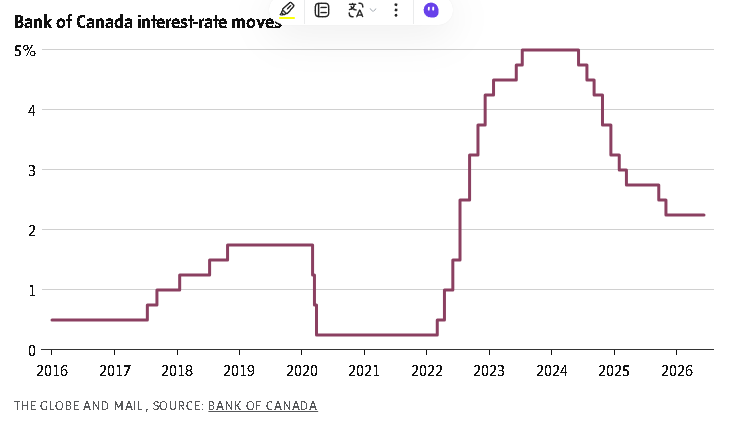
  • Bank of Canada holds rate steady at 2.25% as it grapples with mixed economic signals

    The Bank of Canada held its benchmark interest rate steady on Wednesday and said the path forward for monetary policy remains uncertain amid a challenging mix of weak economic growth and high energy prices.

    As widely expected, the central bank’s governing council kept the policy rate at 2.25 per cent for the fifth consecutive time.
    The war in the Middle East has pushed up global oil prices and lifted inflation in Canada to the upper end of the bank’s target range. At the same time, the Canadian economy is struggling to grow in the face of U.S. protectionism – a dynamic that’s putting downward pressure on inflation.

    “For now, holding the policy rate unchanged balances those risks,” Governor Tiff Macklem said in a press conference following the rate announcement.

    Live blog: Get the latest commentary and analysis on the BoC rate decision

    But the central bank may need to be nimble if the situation changes, he said, reiterating a message he delivered at the last rate announcement in April.

    “If the United States imposes significant new trade restrictions on Canada, we may need to cut the policy rate further to support economic growth,” he said.

    “Alternatively, if the conflict in the Middle East continues and higher energy prices start leading to ongoing generalized inflation, monetary policy will have more work to do – there may be a need for consecutive increases in the policy rate.”

    Financial markets expect the central bank to remain on hold through most of this year, with one quarter-point hike priced in for December, according to Bloomberg data. Market pricing was largely unchanged after Wednesday’s announcement.

    Since the start of the Iran war and the closing of the Strait of Hormuz in February, the bank has flagged the risk that high global oil prices could morph into broad-based inflation in Canada. The longer the war continues, the bigger that risk becomes.

    So far, however, the bank is seeing few signs of this happening in Canada.

    Headline inflation hit 2.8 per cent in April, up from 2.4 per cent the month before, due to rising gasoline prices. At the same time, the core inflation measures the bank pays the most attention to declined to around 2 per cent.

    “So far, there has been limited evidence of broad-based pass-through of higher energy prices to other consumer prices,” Mr. Macklem said, pointing to the core inflation measures and the fact that the share of CPI components running above 3 per cent is close to a historical average.

    “We expect CPI inflation to hover close to 3 per cent in coming months before easing gradually toward 2 per cent,” he added.

    While recent inflation data has remained subdued, economic growth data has been worse than expected.

    The Canadian economy contracted 0.1 per cent on an annualized basis in the first quarter of this year, following a 1-per-cent decline the previous quarter. That was much weaker than the central bank expected, and the back-to-back decline in GDP has sparked a debate about whether Canada is in a recession.

    “Recession is not the word I would use. I would describe the economy as weak. It hasn’t grown really in the last year,” Mr. Macklem said at the press conference, weighing in on a debate that has become heavily politicized in recent weeks. Conservative Leader Pierre Poilievre has used the idea of a “technical recession” to hammer the government.

    “Economists typically define a recession as a significant broad-based decline in economic activity that lasts for more than one quarter,” Mr. Macklem said. “Based on the data we’ve got, based on that definition, the economy is weak, but it’s not clearly in recession.”

    He noted that the first-quarter contraction was small, and the GDP decline was driven by a drop in government spending, while consumer spending remained relatively robust. The bank expects GDP to start growing again slowly in the second quarter.

    When it comes to the labour market, Mr. Macklem played down the strength of May job numbers Statistics Canada published last week. Canada added almost 88,000 jobs in May and the unemployment rate fell to 6.6 per cent from 6.9 per cent the month before.

    “When you look through the bumpiness, employment in Canada is little changed since the start of the year, and the unemployment rate has been fluctuating in the 6.5 to 7 per cent range,” Mr. Macklem said.

    Looking beyond the immediate data, Mr. Macklem warned that structural shifts, tied changing trade relationships, artificial intelligence and a population decline, are making it difficult to get a read on the state of the economy.

    “We will be watching all these developments closely and assessing their implications for growth and inflation. As the outlook evolves, we stand ready to respond as needed,” he said.

    Andrew Grantham, senior economist at the Canadian Imperial Bank of Commerce, said that Mr. Macklem’s reference to possible “consecutive” rate hikes if oil prices stay high plays into market perceptions that the bank is more worried about upside risks to inflation.

    “Overall, however, we view today’s communication as highlighting a very patient central bank that has plenty of time to wait and see how risks to the economy play out,” Mr. Grantham said in a note to clients.

    “We continue to see no change in interest rates this year, and that rates at their current level should support a recovery in the economy later this year and into 2027 assuming some of the uncertainties regarding oil prices and trade lessen during that time period.”
  • Oil prices jump after Trump says Iran will ‘pay the price’ for failing at peace deal

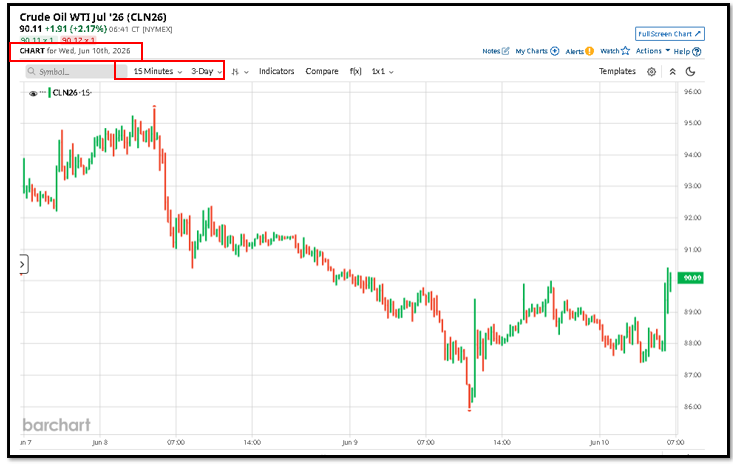
    • Oil prices shot higher Wednesday after U.S. President Donald Trump declared that Iran will “pay the price” for being too slow to negotiate a peace deal.
    • The price movements came after Trump issued a social media post that countered previous claims that the hostilities with Iran were near an end.

    Oil prices shot higher Wednesday after U.S. President Donald Trump declared that Iran will “pay the price” for being too slow to negotiate a peace deal.

    U.S. crude oil futures for July delivery jumped nearly 2% to $89.72 per barrel as of 7:15 a.m. ET, Brent futures, the international benchmark, for August delivery, rose 1.3% to $92.74 per barrel.

    The price movements came after Trump issued a social media post that countered previous claims that the hostilities with Iran were near an end.

    “Iran’s Military is a complete and total mess. Much of it, like their Navy and Air Force, doesn’t even exist anymore – They have been completely defeated. Iran is all talk and no action,” Trump said on Truth Social. “The Bully of the Middle East is DEAD!!! They’ve taken too long to negotiate a deal that would have been great for them, now they will have to pay the price!!!”

    Earlier, the U.S. military said it had completed strikes against Iranian military targets near the Strait of Hormuz. 

    U.S. forces carried out strikes on Iran on Tuesday night after an American Army Apache helicopter was shot down a day earlier, according to U.S. Central Command. Centcom described the operation as a defensive and measured response to what it called Iranian aggression.

    Trump said Tuesday that Iran had brought down a U.S. helicopter conducting patrols near the Strait of Hormuz and indicated that the U.S. would retaliate.

    “The two pilots involved in the attack are safe and uninjured,” Trump wrote on Truth Social. “Nevertheless, the United States must, of necessity, respond to this attack.”

    Rystad Energy said the shutdown of 11.8 million barrels a day of production across six Gulf producers has created the most severe oil supply disruption in modern history. The consultancy estimates cumulative production losses have reached 1 billion barrels and warned that each additional month of conflict could erase another 350 million barrels of output.

  • Gold inches higher as oil falls, U.S. rate-hike fears cap gains

    Gold edged higher on Tuesday, supported by lower oil prices, ​as tensions eased in ​the Middle East but concerns ​about U.S. interest rate hikes ahead of key inflation data this week capped gains.

    Spot gold was up 0.3% at $4,340.31 per ounce. The metal fell to ⁠its lowest ‌level since March 23 in the previous session.

    U.S. gold futures for August delivery were unchanged at $4,364.90.

    “Gold stabilized after a two-day slump that saw prices break below key technical support … However, rising expectations of further U.S. rate hikes continue to create a challenging backdrop for ‌bullion,” Saxo Bank analyst Ole Hansen said. Oil prices fell after Iran and Israel said they had halted attacks on each other following an appeal ​from President Trump.

    Elevated crude oil prices stoke inflation risks, increasing the chances of higher interest rates.

    Although gold is typically viewed as a hedge against inflation, it tends to lose its appeal as a non-yielding asset in ⁠a high-interest-rate environment.

    Investors now await May U.S. consumer price index (CPI) data on Wednesday and producer price ‌index (PPI) data on Thursday for clues on the Federal Reserve’s ‌next moves after a robust jobs report last week ramped up bets for a rate hike this year.

    “Tomorrow’s U.S. CPI, which is expected to exceed 4% for the first time in ⁠almost three years, and most certainly the June 17 FOMC meeting remains key ⁠as the market is looking for the comments and intentions from the ⁠new Fed chair,” Hansen said, referring to the central bank’s new chief Kevin Warsh.

    Traders are now pricing in a 68% chance of a Fed rate hike in December, according to the CME Group’s FedWatch tool.

    Spot gold closed below ‌its 200-day moving average on Friday for the first time since October 2023 and has since traded below that level amid rate-hike fears.

    “The breakout below the 200-DMA is widely considered a negative technical signal, which points to further downside potential in the near term,” analysts at Citigroup said ​in a note on Monday.

    Spot silver rose ‌0.6% to $68.56 per ounce, platinum gained 0.9% at $1,769.83, while palladium rose 2.9% to $1,238.66.

  • Oil prices fall nearly 4% after U.S. Energy Secretary says Hormuz ship traffic is increasing

    • U.S. Energy Secretary Chris Wright said ship traffic through the Strait of Hormuz is “rising very meaningfully.”
    • Wright did not provide specific data on how much oil flows through Hormuz have increased.
    • President Donald Trump sought to convince the market that a deal with Tehran to reopen Hormuz was “two or three days away.”

    Oil prices fell Tuesday after U.S. Energy Secretary Chris Wright said ship traffic through the Strait of Hormuz is “rising very meaningfully.”

    U.S. crude oil futures fell about 3.7% to $87.89 per barrel by 10:42 a.m. ET. Brent futures, the international benchmark, lost 3.19% to $91.24.

    Wright did not provide a specific data on how much oil flows through Hormuz have increased. He made the remarks in an interview with CNBC’s Brian Sullivan at the Atlantic Council Global Energy Forum.

    Wright said oil exports through Hormuz are rising and “will continue to rise.”

    The U.S. Navy has quietly coordinated with some ships that are trying to exit the Persian Gulf. More oil may be going through Hormuz than is publicly visible, JPMorgan analysts wrote in a June 4 note.

    Some 2 million barrels per day might be getting out on tankers that have switched off their transponders, according to the bank’s estimates.

    “Despite the ongoing naval blockade and the steep decline in commercial traffic, surprising volumes of crude and petroleum products still appear to be transiting the Strait,” the JPMorgan analysts said.

    Meanwhile, President Donald Trump sought to convince the market Monday that a deal with Tehran to reopen Hormuz was “two or three days away,” despite the outbreak of violence between Israel and Iran this week.

    Trump has repeatedly said a deal with Tehran to reopen Hormuz is close, but such an agreement still has not materialized. The fragile ceasefire implemented in April nearly unraveled this week after Iran launched missiles at Israel in retaliation for its strikes in Lebanon.

    Israel hit back with strikes on the Islamic Republic. Trump pressured Israel Prime Minister Benjamin Netanyahu to refrain from further attacks.

    The violence spiked oil prices briefly Monday, but the volley of strikes appears to have ended without further escalation for now. Iran and Israel said they have ceased fire.

    Oil prices have surged about 30% since the U.S. and Israel attacked Iran on Feb. 28. Tehran retaliated by attacking tankers in the Strait of Hormuz and mining the sea lane. Traffic through Hormuz has plunged as a consequence, triggering the biggest oil supply disruption in history.

    Trump has sought to pressure Iran into a deal by imposing a naval blockade on its ports and vessels.

    Oil industry executives and analysts say crude prices have remained moderate in comparison to the scale of the disruption due to the buffer provided by global stockpiles. But prices will likely spike later this year as those inventories rapidly decline at the same time summer demand hits its peak, they say.

    https://www.cnbc.com/2026/06/09/chris-wright-hormuz-oil-iran-trump.html

  • New Kinaxis CEO bets Ottawa supply chain software company will be a SaaS-pocalypse winner

    Some cloud software companies are weathering the so-called “SaaS-pocalypse” better than others. Kinaxis Inc. KXS-T -0.99%decrease chief executive Razat Gaurav believes his is one of them.

    The supply chain management software vendor, one of Canada’s 10 most valuable publicly traded tech companies, has seen its valuation tumble along with other SaaS (software-as-a-service) subscription software vendors. All face questions about their viability as generative artificial intelligence tools have enabled anyone to “vibe code” new programs using AI prompts to do the work of developers.

    SaaS stock valuations are at the lowest in the 13-year history of the BVP Cloud Index. Even after a partial recovery since February, Kinaxis shares are down 15 per cent in the past year. Other SaaS names, including Salesforce and Constellation Software, have fared worse.

    “Everyone is in the same penalty box,” the Indian-born CEO, who joined Kinaxis in January, said in an interview. “Investors haven’t yet deciphered” which SaaS companies are at risk of AI disruption and which will benefit.

    “We have a strong belief that for Kinaxis, AI is a tailwind,” Mr. Gaurav said.

    Wednesday’s analyst upgrades and downgrades

    During its annual customer conference in Las Vegas last week, Kinaxis gave an in-depth look at how the company is deploying AI to transform its business.

    Kinaxis has used predictive AI tools in its platform, called Maestro, for years. Now, it is creating an army of digital agents to help the company’s 410 customers – including many of the world’s largest companies – automate tasks. It’s also giving customers the capability to build bespoke agents themselves, and lending its own people to help them do so, in order to encourage adoption.

    It has expanded Maestro’s capabilities to ingest supply chain-relevant data from a range of sources, including other enterprise software programs, weather feeds and even social media channels, to help agents make sharper decisions. “Agentic AI will be a significant expansion of our total addressable market,” Mr. Gaurav said.

    His company is partnering with several global tech leaders to make this happen: Kinaxis is using large language models from giants including OpenAI. Nvidia is supplying technology enabling it to run faster optimization planning scenarios than rival options. Databricks is providing the data intelligence platform.

    It’s part of an effort by the 42-year-old company to position itself as more than a supply chain planning tool provider, but rather the source of a more fulsome and flexible platform that’s suited to help companies respond to dynamic supply chain pressures that have included a pandemic, tariffs, wars and climate change-related disasters.

    It’s “about connecting the dots between designing, planning, executing and delivering – and learning,” guided by an agent-driven system that “functions like an orchestra,” Mr. Gaurav said in his keynote address.

    Customers in Las Vegas were “universally happy with the software and reaffirmed what we knew, that Kinaxis has continued to gain competitive momentum” against competitors SAP, Blue Yonder and o9 Solutions, said BMO Capital Markets analyst Thanos Moschopoulos, who attended.

    There are reasons to share Mr. Gaurav’s optimism. Maestro is mission-critical software for giants including Ford, Lockheed Martin, Unilever, Shell and Eli Lilly, and the top-rated vendor in the field by market research firm Gartner. The sales cycle and product implementation times are lengthy.

    Helping to manage a supply chain is a complex and difficult tax that can’t be replicated using generative AI tools alone, Mr. Gaurav said. For example, changing an expiry date on a single ingredient in one product for an unnamed pharmaceutical customer required 18,000 recalculations on Maestro, according to the CEO.

    Clients “are not looking to vibe code their way through” making a homegrown replacement and Kinaxis has a 95 per cent customer retention rate, he said.

    Mr. Gaurav, 52, arrived just over a year after predecessor John Sicard retired and after period a tepid sales growth. The new CEO, who lives in Austin but spends half his time in Ottawa, worked for most of his career in supply chain software (Kinaxis tried to hire him in 2010) before running a pair of enterprise software companies in other areas for eight years.

    Mr. Gaurav said he was drawn to the opportunity to become CEO of a top company in a field he knows well as the sector is undergoing big changes. He’s worked with 70 to 80 current Kinaxis employees at other supply chain software companies, including Mark Morgan, president of commercial operations. “We brought in a leader who understands our industry, has a strong product and innovation orientation, and has a track record for scaling global businesses,” said chairman Bob Courteau, who led Kinaxis after Mr. Sicard left.

    Mr. Gaurav has arrived at a time of growing momentum for Kinaxis. After expanding SaaS revenues in 2025 by 17 per cent over the previous year, to US$362.4-million (total revenue was US$548-million), Kinaxis has forecast 17 per cent to 19 per cent growth this year. SaaS revenues grew by 19 per cent in the fourth quarter and 21 per cent in the first quarter, surpassing expectations.

    Kinaxis reported a better-than-expected adjusted operating earnings margin of 32 per cent of revenue in the first quarter and expects that to be in themid-20s for the year. Its average new deal size in the first quarter was twice as large as the same period a year ago, thanks in part to a recent overhaul of its sales team. Kinaxis has also changed its pricing to meter the usage of its tools, since charging by the human user alone won’t be as effective if AI agents do more of the work.

    But investors still want Kinaxis to increase its SaaS revenue growth rate, said David Barr, lead manager of the Pender Small Cap Opportunities Fund.

    “Look, the reason I’m here is to scale this business by three to five times” while maintaining current profit margins, Mr. Gaurav said. He thinks Kinaxis could market itself better and wants to cross-list the Toronto Stock Exchange-traded stock on a U.S. exchange once it hires a new chief financial officer (a search is underway). Acquisitions could follow, he said.

    “I’m definitely here to make things exciting,” he said. If Kinaxis can keep up its performance and meet the AI moment with continued innovation, “I see no reason why we can’t be trading at a lot higher price.”

  • Canada’s trade surplus widens in April as soaring crude prices drive record exports

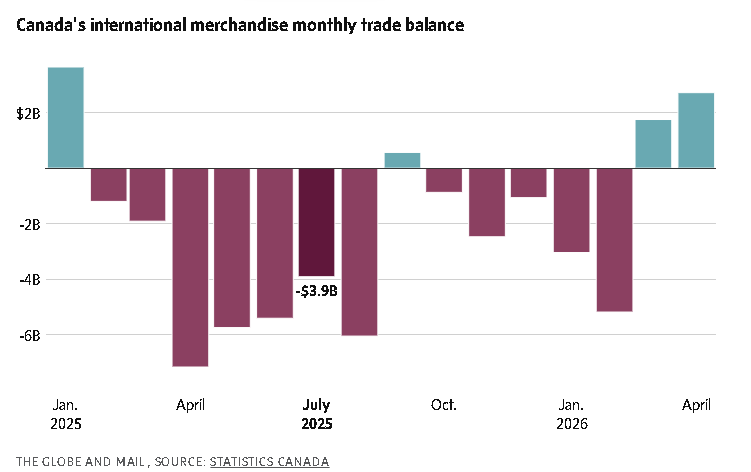
    Crude oil prices pushed up by the Iran war helped propel Canada’s goods trade surplus in April up by 55 per cent to a 15-month high of $2.72-billion, Statistics Canada said on Tuesday.

    Analysts polled by Reuters had forecast a surplus of $2.57-billion. Statscan revised March’s surplus down to $1.75 billion from an initial $1.78-billion.

    Total exports increased 1.6 per cent in April to reach a record high of $75.16-billion. Exports of energy products rose 9.7 per cent in April, following an increase of 23.4 per cent in March

    “Both monthly increases were driven by higher prices, which continued to rise in April amid the uncertainty caused by the conflict in Iran,” Statscan said in a commentary. Crude oil exports, which rose by 7.0 per cent, contributed the most to the gain.

    The overall increase in total exports was offset by a 17.5-per-cent decrease in exports of metal and non-metallic mineral products, which had boomed in February and March. Lower shipments of gold to Britain were largely responsible for the decline.

    Imports edged up 0.3 per cent to hit a record $72.44-billion, largely due to a 16.9 per cent increase in imports of basic and industrial chemical, plastic Although Ottawa is trying to diversify exports away from the United States amid a trade war between the two countries, the market still dominates Canadian trade.

    Exports to the United States grew by 4.8 per cent to $51.98-billion, representing 69.2 per cent of all trade, the largest share since September 2025.

    Imports grew 1.6 per cent to $42.50-billion. As a result, the Canadian surplus with the United States rose to $9.48-billion, the largest since February 2025.

    After reaching a record high in March, exports to countries other than the United States fell 4.8 per cent in April. This was partially offset by higher exports to China, which reached a record $3.84-billion.

  • Nvidia CEO says selloff in tech stocks is a buying opportunity

    Nvidia Corp. chief executive Jensen Huang called a global tech stocks selloff that began last week a buying opportunity, saying the buildout of artificial intelligence has just begun.

    South Korea’s benchmark Kospi Index tumbled on Monday after investors pulled back from AI bets that have fueled a bull market in global equities. Fears of overheating in the AI trade have cooled global tech stocks, with U.S. peers tumbling Friday on concerns over a possible rate hike.

    Huang, responding to questions about how that selloff should be perceived, said the industry was still in the early stages of constructing infrastructure that will serve as the foundation of an AI-fueled future. On Monday, Nvidia and SK Hynix Inc. said they struck a multi-year agreement to design future generations of memory chips for AI, a win for a South Korean leader vying with Samsung Electronics Co. in the red-hot arena. Stocks including SK Hynix pared losses after South Korean President Lee Jae Myung said Monday he believed the domestic market remained undervalued.

    Article content

    “We’re at the beginning of it, and whatever happened to the stock market, you should be very happy because now you can buy at a discount,” he said.  “Everybody should be very excited,” he told reporters after meeting with SK Group Chairman Chey Tae-won in Seoul.

    Article content

    Like many of his industry peers, Huang has consistently argued that AI will revolutionize broad swaths of the global economy and transform the way people work and live. That will in turn drive huge demand for the data centers — and chips — needed to power future AI services.

    Article content

    “It is a foregone conclusion that AI will be infrastructure for the world, just like the internet was infrastructure for the world,” he said.

  • Canada’s business productivity falls for second straight quarter

    One of the economy’s most persistent challenges reared its head again as rising labour costs outpaced growth at the start of 2026 and Canadian business productivity fell for the second straight quarter.

    Article content

    Statistics Canada said Wednesday a “mild contraction” in the pace of output reduced labour productivity in the business sector by 0.5 per cent in the first quarter, following a 0.3 per cent decrease in the fourth quarter of 2025.

    The first-quarter decline was led by a contraction in goods-producing businesses, where productivity fell 1.7 per cent. The agriculture, forestry, fishing and hunting sector was the main contributor with a 3.5 per cent decline. Productivity also declined 1.3 per cent in the construction industry and 0.3 per cent in manufacturing.

    Service-producing industries managed a modest 0.3 per cent increase. The strongest gains in productivity came from information and cultural industries (1.6 per cent), transportation and warehousing (1.2 per cent) and retail trade (one per cent).

    “Overall, productivity decreased in 10 of the 16 main industry sectors in the first quarter,” the agency said.

    Productivity, which measures the amount of economic output produced per hour worked, is widely viewed as a key measure of economic prosperity. Canada has struggled with weak productivity growth for decades and lags many peer countries, including the United States.

    In a note, Desjardins economist LJ Valencia said real GDP in the Canadian business sector has fallen three times in the last five quarters as the ongoing trade tensions with Canada’s neighbour and largest trading partner continues to weigh on the economy.

    Article content

    Article content

    “Looking ahead, our analysis suggests that the federal government’s immigration policies are expected to further slow population growth,” he said. “Still, uncertainty surrounding the trade war will shape the near-term trajectory of Canadian business investment and productivity, with the outcome of this year’s Canada–United States–Mexico Agreement (CUSMA) joint review being pivotal.”

    As productivity dipped, overall hours worked rose 0.4 per cent, reflecting a 0.1 per cent rise in the number of jobs. Average hours worked also increased 0.3 per cent.

    Article content

    Meanwhile, labour costs continued to rise for the fourth quarter in a row. Hourly compensation went up 0.9 per cent, pushing unit labour costs (ULCs) up 1.4 per cent. According to Statistics Canada, ULCs measure the amount businesses pay in wages and benefits to produce one unit of real output.

    Article content

    “The acceleration of ULC growth in the beginning of 2026 is a worrying sign, as elevated costs continue to undermine Canada’s competitive position and continues to exacerbate challenges for businesses across the

    https://financialpost.com/news/economy/canadas-business-productivity-falls-for-the-second-straight-quarter