The Federal Reserve on Wednesday announced its widely expected decision to leave interest rates unchanged, highlighting increased uncertainty about the economic outlook.
In support of its dual goals of maximum employment and inflation at a rate of 2 percent over the longer run, the Fed said it decided to leave the target for the federal funds rate at 4.25 to 4.50 percent for the third straight meeting.
The Fed noted swings in net exports have affected the data but said recent indicators suggest economic activity has continued to expand at a solid pace.
The central bank also said the unemployment rate has stabilized at a low level and labor market conditions remain solid while acknowledging inflation remains somewhat elevated.
The Fed said there are risks to both sides of its dual mandate and warned of increasing risks of higher unemployment and higher inflation.
In considering the extent and timing of additional adjustments to rates, the Fed said it will carefully assess incoming data, the evolving outlook, and the balance of risks.
The Fed reiterated it would be prepared to adjust the stance of monetary policy as appropriate if risks emerge that could impede the attainment of its dual goals.
The central bank’s next monetary policy meeting is scheduled for June 17-18, when Fed officials will also provide their latest projections for the economy, inflation and interest rates.
CME Group’s FedWatch Tool is currently indicating a 71.6 percent chance the Fed will once again leave interest rates unchanged next month but a 27.8 percent chance of a quarter point rate cut.
OTTAWA — Prime Minister Mark Carney said Friday he will meet with U.S. President Donald Trump at the White House on Tuesday.
It will be the first face-to-face meeting for the two since Carney was first sworn in as prime minister on March 14, and will come before Carney has named his new cabinet following Monday’s federal election.
The two are set to discuss Trump’s trade war on Canada and the talks could set the stage for negotiation of a new trade and security pact with the United States.
In his first press conference since securing a minority government in his first federal election, Carney was asked by reporters how he’ll approach Parliament and talks with the Trump administration.
Asked whether he would insist on U.S. tariffs being lifted as a condition of negotiations with the Trump administration, Carney said he doesn’t want to negotiate in public.
When one reporter asked him if he’s worried about being “ambushed” by Trump administration officials in the meeting — as happened to Ukrainian President Volodymyr Zelenskyy earlier this year — Carney said he’ll head into the meeting “well-prepared.”
“I go there with the expectation of … difficult but constructive discussions. That’s the spirit of the conversations that the president and I had,” Carney said. “You know, you go to these meetings well-prepared, understanding the objectives of your counterpart and always acting in the best interests of Canada, and we’ll go from there.”
Prime Minister Carney lays out agenda in first news conference since election win
The White House has cited the cross-border flow of deadly fentanyl to justify its tariffs on Canada, even though only small amounts of the drug have been seized at the northern border.
“There will be difficult discussions,” Carney said in French. “The fentanyl-related tariffs, we don’t understand why they’re still in place.”
Trump also has pointed to the U.S. trade deficit with Canada as a rationale for tariffs.
Trump has repeatedly made the false claim that the U.S. “subsidizes” Canada to the tune of $200 billion annually. The U.S. government’s trade office said the trade deficit with Canada was US$63.3 billion in 2024, a 1.4 per cent decrease since 2023. A trade deficit is also not a subsidy.
Carney campaigned on being the best candidate to deal with Trump’s aggressive push to bolster American manufacturing through massive levies on imports, as well as the president’s threatening statements about making Canada a U.S. state.
Trump toned down his aggressive rhetoric during the election campaign itself and recently referred to Carney as a “very nice gentleman.”
But in the final days of the campaign, Trump again started talking about making Canada a “cherished” U.S. state.
Carney said Trump did not talk about annexing Canada in their call on Tuesday.
The prime minister said that as trade and security discussions resume with the Trump administration, it’s important to separate “wants from reality.”
“The Canadian people clearly have stated, virtually without exception, is this will never ever happen,” Carney said, referring to Trump’s annexation comments.
“We’re meeting as heads of our government to discuss (the Canada-U.S.) partnership. Now, I’m not pretending those discussions will be easy. They won’t proceed in a straight line. There will be zigs and zags, ups and downs, but as I said in my remarks, I will fight for the best deal for Canada and only accept the best for Canada and take as much time as necessary.”
Former prime minister Justin Trudeau spent his last days in office being frequently needled by Trump as the president floated annexation and levied tariffs.
This report by The Canadian Press was first published May 2, 2025.
– The fourth round of indirect nuclear negotiations between the U.S. and Iran, initially scheduled for May 3 in Rome, has been postponed. While Omani officials cited logistical reasons, Iranian authorities say the delay is due to Washington’s imposition of new sanctions targeting oil and petrochemicals during the negotiations, which Tehran has criticized as unconstructive. Things are about to get choppier with respect to these talks, as well, with Trump this week dismissing National Security Adviser Mike Waltz following a security breach that saw him add a journalist to a classified Signal chat that involved U.S. military plans. SoS Rubio has been appointed to replace him, giving him the role of both NSA and SoS (like Kissinger). This is all taking place against a backdrop of incidents in Iran that have not been fully investigated or explained. On April 26, a massive explosion occurred at the Shahid Rajaee port in Bandar Abbas, Iran’s largest maritime hub. The blast resulted in at least 70 deaths and hundreds of injuries. Preliminary investigations suggest that the explosion originated from containers containing rocket fuel chemicals. It remains unclear whether this incident was sabotage or negligence. Iranian media are blaming it on negligence; however, details are few and far between. Tehran has dismissed any speculation of sabotage or foreign meddling. Reports have emerged tying the heart of the explosion to a facility owned by a charitable foundation overseen by Supreme Leader Ayatollah Ali Khamenei’s office. The charitable foundation, Bonyad Mostazafan, is under U.S. sanctions for enriching Khamenei and for direct ties to Iran’s Revolutionary Guards forces. A second explosion on April 29 at the Avanar Parsian Chemical Industries warehouse in Isfahan Province led to two fatalities and two injuries. The facility is known for producing fireworks and industrial gunpowder, and an investigation is underway to determine the cause of the blast. Again–there is no talk from Iran of sabotage or foreign meddling.
– Syria’s new president, Ahmed al-Sharaa, is finding it a bit challenging to transition smoothly from rebel leader to formal leader of a post-Assad nation, and unrest is quickly getting out of control, particularly in the south. In the past week, the southern region has witnessed deadly clashes between the Druze community and forces aligned with the ruling Hay’at Tahrir al-Sham (HTS) coalition. This bout of violent unrest came about after an allegedly fabricated audio clip insulting the Prophet Muhammad was said to be falsely attributed to a Druze cleric. This led to retaliatory attacks in areas like Jaramana and Sahnaya, resulting in over 100 deaths, including civilians, Druze fighters, and HTS members. Israel, which (along with Turkey) has military operations in Syria, stepped in to support the Druze with airstrikes targeting what Israel said were extremist groups responsible for the violence. As we have noted previously, Turkey and Israel have conflicting agendas in Syria, where both are attempting to control the next rulers of the country. From a broader perspective, we are now witnessing a significant change in the regional balance of power in terms of external influence, with Russia and Iran weakened in Syria (but Russia regrouping in Libya and the wider Sahel) and Turkey gaining power and influence. On Friday, Israel’s Netanyahu said Israeli forces had struck a target near the presidential palace in the Syrian capital Damascus.
– The Saudis this week, via unnamed sources speaking to mainstream media, suggested that May 5th’s OPEC+ meet could bring a decision to ramp up output, with Riyadh indicating it can withstand low oil prices for some time. (Keep a close eye on Oilprice.com coverage of this early next week).
Deals, Mergers & Acquisitions
– Chevron’s proposed $53B acquisition of Hess Corporation is facing more legal challenges, with ExxonMobil now launching arbitration proceedings, asserting a right of first refusal over Hess’s stake in the coveted Stabroek block offshore Guyana. The International Chamber of Commerce (ICC) has scheduled a hearing for May 26 in London to address this dispute.
– Woodside Energy has entered into a long-term agreement with BP to supply up to 640 billion cubic feet of natural gas for its Louisiana LNG project. Deliveries are scheduled to begin in 2029. This is the first tranche of a diversified portfolio of feedgas that will support the Louisiana LNG project and connect up several basins and pipelines.
-VARO Energy has announced plans to acquire Preem, Sweden’s largest oil refiner. This acquisition will position VARO as Europe’s second-largest renewable fuel producer, significantly expanding its distribution and storage network across major European markets.
-QatarEnergy is in discussions with Japanese companies, including JERA and Mitsui & Co., for a long-term LNG supply agreement. The deal would involve the delivery of at least 3 million metric tons per annum, linked to Qatar’s North Field expansion project.
Discovery & Development
-TotalEnergies and Oman’s OQEP have commenced construction on the Marsa LNG project in Oman. A charter contract for a new LNG bunkering vessel has been signed by Marsa LNG, marking a significant step in the project’s development.
-ExxonMobil’s Yellowtail project (it’s 4th development in Guyana’s Stabroek Block) is on track for first production in Q3, expected to add some 250,000 bpd to Guyana’s output with the newly arrived ONE GUYANA FPSO vessel. Additionally, ExxonMobil has submitted a field development plan for the Hammerhead project, which is set to produce around 150,000 bpd starting in 2029, pending government approval. (We also note: Guyana’s Natural Resource Fund recorded $605.5 million in oil revenues for the first quarter of 2025, encompassing seven profit oil payments and one royalty payment. Despite increased production, revenues are projected to decline due to a forecasted 10.9% drop in oil prices).
-Rhino Resources (in partnership with Azule Energy, Namibian state-run NAMCOR, and Korres Investments) has announced a light oil discovery at the Capricornus 1-X well in Block 2914 (PEL 85) within Namibia’s Orange Basin. The well encountered a high-quality reservoir with 38 meters of net pay and no observed water contact. This marks Rhino’s second consecutive successful well in the region, following the Sagittarius 1-X discovery earlier this year.
Companies & Earnings
-A fatal accident took place this week at the Port Arthur LNG construction site in Texas, where a scaffolding collapse resulted in three fatalities and two injuries. Investigations are underway to determine the cause of the incident. Families of 2 of the 3 Houston men killed in the incident have filed a $1M lawsuit in the matter.
-On the earnings beat, this week has seen Q1 earnings deliver mixed signals but strong cash flows, with Shell coming in hot with $5.6B in Q1 adjusted earnings (lower YoY, but overtaking Wall Street expectations). Those adjusted earnings represent a 28% decline YoY, but beat expectations of $5 billion. (Down from $7.7 billion in the same period of 2024). Two things contributed to the downturn: A stellar 2024 to compare it with, and lower LNG production and prices. Despite this, Shell is still focusing on shareholders, announcing a $3.5 billion share buyback program for the next quarter (14th quarter in a row with buybacks over $3B). Shell also completed the acquisition of Singapore-based Pavilion Energy, aiming to bolster its Asia LNG portfolio. Shell is down 11% over the past 30 days.
-Equinor came in with adjusted operating income of $8.65B, also exceeding analyst expectations of $8.51 billion, and up from $7.53 billion the previous year. Higher European gas prices and solid operational efficiency were behind the performance, with Equinor holding fast to its 2025 capital expenditure forecast of $13B. It also maintains its expectation of a 4% increase in oil and gas output YoY (from 2024). Equinor plans to reward shareholders with $9 billion in dividends and share buybacks this year. Equinor is trading down over 16% for the last four weeks.
-EOG Resources reported $5.67B in revenue for Q1, representing a YoY decline of 7.4%. Adjusted earnings came in at $2.87/ share, exceeding analyst expectations of $2.79, with performance given a bump by a 63.4% YoY increase in nat gas prices and a 4.8% rise in total production to 98.1 MBoe. Still, the EOG trimmed its 2025 capital expenditure plan by $200 million, adjusting the range to $5.8 billion–$6.2 billion, citing trade war uncertainties. EOG is trading down over 14% in the past month.
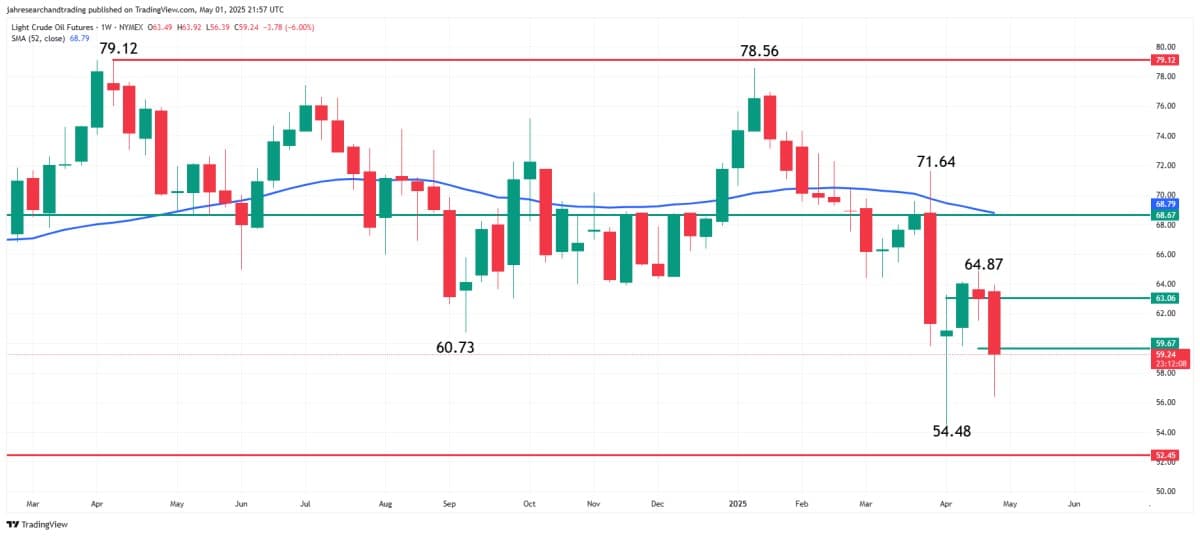
Crude oil futures tumbled over the past week, falling more than 6% as concerns over weakening global demand and a resurgent supply outlook weighed on sentiment. West Texas Intermediate (WTI) briefly hit a low of $56.39 before recovering to $59.24 by Thursday’s close. While dip-buying provided short-term support, the underlying market tone remains distinctly bearish as fundamental pressures intensify.
China Demand Slowdown Fuels Bearish Sentiment
Fresh economic data from China delivered a major blow to oil bulls. The country’s official manufacturing PMI slumped to 49.0 in April, signaling contraction and raising alarm over the health of the world’s largest crude importer. Of particular concern was the new export orders index, which plunged to its weakest level since 2012 outside of pandemic anomalies. Analysts responded by slashing full-year growth forecasts to just 3.5%, casting doubt on sustainable Chinese demand.
Though China’s March crude imports surged, analysts argue this was driven more by pre-sanctions stockpiling than any uptick in consumption. With Beijing’s fiscal stimulus measures struggling to gain traction, traders are increasingly skeptical of China’s ability to sustain meaningful crude demand growth in the near term.
Trade War Escalation Undermines Global Oil Demand Expectations
U.S.-China trade tensions are exacerbating the fragile demand picture. A fresh round of tariffs and retaliatory measures has heightened fears of a global slowdown, with the U.S. economy already contracting in Q1—the first quarterly drop in three years. Analysts warn that President Trump’s tariff strategy is significantly disrupting global trade flows and could push the global economy toward recession, directly pressuring oil consumption.
Barclays and other banks have already downgraded oil demand projections, with Brent forecasts reduced by $4 to $70 per barrel. As confidence in a robust economic recovery falters, so too does support for higher oil prices.
EIA Reports Mixed Inventory Data as Supply Stays Ample
On the supply front, the latest U.S. Energy Information Administration (EIA) data painted a mixed but largely bearish picture. Crude oil inventories fell by 2.7 million barrels to 440.4 million barrels last week—defying analyst expectations for a build of 429,000 barrels. However, inventories at the Cushing, Oklahoma, hub rose by 682,000 barrels, and distillate stockpiles increased by 900,000 barrels, against forecasts for a draw.
Gasoline stocks dropped more than expected—falling 4 million barrels—but refinery activity continued to ramp up, with crude runs rising by 189,000 bpd and utilization climbing to 88.6%. Net U.S. crude imports also fell sharply by 663,000 bpd, pointing to a refined product market that is still structurally oversupplied despite headline crude draws.
OPEC+ Output Plans Keep Pressure on Prices
The broader supply outlook continues to tilt bearish. Several OPEC+ producers are reportedly pressing for accelerated output increases in June, as frustration mounts over internal quota breaches by members like Kazakhstan and Iraq. Saudi Arabia, the bloc’s de facto leader, has signaled it can tolerate prolonged low prices and is unwilling to cut production further—signaling a strategic pivot toward defending market share over price.
Russia, while less aggressive, is unlikely to block moderate increases. With OPEC+ still holding back over 5 million bpd and internal cohesion fraying, traders are bracing for a more aggressive unwind of production cuts that could flood an already soft market with excess barrels.
Geopolitical Risks Offer Only Temporary Relief
Heightened geopolitical tension around Iran briefly lifted crude prices midweek. WTI and Brent rebounded nearly 2% on Thursday after President Trump threatened to impose secondary sanctions on buyers of Iranian oil. The comments followed a postponed round of nuclear talks, adding to uncertainty over Middle East supply flows.
Analysts estimate that effective enforcement of these sanctions could remove up to 1.5 million bpd from global supply. However, this potential disruption is being counterbalanced by OPEC+ production flexibility and rising inventories, limiting the upside potential for prices driven by geopolitics alone.
Weekly Light Crude Oil Futures
Trend Indicator Analysis
The main trend is down according to the weekly swing chart. A trade through $71.64 will change the main trend to up. The minor trend is also down. A trade through $64.87 will change the minor trend to up. This will shift momentum to the upside.
The long-term range is $52.45 to $84.90. Its 50% level is $68.67. This is major resistance. Trading on the bearish side of this key level is also a sign of weakness. Additional resistance is the 52-week moving average at $68.79.
The short-term range is $71.64 to $54.48. Its pivot at $63.06 is controlling the near-term direction. Last week, sellers drove the market to its weakside, triggering the sharp break.
The minor range is $54.48 to $64.87. Its pivot is $59.67. Crude oil is currently on the weakside of this indicator.
Weekly Technical Forecast
The direction of the Weekly Light Crude Oil Futures market the week ending May 9 is likely to be determined by trader reaction to $59.67.
Bullish Scenario
A sustained move over $59.67 will signal the presence of counter-trend buyers. If this creates enough momentum, we could see a possible near-term rally into the major pivot at $63.06.
Bearish Scenario
A sustained move under $59.67 will indicate the presence of sellers. This will leave the market vulnerable to a plunge into the April low at $54.48.
Bearish Oil Prices Forecast as Supply-Demand Balance Breaks Down
The fundamental backdrop for crude oil remains bearish. Demand is deteriorating under the weight of China’s economic slowdown and trade war escalation, while supply resilience from OPEC+ and the U.S. continues to pressure prices. The latest EIA data, despite some bullish headlines, confirms ample domestic supply and robust refining activity.
However, the market remains prone to short-covering rallies—especially around geopolitical flashpoints such as Iranian sanctions or surprise OPEC+ maneuvers. These moves may provide temporary relief, but without a sustained improvement in demand or a decisive policy shift from major producers, they are unlikely to change the overall direction.
Traders should maintain a cautious stance. Unless WTI reclaims and holds above $59.67 this week on the back of stronger fundamentals, the oil prices forecast continues to favor further downside. With structural imbalances deepening, rallies may offer better opportunities to sell than signals of a lasting recovery.
Although the market may be vulnerable to short-covering rallies as it nears value areas, the longer-term trend will remain decisively lower as long as it remains under the 52-week moving average at $68.78.
Eight OPEC+ countries will meet on Saturday to decide whether to agree a further accelerated oil output hike for June or make a smaller increase as originally planned, two sources with knowledge of the matter told Reuters on Friday.
The meeting was originally scheduled to take place on Monday. It was not immediately clear why it had been brought forward.
Last month, Saudi Arabia pushed for a larger-than-planned output hike from the eight members in May, a decision that helped send oil prices below $60 a barrel to a 4-year low.
The group is now expected to raise output by 411,000 barrels per day (bpd), three times the level agreed in December.
Riyadh has been angered by Kazakhstan and Iraq producing above their OPEC+ targets, sources said.
Oil prices fell below $60 a barrel again this week in part after Reuters reported that Saudi officials had told allies and analysts that the country was comfortable living with lower oil prices for longer.
Sources told Reuters last month, some members in the group were pushing for another accelerated hike for June.
OPEC+, which includes the Organization of the Petroleum Exporting Countries and allies such as Russia, is currently cutting output by over 5 million bpd.
The group plans to hold a full ministerial meeting on May 28.
“While we think the situation remains fluid … we do see a case for forgoing another triple-decker increase next month and adhering more closely to the taper timeline from December given current market dynamics,” RBC Capital Markets Helima Croft said.
“Nonetheless, we certainly do not rule out another plot twist from the producer group,” she added.
(9 a.m. ET) Canada’s S&P Global Services PMI for April.
(9:45 a.m. ET) U.S. S&P Global Services and Composite PMI for April
(10 a.m. ET) U.S. ISM Services PMI for April.
Earnings include: Baytex Energy Corp.; CT REIT; Ero Copper Corp.; Ford Motor Co.; Gibson Energy Inc.; Palantir Technologies Inc.; Parkland Fuel Corp.; RioCan REIT; TMX Group Ltd.; Topaz Energy Corp.
Tuesday May 6
Japan markets closed
China and Euro zone services and composite PMI
(8:30 a.m. ET) Canada’s merchandise trade balance for March.
(8:30 a.m. ET) U.S. goods and services trade deficit for March.
(10 a.m. ET) U.S. Global Supply Chain Pressure Index for April.
(10 a.m. ET) Canada’s Ivey PMI for April.
Also: Canadian Prime Minister Mark Carney to meet with U.S. President Donald Trump in Washington; U.S. Fed meeting begins
Earnings include: Advanced Micro Devices Inc.; Boardwalk REIT; Colliers International Group Inc.; Dream Industrial REIT; Dundee Precious Metals Inc.; First Capital Realty Inc.; George Weston Ltd.; Iamgold Corp.; Intact Financial Corp.; Kinross Gold Corp.; Marriott International Inc.; Meg Energy Corp.; Ovintiv Inc.; SSR Mining Inc.; Suncor Energy Inc.
Wednesday May 7
Japan services and composite PMI
Euro zone retail sales
Germany factory orders
(2 p.m. ET) U.S. Fed announcement with chair Jerome Powell’s press briefing to follow.
(3 p.m. ET) U.S. consumer credit for March.
Earnings include: Atco Ltd.; Barrick Gold Corp.; B2Gold Corp.; Canadian Utilities Ltd.; CCL Industries Inc.; First Majestic Silver Corp.; Fortis Inc.; Great-West Lifeco Inc.; IA Financial Corp.; Kinaxis Inc.; Manulife Financial Corp.; Novo Nordisk ADR; Nutrien Ltd.; SmartCentres REIT; Stella-Jones Inc.; Torex Gold Resources Inc.; Tourmaline Oil Corp.; TransAlta Corp.; Uber Technologies Inc.; Walt Disney Co.; WSP Global Inc.
Thursday May 8
China trade surplus
Germany industrial production and trade surplus
Bank of England monetary policy announcement.
(8:30 a.m. ET) U.S. initial jobless claims for week of May 3. Estimate is 233,000, down 8,000 from the previous week.
(8:30 a.m. ET) U.S. productivity and unit labour costs for Q1 (preliminary reading)
(10 a.m. ET) Bank of Canada’s Financial Stability Report and Financial Systems Survey are released with press conference to follow.
(10 a.m. ET) U.S. wholesale inventories for March.
Earnings include: BCE Inc.; Brookfield Corp.; Canadian Natural Resources Ltd.; CAP REIT; Canadian Tire Corp. Ltd.; Chartwell Retirement Residences; CI Financial Corp.; ConocoPhillips; Definity Financial Corp.; Emera Inc.; Franco-Nevada Corp.; Hydro One Ltd.; IGM Financial Inc.; Lundin Gold Inc.; Pembina Pipeline Corp.; Quebecor Inc.; Restaurant Brands International Inc.; Shopify Inc.; Sun Life Financial Inc.; Wheaton Precious Metals Corp.
Friday May 9
China’s aggregate yuan financing, new yuan loans and current account surplus
Japan real cash earnings and household spending
(8:30 a.m. ET) Canadian employment for April. The Street expects a month-over-month increase of 0.1 per cent, or 25,000 jobs, with the unemployment rate remaining 6.7 per cent and average hourly wages up 3.8 per cent year-over-year.
Earnings include: Air Canada; Algonquin Power & Utilities Corp.; Arc Resources Ltd.; Docebo Inc.; Enbridge Inc.; Lassonde Industries Inc.; NuVista Energy Ltd.; Onex Corp.; Orla Mining Ltd.; Telus Corp.
Imperial Oil Ltd. reported a first-quarter profit of $1.29 billion, up from $1.20 billion in the same quarter last year. The company says the profit amounted to $2.52 per diluted share for the quarter ended March 31, up from $2.23 per diluted share a year earlier. The result came as Imperial’s total revenue and other income amounted to $12.52 billion for the quarter, up from $12.28 billion in the same quarter last year. Imperial says upstream production in the quarter averaged 418,000 gross oil-equivalent barrels per day, down from 421,000 gross oil-equivalent barrels per day a year earlier. Downstream throughput in the quarter averaged 397,000 barrels per day, with overall refinery capacity utilization of 91 per cent, compared with 407,000 barrels per day and 94 per cent utilization a year ago. Chief executive Brad Corson says Imperial’s upstream business continued to benefit from improved egress and narrower heavy oil differentials, while downstream profitability “continued to reflect the structural advantages of the Canadian market.” This report by The Canadian Press was first published May 2, 2025. Companies in this story: (TSX:IMO)
Canadian National Railway Co. CNR-T +4.31%increase says profits rose five per cent in its latest quarter as the country’s biggest railroad operator worked through a trade war set off by U.S. President Donald Trump.
CN is reporting net income rose to $1.16 billion in the first quarter, from $1.10 billion the year before.
The Montreal-based company says revenues increased four per cent to $4.40 billion in the three months ended March 31 from $4.25 billion in the same period a year earlier.
It says diluted earnings per share jumped nearly eight per cent to $1.85 from $1.72.
The railway says cargo volumes – as measured in revenue ton miles, a key metric gauging how many tons of freight are hauled in a mile – increased one per cent year-over-year.
In a release Thursday, CN said its financial forecast for 2025 remains unchanged, but stressed the “heightened recessionary risk related to tariffs and trade actions” taken by the U.S. and other countries.
Magna International Inc. MG-T -3.73%decrease reported its first-quarter profit rose compared with a year ago as sales decreased.
The auto parts company says its profit attributable to the company was US$146-million, compared with $9-million during the same period a year ago.
The auto parts company, which keeps its books in U.S. dollars, says its profit amounted to 52 cents US per diluted share for the quarter ended March 31, up from three cents US per diluted share in the first three months of 2024.
Sales for the quarter totalled US$10.1-billion, down from US$11-billion a year earlier.
On an adjusted basis, Magna says it earned 78 cents US per diluted share in its latest quarter, down from an adjusted profit of US$1.08 per diluted share a year earlier.
In its revised outlook for 2025, Magna says it now expects total sales between US$40-billion and US$41.6-billion, and adjusted net income attributable to Magna of US$1.3-billion to US$1.5-billion for the year.