
Executive Summary
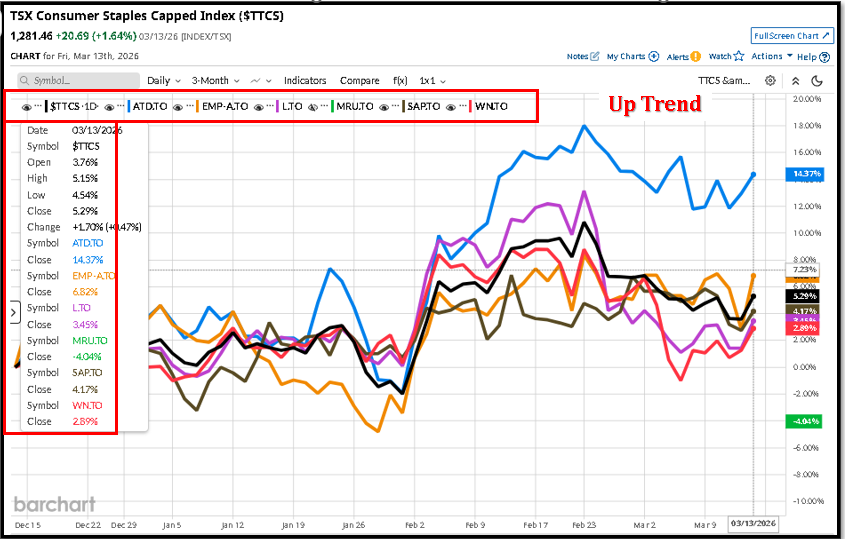
- TTCS (S&P/TSX Capped Consumer Staples Index) ticked up over the past ~10 days mainly due to defensive sector rotation while cyclicals weakened.
- Broader TSX volatility (materials, tech, financials selling off) pushed investors toward stable earnings sectors such as groceries and essential retail.
- The sector’s move is macro-driven, not earnings-driven—no major fundamental revisions in staples companies.
- Index strength is concentrated in few large constituents (Couche-Tard, Loblaw, Dollarama).
- Net effect: modest upward drift rather than a structural breakout.
Key Drivers Behind the Recent TTCS Uptick
1. Defensive Rotation During Market Volatility
Over the last ~10 days the TSX has been volatile due to geopolitical and macro risks, including Middle East tensions and inflation concerns.
When markets become unstable:
- investors typically rotate into defensive sectors
- consumer staples historically act as low-volatility earnings assets
This rotation helped lift staples even while several TSX sectors declined.
Mechanism
| Market Condition | Investor Behaviour | Impact on TTCS |
|---|---|---|
| Rising geopolitical risk | Reduce cyclical exposure | Buy defensive sectors |
| TSX drawdown | Portfolio hedging | Staples outperform |
| Inflation uncertainty | Prefer pricing-power companies | Staples bid up |
2. Relative Outperformance vs Weak Cyclical Sectors
Recent TSX declines have been concentrated in:
- financials
- industrials
- materials
- technology
During these periods the consumer staples sector posted gains (~1.6%) while others fell, reinforcing sector rotation into defensives.
This relative performance—not absolute growth—is the primary reason the index moved up.
3. Concentration Effect in the TTCS Index
The Canadian consumer staples sector is highly concentrated.
Typical top constituents include:
- Alimentation Couche-Tard
- Loblaw
- Dollarama
- Metro
- George Weston
Canada’s staples sector is dominated by grocery and discount retail companies, which are structurally defensive businesses.
If 1–2 large constituents move up:
- the index rises disproportionately.
4. Structural Sector Momentum (Background Trend)
The sector has already been strong over the past year.
Example proxy:
- XST (Consumer Staples ETF)
- ~25% 1-year return
- ~5% YTD gain.
This momentum provides a baseline bid during market uncertainty.
What the Move Does NOT Indicate
The 10-day uptick does not reflect:
- a change in earnings forecasts
- sector re-rating
- new catalysts specific to staples companies
It is primarily portfolio reallocation during macro volatility.
Short-Term Interpretation (Technical)
Current TTCS structure (approximate):
| Level | Interpretation |
|---|---|
| ~1330 | recent resistance area |
| ~1300 | pivot / consolidation |
| ~1270 | support |
The index recently approached its 52-week high near ~1331, showing gradual upward pressure.
However:
- upside is limited without earnings upgrades
- the move is macro-driven defensive demand
What Would Reverse the Recent Strength
TTCS typically underperforms when:
- Risk appetite returns
- cyclical sectors rally
- interest rates fall sharply
In those cases, capital usually rotates out of staples into growth and cyclicals.
Bottom Line
The recent 10-day uptick in TTCS is primarily explained by:
- Defensive sector rotation amid macro volatility
- Relative weakness in cyclicals
- Index concentration in stable grocery retailers
It reflects capital allocation behaviour, not a new growth narrative for the sector.
Leave a Reply
You must be logged in to post a comment.