
Executive Summary
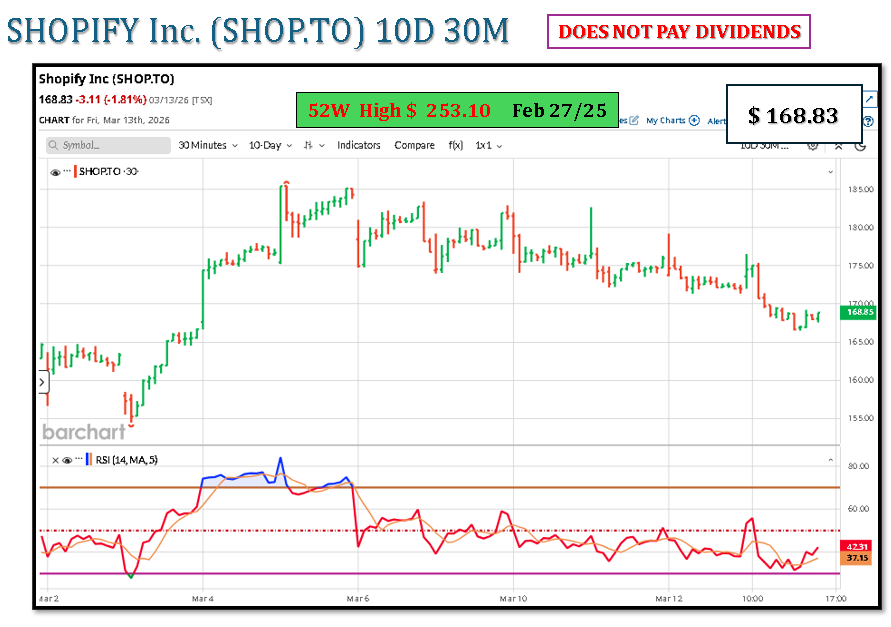
- Shopify (SHOP.TO) declined modestly over the last ~10 trading days mainly due to valuation compression and volatility in high-growth technology stocks, not a collapse in fundamentals.
- The stock has been sensitive to AI-related software sector fears and margin concerns after earnings, which triggered selling across software names.
- Shopify still trades at very high valuation multiples (~140× earnings), making it vulnerable to short-term corrections.
- Technical levels: support roughly C$150–155, resistance C$170–175.
- Analysts maintain “Buy / Moderate Buy” consensus with 12-month targets around C$210–225+ depending on the estimate.
1. What Caused the 10-Day Share Price Decline
1. Valuation Compression
Shopify is one of the most expensive large-cap TSX stocks.
| Metric | Approximate Level |
|---|---|
| Market cap | ~$170B |
| P/E ratio | ~140× |
High-multiple stocks tend to decline when:
- interest-rate expectations change
- investors rotate toward value sectors
- growth expectations moderate
Because of this, price declines often occur without fundamental deterioration.
2. Software Sector Volatility
Technology stocks have been volatile due to concerns that AI-driven software disruption and margin pressure could affect profitability.
Specific issues cited by analysts:
- AI spending could reduce near-term margins
- uncertainty about agentic AI commerce platforms competing with Shopify
These fears triggered broader selling in software equities.
3. Post-Earnings Volatility
Shopify’s latest results were mixed:
| Metric | Result |
|---|---|
| Revenue growth | ~31% YoY |
| EPS | slightly missed expectations |
Despite strong revenue growth, the earnings miss and margin outlook caused a ~6–7% drop in the stock after the report.
High-growth tech stocks frequently move sharply when earnings differ from expectations.
4. Profit-Taking After Strong Multi-Year Gains
Shopify had already risen significantly in previous years and outperformed many markets.
After strong rallies, institutional investors often:
- rebalance portfolios
- trim high-beta technology exposure
This contributes to short-term pullbacks even during long-term growth trends.
2. Technical Structure
Approximate levels derived from recent trading ranges and moving averages.
| Level | Price (CAD) | Interpretation |
|---|---|---|
| Major resistance | 175–180 | recent swing highs |
| Near resistance | 170–175 | short-term supply zone |
| Pivot | 160–165 | recent consolidation |
| Near support | 150–155 | short-term support |
| Major support | 140–145 | trendline / moving average |
The stock remains above long-term support but below recent highs, indicating consolidation.
3. Analyst Forecasts
Consensus analyst expectations remain positive.
| Metric | Estimate |
|---|---|
| Average 12-month target | ~C$209–225 |
| High estimate | ~C$250–300 |
| Low estimate | ~C$157–190 |
| Consensus rating | Buy / Moderate Buy |
These estimates imply ~30–50% potential upside depending on the model used.
4. Scenario Outlook
3-Month Outlook
| Scenario | Price Range | Drivers |
|---|---|---|
| Bear | 140–150 | tech sector selloff or valuation compression |
| Base | 150–175 | consolidation after earnings |
| Bull | 175–190 | tech momentum return / strong growth data |
Most likely outcome: volatile range trading due to tech-sector sensitivity.
12-Month Outlook
| Scenario | Price Range | Drivers |
|---|---|---|
| Bear | 130–150 | growth slowdown or software sector repricing |
| Base | 200–225 | continued revenue growth (~20%+) |
| Bull | 230–260+ | strong AI commerce adoption and margin expansion |
Growth forecasts remain strong:
- ~18% revenue growth per year
- ~20–25% EPS growth expected by analysts.
5. Key Risks
Valuation
- extremely high P/E multiple
Technology competition
- new AI-driven commerce platforms
Profitability
- heavy spending on AI and infrastructure
Market
- rotation out of growth stocks.
6. What Would Change the Outlook
Bullish catalysts:
- faster adoption of AI commerce tools
- stronger merchant growth
- expanding enterprise clients.
Bearish catalysts:
- slowing revenue growth
- margin compression from AI investment
- broad technology sector correction.
✅ Bottom line:
The recent ~10-day decline in SHOP.TO is largely a valuation-driven pullback and tech-sector volatility, not a collapse in the company’s growth trajectory. Current data suggests short-term trading between ~C$150–175, while analyst forecasts still point to ~C$210–225+ over the next 12 months if growth expectations hold.
Leave a Reply
You must be logged in to post a comment.