Author: Consultant

  • National Bank reports $1.25B Q1 profit, up from $997M a year earlier

    National Bank of Canada reported a first-quarter profit of $1.25 billion, up from $997 million a year earlier, helped by its acquisition of Canadian Western Bank.

    The bank says the profit amounted to $3.08 per diluted share for the quarter ended Jan. 31, up from $2.78 in the first quarter of 2025.

    Revenue totalled $3.89 billion, up from $3.18 billion a year earlier.

    National Bank’s provision for credit losses amounted to $244 million for the quarter, down from $254 million a year earlier.

    On an adjusted basis, National Bank says it earned $3.25 per diluted share in its latest quarter, up from an adjusted profit of $2.93 a year earlier.

    Analysts on average had expected an adjusted profit of $2.99 per share, according to LSEG Data & Analytics.

    This report by The Canadian Press was first published Feb. 25, 2026.

  • BMO Financial Group reports $2.49B Q1 profit, up from $2.14B a year earlier

    BMO Financial Group reported a first-quarter profit of $2.49 billion, up from $2.14 billion a year earlier.

    The bank says its profit amounted to $3.39 per diluted share for the quarter ended Jan. 31, up from $2.83 per diluted share in the same quarter last year.

    Revenue for the quarter totalled $9.82 billion, up from $9.27 billion a year earlier.

    The bank’s provisions for credit losses for the quarter amounted to $746 million, down from $1.01 billion.

    On an adjusted basis, BMO says it earned $3.48 per diluted share in its latest quarter, up from an adjusted profit of $3.04 per diluted share a year earlier.

    Analysts on average had expected an adjusted profit of $3.20 per share in the quarter, according to LSEG Data & Analytics.

    This report by The Canadian Press was first published Feb. 25, 2026.

  • Scotiabank reports $2.3B Q1 profit, up from $993M a year earlier

    The Bank of Nova Scotia reported $2.30 billion in first-quarter net income, up from $993 million a year earlier.

    The bank says the profit amounted to $1.73 per diluted share for the quarter ended Jan. 31, up from 66 cents per diluted share in the same period a year earlier.

    Revenue totalled $9.65 billion, up from $9.37 billion.

    Scotiabank says its provision for credit losses was $1.18 billion for the quarter, up from $1.16 billion a year earlier.

    On an adjusted basis, Scotiabank says it earned $2.05 per diluted share in its latest quarter, up from $1.76 a year earlier.

    The average analyst estimate had been for an adjusted profit of $1.95 per share, according to LSEG Data & Analytics.

    This report by The Canadian Press was first published Feb. 24, 2026.

  • IBM is the latest AI casualty. Shares are tanking 11% on Anthropic programming language threat

    International Business Machines stock is getting slammed, becoming the latest victim of rapidly developing AI technology, after Anthropic’s Claude announced COBOL capabilities.

    Shares of IBM fell 11% in Monday afternoon trading after Anthropic outlined a new use case for its Claude Code product: automating the exploration and analysis work that drives most of the complexity in COBOL modernization.

    COBOL, short for Common Business-Oriented Language, is a decades-old programming language used widely in business data processing, which is a core business area for IBM. COBOL continues to power systems responsible for large volumes of transactions, including payment processing and retail transaction systems, making it a prime target for cost-efficient AI disruption.

    In a Monday blog post, Anthropic wrote that COBOL handles an estimated 95% of ATM transactions in the U.S., for example.

    “Hundreds of billions of lines of COBOL run in production every day, powering critical systems in finance, airlines, and government. Despite that, the number of people who understand it shrinks every year,” the Anthropic blog post reads. “AI excels at streamlining the tasks that once made COBOL modernization cost-prohibitive.”

    It then explained that Claude Code can help modernize COBOL codebases by mapping dependencies across thousands of lines of code, documenting workflows and identifying risks that “would take human analysts months to surface.”

    “Legacy code modernization stalled for years because understanding legacy code cost more than rewriting it. AI flips that equation,” the blog post says.

    IBM is the latest stock to fall on AI fears, which have rattled investors in recent weeks and contributed to a volatile “sell first and ask questions later” trading environment. On Friday, a slew of cybersecurity companies tumbled after Anthropic unveiled a new capability it built into Claude Code, called Claude Code Security, that it said is capable of scanning codebases for security vulnerabilities and finding software vulnerabilities for humans to review. The sector remained under pressure in Monday’s session.

    Monday’s sell-off brought IBM shares down nearly 22% year to date.

  • OPINION: Big banks set to post higher profits as lenders continue to shrug off trade war concerns

    Canada’s biggest banks are set to post higher profits as elevated trading activity boosted by volatile equity markets is expected to curb the impact of softening loan demand from consumers and businesses.

    Analysts broadly expect profits to rise in the mid-single-digit percentage points in the first quarter as the lenders continue to shrug off concerns over the U.S. trade war.

    “Notwithstanding the still-unresolved tariff-related uncertainties, the Canadian banks’ business diversification (which resulted in mid-teens percentage earnings growth last year) has benefited their shareholders,” BMO analyst Sohrab Movahedi said in a recent note.

    The first quarter “is unlikely to be a major inflection point. As we await resolution around tariffs, we expect a continuation of last year’s earnings drivers.”

    On Tuesday, Bank of Nova Scotia BNS-T -1.65%decrease will be the first major bank to report earnings for the three months ended Jan. 31. Bank of Montreal BMO-T -2.63%decrease and National Bank of Canada NA-T -0.02%decrease will report results on Wednesday. Royal Bank of Canada RY-T -1.37%decrease, Toronto-Dominion Bank TD-T -1.54%decrease and Canadian Imperial Bank of Commerce CM-T -0.94%decrease will wrap up earnings week on Thursday.

    Canadian bank stocks have edged higher by 4.2 per cent this year, trailing the S&P TSX Composite Index’s 6.5 per cent climb.

    Clients continue to turn to the banks’ capital-markets and wealth-management businesses for trading and advisory services to grab a piece of whipsawing equity markets. Analysts expect this elevated activity to offset dampened borrowing in personal and business banking.

    Based on regulatory data for the first month of the quarter, loans grew modestly, Bank of Nova Scotia analyst Mike Rizvanovic said in a note to clients.

    “We remain positive on the large Canadian banks heading into Q1 earnings season that we suspect will once again feature strong results in market-sensitive businesses, upside to all-bank margins that will help keep [net interest income] growing despite only modest loan volumes, and credit losses remaining in a very manageable range in the absence of any signs of meaningful deterioration in the economic outlook,” Mr. Rizvanovic said.

    Analysts expect provisions for credit losses – the money banks set aside to cover sour loans – to edge higher slightly, easing from their stark upward trajectory in recent years amid concerns over an economic downturn. The provisions are a closely watched measure of financial stress among customers.

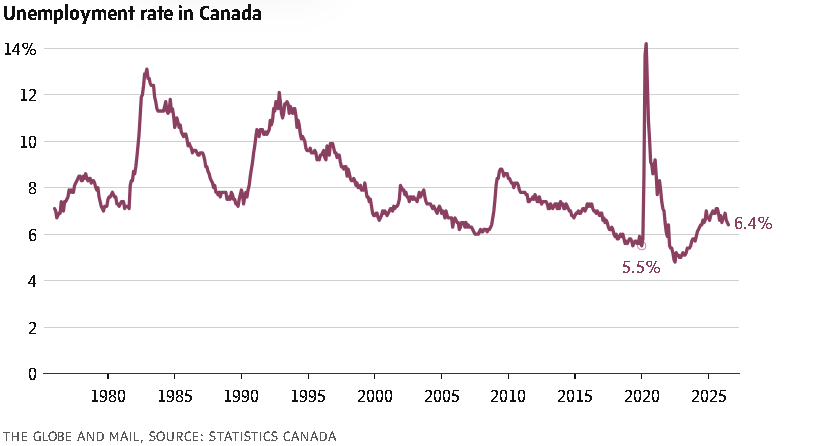
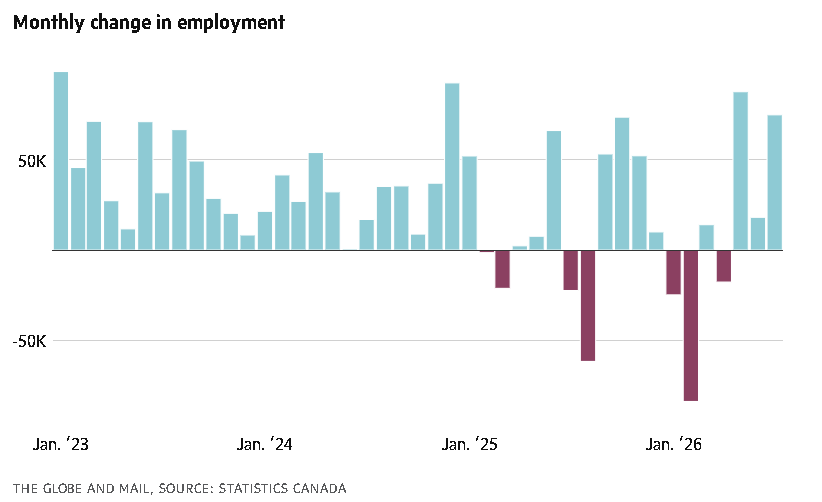
    Canada’s unemployment rate improved in January, suggesting that Canadian consumers and businesses will continue to withstand economic shocks. But credit card trust data – an indicator of consumer credit strength – pointed to rising delinquencies, according to CIBC analyst Paul Holden.

    Overall, the banks have ample provisions to weather an economic downturn, and Mr. Holden said there is room for reserves to be released in the U.S. as regional banks recently set aside fewer provisions than expected. Lenders unwind reserves when confidence increases in the ability of consumers and businesses to pay off their loans. The release of built-up reserves also bolsters the banks’ profits.

    “In Canada, however, given the still-uncertain macro backdrop, we believe it is still too early to see releases,” Mr. Holden said.

    “The banks have updated their forecasts for 2026 unemployment and GDP growth, which have improved from last quarter. This would typically indicate the possibility to release performing provisions, but we believe it is still too early given heightened uncertainty in the outlook.”

  • Loblaw to spend $2.4-billion in 2026 building new stores, renovating others

    Loblaw Cos. Ltd. L-T +2.14%increase says it plans to spend $2.4-billion to expand and renovate its store network and supply chain capabilities this year as it looks to open 70 new stores.

    The grocery and drugstore retailer says its plan includes 34 new Shoppers Drug Mart/Pharmaprix pharmacies and care clinics and 31 No Frills and Maxi stores.

    The new stores will come as the company also renovates 191 stores.

    The parent company of Loblaws and Shoppers Drug Mart is also expected to continue work on a new automated distribution centre in Caledon, Ont.

    The spending is part of the company’s five-year plan to spend $10-billion by 2030.

    Loblaw is expected to report its fourth-quarter and full-year results on Wednesday.

  • Feb 23/26: The most oversold and overbought stocks on the TSX

    The S&P/TSX Composite climbed 2.3 per cnet for the trading week ending with Friday’s close and stands 6.9 per cent higher for 2026 including dividends. The benchmark’s Relative Strength Index (RSI) of 63 leaves it in the upper reaches of technically neutral territory, much closer to the overbought RSI sell signal of 70 than the oversold buy signal of 30.

    There are six index constituents with attractive RSIs below the buy signal this week. Thomson Reuters Corp. is the most oversold company followed by Allied Properties REIT, CGI Inc., Enghouse Systems Ltd., Kinaxis Inc and Superior Plus Corp.

    There are 18 benchmark stocks with RSIs above the overbought warning at 70. Winpak Ltd. is the most overbought company followed by Canadian Pacific Kansas City Ltd., ATCO Ltd., Canadian Natural Resources Ltd. and Canadian Utilities Ltd.

    The list of S&P/TSX Composite stocks trading at new 52-week highs is enormous at 39 and they are ranked by market cap in a table below. The biggest companies making new highs are Agnico Eagle Mines Ltd., Bank of

  • Globe & Mail: What to watch for in Canadian GDP

    BANK WEEK:  The Big Five Canadian banks are set to report this week with Scotiabank BNS-T -1.63%decrease first out of the gates Tuesday, BMO BMO-T -2.71%decrease and National Bank NA-T -0.04%decrease Wednesday, and RBC RY-T -1.47%decrease, CIBC CM-T -1.06%decrease and TD TD-T -1.61%decrease Bank reporting on Thursday. The earnings come as the group is trading at a record high and a premium to their historical average. This might seem counterintuitive considering the concerns about Canada’s economy, but the group is forecast to put up double-digit earnings growth this year. “Strong fundamentals … continue to support elevated multiples,” wrote TD Securities analyst Mario Mendonca in a preview note to clients. Indeed, the banks do seem to be humming along. They are all buying back stock at the same time – a rarity, Mr. Mendonca said. Credit quality isn’t a major issue, U.S. loan growth is papering over softness in Canada, net interest margins aren’t under pressure, cost discipline has been a key focus. High valuations could be one of the main risks. “While banks are not directly connected to the tech sector,” Mr. Mendonca said, “a shift from tech to value stocks should support [insurers] over the banks.”

    ‘Nertia: Nvidia NVDA-Q +0.11%increase will report results Wednesday after the bell as the chipmaker’s stock has stagnated. The results used to be appointment viewing – people were gathering at bars to watch their release. But the trading action on the stock after earnings has been downright pedestrian for the last three earnings reports – moving less than 4 per cent. The stock is still hugging its record high but hasn’t really done much in the last six months. The business, on the other hand, continues to go gangbusters. Sales are expected to surge 67 per cent from last year and free cash is expected to double to US$33-billion. While this is eyewatering growth for a US$4.6-trillion company, investors have seemingly grown wary of the tech trade with the sector underperforming the broader market. There are also concerns about the impending competition. Just last week there were reports Google wants to take on Nvidia and sell their own artificial-intelligence chips. But all those headwinds could be a positive set-up into earnings. “Given middling stock performance, supply chain signals that remain bullish, and a management team that seems frustrated with the prevailing doubts around growth and margin sustainability, the earnings set-up here seems positive,” wrote UBS analyst Timothy Arcuri.

    SaaS-pocalypse: One of the biggest victims of the software selloff, Salesforce CRM-N -5.29%decrease, reports Wednesday afternoon. The sales management software provider has been cut roughly 40 per cent over the past year on fears that AI will replace its offering and their attempts to fight back aren’t strong enough. “We continue to hear about underwhelming Agentforce usage and core product demand,” wrote Citi analyst Tyler Radke in a preview note referencing Salesforce’s AI platform. Mr. Radke’s checks include talking with customers and tracking Salesforce website visits and notes that both have been negative. He’s an outlier, however. Most analysts still rate Salesforce a buy and expectations are for double-digit top-line growth, which the company hasn’t managed to achieve since 2024.

    Down the aisle: Loblaw L-T +2.04%increase reports results Wednesday morning with the stock trading near record levels. Food inflation has been supportive with CPI for food stores up nearly 5 per cent in January. “Food CPI backdrop continues to favour grocers with strong value proposition and likely to keep shaping consumer shopping patterns,” wrote RBC Capital Markets analyst Irene Nattel in a preview note to clients. “Loblaw is earning its place in that group, with a disciplined operating model and commitment to its financial framework, notably bookended by sustainable top-line growth and return of capital to shareholders.”

    GDP and Me: Canadian GDP for the fourth quarter and December will be out Friday and is expected to show a softening economy. The fourth-quarter consensus estimate is that the economy contracted 0.4 per cent after growing 2.6 per cent in the previous quarter. “The silver lining to a soft-looking quarter is that most of the weakness was concentrated in October and November with industry reports for December mostly positive,” wrote RBC Economics. Of course, key for Canada’s economy will be the future of tariffs. Investors will be watching for U.S. President Donald Trump’s response to the U.S Supreme Court ruling that tariffs enacted under emergency measures were illegal. Most of Canada’s exports were already exempt because of the continental free-trade agreement, but that could be upended this year. “We continue to view maintaining CUSMA-related exemptions more important for Canada than the [Supreme Court] ruling itself,” wrote RBC.

  • OPINION: Projected Forecast : Feb 23–27, 2026

    THIS IS AN OPINION

    Executive Summary (next week: Feb 23–27, 2026)

    • Starting point: S&P/TSX Composite closed 33,817.51 on Feb 20 (record high) after a +2.25% weekly gain, helped by reduced tariff uncertainty plus strength in financials and materials.
    • Base case (most likely): Range-bound to modestly higher for the week (~0% to +1%) as the index digests the rally into Canada’s Q4 & Dec GDP and key U.S. data.
    • Main macro catalyst: Canada GDP (Fri)—a downside surprise would likely hit banks, consumer, and domestically exposed cyclicals; an upside surprise supports risk appetite but could push yields higher.
    • Main geopolitics tail risk: Middle East energy risk (Strait of Hormuz disruptions, even temporary) can re-price oil quickly—benefits energy producers, pressures transport/consumer via inflation expectations.
    • Where TSX has support: Current leadership remains materials/energy/industrials, consistent with major Canadian strategy views that stay modestly constructive on those sectors.

    Key Drivers (macro → sector)

    1) Macro: Growth + rates impulse (Canada vs U.S.)

    • Canada: The week culminates with Quarterly GDP (Q4) plus Monthly GDP (Dec) (Fri). These prints can move Canadian front-end yields and re-price the “BoC path,” which usually transmits most to financials and rate-sensitive domestic cyclicals.
    • U.S.: Consumer confidence (Tue), jobless claims (Thu), and PPI (Fri) can shift global risk sentiment and USD—important because TSX leadership has been commodity-heavy, and commodities often react to USD and real rates.

    2) Sector mechanics: TSX is still commodity + banks heavy

    • Materials: Still the “swing factor” on many days—recent TSX strength has been tied to gold/copper momentum.
    • Energy: Geopolitical supply risk can lift crude; however, de-escalation can unwind the risk premium quickly. Iran’s temporary Strait of Hormuz closure for drills underscores this two-way volatility.
    • Financials: A GDP downside surprise typically hurts credit expectations; upside surprises can lift growth but also lift yields (mixed for banks depending on curve dynamics).

    3) Geopolitics & trade: two-sided shock potential

    • Trade policy sensitivity is elevated: TSX’s latest push to highs was partly tied to reduced tariff uncertainty after a U.S. Supreme Court ruling limiting unilateral tariff actions (as reported).
    • Supply-chain disruption risk persists: Russian strikes affecting Ukraine’s Black Sea port throughput have raised export costs and reduced capacity—relevant for global grains/industrial supply chains (and can indirectly influence Canadian resource and fertilizer narratives via price effects).

    Data & Evidence (what hits the tape next week)

    DateRelease/EventWhy it matters for TSXTSX sensitivity (typical)
    Mon Feb 23US: Chicago Fed Nat Activity; Factory OrdersEarly read on U.S. growth toneModerate (sentiment, USD)
    Tue Feb 24US: Consumer Confidence; Case-Shiller; Wholesale Trade SalesRisk appetite + rates expectationsModerate
    Thu Feb 26CA: Current Account (Q4); CA: SEPH (Dec); US: Jobless ClaimsCanada external balance + labour/earnings proxy; U.S. labour pulseModerate–High for banks/CAD
    Fri Feb 27CA: Quarterly GDP (Q4) + Monthly GDP (Dec); US: PPI (Jan); CA: BoC Senior Loan Officer SurveyPrimary macro catalyst for Canada; inflation pipeline for U.S.; credit conditionsHigh (index-level)
    OngoingMiddle East / Hormuz riskOil risk premium affects inflation expectationsHigh (energy-led)

    Valuation Logic (how the market is likely to “score” the week)

    This is a 1-week horizon, so “valuation” mostly transmits through rates + commodities + risk premium, not long-term DCF changes.

    • If Canada GDP is weak: markets typically price more easing / slower growthbanks + domestic cyclicals underperform; bond proxies may catch a bid; TSX can still be cushioned if gold stays strong.
    • If oil spikes on geopolitics: TSX can outperform global peers short-term (energy weight), but the second-order effect is inflation risk → higher yields → pressure on rate-sensitive equities.

    Risks (what can break the base case)

    • Event risk into Friday: With both Canada GDP and U.S. PPI on the same day, cross-asset volatility (rates/FX/commodities) can rise.
    • Oil tail risk is binary: Even “temporary” Hormuz disruptions can force a fast repricing of energy and inflation hedges.
    • Crowding at highs: TSX is at/near record levels—good news may already be partially priced, increasing sensitivity to “less-bad vs good” surprises.

    Scenarios (weekly total return on TSX; probabilities are subjective)

    Bull (25%) — +1% to +2.5%

    • Canada GDP prints better than feared and U.S. data doesn’t re-ignite inflation anxiety; commodities hold firm; risk premium stays contained.

    Base (50%) — 0% to +1%

    • Mixed macro prints; TSX consolidates near highs; leadership remains materials/financials, with energy reacting to headlines.

    Bear (25%) — -1.5% to -3.5%

    • Canada GDP disappoints and/or U.S. inflation pipeline (PPI) surprises higher, lifting yields; or a sharp geopolitical escalation sparks broad risk-off (even if oil up).

    What would disprove the base case quickly

    • A decisive breakout above highs with broad participation (not just materials/energy) would argue for stronger risk appetite than assumed.
    • A >~2% down day on benign data would signal positioning/technical fragility rather than macro-driven pricing.

    Actionable Takeaways (no advice language)

    • Treat Fri (Canada GDP + U.S. PPI) as the week’s main volatility window; most other releases are secondary unless they surprise sharply.
    • Expect TSX leadership to remain commodity-and-bank influenced; watch oil and gold as the quickest real-time “explainers” for intraday moves.

    THIS IS AN OPINION