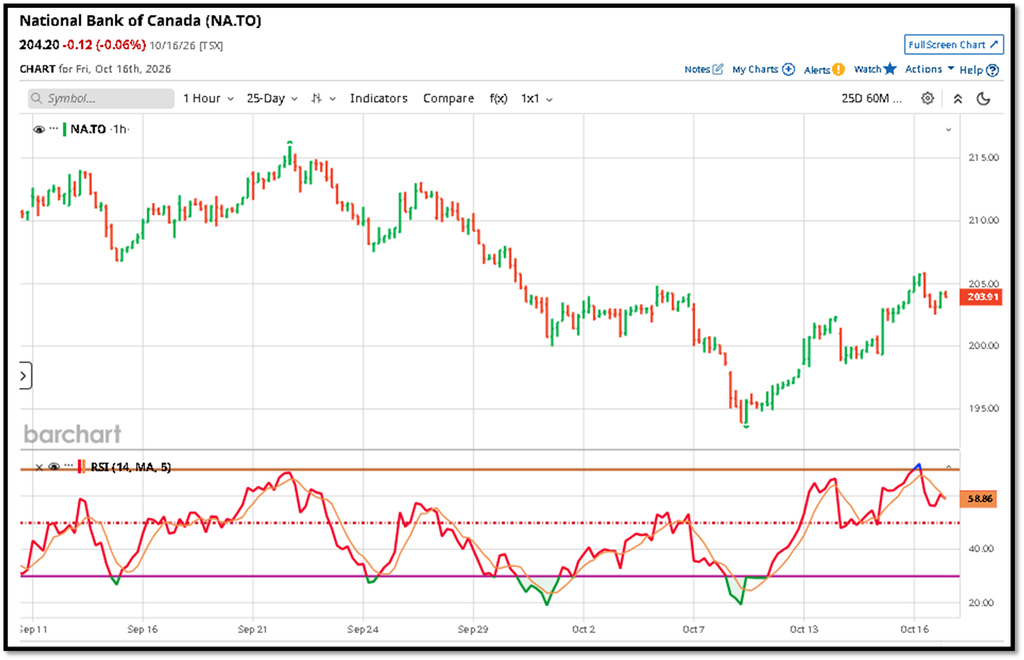
National Bank declined approximately 3.2%, from C$211 to C$204.20, after reaching a high near C$216 on September 22.
Price movements
September 11–22: Advanced toward C$216, reflecting positive banking-sector momentum.
September 23–30: Declined toward C$201 as selling pressure increased across Canadian financial stocks.
October 1–6: Stabilized between approximately C$201 and C$205.
October 7–9: Renewed selling pushed the stock toward C$194, its lowest level on the chart.
October 12–16: Recovered to C$204.20, approximately 5.3% above its recent low.
Main reasons for the decline
Interest-rate uncertainty: Rising bond yields increased concerns about borrowing costs and bank valuations.
Credit-loss concerns: Investors became more cautious about potential loan defaults and provisions for credit losses, particularly in commercial lending.
Economic uncertainty: Canadian economic weakness and trade-related risks contributed to a more cautious outlook for bank earnings.
Sector-wide selling: National Bank’s decline coincided with broader weakness in Canadian financial shares.
These are plausible contributing factors, not verified explanations for each trading session.
Technical outlook
Indicator
Assessment
October 16 close
C$204.20
RSI(14), hourly
Approximately 58–59 — positive momentum
Support
C$200–201
Stronger support
C$194–195
Resistance
C$205–206
Stronger resistance
C$210–212
Conclusion: National Bank’s decline was consistent with broader concerns about Canadian bank valuations, interest rates and credit quality.
The recovery from C$194 to C$204.20 indicates improving short-term momentum. However, a sustained move above C$206 would provide stronger evidence of a recovery, while a decline below C$200 would weaken the outlook.
The RSI remains above 50, suggesting that buying momentum has improved without reaching significantly overbought conditions.
WSP Global Inc provides a professional services consulting firm offering technical expertise and advice to clients in the Transportation & Infrastructure, Earth & Environment, Property & Buildings, and Power & Energy sectors. The company also offers specialized services in project and program delivery and advisory services. The firm operates through four reportable segments namely, Canada, Americas ( United States and Latin America), EMEIA (Europe, Middle East, India and Africa), and APAC (Asia Pacific, comprising Australia, New Zealand and Asia).
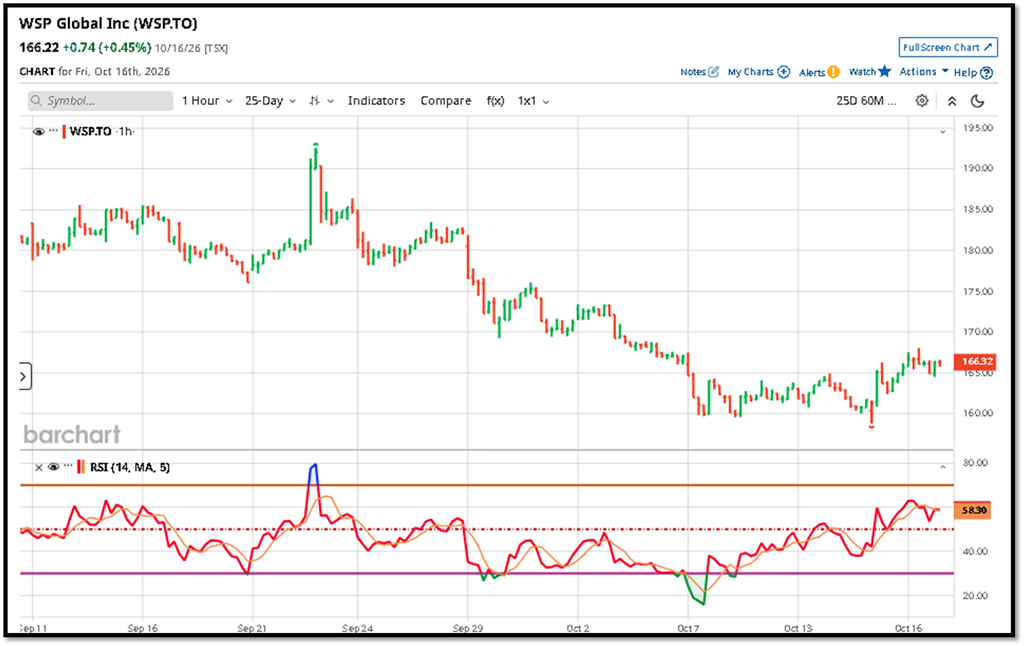
WSP declined approximately 8.2%, from C$181 to C$166.22, despite a modest recovery during the final trading sessions.
Price movements
September 11–22: Traded mainly between C$178 and C$185, briefly spiking toward C$192.
September 23–29: Selling intensified, pushing the share price below C$175.
September 30–October 8: Continued declining toward C$160, establishing a clear downward trend.
October 9–14: Consolidated around C$160–164.
October 15–16: Recovered to C$166.22, suggesting improving buying interest.
Main reasons for the decline
Rising bond yields: Higher interest rates pressured valuations and increased concerns about financing costs for infrastructure projects. The Wall Street Journal
Acquisition and integration costs: WSP raised its 2026 forecast for acquisition, integration and reorganization expenses to C$285–305 million, although its underlying business continued growing. WSP
Profit-taking and market volatility: Selling following the September price spike likely contributed to the decline. This is a technical interpretation, not a confirmed cause.
Uncertainty ahead of earnings: Investors are awaiting WSP’s third-quarter results on November 4. WSP
Technical outlook
Indicator
Assessment
October 16 close
C$166.22
RSI(14), hourly
Approximately 56–58; improving
Support
C$160–162
Resistance
C$170–173
Stronger resistance
C$175–180
Conclusion: WSP experienced a sustained decline followed by a modest recovery. The chart indicates improving short-term momentum, but not yet a confirmed trend reversal.
Importantly, WSP reported 22.9% year-over-year net revenue growth and a C$20.1 billion backlog in Q2, suggesting that the share-price decline does not, by itself, establish deteriorating business fundamentals.
WSP
A sustained move above C$173 would strengthen the recovery case; a break below C$160 would renew downside concerns.
These are potential contributing factors, not independently verified explanations for each day’s decline.
Technical outlook
Indicator
Assessment
October 16 close
C$100.81
RSI(14), hourly
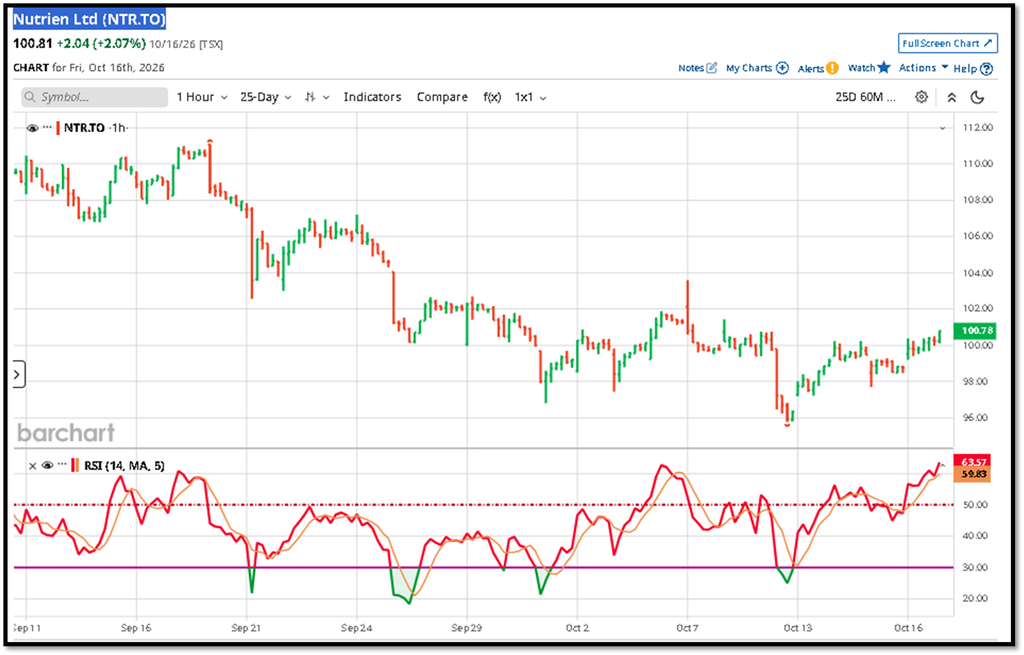
63.57 — improving momentum
Support
C$98–99
Stronger support
C$95–96
Resistance
C$102–104
Stronger resistance
C$106
Conclusion: Nutrien experienced a sustained decline followed by a recovery in the final sessions. The RSI above 60 suggests improving short-term momentum, but the stock remains below its September highs.
A sustained move above C$104 would strengthen the recovery case; a decline below C$98 would weaken it.
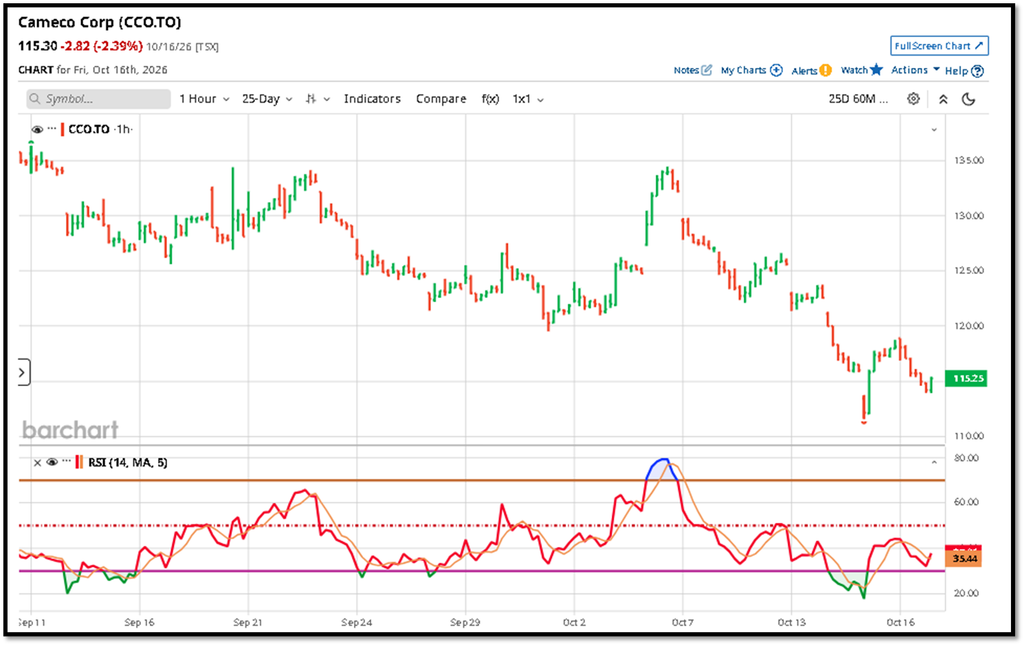
Cameco declined approximately 14.6%, from around C$135 to C$115.30, despite a brief recovery in early October.
Price movements
September 11–16: Declined from approximately C$135 to C$127, indicating early selling pressure.
September 17–22: Rebounded toward C$134 as buying interest returned.
September 23–October 2: Fell toward C$121, establishing a short-term downward trend.
October 5–6: Recovered sharply toward C$134, but the rally failed to hold.
October 7–16: Renewed selling pushed the stock toward C$112 before closing at C$115.30.
Main reasons for the decline
Production and earnings concerns: Reports of operational difficulties and lower production expectations increased concerns about Cameco’s future profitability. Trefis
Uranium shares lagged uranium prices: Despite historically strong long-term uranium contract prices, uranium equities weakened, suggesting investors were concerned about earnings execution and valuations. FairsOnline
Profit-taking and risk aversion: Global equity-market volatility likely amplified selling in Cameco following its earlier gains. Reuters
Technical outlook
Indicator
Assessment
October 16 close
C$115.30
RSI(14), hourly
Approximately 35–40, weak momentum
Support
C$112–114
Resistance
C$120–123
Stronger resistance
C$125–130
Conclusion: Cameco’s decline reflects both company-specific profitability concerns and weakening investor sentiment toward uranium equities. The stock remains technically weak. A sustained recovery above C$123 would be an initial indication of improving momentum, while a break below C$112 would increase downside risk.
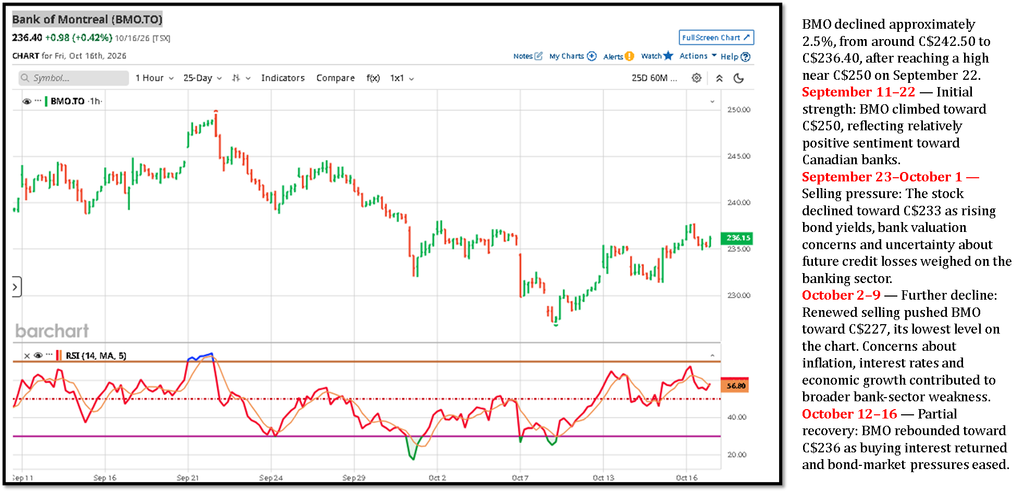
BMO declined approximately 2.5%, from around C$242.50 to C$236.40, after reaching a high near C$250 on September 22.
Main reasons for the movement
September 11–22 — Initial strength: BMO climbed toward C$250, reflecting relatively positive sentiment toward Canadian banks.
September 23–October 1 — Selling pressure: The stock declined toward C$233 as rising bond yields, bank valuation concerns and uncertainty about future credit losses weighed on the banking sector.
October 2–9 — Further decline: Renewed selling pushed BMO toward C$227, its lowest level on the chart. Concerns about inflation, interest rates and economic growth contributed to broader bank-sector weakness.
October 12–16 — Partial recovery: BMO rebounded toward C$236 as buying interest returned and bond-market pressures eased.
These are plausible market drivers; the chart alone cannot establish the precise cause of each movement.
Technical outlook
Indicator
Interpretation
October 16 close
C$236.40
RSI(14)
56.8 — moderately positive
Support
C$228–230
Resistance
C$238–240
Stronger resistance
C$245
Conclusion: BMO’s decline was consistent with broader banking-sector concerns about elevated interest rates, bond-market volatility and credit risk.
The rebound from its October 8 close of C$228.42 to C$236.40 on October 16 (+3.49%) indicates improving short-term momentum, but a sustained move above C$240 would provide stronger evidence of a trend reversal.
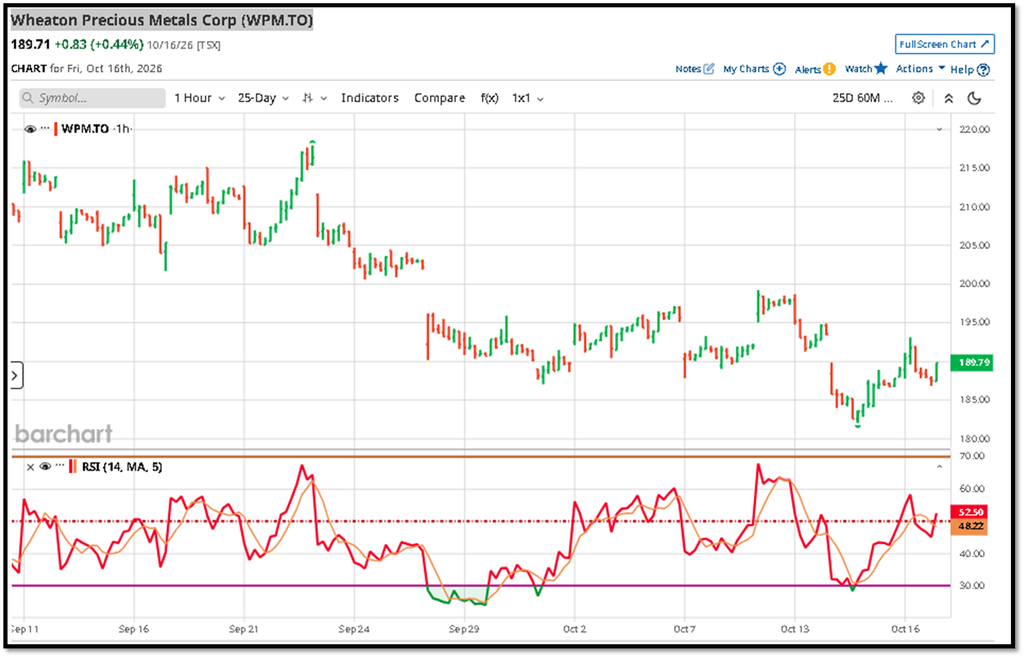
Wheaton Precious Metals declined approximately 13%, from around C$217 in mid-September to C$189.71 on October 16, 2026.
The chart shows three periods of weakness:
September 23–30: Sharp selling, with the share price falling toward C$191.
October 1–10: Partial recovery, but insufficient to reverse the decline.
October 13–15: Renewed selling pushed the share price toward C$182 before rebounding.
Main reasons for the decline
Falling gold and silver prices: Both metals weakened, reducing expected revenue and cash flow for precious-metal companies. Silver was particularly weak.
Inflation and interest rates: Higher U.S. inflation increased expectations of Federal Reserve rate hikes, putting pressure on gold and silver prices. The Wall Street Journal+1
Profit-taking: Selling followed WPM’s September rally, particularly after its September 22 peak.
Precious-metal sector weakness: Investors reduced exposure to precious-metal equities as commodity prices declined.
Technical outlook
Level (CAD)
Interpretation
$182–185
Near-term support
$190–195
First resistance
$200
Stronger recovery threshold
RSI 52.50
Neutral to slightly positive momentum
Conclusion: The decline appears primarily driven by weaker precious-metal prices and interest-rate expectations, rather than confirmed deterioration in WPM’s underlying operations. The rebound toward C$190 is encouraging, but a sustained move above C$195 would provide stronger evidence of recovery.
TSX Composite rose 1.44% for the week, closing at 36,176.55, compared with 35,664.62 on October 9.
Energy stocks were a major source of strength, supported by rising oil prices and Middle East supply concerns.
Materials and mining stocks rebounded, contributing to a strong Thursday session.
Technology stocks faced conflicting pressures: lower bond yields supported valuations, while the U.S. AI-related selloff threatened investor confidence.
Canada outperformed the U.S. S&P 500, which declined 1.95% over the same week. MarketScreener+3
1. TSX Composite — Weekly results
October 9
35,664.62
October 16
36,176.55
Weekly return
+1.44%
The TSX gained 511.93 points during the holiday-shortened trading week.
On October 13, energy strength helped push the TSX to 35,983.98. On October 15, gains in mining and technology lifted the index 1.55% to 36,137.10. Friday’s further 0.11% advance brought the index to its highest close since early September.
Reuters
+2
2. What drove the weekly performance?
Energy — Strong positive contribution
Oil producers benefited from increasing geopolitical supply risks. Brent crude approached US$110 per barrel on October 16, and the TSX energy sector gained 2.8% that day.
Higher realized crude prices can improve operating cash flow at producers such as SU, CNQ and IMO, although refining margins, operating costs and hedges also matter.
The longer-term risk is that sustained high oil prices increase inflation and eventually reduce global petroleum demand.
MarketScreener
+1
Materials — Recovery in mining shares
Mining stocks helped lift the TSX, particularly during Thursday’s broad rebound.
Lower government bond yields can support precious-metal valuations by reducing the opportunity cost of holding gold. Copper producers remain more exposed to Chinese industrial demand and global manufacturing growth.
The net effect differs substantially among gold miners, copper producers and diversified mining businesses.
Reuters
+1
Technology — Competing forces
The TSX technology sector benefited from falling bond yields on Thursday, but international sentiment deteriorated sharply toward AI-related companies.
The U.S. Nasdaq lost about 4.5% over the week. Concerns centred on expensive AI infrastructure, financing requirements and whether projected revenue growth could justify high valuations.
For Canadian names such as SHOP, CSU and KXS, the important variables are earnings growth, free cash flow and whether their share-price multiples are supported by those fundamentals.
Reuters
+1
3. Understanding the sector chart you supplied
Your Barchart image is a six-month relative-performance chart ending October 2, rather than a chart of the latest week.
It shows how different TSX sectors performed over approximately April–October 2026. The following values come from the chart’s October 2 tooltip, not from the latest week’s sector returns.
TSX index / sector
Six-month chart return
Technology (TTTK)
+29.41%
Financials (TTFS)
+19.14%
Energy (TTEN)
+8.03%
TSX Composite
+7.23%
Industrials (TTIN)
+5.69%
Healthcare (TTHC)
+2.13%
Consumer Discretionary (TTCD)
+0.71%
Materials (TTMT)
−2.69%
Consumer Staples (TTCS)
−4.08%
This reveals three important developments.
First, technology and financials led the preceding six-month period. Technology gained 29.41%, significantly outperforming the TSX Composite. That earlier appreciation also creates vulnerability if investors begin reducing growth-stock valuations.
Second, energy strengthened during the latter part of the period. This helps explain why higher oil prices could support the TSX during October’s global technology weakness.
Third, materials lagged the broader index. Its recent rebound therefore needs to be distinguished from the sector’s weaker longer-term trend.
These returns are historical chart readings; they must not be interpreted as sector returns for October 12–16.
October 12–16, 2026Nasdaq fell 4.48%, its worst week since June, as semiconductor and AI-related companies experienced substantial selling.
S&P 500 declined 1.95%, pressured by technology stocks, which have significant weight in the index.
Dow Jones gained 0.67%, benefiting from stronger performance in energy, consumer staples and other non-technology sectors.
AI investment profitability became a major concern. Investors questioned whether enormous data-centre expenditures would generate sufficient returns.
Higher oil prices and persistent inflation increased concerns about borrowing costs, corporate margins and Federal Reserve monetary policy
What caused the decline?
Nasdaq — Technology and AI selloff
Weekly −4.48%
The Nasdaq experienced the most significant losses because of its heavy exposure to technology and semiconductor companies.
Four primary reasons:
AI spending concerns: Investors questioned the profitability of rapidly expanding AI data centres and whether future revenues would justify capital expenditures.
Semiconductor selling: Chip manufacturers declined sharply. Micron Technology fell approximately 5.6% Friday, while Intel declined approximately 5.8%.
Financing risks: AI infrastructure providers that rely heavily on borrowing came under pressure. CoreWeave lost approximately 25% over five trading sessions.
Valuation compression: High-growth technology shares became vulnerable as investors reduced expectations for future earnings and became less willing to pay premium multiples.
The PHLX Semiconductor Index declined approximately 11.4% during the week, demonstrating how concentrated the selling became in chip-related companies.
AP News
+2
Assessment: The selloff reflects increased doubts about the financial returns from AI investments, not necessarily a collapse in demand for AI technology.
The S&P 500 declined because weakness in large technology companies outweighed gains in other sectors.
Technology, communication services and growth-oriented businesses suffered from valuation pressures. Meanwhile, selected energy, utility and consumer-staples companies performed better.
The combination of persistent inflation and expensive equity valuations increased sensitivity to earnings disappointments.
On Friday, the technology sector declined approximately 3%, compared with a gain of around 2.5% for energy.
Dean Financials
+1
Dow Jones — Positive week despite Friday’s decline
Weekly +0.67%
The Dow’s resilience was primarily due to its different sector composition.
The index has less exposure to the most speculative AI infrastructure businesses and greater representation from established industrial, healthcare, consumer and financial companies.
Investors rotated toward sectors with established profitability and more predictable cash flows.
Energy and consumer staples each gained approximately 5% over the week, helping explain why the Dow outperformed the Nasdaq by approximately 5.15 percentage points.
Barron’s
+1
3. Major economic factors affecting Wall Street
Factor
Weekly development
Market impact
U.S. inflation
CPI approximately 3.7% YoY
Raised concerns about persistent price pressures
WTI crude oil
Approximately +10.4% weekly
Supported energy companies but threatened inflation and consumer spending
U.S. 10-year Treasury yield
Fell from 5.244% to 5.098%
Suggested increased demand for bonds despite inflation concerns
Semiconductor stocks
Approximately −11.4%
Significant pressure on Nasdaq and S&P 500
Market volatility (VIX)
Rose from 14.84 to 19.99
Indicated greater expectations of short-term equity volatility
Portfolio Terminal
+2
Important distinction: Falling Treasury yields did not signal an end to inflation concerns. Investors appeared increasingly concerned about equity valuations and economic growth, encouraging capital movement into bonds.
4. Implications for the TSX
TSX sector
Examples
Expected near-term influence
Technology
SHOP, CSU, KXS
Negative — potential spillover from Nasdaq valuation pressures
Energy
SU, CNQ, IMO
Positive earnings sensitivity to stronger WTI prices
Gold
AEM, ABX, WPM
Potential support from uncertainty and safe-haven demand
Financials
RY, TD, BMO
Mixed — lower bond yields may help valuations, while slower growth threatens credit quality
Materials
TECK.B, FM, LUN
Mixed — infrastructure investment supports demand, but global growth concerns create downside risk
The strongest direct earnings benefit could occur among Canadian oil producers if higher crude prices persist. Technology shares face the clearest near-term sentiment risk.
5. U.S. market outlook — October 19–23
Scenario
Key conditions
Likely market response
Bull
Strong corporate earnings, recovery in semiconductor shares and easing inflation expectations
Nasdaq rebounds; S&P 500 strengthens
Base
Mixed earnings, elevated oil prices and continued AI valuation concerns
Treasury yields: Whether bond investors continue favouring safety over equities.
Market breadth: Whether weakness spreads from technology into industrials, financials and consumer stocks.
Conclusion
The U.S. market experienced a significant rotation out of AI-related technology stocks rather than a uniform equity-market decline.
The Nasdaq’s 4.48% weekly fall contrasted with the Dow’s 0.67% advance. This divergence indicates growing investor selectivity toward valuations, earnings quality and capital expenditure.
For the TSX, the immediate implications are potential strength in oil producers, increased volatility in technology stocks and mixed prospects for banks.
A sustained rebound in semiconductor shares, supported by improving earnings expectations and cash-flow forecasts, would weaken the bearish technology thesis.
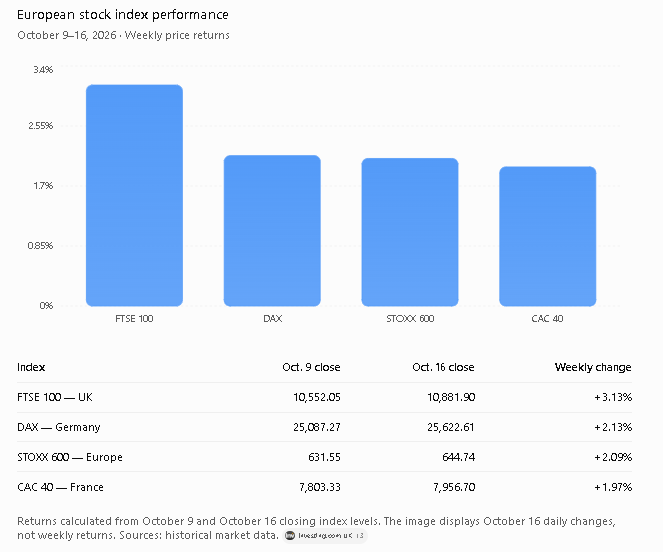
European equities advanced across all four major indices, outperforming the technology-heavy U.S. Nasdaq.
FTSE 100 led, gaining 3.13%, its strongest weekly performance in approximately six months.
Germany’s DAX gained 2.13%, supported by corporate earnings and improving sentiment toward European equities.
STOXX 600 gained 2.09%, its strongest week since June, helped by earnings and rotation away from highly valued U.S. technology stocks.
France’s CAC 40 gained 1.97%, although fiscal uncertainty and weak luxury-sector performance remained concerns.
European equities benefited from investors moving toward defensive companies and selected industrial businesses, even as inflation and interest-rate risks remained elevated
What drove each market?
United Kingdom — FTSE 100
Weekly +3.13%
The FTSE 100 was Europe’s strongest performer among the four indices.
Key reasons:
Defensive sector rotation: Investors favoured established companies in consumer staples, healthcare and other less technology-dependent sectors.
Fiscal reassurance: Government commitments to fiscal discipline helped stabilize market sentiment.
Economic resilience: UK GDP expanded 0.1% in August, reducing immediate concerns about an economic contraction.
Banking uncertainty: Potential increases in UK bank taxation weighed on Lloyds, NatWest and other financial stocks, limiting gains in that sector.
The rally reflected both earnings expectations and changing investor preferences, rather than evidence of a substantial acceleration in UK economic growth.
Reuters
+3
Germany — DAX
Weekly +2.13%
Germany recovered despite continued uncertainty affecting manufacturing and export-oriented companies.
Key reasons:
Positive European industrial and technology earnings helped improve investor confidence.
Lower bond yields during parts of the week supported equity valuations.
European technology and industrial companies benefited from selective buying despite the broader AI-related selloff.
Aerospace and defence companies attracted interest following reports of potential European industry consolidation.
Principal risk: Germany remains sensitive to global trade, energy costs and demand from China. Persistently high oil prices or weaker international industrial activity could undermine the recovery.
Reuters
+2
Europe — STOXX 600
Weekly +2.09%
The broad European benchmark gained 13.19 index points.
Key reasons:
Strong corporate results helped offset weakness in AI-related stocks.
European banks contributed to gains early in the week.
Individual companies including Ericsson, Aixtron and Nestlé provided support.
Investors increasingly diversified away from concentrated U.S. technology exposure.
Reuters reported that STOXX 600 companies’ third-quarter earnings were expected to grow approximately 20.7% year over year. This was an earnings forecast, not realized earnings growth.
Principal risk: Euro-area inflation and the possibility of further ECB tightening could pressure borrowing costs and equity valuation multiples.
Reuters
+1
France — CAC 40
Weekly +1.97%
France recovered during the week but continued to face more significant domestic risks than Germany or the UK.
Key reasons:
A rebound in industrial and luxury shares helped the index recover from previous weakness.
Improved European earnings sentiment supported French multinational companies.
Broader European market gains helped offset domestic political uncertainty.
Principal risks:
France’s public debt, approaching 120% of GDP, and elevated government bond yields remain concerns. Luxury companies also face weaker Chinese demand, while banks are sensitive to sovereign debt and financing conditions.
The weekly gain is therefore a recovery, not confirmation that France’s structural challenges have been resolved.
Financial Times
+1
3. Key economic and geopolitical factors
Factor
Impact on European equities
Corporate earnings
Positive — stronger results supported valuations
AI-related selloff
Mixed — hurt technology but encouraged rotation into other sectors
Interest rates
Mixed — easing bond yields helped, but further ECB hikes remain a risk
Middle East tensions
Negative for energy-intensive industries through elevated oil costs
China economic weakness
Negative for exporters, automakers and luxury companies
European defence investment
Positive for selected aerospace and defence companies
European market performance contrasted with the U.S. Nasdaq, which declined approximately 4.5% during the week. This divergence suggests investors were increasingly distinguishing between businesses with established cash flows and those dependent on aggressive AI investment assumptions.