LNG Canada, country’s $40-billion ‘second chance’ at becoming a global LNG leader, takes shape
On a drizzly stretch of B.C. coastline at the head of the Douglas Channel, Canada’s first natural gas export terminal is taking shape.
The sprawling site on the traditional territory of the Haisla Nation teems with more than 5,000 construction and trades workers, working around the clock to bring the $40-billion Shell Plc.-led LNG Canada terminal to completion.
The latest piece of the puzzle: a colossal 3,000-ton Baker Hughes compressor that arrived in Kitimat by boat from Italy on Sep. 20, the first of four that will form the powerful jet engine of the terminal’s liquefaction process. Its arrival puts the project — and the country — one important step closer to seeing the first cargo of liquified natural gas depart from its shores.
Already more than 70 per cent complete, LNG Canada could be operational by the middle of the decade and promises to unlock the full economic potential of Canada’s rich gas reserves for the first time.
It’s a change that will take some adjusting to in the oilpatch. Despite being the fifth-largest supplier of natural gas in the world, Canada’s energy sector has long seen its production hemmed in by pipeline constraints and market conditions in the U.S.
Once it is operational, LNG Canada will be a major export terminal for liquified natural gas from the West Coast. Requiring a massive infrastructure lift, including the largest tank built for LNG in the world (2nd only in size to a tank built for imports in Southeast Asia) pic.twitter.com/n2B4yl8J2G— Meghan Potkins (@mpotkins) September 29, 2022
‘The Fed is breaking things’ – Here’s what has Wall Street on edge as risks rise around the world
Markets entered a perilous new phase in the past week, one in which statistically unusual moves across asset classes are becoming commonplace.
Surging volatility in what are supposed to be among the safest fixed income instruments in the world could disrupt the financial system’s plumbing, according to Mark Connors, former Credit Suisse global head of risk advisory.
That could force the Fed to prop up the Treasury market, he said. Doing so will likely force the Fed to put a halt to its quantitative tightening program ahead of schedule.
The other worry is that the whipsawing markets will expose the weak hands among asset managers, hedge funds and other players who may have been overleveraged or took on unwise risks. Margin calls and forced liquidations could further roil markets.
Oil prices could soon return to $100 as OPEC+ considers ‘historic’ cut, analysts say
OPEC and non-OPEC producers, a group often referred to as OPEC+, will meet in Vienna, Austria on Wednesday to decide on the next phase of production policy.
The oil cartel and its allies are considering an output cut of more than a million barrels per day, according to OPEC+ sources who spoke to Reuters.
“The OPEC ministers are not going to come to Austria for the first time in two years to do nothing. So there’s going to be a cut of some historic kind,” said Dan Pickering, CIO of Pickering Energy Partners.
An influential alliance of some of the world’s most powerful oil producers is reportedly considering their largest output cut since the start of the coronavirus pandemic this week, a historic move that energy analysts say could push oil prices back toward triple digits.
OPEC and non-OPEC producers, a group often referred to as OPEC+, will meet in Vienna, Austria, on Wednesday to decide on the next phase of production policy.
“The OPEC ministers are not going to come to Austria for the first time in two years to do nothing. So there’s going to be a cut of some historic kind,” Dan Pickering, CIO of Pickering Energy Partners, said, referring to the group’s first in-person meeting since 2020.
However, Pickering said he expects the actual number of barrels coming off the market will likely be around 500,000, which is “going to be enough to support the market in the near term.”
International benchmark Brent crude futures popped 4% to $88.54 per barrel, while U.S. West Texas Intermediate futures climbed 4.2% to trade at $82.83 per barrel.
Stocks rally to start October and a new quarter, Dow up over 700 points
The Dow Jones Industrial Average jumped 739 points, or 2.6%. At one point it advanced as much as about 700 points. The S&P 500 rose 2.5%, after falling Friday to its lowest level since November 2020, and the Nasdaq Composite gained 2.1%.
Those moves came as the yield on the 10-year U.S. Treasury note rolled over to trade at around 3.7%, after topping 4% at one point last week.
“It’s pretty simple at this point, 10-year Treasury yield goes up, and equities likely remain under pressure,” Raymond James’ Tavis McCourt said. “It comes down, and equities rally.”
Wall Street is coming off a tough month, with the Dow and S&P 500 notching their biggest monthly losses since March 2020. The Dow on Friday also closed below below 29,000 for the first time since November 2020.
The Dow shed 8.8% in September, while the S&P 500 and Nasdaq Composite lost 9.3% and 10.5%, respectively.
For the quarter, the Dow fell 6.66% to notch a three-quarter losing streak for the first time since the third quarter of 2015. Both the S&P and Nasdaq Composite fell 5.28% and 4.11%, respectively, to finish their third consecutive negative quarter for the first time since 2009.
As the new quarter kicks off, all S&P 500 sectors sit at least 10% off their 52-week highs. Nine sectors finished the quarter in negative territory.
In the fourth quarter, elevated inflation and a Federal Reserve intent on bringing surging prices to a halt regardless of what it means for the economy will likely continue to weigh on markets, said Truist’s Keith Lerner. Oversold conditions, however, also make the market vulnerable to a sharp short-term bounce on good news, he added.
“I think we could be set up for some type of reprieve but the underlying trend at this point is still a downward trend and choppy waters to continue,” Lerner said.
• (8:30 a.m. ET) Canadian employment for September. The Street expects an increase of 0.1 per cent, or 20,000 jobs, from August with the unemployment rate remaining 5.4 per cent.
• (8:30 a.m. ET) U.S. nonfarm payrolls for September. The consensus is an increase of 250,000 jobs from August with the unemployment rate staying at 3.7 per cent.
• (10 a.m. ET) U.S. wholesale inventories for August.
U.S. investors brace for more wild market gyrations after dizzying Q3
In a year of wild market swings, the third quarter of 2022 was a time when events took a truly extraordinary turn.
As the Federal Reserve ratcheted up its monetary policy tightening to tame the worst inflation in decades, U.S. Treasury yields shot to their highest levels in more than a decade and stocks reversed a summer rally to plumb fresh depths.
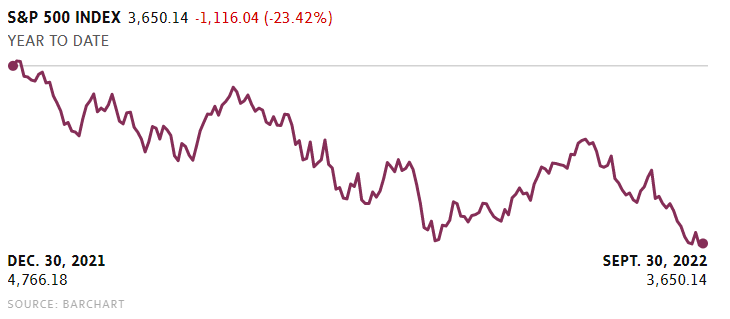
The S&P 500 is down nearly 24% year-to-date, while yields on the benchmark 10 year Treasury note,
which move inversely to bond prices, recently hit their highest level since 2008.
Outside the United States, the soaring dollar spurred big declines in global currencies, pushing Japan to support the yen for the first time in years. A slump in British government bond prices, meanwhile, forced the Bank of England to carry out temporary purchases of long-dated gilts.
Many investors are looking to the next three months with trepidation, betting the selloff in U.S. stocks will continue until there are signs the Fed is winning its battle against inflation.
Yet the last quarter of the year has often been a beneficial time for U.S. equities, spurring hopes that markets may have already seen the worst of the selloff.
PASS THE DIP
The strategy of buying stock market dips yielded rich rewards for investors in the past but failed badly in 2022: the S&P 500 has rallied by 6% or more four times this year and went on to make a fresh low in each instance.
The third quarter saw the index rise by nearly 14% before reversing to make a fresh two-year low in September after investors recalibrated their expectations for even more aggressive Fed tightening.
LOOK OUT BELOW?
With several big Wall Street banks expecting the benchmark index to end the year below current levels – Bank of America and Goldman Sachs both recently published year-end targets of 3,600 – the outlook for dip-buying remains murky.
In addition, the current bear market, which has so far lasted 268 days and notched a peak-to-trough decline of about 24%, is still relatively short and shallow compared with past drops. Since 1950, the average bear market has lasted 391 days with an average peak-to-trough drop of 35.6%, according to Yardeni Research.
LOOK TO BONDS
Though equities have been volatile, the gyrations in bond markets have been comparatively worse.
The ICE BofAML U.S. Bond Market Option Volatility Estimate Index shot to its highest level since March 2020 as the ICE BofA US Treasury index is on track for its biggest annual drop on record.
By comparison, the Cboe Volatility Index – the so-called Wall Street “fear gauge” – has failed to scale its March peak.
Some investors believe stock turbulence will continue until bond markets calm down.
“I think there is a good scenario where once we get through the bond market violence, we get to a more tradable bottom (for stocks),” said Michael Purves, chief executive at Tallbacken Capital Advisors in New York.
… AND THE DOLLAR
Soaring U.S. interest rates, a relatively robust American economy and investors’ reach for safe haven amidst a rise in financial market volatility has boosted the U.S. dollar – to the detriment of other global currencies.
The greenback is up about 7% for the quarter against a basket of currencies and stands near its highest level since May 2002. The dollar’s strength has the Bank of Japan to shore up the yen through interventions while also presenting an earnings headwind for U.S. corporates.
“Market risk-takers are grappling with the double-barreled threat of persistent dollar strength and dramatically higher interest rates,” Jack Ablin, chief investment officer at Cresset Capital, said in a note.
EARNINGS TEST
Third quarter earnings may present another obstacle to markets, as companies factor in everything from dollar-fueled currency headwinds to supply chain issues.
Analysts have become more downbeat on third quarter profit growth, with consensus estimates falling to 4.6% from 7.2% in early August, according to Refinitiv IBES. So far, that is only slightly worse than the median 2.2 percentage point decline ahead of reporting periods historically, yet warnings from companies such as FedEX and Ford have hinted at the possibility of more pain to come.
‘TIS THE SEASON
The calendar may offer weary stock investors some hope.
The fourth quarter is historically the best period for returns for major U.S. stock indexes, with the S&P 500 averaging a 4.2% gain since 1949, according to the Stock Trader’s Almanac.
Unrelenting inflation is taking a toll, leaving more Americans living paycheck to paycheck
With persistent inflation weighing on consumers, the number of Americans living paycheck to paycheck is increasing, according to a recent report.
The rise has been sharpest for higher earners, the report found.
Almost everyone has felt the sting of rising prices.
As of August, 60% of Americans were living paycheck to paycheck, according to a recent LendingClub report — a number that hasn’t budged much since inflation hit 40-year highs. A year ago, the number of adults who felt stretched too thin was closer to 55%.
Even high-income earners are feeling the strain, the report found. Of those earning more than six figures, 45% reported living paycheck to paycheck, a jump from the previous year’s 38%.
he Brent crude oil spot price in our forecast averages $98 per barrel (b) in the fourth quarter of 2022 (4Q22) and $97/b in 2023. The possibility of petroleum supply disruptions and slower-than-expected crude oil production growth continues to create the potential for higher oil prices, while the possibility of slower-than-forecast economic growth creates the potential for lower prices.
U.S. crude oil production in our forecast averages 11.8 million barrels per day (b/d) in 2022 and 12.6 million b/d in 2023, which would set a record for the most U.S. crude oil production during a year. The current record is 12.3 million b/d, set in 2019.
We estimate that 99.4 million b/d of petroleum and liquid fuels was consumed globally in August 2022, up by 1.6 million b/d from August 2021. We forecast that global consumption will rise by an average of 2.1 million b/d for all of 2022 and by an average of 2.0 million b/d in 2023. As a result of high natural gas prices globally, we increased our forecast for oil consumption in 4Q22 and 1Q23 as electricity providers, particularly in Europe, may switch to oil-based generating fuels.
We expect retail gasoline prices will average $3.60 per gallon (gal) in 4Q22 and $3.61/gal in 2023. Retail diesel prices in our forecast average $4.90/gal in 4Q22 and $4.28/gal in 2023.
Natural Gas
In August, the Henry Hub spot price averaged $8.80 per million British thermal units (MMBtu), up from $7.28/MMBtu in July. Natural gas prices rose in August because of continued strong demand for natural gas in the electric power sector, which has kept natural gas inventories below their five-year (2017–2021) average. We expect the Henry Hub price to average about $9/MMBtu in 4Q22 and then fall to an average of about $6/MMBtu in 2023 as U.S. natural gas production rises.
U.S. natural gas inventories ended August at 2.7 trillion cubic feet (Tcf), which was 12% below the five-year average. We forecast that inventories will end the injection season (April through October) at more than 3.4 Tcf, which would be 7% below the five-year average.
U.S. LNG exports in our forecast average 11.7 billion cubic feet per day (Bcf/d) in 4Q22, up 1.7 Bcf/d from 3Q22. Factors that will affect the volume of LNG exports in the coming months include the planned outage at Cove Point in October and Freeport LNG resuming partial operations by mid- to late-November. We forecast LNG exports will average 12.3 Bcf/d in 2023.
U.S. consumption of natural gas in our forecast averages 86.6 Bcf/d in 2022, up 3.6 Bcf/d from 2021, driven by increases across all consuming sectors. We expect consumption to fall by 1.9 Bcf/d in 2023 because of declines in consumption in the industrial and electric power sectors.
Dry natural gas production has been rising relatively steadily since 1Q22, when it averaged 94.6 Bcf/d. We forecast U.S. dry natural gas production to average 99.0 Bcf/d in 4Q22 and then rise to 100.4 Bcf/d for 2023.