Author: Consultant

  • Saputo reports $220M profit in the third quarter, reversing last year’s $518M loss

    Saputo Inc. says its net earnings came in at $220 million during the third quarter, up from a loss of $518 million during the same period a year earlier.       

    The Montreal-based company attributed the swing in profit to the absence of an impairment charge recorded in its U.K. dairy division in the third quarter of last year. 

    On a per share basis, Saputo says its earnings amounted to 53 cents, up from a loss of $1.22 during the prior year quarter. 

    Saputo’s quarterly revenue came in at $4.89 billion, down from $4.99 billion a year earlier. 

    The company attributed the decline in revenue to lower U.S. dairy commodity pricing. 

    Saputo CEO Carl Colizza says in a news release that efficiencies from its modernized network drove robust cash generation during the quarter. 

  • Canadian Tire reports strong holiday season, Q4 revenue up from year earlier

    Canadian Tire Corp. Ltd. reported its fourth-quarter revenue rose compared with a year earlier as chief executive Greg Hicks says the retailer had one of the best holiday seasons in recent memory.

    The retailer says revenue for the quarter totalled $4.55 billion, up from $4.20 billion a year earlier.

    The increase came as consolidated comparable sales rose 4.2 per cent, while comparable sales at its namesake Canadian Tire stores gained 2.7 per cent.

    SportChek comparable sales rose 9.5 per cent and Mark’s comparable sales added 7.2 per cent.

    Canadian Tire says its net income attributable to shareholders from continuing operations amounted $211.0 million or $3.96 per diluted share,  down from $365.2 million or $6.54 per diluted share a year earlier.

    On an normalized basis, Canadian Tire says it earned $4.47 per diluted share in its latest quarter, up from $3.24 per diluted share a year earlier.

  • Breaking News: Supreme Court strikes down Trump tariffs

    • The Supreme Court struck down a huge chunk of President Donald Trump’s far-reaching tariff agenda.
    • The law that undergirds those import duties “does not authorize the President to impose tariffs,” the majority ruled six to three.
    • Chief Justice John Roberts delivered the opinion of the court. Justices Clarence Thomas, Samuel Alito and Brett Kavanaugh dissented.

    https://www.cnbc.com/2026/02/20/supreme-court-trump-tariffs-ruling.html

    On February 20, 2026, the U.S. Supreme Court issued a 6-3 ruling striking down a significant portion of President Donald Trump’s sweeping tariffs. These tariffs were imposed using the International Emergency Economic Powers Act (IEEPA) of 1977, which the Court ruled does not authorize the president to impose tariffs. Chief Justice John Roberts wrote the majority opinion, joined by Justices Amy Coney Barrett, Neil Gorsuch, and the Court’s three liberal justices. Justices Clarence Thomas, Samuel Alito, and Brett Kavanaugh dissented.

    The decision invalidates tariffs enacted under IEEPA, including:

    • “Reciprocal” tariffs applied to dozens of trading partners (often described as addressing trade deficits declared a national emergency).
    • Tariffs on goods from Canada, Mexico, and China (initially tied to a declared emergency over fentanyl and drug trafficking, with rates like 25% on Canada, later increased in some cases to 35%).

    This does not affect all tariffs—those imposed under other authorities (e.g., Section 232 for national security or Section 301 for unfair trade practices) remain in place, and the administration may seek to shift or reimpose measures under alternative laws.

    Impact on the United States:

    • Economic relief for consumers and businesses — These tariffs had raised import costs, contributing to higher prices for goods and inflation pressures. Striking them down could lower costs for American importers, manufacturers reliant on foreign inputs, and consumers. Estimates suggest over $175 billion in collected duties may now face refund claims from importers.
    • Broader economic effects — Prior tariffs were projected to generate substantial revenue (hundreds of billions over a decade) but also imposed costs estimated in the trillions long-term due to higher prices and disrupted supply chains. The ruling removes a major source of uncertainty that had spooked markets and businesses.
    • Policy setback — This represents a rare rebuke from the conservative-leaning Court to Trump’s executive power expansion on trade, a core part of his economic agenda. It limits unilateral presidential tariff authority under emergency laws, reinforcing Congress’s constitutional role in levying duties.
    • Potential next steps — The administration could pivot to other legal bases for tariffs, though those often require more process, justification, or congressional involvement, potentially slowing implementation.

    Impact on Canada:

    • Significant positive development — Canada faced targeted high tariffs (e.g., 25-35% on various goods) under the fentanyl-related emergency declaration, straining cross-border trade. The ruling eliminates these IEEPA-based duties, easing pressure on Canadian exporters (especially in sectors like autos, energy, steel, and agriculture integrated with U.S. supply chains via the USMCA).
    • Trade relationship stabilization — The tariffs had heightened tensions and prompted retaliatory measures or diplomatic friction. Removing them reduces immediate economic harm to Canadian businesses and consumers, potentially lowering costs for goods flowing both ways and supporting jobs in export-dependent industries.
    • Broader context — While USMCA provides some baseline protections, the struck-down tariffs went beyond standard frameworks. Canada (along with Mexico) benefits from restored predictability in North American trade, though other U.S. tariffs (if reimposed differently) could still pose risks.

    Overall, the ruling curbs aggressive unilateral trade actions, likely benefiting integrated economies like those of the U.S. and Canada by reducing artificial trade barriers and costs in the short term. Markets and businesses may see immediate relief, though long-term trade policy remains fluid as the administration responds.

  • WPM – $ 11.50 per share gain in 3 days

    Mkt Update Issued Feb 12, 2026

    Wheaton Precious Metals Corp (WPM.TO)

    Wheaton Precious Metals Corp is a precious metal streaming company. Its reportable segment includes: Gold, Silver, Palladium, Platinum, Cobalt, and Other. It generates its revenue from the sale of precious metals (gold, silver and palladium) and cobalt.

    6M Daily (Feb 12/26)

    Track Gold Prices

    Feb 12/26: Gold prices slipped on Thursday as January’s jobs data bolstered expectations that the Federal Reserve will hold interest rates steady for longer than previously anticipated.

    Traders currently assign a 94.1 percent chance that the Fed will leave rates unchanged at its upcoming March meeting, according to the CME Group’s FedWatch Tool.

    Spot gold slipped 0.2 percent to $5,073.59 an ounce while U.S. gold futures were down 0.1 percent at $5,093.86.

    Data released on Wednesday showed U.S. non-farm payroll employment jumped by 130,000 jobs in January after rising by a downwardly revised 48,000 jobs in December.

    The jobless rate dipped from 4.4 percent to 4.3 percent, but revised data showed the world’s largest economy generated far fewer jobs in 2024 and 2025 than was initially estimated.

    The dollar was slightly lower in European trade ahead of the release of U.S. reports on weekly jobless claims and existing home sales later in the day.

    On Friday, the Labor Department is scheduled to release a report on consumer price inflation that may shed additional light on the outlook for rates.

    Analysts warn that a softer CPI print on Friday coupled with the jobs data released on Wednesday could see gold make a foray back below the $5000/oz mark.

  • KXS.TO: Competitive Moat Analysis & Stock Thesis


    Part 1: The Moat — How Durable Is It?

    Kinaxis’s moat rests on four interlocking pillars, each reinforcing the others:

    1. Switching Costs (the strongest pillar) Supply chain planning software is deeply embedded in enterprise operations — connected to ERP systems, demand signals, supplier networks, and financial planning. Ripping out Kinaxis means years of re-implementation, retraining, and risk. Large enterprises (aerospace, auto, pharma) do not switch lightly. This creates extremely high churn protection, and Kinaxis has historically maintained strong customer retention rates in its long-term contracts.

    2. Patented Concurrent Planning Technology Kinaxis combines its patented concurrency technique with a human-centered approach to AI to empower businesses of all sizes to orchestrate their end-to-end supply chain network, from multi-year strategic planning through execution. Kinaxis No competitor has directly replicated this architecture — it’s the reason Kinaxis can show the real-time impact of any decision across the entire supply chain simultaneously.

    3. Brand & Trust in Complex Industries Kinaxis was named the only vendor to achieve the 2024 Gartner Peer Insights Customers’ Choice for Supply Chain Planning Solutions Kinaxis — a peer-validated signal of trust that’s hard to manufacture. Serving brands like ExxonMobil, General Motors, Pfizer, and Colgate-Palmolive creates reference-customer flywheel effects in sales cycles.

    4. Agentic AI Momentum (emerging moat layer) Kinaxis launched new generative AI and agentic AI capabilities under Maestro, which were available for subscription to initial customers in the second half of 2025 — with management claiming these further extend their lead over competitors. Business Wire This is important: if Kinaxis can embed AI deeply enough into existing workflows, switching costs compound further.

    Moat Rating: Medium-Wide — strong in the installed base, but being tested at the new business frontier where AI-native competitors (o9 especially) are winning deals.


    Moat Risks to Watch

    The primary threat isn’t that existing customers leave — it’s that AI-native competitors win new logos at a faster rate, gradually shifting market share over 5–10 years. Key risks:

    • Revenue growth slowing: Kinaxis’s revenue growth is expected to slow to ~14% through 2026, while the wider industry is forecast to grow at ~18% per year arXiv — a meaningful gap suggesting some new business headwinds.
    • CEO transition risk: Kinaxis has been operating with an interim CEO (Bob Courteau) rather than a permanent one, which introduces execution uncertainty during a critical AI investment cycle.
    • AI perception gap: Even if Kinaxis’s AI is technically competitive, being perceived as an “incumbent adding AI” vs. “AI-native” can hurt in competitive sales processes, particularly with tech-forward buyers.

    Part 2: Valuation & Stock Thesis

    Current Picture (as of Feb 2026):

    KXS is currently trading around C$123.77, with an average analyst 12-month price target of C$212, representing roughly 71% upside potential. The high target is C$245 and the low is C$200. Stanford

    From a DCF perspective, KXS is estimated to be trading below fair value — with the stock at ~C$175 vs. an estimated fair value of ~C$283, suggesting it is significantly undervalued on a cash flow basis. However, on a P/E basis, KXS trades at ~102.7x earnings, compared to a peer average of 36.2x and a Canadian software industry average of 49.3x. Oxford Insights

    This creates a classic “two stories” valuation tension:

    LensSignalImplication
    DCF / Cash FlowBelow fair valueUndervalued — buy
    P/E Ratio102x vs. 36x peer avgExpensive — cautious
    Analyst Consensus71% upside to targetStrong buy signal
    Revenue growth vs. peers14% vs. 18% industryMild concern
    Rule of 40Achieved 4 consecutive quartersHealthy SaaS business

    The Bull Case: Kinaxis is a high-quality SaaS business with sticky enterprise customers, improving profitability (25% EBITDA margins), record Q2 2025 new business with growth balanced between new wins and expansions Kinaxis, and a stock that has been meaningfully de-rated from its peaks — creating an attractive entry point if you believe the AI transition succeeds.

    The Bear Case: The stock still carries a premium multiple for a business whose growth is decelerating relative to its industry. If AI-native competitors accelerate market share gains in new deals and growth slips further toward ~10%, the premium compression could be painful.


    Bottom Line

    KXS is best characterized as a high-quality compounder going through an AI transition — not a high-growth AI pure-play. The moat is real but being stress-tested. The valuation, after a meaningful drawdown from highs, is more compelling than it was, and the analyst community is broadly bullish with a wide consensus around ~C$212–231 targets.

    The key question for any investor is simply: does Maestro’s agentic AI close the perception gap with o9 fast enough to reaccelerate new business wins? If yes, the stock has significant upside from current levels. If not, modest multiple compression continues.

    What is o9 Solutions?

    o9 Solutions is a Dallas-based enterprise software company founded in 2009 that sells a cloud-hosted planning suite branded as the “Digital Brain” for integrated business planning (IBP), demand and supply planning, supply chain analytics, and revenue growth management. Amazonaws

    It was co-founded by Sanjiv Sidhu (previously founder of i2 Technologies, an early supply chain pioneer) and Chakri Gottemukkala, who is the current CEO.

    How It Works — The “Digital Brain”

    The platform is built around two core technical differentiators:

    Enterprise Knowledge Graph (EKG): An in-memory “Graph-Cube” store that models business entities and hierarchies, fed by batch ETL and real-time APIs. Amazonaws Think of it as a living map of your entire business — products, suppliers, customers, factories — all connected and queryable in real time.

    AI/ML Layer: The platform is augmented with specialized AI agents, self-learning models, and self-service innovation tools that enable faster, smarter decision-making across planning horizons and business domains. Lightcast


    Scale & Traction

    As of 2025, o9 services some of the largest companies in the world, including Walmart, Nike, Estée Lauder, Starbucks, Nestlé, Google, Sony, Samsung, Caterpillar, and Bridgestone. Stanford HAI

    ARR grew 37% year-over-year in 2024, and o9 reported 60% growth in new client acquisition in Q1 2025. Stanford HAI They completed more than 30 go-lives worldwide in 2025 alone. IEEE Spectrum


    Financials & Ownership (Private Company)

    o9 was bootstrapped for over a decade before taking its first external investment from KKR in 2020 at a $1 billion valuation. Later, General Atlantic, KKR, and Generation Investment Management invested at a $2.7 billion valuation, and the most recent round valued o9 at $3.7 billion. Stanford HAI Total funding raised is ~$536M. The company remains private.


    Why It Matters to Kinaxis

    o9 is arguably Kinaxis’s most dangerous competitive threat right now because:

    1. It’s winning new logos at 60% growth — faster than Kinaxis
    2. It was named a Leader in the 2025 Gartner Magic Quadrant for Supply Chain Planning Solutions Oxford Insights — the same quadrant Kinaxis has dominated for 11 years
    3. o9 is actively positioning itself to capture SAP APO customers migrating away from that legacy platform, which SAP plans to sunset in 2027 Stanford HAI — a massive replacement cycle that both o9 and Kinaxis are competing for

    In short, o9 is the AI-native challenger most likely to put pressure on Kinaxis’s new business pipeline over the next 3–5 years.

  • Oil prices hit six-month highs after Trump warns Iran of ‘bad things’ if there’s no deal

    • U.S. President Donald Trump has given Iran “10 to 15” days to make a meaningful deal over its nuclear program — or “really bad things” will happen.
    • Oil prices held at six-month highs on Friday morning as energy market participants continue to closely monitor heightened geopolitical tensions.
    • Strategists at Barclays said “if conflict is imminent it is likely to be short lived, in our view.”

    https://www.cnbc.com/2026/02/20/oil-prices-trump-us-iran-conflict-strikes-energy.html

  • Here’s everything that’s pushing up food inflation right now

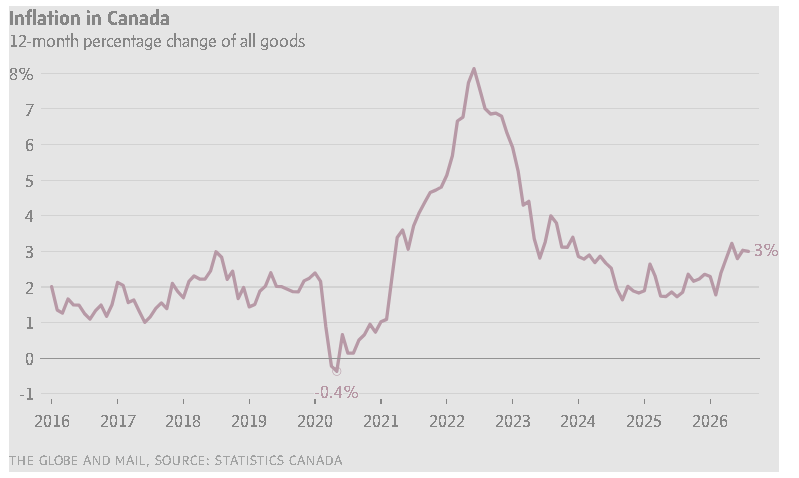
    Canada holds the unwelcome title of having the highest rate of food inflation in the G7. And while that’s putting added price pressure on Canadian consumers, a few key items are driving much of the pain.

    The annual rate of food inflation climbed by 7.3 per cent in January, according to numbers released this week by Statistics Canada, more than double the pace from six months ago.

    By far the biggest driver of annual price increases was the end of the tax holiday the former Trudeau government put in place for restaurants, snacks and other food items from mid-December, 2024 to mid-February, 2025.

    In the same way top-line food prices declined 0.6 per cent a year ago because of the tax holiday, the end of that break is having the reverse statistical effect now.

    But several grocery items are soaring in price for other reasons. After years of declining cattle herds, beef prices jumped 18.8 per cent in January from the year before, while low coffee yields pushed java prices up 29.8 per cent. (By comparison, in the U.S. beef increased 15 per cent and coffee jumped 18 per cent.)

    And because Statscan gives different weightings in calculating inflation that are proportional to the share of household spending on each item, those particular price increases matter a lot to overall food inflation.

    Think of it this way. If pestilence wiped out mushroom crops, supply shortfalls would make mushrooms a lot more expensive. But since households don’t spend all that much on mushrooms, even skyrocketing mushroom prices would do little to nudge the overall inflation needle.

    However, Canadians do spend a large share of their money dining out, or buying beef products and coffee, so rising prices for them have an outsized effect on food inflation.

    Of course, none of this changes the fact that shoppers are still experiencing sticker shock across grocery aisles – lettuce prices climbed 6.7 per cent, while soup was up 6.3 per cent.

    At least mushroom prices climbed less than 1 per cent.

  • Canadian retail sales down 0.4% in December, led by drop in vehicles, parts

    Canadian retail sales decreased by ‌0.4 per cent in December to $70-billion on a monthly basis, led by a drop in ⁠sales ​at motor vehicle and parts dealers, Statistics Canada said on Friday.

    Sales were down in three of the nine subsectors with the building ​materials category and furniture, ‌electronics and appliances retailers category also reporting a drop in sales. Sales at fuel pumps helped offset some of the fall, Statscan said.

    In volume terms, ‌retail sales ​were unchanged ‌in December.

    Retail sales, which include domestic sales ​of cars, furniture, food and gasoline, ⁠are considered an early indicator of gross ⁠domestic product growth and contribute around 40 per cent ​to total consumer spending.

    Core retail sales, which exclude gasoline stations and fuel vendors and the motor vehicle and parts dealers, were down 0.3 per cent in December.

    The motor vehicles ⁠and parts dealers’ category, which accounts for more than one-fourth of total retail sales, fell by 1.6 per cent to $18.71-billion.

    The second biggest contributor to retail sales is the ⁠food and beverage retailer category. Sales were ​unchanged in December in this subsector.

    Building materials ⁠dropped by 4 per cent and the furniture and appliances category registered ‌a 1.7-per-cent month-on-month drop.

    In January, sales were ​likely up 1.5 per cent but this number is likely to be updated next month, the agency said in a flash estimate.

  • Alberta to hold wide-ranging referendum in October, Danielle Smith says

    Premier Danielle Smith says Alberta will hold a referendum in October focused on wresting more control over immigration from the federal government and limiting access to education and health care for some newcomers – measures she argues are necessary as economic conditions in the province worsen.

    Ms. Smith announced the referendum, which she said would take place on Oct. 19, in a televised prime-time address on Thursday night.

    She said the referendum will also include questions about the possibility of negotiating with like-minded provinces on amendments to the Constitution. Albertans will be asked about their opinions on abolishing the federal Senate, giving permission to provincial governments to advocate for control over appointing members of the judiciary and allowing provinces to opt out of federal programs without losing the funding tied to them.

    “Although there are some politicians and commentators that fear direct democracy, such as referendums, I do not. I trust the judgment of Albertans,” Ms. Smith said in her televised remarks.

    “I know that as a province, we will thoughtfully ponder, debate and ultimately come to a wise decision on these questions.”

    Ms. Smith also warned of a large deficit that is expected to headline the provincial budget, which will be tabled next week.

    The United Conservative Party government’s referendum questions focus on two issues that have recently dominated Ms. Smith’s agenda: immigration and greater Alberta autonomy. Last summer, Ms. Smith convened a group to travel the province, holding town halls to gauge residents’ interest in how the provincial government could alter its relationship with Ottawa.

    That exercise informed the nine questions that will appear in the October vote, Ms. Smith said.

    The referendum exercise is happening at a time when Alberta and Ottawa have been working to resolve long-standing disputes between the two over resource development and environmental regulations − part of an effort to unite the country in response to tariffs and other U.S. trade threats. But any financial gains the province might realize from future resource projects remain distant.

    Despite the renewed spirit of co-operation between the two governments, Ms. Smith’s willingness to push back on Ottawa still has political purchase in her province.

    Amid a wave of Canada-wide unity, Alberta’s separatism movement pushes back

    Alberta could also be facing an independence question on the October ballot if a current citizen-led effort to collect the nearly 178,000 signatures required to force a vote succeeds.

    The movement captured headlines this year after independence leaders met with U.S. State Department officials, while some U.S. political officials have spoken publicly of the campaign. Immigration is one of the galvanizing topics behind the Alberta independence movement.

    Ms. Smith, on Thursday evening, described her immigration proposals as “a significant departure from the status quo” requiring consent from a majority of Albertans.

    It’s not yet clear whether the immigration referendum questions would be binding.

    The sweeping proposals would dramatically alter how, and if, services are delivered to certain immigrants in Alberta. One question asks if voters support mandating that only Canadian citizens, permanent residents and those with an “Alberta approved immigration status” should be eligible for provincially funded programs, including health and education.

    Another asks if residents support charging “a reasonable fee or premium” for health care and education to people with non-permanent immigration status living in Alberta.

    “The fact is, Alberta taxpayers can no longer be asked to continue to subsidize the entire country through equalization and federal transfers, permit the federal government to flood our borders with new arrivals, and then give free access to our most-generous-in-the-country social programs to anyone who moves here,” Ms. Smith said.

    The proposals mark a significant shift in thinking for the Premier who, as recently as two years ago, said her government was preparing to more than double Alberta’s population to 10 million by 2050.

    Droves of people have moved to Alberta over the past five years, from inside and outside Canada.

    Alberta’s population hit five million in 2025, up 14 per cent compared with the province’s headcount of 4.4 million in 2020, according to data compiled by the Alberta government, based on federal statistics.

    Net migration climbed sharply between early 2021, when it was essentially flat, to peak at around 58,649 in the third quarter of 2023. Since then, Alberta’s net migration has been on a slide. The province absorbed 37,625 migrants in the first three quarters of 2025, down 73 per cent compared with the 140,490 people who came to Alberta in the same timeframe in 2024.

    Just 197 international migrants landed in the province in the third quarter of 2025, a drop of 99 per cent compared with 32,046 in the same quarter in 2024.

    The significant growth was partly abetted by the province’s highly successful Alberta is Calling advertising campaign, which used billboards and transit ads across Canada, tax credits and promises of a lower cost of living in an effort to entice people to move there.

    The Premier described the potential program cuts to immigrants as her “short-term plan” as the province works to grow its Heritage Savings Trust Fund to $250-billion by 2050, with the goal of limiting Alberta’s reliance on resource revenues.

    Ms. Smith justified the proposed immigration changes as a way to deal with Alberta’s grim economic picture without drastic cuts to social services for all citizens. In November’s fiscal update, Alberta Finance Minister Nate Horner projected a $6.4-billion deficit.

    “To sum up our budget challenge – low oil prices combined with out-of-control federal immigration policies are together driving unsustainable budget deficits – not just here but across the country,” Ms. Smith said.

    Opinion: Alberta separatists should be careful what they wish for

    The Premier, in her fourth year leading the province, has long said she wants to see oil production in Alberta double by 2035 so it can pull in greater resource revenues, and last year major producers such as Suncor Energy Inc. and Cenovus Energy Inc. pumped record amounts of crude into the market.

    But the fact remains that Alberta’s economy remains at the whim of international commodity prices – no matter how many barrels are pumped from the ground. Provincial coffers take an approximately $750-million hit for every $1 drop in the price of oil.

    Benchmark oil prices fell by almost 20 per cent in 2025, the biggest annual loss since the height of the pandemic in 2020. And analysts expect weakened oil prices to drag through 2026 and perhaps into 2027.

    The U.S. Energy Information Administration said this month that it expects global benchmark oil prices to fall further in 2026 and remain under US$60 a barrel in 2027, in large part because of a massive global supply glut. It forecasts the price of West Texas Intermediate, the North American benchmark, to fall to US$53 this year and US$49 in 2027.

    Opinion: Saskatchewan shows Alberta how to handle a separatist threat seeking U.S. support

    Ms. Smith said her UCP government’s budget will cut “unnecessary bureaucracy,” improve efficiencies and prioritize “needs before wants.”

    Ms. Smith’s government has encouraged Albertans to take part in what she calls “direct democracy,” a type of governance – long used in Switzerland and some U.S. states including California – that allow residents to have a say on policy.

    The October referendum will be among the first to tackle consequential policy in Alberta. The first-ever policy-focused vote happened in 2021, when Albertans narrowly voted against year-round Daylight Saving Time.

    In that same referendum, 61 per cent of Alberta residents voted to remove equalization payments from the Canadian Constitution, but the vote was widely viewed as a political stunt because constitutional amendments require the support of at least seven provinces and 50 per cent of Canada’s population.