This is not a 50% tariff on all Canadian exports. It is an additional 50% duty on selected Canadian products worth roughly US$20 billion, including alcohol, dairy products, cement and hockey equipment. Major exports such as energy, potash, critical minerals and products already covered by separate Section 232 tariffs are excluded.
The United States has legitimate complaints about some Canadian trade barriers, particularly dairy supply management and restrictions affecting American alcohol and vehicles.
However, the 50% rate is economically excessive relative to the specific disputes. It taxes a much broader range of Canadian products than the industries at the centre of the complaints.
The tariff is paid initially by the U.S. importer, but the economic burden will be shared among American consumers, U.S. businesses and Canadian exporters.
The policy is best understood as negotiating pressure before August 19, rather than a carefully designed long-term trade policy.
What Trump Is Right About
Canada is not a completely open market.
Canada’s dairy supply-management system restricts imports through quotas and very high tariffs once those quotas are exceeded. Provincial removal of American alcohol from government-controlled distribution also substantially reduced U.S. sales. Canada has additionally imposed retaliatory measures against U.S. vehicles and other products.
These policies create real barriers for American producers. The United States is therefore justified in demanding negotiations and greater market access.
However, some Canadian restrictions were introduced in response to earlier U.S. tariffs. The dispute is therefore not simply Canada discriminating against innocent American exporters. It is an escalating cycle of tariff, retaliation and counter-retaliation.
Where Trump’s Argument Is Misleading
“Canada pays the tariff”
Canada does not directly pay the U.S. government.
The tariff is collected from the American company importing the Canadian product. That importer can:
Raise its selling price.
Accept a lower profit margin.
Demand a lower price from the Canadian supplier.
Replace the Canadian product with another supplier.
The actual cost is therefore divided between U.S. consumers, U.S. businesses and Canadian producers. Products with few substitutes will generate more U.S. price inflation; easily replaced products will cause more lost Canadian sales.
“The tariff protects all American workers”
Some U.S. producers may benefit from reduced Canadian competition. But other American businesses use Canadian inputs and will face higher costs.
For example, tariffs on Canadian cement may help some U.S. cement producers while increasing costs for American builders, infrastructure projects and homebuyers. Tariffs redistribute income between industries; they do not create a cost-free national benefit.
“The U.S. trade deficit proves Canada is cheating”
The U.S. goods deficit with Canada is heavily influenced by American imports of Canadian crude oil. The United States buys Canadian energy because its refineries and transportation system need it—not simply because Canada maintains unfair trade barriers.
The decision to exempt energy implicitly acknowledges this reality. A 50% tariff on Canadian oil would impose substantial costs on American refiners and consumers.
Economic Impact
Canada
The overall Canadian economy is unlikely to collapse because the affected trade is limited relative to total Canada–U.S. commerce and major energy exports are exempt.
The impact may nevertheless be severe for individual businesses and communities dependent on the affected products:
Lower export volumes
Reduced manufacturing output
Margin pressure
Delayed investment
Potential layoffs
Downward pressure on the Canadian dollar
The Canadian dollar weakened following the announcement, reflecting increased growth uncertainty and reduced expectations for higher Bank of Canada interest rates.
United States
The national inflation effect may be modest because the targeted imports are relatively limited. But prices could rise materially in affected categories.
U.S. companies may also face supply-chain disruption, contract renegotiations and increased administrative costs. These effects are particularly important where Canadian and American production is integrated.
Strategic Interpretation
The 50% tariff appears designed to maximize political pressure while limiting damage to essential U.S. industries.
Trump excluded Canadian energy and other strategically important commodities, while targeting highly visible products. The tariffs are also delayed until August 19, 2026, leaving time for negotiations. Canada and the United States have already agreed to intensify discussions aimed at averting implementation.
This suggests the primary objective is to extract concessions on:
Dairy market access
Alcohol distribution
Automobile trade
Canada’s retaliatory tariffs
The broader USMCA relationship
Bull, Base and Bear Outcomes
Scenario
Likely development
Economic effect
Bull
Canada and the U.S. reach a limited agreement; most tariffs are suspended
Canada offers selective concessions; some tariffs proceed while others are delayed or reduced
Concentrated exporter losses; modest Canadian GDP drag; limited U.S. inflation
Bear
Full tariffs take effect and Canada retaliates broadly
Weaker Canadian growth, higher North American prices and deeper supply-chain disruption
Bottom Line
Trump has a valid basis for challenging certain Canadian trade barriers. Canada protects dairy, restricts alcohol distribution and has retaliated against U.S. products.
But a 50% tariff is a blunt and disproportionate instrument. It will not be paid solely by Canada, and it will not produce gains without costs to American businesses and consumers. Its principal value to Trump is negotiating leverage, not economic efficiency.
The fairest conclusion is:
Canada has trade practices worth challenging, but the 50% tariff is an aggressive political bargaining tool that risks harming both countries. It may secure limited Canadian concessions, but a prolonged tariff regime would weaken integrated North American supply chains, raise selected U.S. prices and damage Canadian exporters more severely than the Canadian economy as a whole.
The final outcome remains dependent on negotiations before August 19, 2026.
The U.S. is imposing additional 50% tariffs on a range of Canadian goods, senior Trump administration officials said.
President Donald Trump signed three proclamations Monday targeting different sets of Canadian imports with the steep tariffs in response to alleged trade discrimination.
The tariffs, which fall under the rarely used Section 338 of the Tariff Act of 1930, are set to take effect 30 days after the signings, according to the officials.
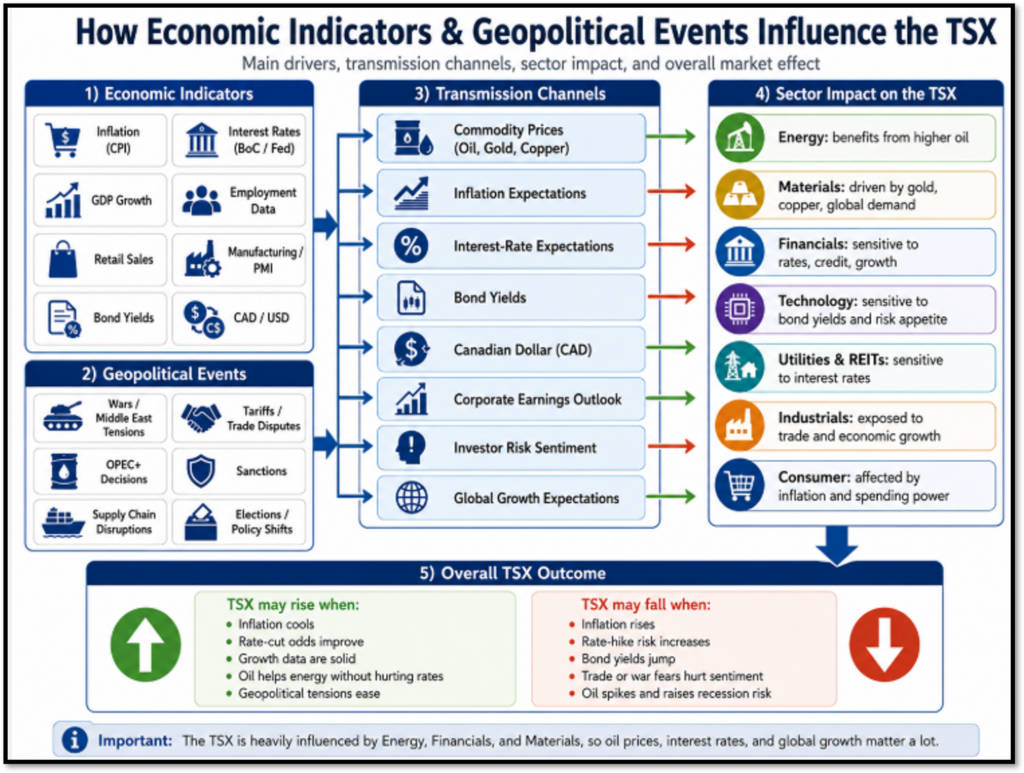
Canada’s June CPI on Monday is the principal scheduled TSX event. It will influence Bank of Canada rate expectations, bond yields, the Canadian dollar and rate-sensitive sectors.
Canada’s May retail-sales report on Thursday will provide the clearest reading on household spending and consumer-sector demand.
The U.S.–Iran conflict and Strait of Hormuz disruption are the largest unscheduled risks, particularly for oil, inflation, gold and overall market volatility.
The European Central Bank decision Thursday and global PMI data Friday could alter global bond yields and expectations for economic growth.
Canadian manufacturing, wholesale and producer-price indicators Friday will provide secondary evidence on tariffs, industrial activity and input-cost inflation.
Canada manufacturing and wholesale advance indicators
Medium–high
Industrials, autos, railways, banks
Canada new-home and construction price indexes
Medium
REITs, banks, building-material companies
1. Monday, July 20
Canada Consumer Price Index—June 2026
Statistics Canada is scheduled to release June CPI at 8:30 a.m. Eastern. It will also publish building investment, mineral-production, credit and energy-transportation data.
Potential TSX impact
CPI outcome
Likely market response
Potential sector effect
Below expectations
Bond yields and CAD may decline; rate-cut expectations increase
Positive for REITs, utilities, technology and discretionary stocks
Near expectations
Limited market reaction
Stock-specific factors dominate
Above expectations
Bond yields and CAD may rise; rate cuts pushed back
Negative for REITs, utilities, technology and leveraged consumers
High CPI caused mainly by oil
Energy benefits, but broader valuations pressured
Mixed TSX result
The important distinction will be between headline CPI and underlying inflation. An oil-driven headline increase may support TSX energy shares but still reduce the probability of future Bank of Canada easing.
China loan prime rates
Markets will assess whether China changes its benchmark lending rates. A rate reduction or stronger stimulus signal would generally support expectations for Chinese industrial demand.
TSX sensitivity:
Positive: copper, base metals, fertilizers, forestry and industrial exporters
Negative surprise: materials and China-sensitive cyclicals
U.S.–Iran conflict and Strait of Hormuz
The conflict intensified over the weekend after further U.S. strikes and Iranian attacks on Gulf-region targets. Shipping through the Strait of Hormuz has been disrupted, while oil prices have risen as the risk to regional energy infrastructure increases.
TSX transmission
Conflict escalation→higher oil→higher energy earnings
but also:higher oil→higher inflation→higher bond yields→lower equity multiples
Potential beneficiaries
Potential pressure
CNQ, SU, IMO and other producers
Airlines and transportation
Pipelines, depending on volume expectations
Consumer discretionary
Gold shares during safe-haven buying
Utilities and REITs if yields rise
Canadian dollar
Manufacturing companies with energy-intensive costs
This is likely to be the dominant geopolitical variable for the entire week.
2. Tuesday, July 21
U.S. regional employment and wage data
The U.S. Bureau of Labor Statistics is scheduled to release state employment and unemployment figures, along with second-quarter usual weekly earnings, at 10:00 a.m. Eastern.
These are not normally major TSX-moving releases, but an unexpected wage acceleration could reinforce inflation concerns and push U.S. Treasury yields higher.
TSX impact
Higher yields: negative for technology, REITs, utilities and gold
Strong employment: positive for economically sensitive companies, but potentially negative for rate-cut expectations
Weak employment: initially negative for growth expectations but potentially supportive for bonds and rate-sensitive stocks
Canada transportation data
Statistics Canada is scheduled to release public-transit and airport-activity information.
The direct market impact should be limited, but the figures may provide background evidence for passenger demand, urban activity and transportation trends.
3. Wednesday, July 22
U.S. Treasury bond auction
The U.S. Treasury is expected to auction US$13 billion of 20-year bonds Wednesday. Weak demand could lift long-term yields; strong demand could lower them.
Why it matters to the TSX
Long-duration equities are particularly sensitive to Treasury yields:
Shopify and other technology shares
Utilities
REITs
High-valuation consumer companies
Gold and precious-metal equities
A poorly received auction could pressure these sectors even without any change in company fundamentals.
U.S. petroleum inventories
Weekly EIA petroleum data will be watched closely because the normal inventory signal is currently interacting with Middle East supply disruption.
Inventory result
Likely implication
Large crude draw
Additional support for WTI and TSX energy
Large build
Could offset part of the geopolitical premium
Falling gasoline demand
Negative for refiners and demand expectations
Product shortages
Supportive for refining margins
The geopolitical situation may dominate ordinary inventory data if shipping conditions deteriorate materially.
4. Thursday, July 23
Canada retail sales—May 2026
Statistics Canada will release May retail trade at 8:30 a.m. Eastern, along with refined-petroleum and natural-gas statistics.
This is the week’s second-most important Canadian release after CPI.
Sector implications
Retail-sales result
Likely beneficiaries
Likely pressure
Strong headline and volume growth
CTC.A, LNR indirectly, banks and consumer discretionary
Defensive retailers may lag
Weak core retail sales
Dollarama and discount retailers may outperform relatively
Canadian Tire, apparel and discretionary retailers
Strong auto sales
Magna, Linamar and auto-related lenders
—
Weak gasoline volumes
Convenience retailers and refiners
Energy demand sentiment
The volume measure matters more than nominal sales. Higher sales caused only by price increases do not necessarily indicate stronger consumer demand.
European Central Bank decision
The ECB’s monetary-policy meeting and press conference are scheduled for July 23. Economists broadly expect no immediate change, but higher energy prices have increased the possibility of a later rate increase.
TSX impact
Hawkish ECB: global yields could rise; negative for technology, gold, utilities and REITs
Dovish ECB: supportive for global equities and precious metals
Strong euro reaction: may weaken DXY, potentially supporting gold and commodities
Energy-inflation emphasis: reinforces the Middle East–inflation risk
U.S. weekly jobless claims
Claims will provide a timely reading on the U.S. labour market ahead of the July 29 Federal Reserve decision.
A sharp rise in claims could support rate-cut expectations but also increase recession concerns. The TSX reaction would therefore depend on whether investors focus on lower yields or weaker growth.
5. Friday, July 24
Global flash PMIs
Preliminary July purchasing-managers’ indexes for the United States, eurozone and United Kingdom are expected Friday. These reports will provide an early reading on manufacturing, services, orders, employment and input-price pressures.
TSX sensitivity
PMI signal
Likely effect
Strong manufacturing and new orders
Positive for industrials, materials, energy and railways
Weak manufacturing
Negative for copper, steel, forestry and transportation
Strong services plus rising prices
Inflation concern; yields may rise
Weak services and manufacturing
Recession concern; defensive sectors may outperform
The input-price components will be particularly important because markets are already assessing higher oil costs.
U.S. new-home sales
June new-home sales are scheduled for 10:00 a.m. Eastern.
The TSX exposure is mainly indirect:
Forestry and lumber companies
Building-material suppliers
Railways
Canadian banks with U.S. exposure
Interest-rate-sensitive equities
Strong sales could support cyclical companies but also keep U.S. bond yields elevated.
Infrastructure margins and real-estate development
Rising raw-material prices are positive for commodity producers but negative for companies unable to pass costs through to customers.
Geopolitical Risks to Monitor All Week
1. Strait of Hormuz and broader Gulf conflict — highest risk
Watch for:
Further reductions in tanker traffic
Damage to oil, LNG, power or desalination infrastructure
Expansion into the Red Sea
U.S. or Iranian indications of negotiations
Strategic petroleum reserve releases
Insurance and freight-rate increases
TSX direction: positive for energy initially; negative for the broad index if oil inflation pushes yields sharply higher.
2. Canada–U.S. trade and USMCA uncertainty
The United States declined to extend the North American trade agreement during its formal review, while existing tariffs on Canadian autos, metals and lumber remain major points of dispute.
Exposed TSX groups
Magna and Linamar
Steel and aluminum producers
Forestry companies
Railways
Industrials
Canadian dollar
Banks through business-credit exposure
Any announcement of sector exemptions or negotiations would be positive. Additional tariffs or retaliatory measures would be negative.
3. OPEC+ supply response
OPEC+ approved an additional August production increase, while OPEC also reduced its 2026 oil-demand-growth forecast.
This creates opposing forces:More OPEC+ supply→lower oil pressure
versus:Hormuz disruption→higher oil pressure
The ability to transport oil may be more important than stated production targets while the strait remains disrupted.
Priority Ranking
Rank
Event or risk
Expected TSX relevance
1
U.S.–Iran conflict and Strait of Hormuz
Energy, inflation, gold and broad risk sentiment
2
Canada CPI—Monday
BoC expectations, yields, CAD and rate-sensitive sectors
3
Canada retail sales—Thursday
Consumer companies and banks
4
ECB decision—Thursday
Global yields, currencies and gold
5
Global PMIs—Friday
Materials, energy and industrial growth expectations
6
Canada producer/manufacturing data—Friday
Industrial margins and domestic activity
7
Canada–U.S. trade developments
Autos, metals, forestry and industrials
8
U.S. housing and labour indicators
Secondary yield and growth effects
Actionable Takeaways
The week’s TSX direction will likely depend on the interaction of three forces:Canadian inflation+Middle East oil risk+global bond yields
Energy could rise while the broader TSX falls if escalating conflict pushes both oil and bond yields higher.
A soft Canadian CPI report could support REITs, utilities, technology and consumer discretionary shares.
Weak retail sales would favour defensive staples relative to discretionary companies.
Friday’s PMI and Canadian producer-price data will show whether higher energy costs are beginning to weaken growth while raising inflation.
830 am ET: Canadian consumer price index for June. Consensus is for a decline of 0.2% from May and a rise of 3% from a year earlier
830 am ET: Canadian construction investment for May
830 am ET: Canadian household credit
10 am ET: U.S. leading indicator for June
Earnings include: Domino’s Pizza Inc.; Steel Dynamics Inc.
Tuesday July 21
UK employment data and Germany business conditions survey
815 am ET: U.S. ADP employment report
Earnings include: Capital One Financial Corp.; Charles Schwab Corp.; General Motors Co.; Halliburton Co.; Hasbro Inc.; Interactive Brokers Group Inc.; Novartis AG; 3M Co.
Wednesday July 22
UK inflation data for June
Earnings include: Alphabet Inc.; AT&T Inc.; Choice Properties REIT; CSX Corp.; Kinder Morgan Inc.; Phillip Morris International Inc.; Rogers Communications Inc.; Tesla Inc.; Texas Instruments Inc.; Waste Connections Inc.
Thursday July 23
7 am ET: CFIB Business Barometer
815 am ET: ECB monetary policy announcement
830 am ET: Canadian retail sales for May. Consensus is for a rise of 1%. An advance estimate for June will also be released
830 am ET: U.S. weekly initial jobless claims
Euro area consumer confidence survey
Earnings include: American Airlines Group Inc.; Blackstone Inc.; Cenovus Energy Inc.; FirstService Corp.; Freeport-McMoran Copper & Gold Inc.; Honeywell International Inc.; Intel Corp.; Lockheed Martin Corp.; Newmont Corp.; Norfolk Southern Corp.; Ovintiv Inc.; RTX Corp.; Teck Resources Ltd.; T-Mobile US Inc.; Union Pacific Corp.; Winpak Ltd.
Friday July 24
Japan inflation data and PMIs
Euro area PMIs and consumer confidence reports
830 am ET: Canada industrial product price index and raw materials price index for June.
830 am ET: Canadian manufacturing sales for June
830 am ET: Canadian wholesale trade for June
830 am ET: Canadian new housing price index for June. It’s expected to be down 0.3% on a monthly basis, or a decline of 2.5% on an annual basis.
945 am ET: S&P global PMIs
10 am ET: U.S. new home sales
Earnings include: American Express Co.; Canadian National Railway Co.; Exxon Mobil Corp.; NextEra Energy Inc.; Verizon Communications Inc.
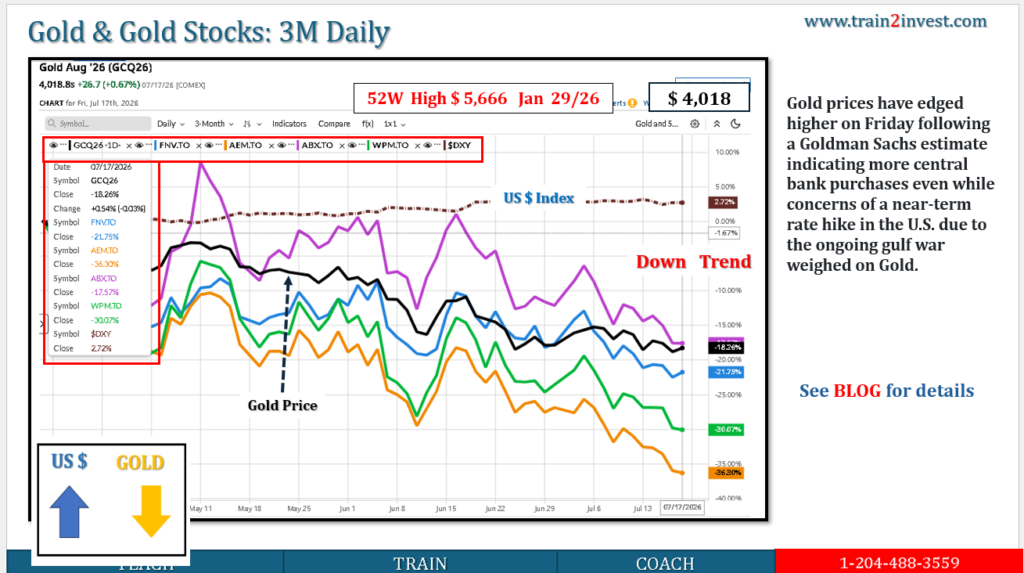
Gold fell 2.23% over the five trading days ended July 17, 2026, closing at approximately US$4,012.70 per ounce.
The U.S. Dollar Index was slightly lower, falling from roughly 100.95 to 100.76. Gold therefore declined despite a softer dollar.
Gold equities fell more than bullion: approximately FNV –3.3%, ABX –5.7%, WPM –6.3% and AEM –7.7%.
The main pressure came from higher-for-longer interest-rate expectations, rising oil-related inflation concerns, analyst target reductions and profit-taking.
A stronger Canadian dollar also reduced the CAD value of U.S.-dollar gold revenue, creating an additional headwind for TSX-listed producers.
Five-Day Performance: July 13–17, 2026
Asset
July 10
July 17
Approx. change
Gold futures
US$4,104/oz
US$4,012.70/oz
–2.23%
U.S. Dollar Index—DXY
100.95
100.76
–0.2%
Franco-Nevada—FNV.TO
C$290.92
About C$281.30
–3.3%
Barrick Mining—ABX.TO
C$51.90
C$48.92
–5.7%
Wheaton Precious Metals—WPM.TO
C$155.83
C$145.96
–6.3%
Agnico Eagle—AEM.TO
C$207.94
C$191.93
–7.7%
Gold’s weekly result and Friday close are confirmed by commodity-market data. The individual equity figures are based on available historical closing-price records; FNV’s July 17 figure should be treated as approximate because public sources displayed inconsistent intraday and closing data.
1. Gold Price
Why gold declined
Gold started the week near US$4,100 per ounce, weakened materially Wednesday and Thursday, then recovered modestly Friday.
The key decline occurred Thursday, when gold fell about 2%. Escalating U.S.–Iran tensions pushed oil prices higher, which increased concern that energy inflation could keep U.S. interest rates elevated.
Ordinarily, geopolitical conflict supports gold through safe-haven demand. During this week, however, the market focused more heavily on the inflation and interest-rate consequences:Higher oil→higher inflation risk→higher expected interest rates→pressure on gold
Gold pays no interest. When government-bond yields remain high, the opportunity cost of holding gold increases.
U.S. gold futures settled at US$4,051.80 on Wednesday, before falling further Thursday. Gold then gained approximately 0.7% Friday, but the rebound was insufficient to reverse the weekly loss.
Why geopolitical tension did not lift gold
The geopolitical effect was contradictory:
Effect
Gold implication
Safe-haven demand
Positive
Higher oil and inflation expectations
Negative
Higher expected interest rates
Negative
Market risk reduction
Potentially positive
Profit-taking after the previous gold rally
Negative
During this five-day period, the negative interest-rate and positioning effects outweighed safe-haven buying.
2. U.S. Dollar Index—DXY
DXY was broadly stable to slightly lower. It began the period near 100.95, rose to approximately 101.24 Monday, and ended close to 100.76 Friday.
Why the dollar weakened
Softer-than-expected U.S. inflation data reduced expectations for another Federal Reserve rate increase. This lowered the relative interest-rate support available to the dollar.
At the same time, geopolitical tensions created some safe-haven demand for U.S. dollars. The two forces largely offset each other:Lower Fed expectations→weaker dollar
butGeopolitical risk→safe-haven dollar demand
The result was a relatively small weekly DXY movement.
Why gold fell even though DXY weakened
Gold and the U.S. dollar frequently move inversely, but this is not a fixed mathematical relationship.
This week:
DXY declined only modestly.
Real and nominal interest-rate concerns remained elevated.
Oil-related inflation fears increased.
Investors continued reducing precious-metals exposure.
Therefore, the interest-rate and positioning effects were stronger than the small positive effect of a softer dollar.
3. Franco-Nevada—FNV.TO
FNV declined approximately 3%–4%, less than the major gold producers.
Why FNV held up better
Franco-Nevada is a royalty and streaming company, not a conventional mine operator. It provides capital to mining companies in exchange for a percentage of future production or revenue.
It has limited direct exposure to:
Mine operating costs
Labour inflation
Fuel costs
Equipment costs
Mine construction overruns
Daily mine-management problems
That generally gives FNV lower operating leverage than Barrick or Agnico Eagle.
The stock still fell because lower gold prices reduce the expected value of future royalty revenue. But the royalty model helped limit the decline relative to the producers.
FNV closed around C$290.92 on July 10 and traded near the low-C$280s by the end of the week.
4. Barrick Mining—ABX.TO
ABX declined from C$51.90 to C$48.92, a loss of approximately:51.9048.92−51.90×100=−5.74%
Why Barrick underperformed gold
Barrick has operating leverage to gold:Operating profit per ounce=gold price−production cost
Illustrative example:
Assumption
Before decline
After decline
Gold price
US$4,100
US$4,010
Production cost
US$1,700
US$1,700
Margin per ounce
US$2,400
US$2,310
Margin change
—
–3.8%
A roughly 2.2% gold decline can therefore produce a larger percentage reduction in expected operating profit.
Barrick is also exposed to:
Political and permitting risk
Mine-development risk
Copper-price exposure
Capital expenditures
Production guidance
Cost inflation
Those factors explain why ABX fell substantially more than bullion.
5. Wheaton Precious Metals—WPM.TO
WPM fell from C$155.83 to C$145.96, a decline of approximately:155.83145.96−155.83×100=−6.33%
Why WPM fell more than FNV
Wheaton is also a streaming company, but its revenue has meaningful exposure to silver as well as gold.
Silver declined approximately 6.3% during the week, substantially more than gold.
Therefore, WPM faced two commodity pressures:
Lower gold prices
A much sharper silver-price decline
WPM’s higher sensitivity to silver helps explain why it underperformed Franco-Nevada despite both having royalty-and-streaming models.
6. Agnico Eagle—AEM.TO
AEM declined from roughly C$207.94 to C$191.93, a loss of approximately:207.94191.93−207.94×100=−7.70%
Why AEM experienced the largest decline
AEM faced both sector-wide and company-specific pressure.
Gold-price leverage
As a major operating producer, AEM’s earnings and cash-flow expectations are sensitive to changes in gold prices.
Barnat mine concern
Agnico previously reported a rock-mass movement at the Barnat open pit. Although this was not necessarily a new development during the five-day period, it remained an operational uncertainty affecting market sentiment.
Analyst target reductions
Several analysts reduced their AEM price targets during the period or immediately around it, largely reflecting lower commodity-price forecasts and mine-specific assumptions. The ratings were often maintained, but lower targets reinforced short-term selling pressure.
A target reduction does not directly reduce the company’s cash flow. It can, however, influence investor positioning when it confirms that analysts are using lower gold-price assumptions.
Canadian-Dollar Effect
The Canadian dollar gained approximately 1% against the U.S. dollar during the week, reaching about US$0.7135, or C$1.4015 per U.S. dollar.
Gold is priced internationally in U.S. dollars. For a TSX-listed gold company:CAD gold price=USD gold price×USD/CAD exchange rate
If gold falls in U.S. dollars and the Canadian dollar strengthens, the decline in Canadian-dollar gold revenue is amplified.
Illustrative example:
Variable
Start
End
Gold
US$4,104
US$4,013
USD/CAD
1.4125
1.4015
Implied CAD gold
C$5,798
C$5,624
Approximate decline
–3.0%
Thus, although U.S.-dollar gold fell about 2.2%, its implied Canadian-dollar value declined closer to 3%.
That created an additional headwind for FNV, ABX, WPM and AEM on the TSX.
Gold producer plus operational and analyst concerns
–7.7%
The ordering is economically consistent:bullion→royalty company→operating miners
Operating mining shares normally move more than the underlying commodity because their earnings contain operational and financial leverage.
Scenarios
Scenario
Gold and equities implication
Bull
Lower bond yields, weaker DXY and easing oil inflation allow gold to recover above US$4,100; miners likely outperform bullion
Base
Gold consolidates around US$3,950–US$4,100; royalty companies remain more stable than producers
Bear
Higher oil, persistent inflation and renewed rate-hike expectations push gold below US$3,950; producers remain the most vulnerable
What Would Disprove This Interpretation?
The interest-rate thesis would weaken if:
Bond yields decline materially but gold continues falling.
DXY weakens significantly without a gold recovery.
Gold stabilizes while AEM, ABX and WPM continue declining sharply.
Mining companies report new production, cost or balance-sheet problems.
In those circumstances, company-specific operational and valuation concerns would be more important than the gold price itself.
Actionable Takeaways
Gold declined despite a modestly weaker DXY because interest-rate and inflation concerns dominated the currency effect.
Gold equities amplified bullion’s decline because of operating leverage and the stronger Canadian dollar.
FNV was relatively defensive because it does not operate mines.
WPM was additionally affected by silver’s sharp decline.
AEM experienced the greatest pressure, reflecting gold weakness, analyst target cuts and continuing mine-specific uncertainty.
A sustainable recovery would likely require some combination of lower bond yields, softer oil-driven inflation, a weaker dollar and stabilization above US$4,000 gold.