
- U.S. Vice President JD Vance said “great progress” was made in peace talks with Iran over the weekend.
- Mediators Qatar and Pakistan said U.S. and Iranian officials had agreed on a roadmap aimed at reaching a final deal within 60 days.
Category: Uncategorized
-
Oil prices fall after Vance says U.S. and Iran made progress in peace talks
-
Treasury Department authorizes Iranian oil sales through August
- The U.S. Treasury Department has authorized the production, delivery and sale of Iranian oil for 60 days.
- Treasury Secretary Scott Bessent said the authorization comes after “productive talks” between Tehran and Washington in Switzerland.
- The U.S. Navy last Thursday lifted its blockade of Iran’s ports and coastal areas.
The U.S. on Monday authorized Iranian oil sales through August after “productive talks” between Tehran and Washington in Switzerland over the weekend, Treasury Secretary Scott Bessent said.
“As part of the framework, Treasury has issued a temporary 60-day general license authorizing the production, delivery, and sale of Iranian oil,” Bessent said in a post on X. The authorization expires August 21, unless its renewed.
Vice President JD Vance said earlier Monday that “great progress” was made during the talks in Switzerland, despite Iran’s declaration over the weekend that it had closed the Strait of Hormuz. U.S. Central Command said Hormuz had not been closed.
Vance said Iran agreed to allow weapons inspectors from the International Atomic Energy Agency back into the Islamic Republic, while Bessent said Tehran had also committed to free and open transit through Hormuz.
The U.S. Navy last Thursday lifted its blockade of Iran’s ports and coastal areas. Iranian supertankers have switched on their transponders, after going dark during the war, as they depart the Persian Gulf loaded with oil.
Iran typically loaded more than 1.5 million barrels per day (bpd) for export before the U.S. imposed its blockade in April, with most of that oil going to China. Loadings declined to just 260,000 bpd in May as the blockade took hold.
Ship traffic through Hormuz plunged during the war as Iran attacked vessels, triggering the largest oil supply disruption in history. About 20% of global crude supplies were exported through the strait before the war.
Traffic has since increased after the U.S. and Iran signed a memorandum of understanding on June 17. Transits rose sharply to 35 on Saturday before declining to 17 crossings on Sunday amid confusion over whether the strait was open or closed due to Iran’s threats, according to data from Kpler.
Traffic remains far below prewar levels, when more than 100 vessels transited Hormuz daily.
Iran must allow ships to transit Hormuz toll free for 60 days under the agreement with the U.S. After that, Tehran is supposed to discuss with Oman and the Gulf states how the strait will be administered, leaving open the possibility that tolls could be imposed later.
-
Canada’s inflation rate rises to 3.2% in May, highest in more than two years
Canada’s annual inflation rate in May accelerated more than expected to 3.2 per cent, a 29-month high, data showed on Monday, as the impact of higher crude oil prices due to the Iran conflict continued to filter through gasoline costs.
Analysts polled by Reuters had estimated the annual inflation rate to touch 3 per cent in May, up from 2.8 per cent in April.
The prices, however, are already showing a major reversal in June after an interim peace deal was signed between the United States and Iran last week, which, analysts have said, could help ease the headline number in June.
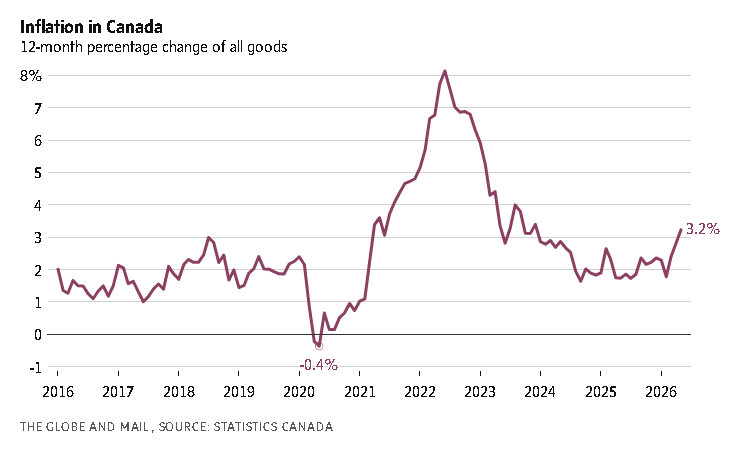
Statistics Canada said excluding the impact of gasoline prices, the consumer price index still posted a higher increase of 2.2 per cent in May from 2 per cent in April led by elevated cost of food, recreation and alcoholic beverages.
The monthly inflation rate rose to 1 per cent in May, exceeding expectations of 0.8-per-cent rise. This is the highest monthly rise in 15 months.
Gasoline prices in May rose by 33.2 per cent on a year-over-year basis. Consumers in May shelled out more for gasoline than from its previous peak four years ago when Russia invaded Ukraine, Statscan said.
This led to an increase in the cost of transportation, which accounts for almost 18.5 per cent of the CPI basket, posting a 9-per-cent annual increase last month.
The inflation number is not likely to alter Bank of Canada’s assessment of underlying inflation as it said earlier this month that it was seeing limited evidence higher energy prices were fuelling broad-based inflation.
Cost of food, which also contributes around 17 per cent of the CPI basket, rose 3.8 per cent in May from 3.5 per cent in April, Statscan said, adding that this was fuelled by an increase in prices of fresh fruits and vegetables which rose by 5.3 per cent and 9 per cent respectively in May.
The impact of higher transportation and food prices were largely offset by shelter costs, the biggest contributor to the CPI basket at close to 30 per cent. Shelter costs rose by 1.7 per cent in May following a 1.8-per-cent increase in April, data showed, especially led by a reduction in mortgage costs which shrunk by 0.2 per cent last month.
The closely tracked measure of core inflation stayed unchanged in May.
CPI-median, the centremost component of the CPI basket, was at 2.1 per cent, while CPI-trim, which excludes the most extreme price changes, was at 2 per cent.
-
AI response to the question: list provinces debt and equalization receipts for 2025
Data gap: the provided search results confirm 2025–26 federal transfer/equalization sources, but do not provide a full province-by-province debt table. The only visible debt-related source is TD’s 2025/26 provincial budget table snippet, but it shows only partial rows. [6]
Province 2025 Equalization receipt 2025/26 debt / budget data visible in provided sources Alberta Not shown in provided results Not shown British Columbia Not shown Not shown Manitoba Receives Equalization, amount not shown in snippets Budget balance: -$1.66B, -1.7% of GDP [6] New Brunswick Receives Equalization, amount not shown Not shown Newfoundland & Labrador Not shown Not shown Nova Scotia Receives Equalization, amount not shown Not shown Ontario Equalization status/amount not shown Budget balance: -$13.5B, -1.1% of GDP [6] Prince Edward Island Receives Equalization, amount not shown Not shown Quebec Receives Equalization, amount not shown Budget balance: -$9.9B; % GDP not visible [6] Saskatchewan Not shown Budget balance: -$427M, -0.4% of GDP [6] Canada’s total Equalization envelope was $25.3B in 2024–25, and major federal transfers to provinces/territories total $108.4B in 2025–26. [4] [1]
🌐 Sources
- canada.ca – Major federal transfers
- canada.ca – Monthly payments made to provinces and territories
- facebook.com – Canadian equalization dollars by province
- lop.parl.ca – Canada’s Equalization Formula
- wikipedia.org – Equalization payments in Canada
- economics.td.com – Canada: Gearing Up for Provincial Budget Season
Equalization receipts (payments) for Canadian provinces in 2025-26 (in $ millions CAD).
These are federal unconditional transfers to “have-not” provinces to enable comparable public services at comparable tax rates. Data is for the 2025-26 fiscal year (from official sources/Wikipedia compilation based on Dept. of Finance Canada). Alberta, British Columbia, and Saskatchewan receive $0.
- Quebec: 13,567
- Manitoba: 4,689
- Nova Scotia: 3,465
- New Brunswick: 3,123
- Prince Edward Island: 666
- Ontario: 546
- Newfoundland and Labrador: 113
- Alberta: 0
- British Columbia: 0
- Saskatchewan: 0
- Total: ~26,170
Notes on equalization: Total program ~$26.2 billion. Quebec receives the largest share due to population size. Payments are calculated based on fiscal capacity (tax bases like income, business, consumption, property, and partial natural resources) relative to a 10-province standard, with adjustments for stability and GDP growth.
Provincial (and combined federal-provincial) net debt for 2025/26:
Exact absolute provincial net debt figures for the end of 2025-26 are projections and vary by source (e.g., provincial budgets, RBC Economics, Fraser Institute). Comprehensive per-province absolute net debt tables are often in detailed fiscal reports or PDFs rather than single web pages, but here is a summary based on available 2025/26 projections and analyses:
- Provincial net debt-to-GDP ratios (approximate, from TD Economics and related analyses for FY 2025/26): Alberta lowest (~8-9%), followed by Saskatchewan (~15%), BC (~26%), etc. Higher in Atlantic provinces and Manitoba/Ontario/Quebec (~35-45%+).
- Combined federal + provincial net debt-to-GDP (Fraser Institute 2026 Edition projections for 2025/26): Manitoba highest (~91%), Alberta lowest (~43%). Combined per-person debt ranges from ~$42k in Alberta to ~$72k in Newfoundland & Labrador.
- Overall trend: Combined federal-provincial net debt projected around $2.44 trillion in 2025/26 (inflation-adjusted nearly doubled since 2007/08). Provincial debt has grown but varies significantly; “have” provinces like Alberta generally have lower debt burdens relative to GDP.
For the most precise/current absolute provincial net debt numbers, check individual provincial budgets/public accounts or consolidated sources like RBC Fiscal Tables or Statistics Canada. Debt figures are often reported as of fiscal year-end (March 31) and include projections.
Equalization data is firm for 2025-26; debt data is more variable as it depends on final audited figures and projections. Let me know if you need per-capita breakdowns, historical comparisons, or details for a specific province!
-
CRA records show temporary residents received $1.35 billion in child benefits over four years

Canada Revenue Agency records reveal that temporary residents received $1.35 billion in child benefit payments over a four-year period. The 2023 data indicates these payments exceeded the $3…
-
U.S.-Iran nuclear talks begin in Switzerland
U.S. Vice President JD Vance said Sunday there was an opportunity to “turn over a new leaf” with Iran as the sides launched talks aimed at building out the interim deal to end the war in Iran reached by the two sides last week.
Vance is holding talks with Iran’s parliamentary speaker, Mohammad Bagher Qalibaf, and Foreign Minister Abbas Araghchi, at a Swiss mountainside resort near Lake Lucerne. Mediators from Pakistan and Qatar were also in the room for the direct engagement.
The U.S. is looking to get Iran locked into negotiations over its nuclear program amid concerns it may be used for military purposes, which Iran denies. Vance also wants to push Tehran to commit to keeping open the Strait of Hormuz, the critical waterway through which about a fifth of world traded oil passes.
But the on-again, off-again conflict in Lebanon, between Israel and Iranian-backed Hezbollah militants, continues to threaten to derail the effort for the U.S. to win concessions from Tehran on its nuclear program and keep the Strait of Hormuz open.
“The question before us now is how much more can we accomplish together? Can we turn over a new leaf?” Vance said in brief comments as the talks, dubbed the “Lake Lucerne Summit,” got under way.
“Can we change relations in the Middle East permanently, or do we go back to doing things the old way, which is not our preference, but is certainly very much something that can happen.”

Iran’s Foreign Minister Abbas Araqchi shakes hands with Pakistan’s Prime Minister Shehbaz Sharif.Fabrice Coffrini/Reuters Iran’s main focus during negotiations on Sunday would be the ongoing war between Israel and Hezbollah in Lebanon, Iranian Foreign Ministry spokesman Esmail Baghaei told Iran’s state news agency ahead of the meeting with Vance.
The interim agreement was signed last week, and now top American and Iranian negotiators are in a 60-day sprint to reach an agreement on the technical details that hold massive implications for the world economy and global security.
Yet only days after signing the agreement, it is being stress-tested after fighting escalated in Lebanon between Israel and the Iranian-backed militant group Hezbollah – and by the subsequent announcement by Iran’s military that it had again closed the vital waterway that transits one-fifth of the world’s traded oil and natural gas. A renewed ceasefire in Lebanon, brokered on Saturday, appeared to be holding.

The convoy carrying U.S. officials, including Vice-President JD Vance, arrives at the Buergenstock resort in Switzerland on Sunday.URS FLUEELER/Reuters Vance stressed that “great progress” had been made on Lebanon. But minutes after he was finished speaking, President Donald Trump took to social media to threaten Iran if it didn’t rein in Hezbollah.
“If they don’t, we’ll hit Iran very hard again, just like we did last week, only harder!!!” Trump wrote.
Iran is cautiously approaching the talks given its previous experience with the U.S. negotiations on the nuclear issue, which twice in the past year have been interrupted by massive military strikes against the country. “The implementation of any document is more important than its signing,” Baghaei said Sunday.
Iran’s president added that Iran will maintain its right to a nuclear program.
“What is certain is that we will never back down from the right to enrich uranium, and the other side is also forced to accept it,” Iranian President Masoud Pezeshkian said Sunday, according to Iran’s state media.

Mr. Vance is joined by Special Envoy Steve Witkoff and U.S. President Donald Trump’s son-in-law Jared Kushner.Pool/Getty Images Vance had originally been slated to be on the ground at the Bürgenstock resort near Lucerne on Friday, but his departure from the United States was delayed after fighting escalated in Lebanon and Iranian officials cancelled plans to attend the talks.
U.S. Central Command disputed Iran’s claim that it had once again shuttered the strait and said U.S. forces continued to monitor the situation to ensure traffic continues to flow through the waterway. Vance has said that millions of barrels of oil have moved through the strait in recent days.
Vance departed the U.S. just after Iranian state TV said Iran’s negotiators had arrived in Switzerland.
The vice president was joined by special envoy Steve Witkoff and Jared Kushner, Trump’s son-in-law, for Sunday’s talks. Witkoff and Kushner were on the ground in Switzerland ahead of Vance to begin sifting through the technical details of the nuclear talks.
Vance and his wife, second lady Usha Vance, arrived at Emmen Air Base outside Lucerne just before 6 a.m. local time, according to his office.
While Vance said he planned to be in Switzerland for just “a day or two,” leaving much of the detailed negotiations to be spearheaded by Witkoff and Kushner, his role in the talks has heightened scrutiny of the vice president at a time when he’s actively considering a 2028 presidential campaign.

Cargo vessels remain anchored off the coast of Oman near the Strait of Hormuz on Saturday. Mr. Trump threatened levy U.S. tolls on vessels passing through the strait if there is no deal with Iran in 60 days.Getty Images/Getty Images Trump and Vance have come under searing criticism from parts of their own party for the deal, with Republican hard-liners unfavourably likening it to a nuclear agreement signed by the Obama administration that Trump and the GOP have insisted did nothing to actually terminate Iran’s nuclear program.
The agreement signed by Trump and Iranian President Pezeshkian immediately allows Tehran to sell its oil freely and paves the way for Iran to tap into billions of dollars in assets that are currently frozen. It also calls for Iran to dilute its stockpile of highly enriched uranium, believed to be buried under nuclear sites that were targeted in U.S. strikes last summer.
The agreement says commercial vessels can pass through the Strait of Hormuz for 60 days without a charge, but does not preclude future fees imposed by Iran. Trump made his own threat on Saturday to levy U.S. tolls on the strait if there is no deal with Iran in 60 days, insisting in a social media post that the money would be for “services rendered as the Guardian Angel to the countries of the Middle East.”
The Trump administration has been working to reassure global markets that the Iran war has been merely a blip on oil prices, as Americans complain the conflict resulted in hiking gasoline prices ahead of peak summer travel months. After the White House announced the deal a week ago, oil futures dropped almost 8 per cent – and markets are expected to closely track the progress of talks when they open for trading on Sunday evening.
Further complicating matters, neither Israel nor Hezbollah is a signatory to the deal between the U.S. and Iran, and Israeli Prime Minister Benjamin Netanyahu has vowed to keep his forces in southern Lebanon until any threat to Israel is eliminated. Hezbollah has refused to halt its attacks unless Israel commits to withdrawing from Lebanon.
-
Linamar Corp (LNR.TO)
Summary — LNR.TO 10D Performance
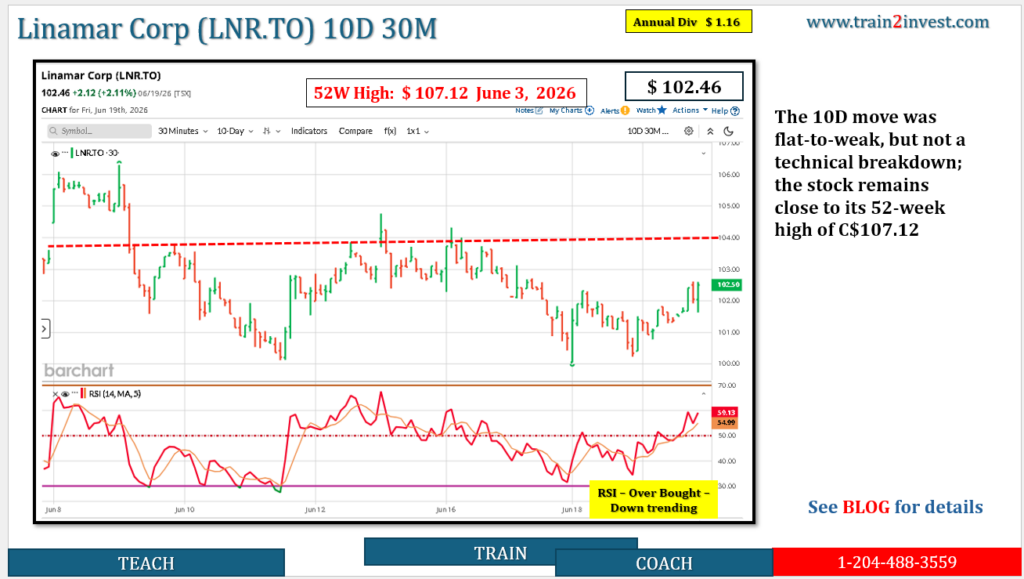
- Linamar (LNR.TO) closed at C$102.46 on June 19, 2026, up +2.11% on the day.
- Over the last 10 trading days, LNR.TO was down about -0.95%; it fell in 6 of the last 10 sessions.
- From the June 5 close of C$103.44 to June 19 close of C$102.46, the stock declined C$0.98 / -0.95%.
- The 10D move was flat-to-weak, but not a technical breakdown; the stock remains close to its 52-week high of C$107.12.
- LNR.TO modestly outperformed MG.TO, which was down about -1.13% from June 8 to June 19 based on the prior review.
Data & Evidence
Measure LNR.TO June 5 close C$103.44 June 19 close C$102.46 10D price change -C$0.98 10D % change -0.95% Days down in last 10 6 of 10 June 19 daily move +2.11% 52-week high C$107.12 Distance from 52-week high -4.35% Key Drivers
Macro: LNR.TO is exposed to cyclical manufacturing, autos, agriculture equipment, access equipment, and global industrial demand. The stock is sensitive to rates, tariffs, vehicle-production expectations, and general risk appetite.
Sector: The performance was similar to Magna: choppy and sideways after a strong prior advance. The stock did not sell off materially, but it failed to extend above the C$103–107 area.
Company: Linamar’s own investor materials show Q1 2026 as “record sales and earnings” and highlighted strong cash flow while navigating tariff challenges. The company also maintained its 2026 outlook after assessing Section 232 tariff changes.
Technical Read
Level Interpretation C$100–101 Near-term support; June 19 intraday low was around C$100.41. C$102–103 Current trading zone. C$107.12 52-week high / resistance zone. Below C$100 Would weaken the short-term setup. Scenarios
Scenario 10D Interpretation Bull Break above C$107 confirms renewed momentum after consolidation. Base Trades sideways in the C$100–107 range while investors wait for tariff, auto, and industrial-demand clarity. Bear Break below C$100 signals profit-taking after the prior rally and could pull the stock toward the mid-C$90s. Actionable Takeaways
LNR.TO’s 10-day move was slightly negative but resilient. The important point is not the -0.95% move; it is that the stock remains near a 52-week high despite tariff concerns. Watch C$100 support and C$107 resistance. A break above C$107 would be constructive; a break below C$100 would suggest the recent rally is losing strength.
-
Magna International Inc (MG.TO):
Summary — MG.TO 10D Performance
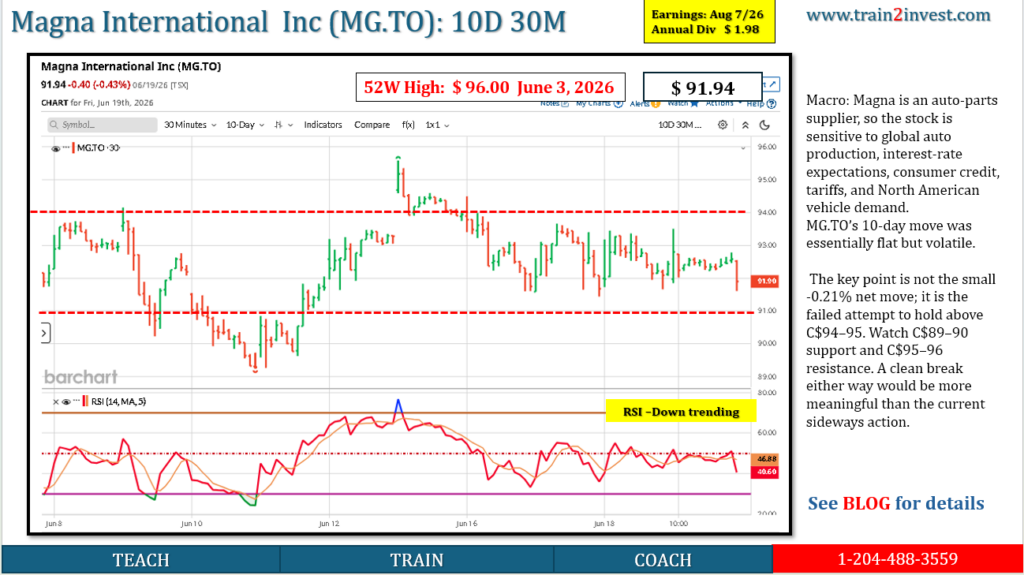
- Magna International (MG.TO) closed at C$91.94 on June 19, 2026, down C$0.40 / -0.43% on the day.
- Over the last 10 trading sessions, using June 5 close to June 19 close, MG.TO was down C$0.19 / -0.21%.
- Using June 8 to June 19 close, the stock was down C$1.05 / -1.13%.
- The stock was volatile: it fell -3.07% on June 10, rebounded +2.61% on June 11, and dropped -2.26% on June 16.
- Performance was broadly flat-to-weak, underperforming TTCD, which was slightly positive over the same period.
MG.TO — Daily Price Action
Date Close Daily Change Jun 19 C$91.94 -0.43% Jun 18 C$92.34 +0.69% Jun 17 C$91.71 0.00% Jun 16 C$91.71 -2.26% Jun 15 C$93.83 +0.67% Jun 12 C$93.21 +1.69% Jun 11 C$91.66 +2.61% Jun 10 C$89.33 -3.07% Jun 9 C$92.16 -0.89% Jun 8 C$92.99 +0.93% Jun 5 C$92.13 -2.72% Historical table source: StockAnalysis / S&P Global Market Intelligence.
Key Drivers
Macro: Magna is an auto-parts supplier, so the stock is sensitive to global auto production, interest-rate expectations, consumer credit, tariffs, and North American vehicle demand.
Sector: The move looks more like consolidation after a prior rally, not a fresh breakdown. MG.TO rose strongly in May, then traded sideways through early/mid-June.
Company: Magna reported stronger Q1 2026 results, with sales up 3% YoY to US$10.4B and adjusted EPS above consensus, but Reuters also noted tariff costs and market uncertainty, with Magna trimming its full-year sales outlook to US$41.5B–US$43.1B.
Technical Read
Level Interpretation C$89–90 Near-term support from June 10 low area C$92–94 Current trading band C$95–96 Near-term resistance from June 3 / June 15 highs Scenarios
Scenario 10D Read Bull Breaks above C$95–96, suggesting buyers are willing to pay up after consolidation. Base Holds C$90–94, range-bound while investors wait for auto demand and tariff clarity. Bear Breaks below C$89, pointing to renewed concern over margins, vehicle production, or sector rotation. Actionable Takeaways
MG.TO’s 10-day move was essentially flat but volatile. The key point is not the small -0.21% net move; it is the failed attempt to hold above C$94–95. Watch C$89–90 support and C$95–96 resistance. A clean break either way would be more meaningful than the current sideways action.
-
Canadian Tire Corp (CTC-A.TO):
Summary — CTC.A.TO 10D Performance
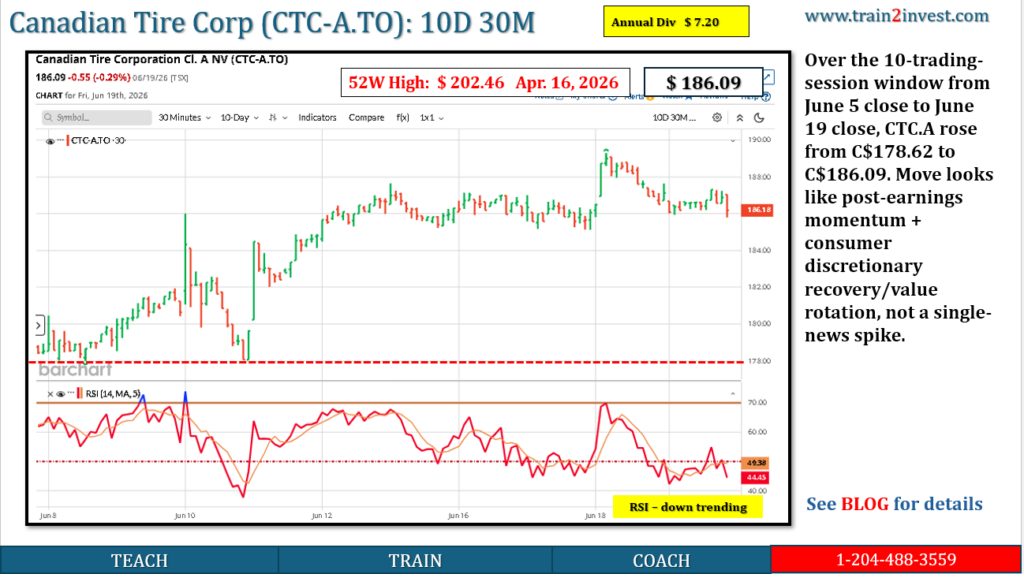
- Canadian Tire Class A Non-Voting Shares closed at C$186.09 on June 19, 2026, down 0.29% on the day.
- Over the 10-trading-session window from June 5 close to June 19 close, CTC.A rose from C$178.62 to C$186.09.
- 10D performance: +C$7.47 / +4.18%.
- The strongest daily move in the period was June 11: +2.74%, followed by June 12: +1.21%.
- Move looks like post-earnings momentum + consumer discretionary recovery/value rotation, not a single-news spike.
Data & Evidence
Date Close / Price Daily Move Comment Jun 5 C$178.62 +1.37% Start of 10-session window Jun 8 C$179.13 +0.29% Modest continuation Jun 9 C$180.79 +0.93% Momentum improving Jun 10 C$179.62 -0.65% Pullback Jun 11 C$184.54 +2.74% Main breakout day Jun 12 C$186.77 +1.21% Follow-through Jun 15 C$186.31 -0.25% Consolidation Jun 16 C$185.94 -0.20% Flat/slight pullback Jun 17 C$186.05 +0.06% Stable Jun 18 C$186.64 +0.32% Stable higher Jun 19 C$186.09 -0.29% Latest close cited Sources: Canadian Tire investor stock quote and Fund Library pricing history.
Calculation:
C$186.09 ÷ C$178.62 − 1 = +4.18%Key Drivers
1. Earnings support
Canadian Tire reported Q1 2026 revenue of C$3.57B, up 3.3% YoY, and diluted EPS of C$2.02, compared with C$0.67 reported EPS and C$2.00 normalized EPS in Q1 2025. That gave investors some support that operations were not deteriorating sharply.
2. Retail sentiment improved short-term
The stock had been pressured earlier by weak Canadian consumer concerns. The 10D rise suggests some re-rating as investors looked past near-term retail weakness and focused on stabilization.
3. Dividend/value appeal
At the June 19 quote, Google Finance showed a dividend yield around 3.87%, P/E around 16.77x, and 52-week range of C$158.18–C$202.46. That places the stock above its lows but still below its 52-week high.
Valuation Logic
Metric Reading Latest price C$186.09 52-week high C$202.46 52-week low C$158.18 Distance from 52-week high ~8.1% below Distance from 52-week low ~17.6% above Approx. dividend yield ~3.9% The 10D move is positive, but CTC.A is not yet at breakout-to-new-high territory. It is recovering within its 52-week range.
Scenarios — Next 1–3 Months
Scenario Price Bias What Drives It Bull C$195–202 Better retail sales, rate-cut expectations, continued margin discipline Base C$180–195 Stock consolidates after 10D rise; valuation remains fair but not cheap enough for a major rerate Bear C$170–180 Weak Canadian consumer spending, disappointing same-store sales, margin pressure Risks
- Canadian consumer spending remains soft.
- Weather-sensitive categories can affect seasonal sales.
- Financial Services segment is exposed to credit risk.
- If rates stay higher for longer, discretionary retail multiples may compress.
- A move above C$186 after a fast 10D gain may invite short-term profit taking.
Actionable Takeaways
- Trend: Positive short-term momentum.
- 10D move: +4.18%, mainly driven by June 11–12 strength.
- Key level to watch: C$186–187. A sustained hold above this area keeps the short-term trend constructive.
- Resistance zone: C$195–202.
- Support zone: C$179–181, then C$175–176.
- Thesis breaker: renewed weakness below C$179 would suggest the 10D rally has failed.


