Alimentation Couche-Tard Inc. says its net earnings attributable to shareholders came in at US$757.2 million for the third quarter, up from US$641.4 million in the same period last year.
On a per diluted share basis, the company reported net earnings attributable to shareholders of 82 cents US for the quarter, compared with 68 cents US during the prior year quarter.
The Laval, Que.-based company, which keeps its books in U.S. dollars, says its revenue amounted to US$21.8 billion during the period ended Feb. 1, up year over year from US$20.9 billion.
Couche-Tard says its total merchandise and service revenues reached US$5.8 billion during the quarter, rising 8.7 per cent from US$5.3 billion.
Chief financial officer Filipe Da Silva says the company delivered one of its best quarterly results in over two years, validating its new approach.
In February, Couche-Tard unveiled a new corporate strategy focused on strengthening its core platforms and pursuing targeted investment opportunities.
This report by The Canadian Press was first published March 17, 2026.
Extending the nosedive seen over the two previous sessions, Canadian stocks plunged on Friday as inflationary concerns due to the intensifying gulf war pressured investors away from risky assets.
After opening below yesterday’s close, today the benchmark S&P/TSX Composite Index traded firmly negative before settling at 31,317.23, up by 537.75 points (or 1.69%).
Of the 11 sectors, only Consumer Staples posted gains today.
The U.S.-Israel versus Iran war entered day number twenty-one.
Today, Kuwait’s largest oil refinery, Mina al-Ahmadi, which processes around 730,000 barrels of oil per day, was struck by Iran, leading to the shutdown of several of its units.
Following Israel’s massive attacks on Iran’s South Pars gas field, Iran conducted strikes on Qatar’s largest LNG plant, Ras Laffan. The facility suffered extensive damage, with the resumption of operations estimated to begin only after a year.
Iran warned that it will show “zero restraint” if its facilities are attacked again.
With an end to the conflict, becoming unpredictable, the spike in crude oil prices and the resultant inflation concerns, along with vanishing expectations of any rate cut in the near-term, have forced investors to avoid making “big” investments.
The Strait of Hormuz, a narrow waterway off Iran’s coastal region remains blocked for vessels carrying oil and energy from Arab nations.
The U.S. Federal Reserve held interest rates at the current 3.50% to 3.75% range on Wednesday.
Market participants have canceled their bets on lowering of interest rates by the Fed, with many of them anticipating a rate hike this year.
The CME Group’s FedWatch Tool was last seen indicating that traders were betting on a 12.40% chance of a “quarter-point rate hike” at the April meeting.
Other central banks globally have followed suit, expressing concerns about the impact of skyrocketing crude oil prices on national economies and the inflationary effects.
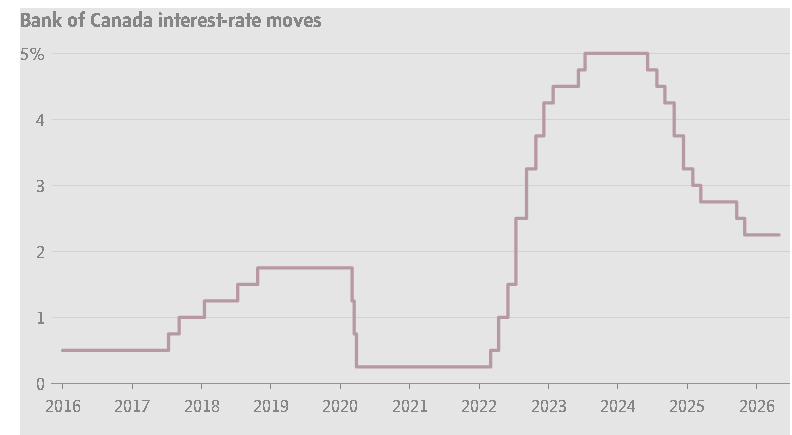
On Wednesday, the Bank of Canada elected to hold interest rates at the current 2.25% level.
Data released by Statistics Canada today revealed that Canadian producer prices rose by 0.4% month-over-month in February, below market forecasts of a 1.1% increase. Producer Prices surged 5.4% in January compared to the same month in the previous year.
A preliminary estimate revealed that retail sales in Canada increased by 0.90% from February.
With rate-cut expectations receding from the radar, the attention of traders is now focused on any breakthrough in the Canada-United States-Mexico agreement.
The only sector that gained in today’s trading was Consumer Staples (0.17%).
Among the individual stocks, Maple Leaf Foods (2.37%), Saputo Inc (1.36%), Metro Inc (0.80%), and Weston George (0.45%) were the prominent gainers.
Major sectors that lost in today’s trading were Utilities (2.02%), IT (2.62%), Healthcare (2.94%), and Materials (3.13%).
Among the individual stocks, Lithium Americas Corp (7.59%), Vizsla Silver Corp (6.85%), B2Gold Corp (6.75%), Perpetua Resources Corp (5.77%), and Curaleaf Holdings Inc (4.75%) were the notable losers.
Orla Mining Ltd (4.50%) and Secure Waste Infrastructure Corp (3.65%) were among the prime market-moving stocks today.
Stocks ended sharply lower, as the U.S.-Israeli war against Iran entered its fourth week, deepening worries about inflation and the potential for higher interest rates. The U.S. military was deploying a large amphibious assault ship with thousands of additional Marines and sailors to the Middle East, while Iran’s new supreme leader hailed Iran’s “unity” and “resistance.”
The S&P 500 declined 1.51% to end the session at 6,506.48 points, its lowest since September. The Nasdaq slumped 2.01% to 21,647.61 points, leaving it down almost 10% from its record high close on October 29. The Dow Jones Industrial Average declined 0.96% to 45,577.47 points.
The S&P/TSX composite index was down 1.69%, at 31,317.23. All major sectors on the TSX were in negative territory, with materials leading losses, down 3.1%. Energy stocks fell 0.6%. The TSX fell 3.8% this week and closed at its lowest level since December, extending its total decline since the Iran war began to nearly 9%.
Short-term bond yields were sharply higher in both the U.S. and Canada. Money markets are now fully pricing in a quarter-point interest rate hike by the Bank of Canada by this July’s policy meeting. Almost three quarter-point rate hikes are priced in by the end of this year. Canada’s 2-year bond yield, sensitive to central bank policy moves, was up 23 basis points by late afternoon to its highest level in more than a year. For the Fed, interest-rate futures were pricing around a 25% chance of a rate hike by December.
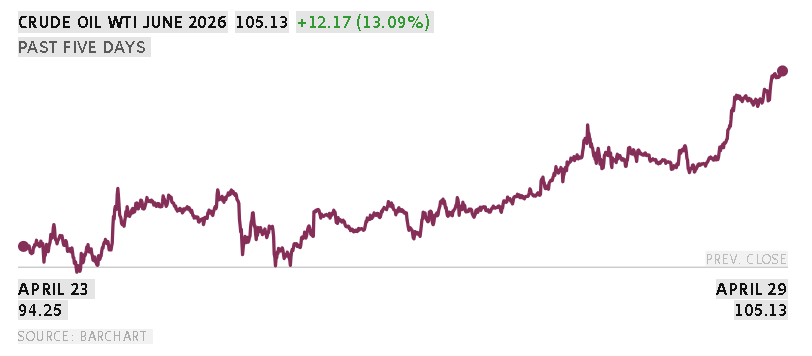
Oil prices jumped to their highest in nearly four years, as Iraq declared force majeure on all oilfields developed by foreign oil firms. Brent futures for May settled up $3.54, or 3.26%, to $112.19 a barrel, the highest since July 2022. U.S. West Texas Intermediate crude futures for April, which expired on Friday, settled up $2.18, or 2.27%, at $98.32.
Gold prices fell nearly 2 per cent as the U.S. dollar strengthened.
Gold prices have been highly elevated in early 2026, with recent spot prices fluctuating around $4,800–$5,000 per ounce (based on mid-March 2026 data, showing some volatility and pullbacks from earlier highs near $5,200+).
Forecasts for the next 3 months (roughly April through June 2026, or Q2) are mixed but lean bullish overall, driven by factors like central bank buying, investor diversification into gold, geopolitical uncertainties, potential lower interest rates, and a weaker US dollar in some scenarios. However, short-term corrections are possible due to recent volatility, economic data (e.g., inflation readings, Fed policy), or risk-off events.
Key Analyst Forecasts and Outlooks
Major institutions and models project upward momentum through 2026, with many seeing potential gains in the coming months:
J.P. Morgan remains strongly bullish, expecting prices to push toward higher levels in 2026 overall (with year-end targets around $5,000–$6,300/oz in various updates). They highlight sustained demand from central banks and investors as key drivers.
UBS targets up to $6,200/oz for periods including March, June, and September 2026, suggesting potential for 20%+ gains from certain levels, though with some consolidation expected later in the year.
Goldman Sachs has raised targets, with year-end 2026 forecasts around $5,400/oz, implying room for upside in the near term from current prices.
Macquarie (earlier 2026 updates) projected Q1 averages around $4,590/oz and Q2 around $4,300/oz, but these may have been revised upward amid ongoing rallies.
Algorithmic/model-based forecasts (e.g., from CoinCodex) show monthly ranges for April–June 2026 with potential highs above $5,000 (e.g., up to $5,185 in some monthly upside scenarios), though with volatility and possible dips.
World Gold Council scenarios suggest moderate gains (5–15%) or stronger surges (15–30%) in 2026 depending on economic slowdowns or risk events, which could play out in Q2.
Consensus across sources points to gold trading in a broad range of roughly $4,300–$6,200/oz through mid-2026, with many expecting net upside from current levels (~$4,800–$5,000) due to structural demand trends.
Short-Term Considerations (Next 3 Months)
Bullish case: Continued central bank purchases, persistent inflation/geopolitical risks, or Fed signals of easier policy could drive prices toward $5,200–$5,800+.
Bearish risks: Stronger-than-expected economic data, higher yields, or reduced safe-haven demand could lead to pullbacks toward $4,500 or lower support levels.
Prices are not linear—expect volatility, as seen in recent swings.
Gold forecasts are inherently uncertain and influenced by unpredictable events (e.g., Fed decisions, global tensions). This is not financial advice; always do your own research or consult a professional advisor before making investment decisions. For real-time prices, check reliable sources like Kitco or Bloomberg.
Gold is down about 6% at midday and is now down more than US$700 an ounce since March 2, a couple days after the start of the Middle East conflict.
There are mounting concerns the war will continue for some time to come. So why isn’t gold – known for being one of the market’s biggest safe haven investments – doing so poorly amid the surge in geopolitical tensions and market uncertainty?
Recent strength in the U.S. dollar – which tends to move inversely to gold – can explain some of gold’s lack of glitter of late. But that unlikely explains all of it, given the greenback’s moves against major currencies have been relatively rangebound by comparison.
Veteran Wall Street analyst Ed Yardeni offered up some other suggestions on why gold has lost its popularity in a note to clients today.
“The always-reliable quick answer is: profit-taking following a meteoric rise. Perhaps investors in the Middle East are selling gold to buy the US dollar, which has strengthened during the war, even though both are considered safe havens. Rising bond yields might also explain gold’s recent meltdown. The probability of further Fed rate cuts is falling as inflation heats up,” he said.
“Technically speaking, gold’s price dropped below a short-term uptrend line this week. The next uptrend support line could be tested closer to $4000. Another technical explanation is that the gold price rose too far, too fast since early last year, jumping above its ascending channel this year.”
“We are still targeting gold at $6,000 by the end of this year and $10,000 by the end of 2029. However, we are considering lowering our year-end target back to $5,000 if gold continues to defy our expectations that it should be rising on unsettling geopolitical developments, rising inflation, and mounting US government debt.”
“From a sentiment perspective, the recent drop in GLD’s stock price on high volume suggests panic selling. From a contrarian perspective, that could soon make a bottom in the recent selloff.”GLD-A -5.42%decrease, the SPDR Gold Shares ETF, is the world’s largest physically backed gold exchange-traded fund
The Bank of Canada held its benchmark interest rate steady on Wednesday but said it’s prepared to adjust monetary policy if needed amid a global oil price shock that risks reigniting inflation.
As widely expected, the central bank’s governing council kept the policy rate at 2.25 per cent for the third consecutive time.
The rate decision was made against the backdrop of a sharp rise in energy prices caused by the war between the United States, Israel and Iran, which has largely closed the Strait of Hormuz through which around a fifth of global oil supplies typically travel.